
上海沪教版六年级下 U2 知识点和练习题
周老师英语课堂
1 六年级 春季课 第2讲
———— Unit 2 At the airport
★Key words:
arrive 到达(v.) —— arrival (到达(n.) fly 飞 (v.) —— flight (航班(n.)
pass 通过(v.) —— passenger (乘客(n.) worry(v. 担心) ——worried (a.担心的)
board 甲板(n.)——boarding (登机(adj.) check 检查(v.) ——checklist (清单n.)
drive 驾驶(v.) —— driver (司机(n) trolley (n.) —— trolleys (pl.)
enter (v.) —— entrance (n.) pack (v.) —— package (n.包装)
scarf (n.围巾) ——scarves (n.复数) distance (n. 距离) —— distant (a遥远的)
different(a.不同的) —— difference(n.不同之处)
depart离开((v.) ————departure(离开n.) ————department(n. 部门)
动词过去式 过去分词
plan --- planned ---planned buy—bought--- bought
bring --- brought --- brought pack --- packed --- packed
leave --- left ---left be ---was/ were --- been
go --- went --- gone come ---came --- come
have---had ---had write ---wrote --- written
get---got---got put---put---put
fly-----flew-----flown eat---ate---eaten
catch---caught---caught feel---felt---felt
★Phrases:
1. at the airport 在机场 2.a trip to Los Angeles一次去洛杉矶之行
3. a plane ticket 一张机票 4. several silk
scarves 几条真丝围巾
5. go to sp. to see sb去某地看望某人 6. live in..for 6 years 在某地住了6年
7. plan to stay there for two weeks 8.plenty of T-shirts 大量的T恤
9. have to do/be 不得不做某事 10buy sb sth/buy sth for sb给某人买某物
11.pack one’s suitcase收拾某人的行李箱 12. enough space/room 足够多的空间
13. drive sb. to sp. 开车送某人去… 14. all passengers 所有的乘客 周老师英语课堂
2 15.a flight trip 一次飞机之行 16.leave for Los Angeles 动身去洛杉矶
17. flight number 航班号 18. departure time 出发时间
19. arrival time 到达时间 20. the economy class 经济舱
21.the plane ticket says机票上写着 22.find a trolley 找到一辆手推车
23 .leave home 离家 24. leave rubbish 留下垃圾
25.leave the notebook 忘了拿笔记本 26. call sb 给某人打电话
27. write down address 写下地址 28.bring a camera 带来一个照相机
29.put a name tag on the suitcase 把姓名牌贴在手提箱上
30. have done a lot of things 已经做了很多事
31.go on a business trip 出差
32. leave for =go to =depart for=set off for 动身去。。。
33.go to sp. for a holiday ==go for a holiday 去某地度假
34.have to stay at the airport for two hours 不得不在机场逗留两个小时
35arrive at the airport two hours before the departure time在起飞前两小时到达机场
★Sentences:
1. leave for sp = go to sp =depart for=set off for 出发至某地
leave for Beijing 出发至北京
e.g I will leave Tokyo for Bangkok. 我将离开东京去曼谷。
leave sp. 离开某地
leave Beijing 离开北京 leave home 离开家
区别: leave 和forget
leave 是把某东西遗忘在了某个地方,后面可以接地点, 而forget做忘记不能
词组: leave sth + 地点 把某物落在某地
e.g. I left my pen in the classroom. 我把笔落在教室了。
但forget后不能跟地点.e.g.:Don't forget to turn off the light.
2. plan to do … = be going to do … 打算做某事
plan – planned –planned
plan to do sth 计划去做某事 plan a trip to sp. 计划一个去某地的旅行
e.g I plan to call him when my parents come back..
3. have/ has/ had /will have to do sth 不得不做某事
(否) don’t/ doesn’t / didn’t have to /will not have to 周老师英语课堂
3 e.g. He is too young to go to school , so he has to stay at home . ( 一般现在时)
His mother was ill, so she had to look after his mother.. (过去时)
He will have to finish his homework first. (一般将来时)
4. enough 足够的(地), 充足的(地)
1) n. + enough There are enough desks for all the students.
2) enough + adj. / adv. It’s warm enough to swim.
5, 现在完成时的结构: have/ has + done (动词的过去分词)
(否定) have (has) not+ done (haven’t/hasn’t)
(疑问) Have (Has)…..+ done
e.g. I have cleaned the classroom.
e.g. I have lived in Shanghai for about six years.
e.g. Peter has learnt to play the piano since he was five years old.
6. 现在完成时与一般过去时的区别:
He lived in Los Angeles last year. 他去年住在洛杉矶.
We have already bought a new car.
We bought a car last year.
7. have (has) been to 去过(已经回来了) e.g. I have been to Beijing
have (has) gone to 去了(还没回来) A: Where is he? B: He has gone to
Bangkok.
have (has ) been in + 一段时间 待在那里 Ben has been in Shanghai for 9 years.
★Composition
A trip to Beijing
I will have a trip to Beijing this weekend. I will get there by air. I have bought my plane ticket and
a big suitcase for this trip. I will visit my aunt and my uncle in Beijing. They will show me around
沪教版牛津英语四年级第二学期4B 单元练习M1U1M2U1U2U3(4套)(附答案)

沪教版牛津英语小学四年级第二学期4BM1U3 练习卷
Class________ Name_______
一、Read and write (正确抄写,注意大小写及标点符号)
can you see the trees shadow in the morning yes i can
二、Think and write (写出划线部分的同类词,使句子意思通顺)
1. Do you like apples? No. I like and .
2. Sometimes my shadow is beside me, sometimes it’s me, sometimes it’s
me.
3. I’m thirsty. I want to drink some and some water.
4. I go to school at seven o’clock in the morning. And I go home at o’clock
in the afternoon.
5. The sun in the morning. It goes down in the evening.
6. There is a hill, a and some in the park.
三、Fill in the blanks with the given words in their proper forms.(用单词正确形式填空)
1. Sometimes my shadow (walk) in front of (I).
2. (not) put your pencil on the desk.
【英语】初中课程大纲
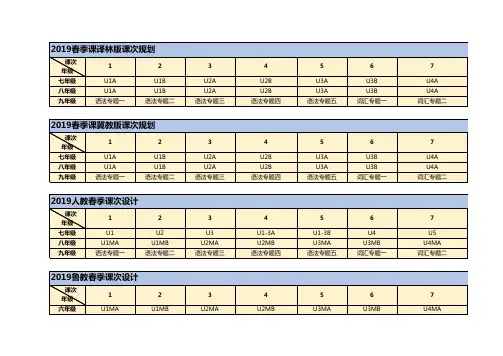
课次年级1234567
七年级U1AU1BU2AU2BU3AU3BU4A
八年级U1AU1BU2AU2BU3AU3BU4A
九年级语法专题一语法专题二语法专题三语法专题四语法专题五词汇专题一词汇专题二
课次年级1234567
七年级U1AU1BU2AU2BU3AU3BU4A
八年级U1AU1BU2AU2BU3AU3BU4A
九年级语法专题一语法专题二语法专题三语法专题四语法专题五词汇专题一词汇专题二
课次年级1234567
七年级U1U2U3U1-3AU1-3BU4U5
八年级U1MAU1MBU2MAU2MBU3MAU3MBU4MA
九年级语法专题一语法专题二语法专题三语法专题四语法专题五词汇专题一词汇专题二
课次年级1234567
六年级U1MAU1MBU2MAU2MBU3MAU3MBU4MA2019春季课译林版课次规划
2019春季课冀教版课次规划
2019人教春季课次设计
2019鲁教春季课次设计
891011121314
U4B期中复习A期中复习BU5AU5BU6AU6B
U4B期中复习A期中复习BU5AU5BU6AU6B
词汇专题三词汇专题四词汇专题五词汇专题六听力专题完型专题一完型专题二
891011121314
U4B期中复习A期中复习BU5AU5BU6AU6B
U4B期中复习A期中复习BU5AU5BU6AU6B
词汇专题三词汇专题四词汇专题五词汇专题六听力专题完型专题一完型专题二
891011121314
U6U4-6AU4-6BU7U8U9 U7-9A
U4MBU5MAU5MBU6MAU6MBU7MAU7MB
词汇专题三词汇专题四词汇专题五词汇专题六听力专题完型专题一完型专题二
891011121314
U4MBU5MAU5MBU6MAU6MBU7MAU7MB
1516171819
U7AU7BU8AU8B期末复习A
U7AU7BU8AU8B期末复习A
标准化阅读专题本地化阅读专题一本地化阅读专题二写作专题中考模拟测试卷一
1516171819
沪教版五年级上册。英语期末复习总结及练习题
沪教版五年级上册。英语期末复习总结及练习题
Shanghai n Press Grade 5 English Final Review
I。Interrogative Pronouns
n Word Meaning Usage
What Asking about things or objects
What day Asking about the day of the week
What time Asking about a specific time
How Asking about a n or state
Who Asking about a person
How old Asking about age
Whose Asking about ownership
How many Asking about quantity of countable nouns
Where Asking about n
How much Asking about quantity of uncountable nouns or
money
What colour Asking about colour
Which Asking about a specific one
II。Homophones
pear--pair。right—write。see—sea。aren
who’s—whose。for—four。to—two—too。know
where—wear。hear—here。there—their
by—buy—bye。flour--flower
III。Plural Forms of Nouns
1.Add "s" to the end of most words
2.Add "es" to words ending in o。s。x。ch。or sh
3.Change "y" to "ies" for words ending in a consonant and "y"
上海沪教牛津版小学五年级英语下册Unit 3 In the future 习题及答案
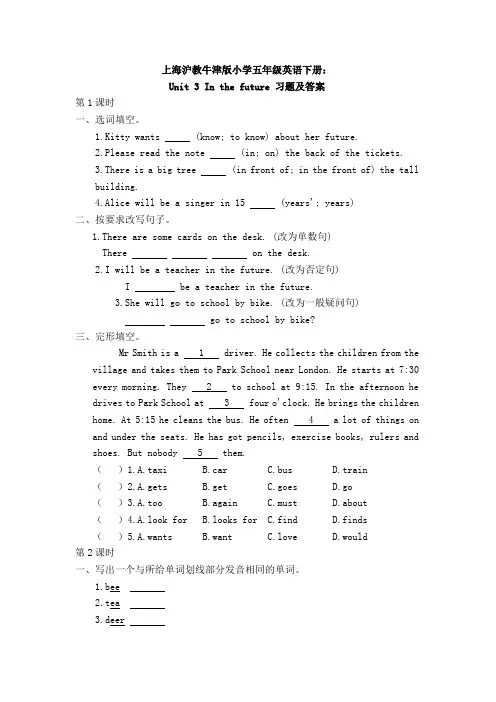
上海沪教牛津版小学五年级英语下册:
Unit 3 In the future 习题及答案
第1课时
一、选词填空。
1.Kitty wants (know; to know) about her future.
2.Please read the note (in; on) the back of the tickets.
3.There is a big tree (in front of; in the front of) the tall
building.
4.Alice will be a singer in 15 (years'; years)
二、按要求改写句子。
1.There are some cards on the desk. (改为单数句)
There on the desk.
2.I will be a teacher in the future. (改为否定句)
I be a teacher in the future.
3.She will go to school by bike. (改为一般疑问句)
go to school by bike?
三、完形填空。
Mr Smith is a 1 driver. He collects the children from the
village and takes them to Park School near London. He starts at 7:30
沪教版五年级上册 英语期末复习总结及练习题
沪教版五年级上册 英语期末复习卷
一、特殊疑问词
疑问词 意思 用法
• What 什么 问东西、事物
• What day 星期几 问星期几
• What time 什么时间 问具体时间
• How 怎样 问情况,状态
• Who 谁 问人
• How old 多大年纪 问年纪
• Whose 谁的 问主人
• How many 多少数量(可数名词) 问数量
• Where 在哪里 问地点
• How much 多少钱;多少数量(不可数名词)
• What colour 什么颜色 问颜色
• Which 哪一个 问哪一个
二、同音词
• pear--pair right—write see—sea aren’t—aunt
• who’s—whose for—four to—two—too know—no
• where—wear hear—here there—their
• by—buy—bye flour--flower
三、名词的复数形式
1、一般情况词尾加s
2、o、s、x、ch、sh结尾的加es
potato-- bus-- class-- glass-- sunglass—
2019年上海初三英语上沪教版Unit2综合检测(无答案)
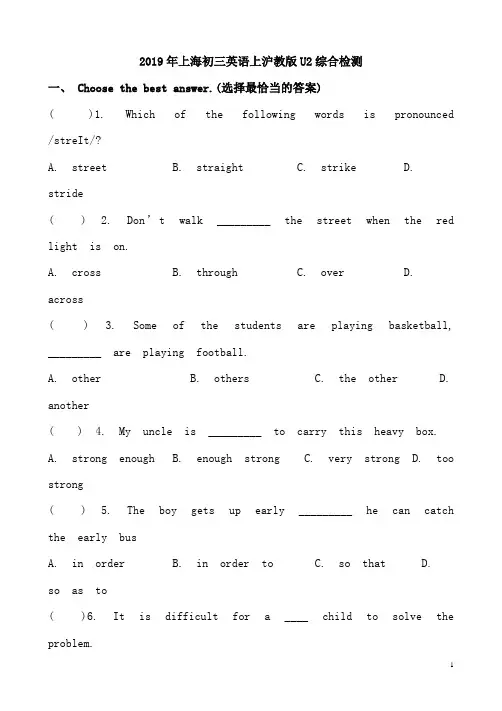
1 2019年上海初三英语上沪教版U2综合检测
一、 Choose the best answer.(选择最恰当的答案)
( )1. Which of the following words is pronounced
/streIt/?
A. street B. straight C. strike D.
stride
( ) 2. Don’t walk _________ the street when the red
light is on.
A. cross B. through C. over D.
across
( ) 3. Some of the students are playing basketball,
_________ are playing football.
A. other B. others C. the other D.
another
( ) 4. My uncle is _________ to carry this heavy box.
A. strong enough B. enough strong C. very strong D. too
strong
( ) 5. The boy gets up early _________ he can catch
the early bus
A. in order B. in order to C. so that D.
so as to
( )6. It is difficult for a ____ child to solve the
problem. 2 A. six years old B. six-years-old C. six-year-oldD.
six-years old
七年级下沪教版英语u2知识点
七年级下沪教版英语u2知识点
在七年级下学期的沪教版英语教材中,第二个单元主要学习生活场景中常见的英语用语,如问路、介绍自己等。在学习这些话题的同时,还需要掌握一些基础知识,下面将重点介绍有关的知识点。
1. 人称代词
在英语中,人称代词用于代替人或事物。根据代替的对象不同,人称代词分为主格、宾格、所有格三种。主格代词用于作主语,宾格代词用于作宾语,所有格代词用于表示所有关系。
如:I am a student.(主格)→ Me too.(宾格)
My book is here.(所有格)
2. be动词
be动词是英语中最基础的语法之一,用于表达主语的身份、状态等。常用的be动词有am、is、are三种形式,需要根据主语的单复数和人称来进行变化。例如:
I am a student.
He is my friend.
They are students.
3. 物主代词
物主代词是用来表示所属关系的代词,常见的有my、your、his、her、its(表示物)、our、their等。如:
This is my book.
That pencil is yours.
The football belongs to him.
4. 介词
英语中的介词用于表示位置、时间、方式等关系,在句子中常常和其他词搭配使用。如:
He is sitting on the chair.
I have an English class at 9 o'clock.
We go to school by bus.
5. 时间表达
时间的表达方式有很多种,包括点钟时间、时间段、日期等。在口语交流中,使用得比较多的是点钟时间和时间段。例如:
It's 2 o'clock.
We have a break from 10 to 10:15.
Today is September 1st.
以上就是七年级下沪教版英语u2知识点的介绍。通过学习这些基础知识,可以更好地理解和掌握生活场景中常见的英语用语,进而提高英语口语表达和交流能力。
上海牛津沪教版六年级(下)同步讲义unit2
第二讲 Unit2 At the airport
上海牛津沪教版六年级 (下 )同步讲义
Unit2 At the airport
适用学科 初中英语 适用年级 初中六年级
适用区域 上海 课时时长(分钟) 120 分钟(一对一)
知识点 1:本单元词汇
知识点 2:词组
知识点 知识点 3:句型
知识点 4:现在进行时
知识点 5:现在完成时
知识:学生能够基本掌握 6年级下册 Unit2 中的词汇、词
组、句型及语法。
方法:牢记各个知识点的用法,归纳总结异同点,通过
习题加强巩固。
教学目标
能力:熟练掌握各种词汇的用法;
具备准确判断词性及转换的能力;
熟练掌握现在完成时的运用能力;
熟练运用现在进行时表将来的能力。
教学重点 词性转换;现在完成时
教学难点 现在完成时用法
教学过程
一、课堂导入
教师讲述一个与本节课题目有关的英文小故事,引出今日所要讲解的
知识点,然后让学生简单梳理一下所涉及的问题,带着问题学习本节
课的内容。
二、复习预习
教师引导学生复习上节课学的重点内容,检测单词的用法, (以提问、
回顾的形式进行),针对上节课的作业进行讲评、订正、答疑,并通过
英文小故事导入本节课所要学习的新知识。
三、知识讲解
1. 知识点一:重点单词
1)before [ bi'f ?:]
【词性】adv.
【词义】以前
【易混淆点 】ago 以前
【经典例句 】
Mrs. Wang and Grandma have not been to the USA before.
王太太和奶奶之前没有去过美国。
2)several [ 'sev?r?l]
【词性】adj.
【词义】几个
【易混淆点 】 some 一些
【经典例句 】
Grandma has bought Aunt Judy plenty of T-shirts and several silk
牛津沪教版英语六年级下册复习(讲义)
U1
一
how much how tall do exercise
after school go fishing how exciting
live in a lot of go to work
by car at the weekend
enjoy oneself = have fun = have a good time
ride their bikes plant crops get the crops in
in spring fly a kite read a book
see a film be from = come from
二
1. How much do you weigh?
I weigh 40 kilograms.
2. How tall are you?
I’m 152 centimetres tall.
3. What do you usually do after school?
I usually play table tennis after school.
4. I’m 152 centimetres tall. You are154 centimetres tall.
You are taller.
5. 频度副词可放在句首,句中,句末。
6. There’s no river near my home.
7. high -- height weigh -- weight
8. myself yourself himself herself itself
沪教版小学英语单词句型知识点归纳
新版英语5A单词归纳
U1cook pilot taxi driver
U2by bike by bus by car on foot
U3first second third eighth ninth twelfth twentieth
thirtieth
U4always usually often sometimes never
U5same different
U6bathroom bedroom kitchen living room
U7beach sea
U8hill lake map
U9flower shop post office hospital toy shop
U10gently strongly slowly quickly
U11put out fire grow crops
U12Don’t smoke! Don’t play with matches!
Learn the sounds
U1desk mask U2wasp crisp U3toast
postman
U4dish wash U5dress princess U6bread ice
cream
U7fruit grandpa tree U8slide snake swing
U9smoke spider star U10scarf skateboard
U11this that U12thin path
新版英语5A句型归纳
U1What do you want to be I want to be a pilot. I want to
fly a plane in the sky.