
八年级英语上册教案
- 1 - 八年级英语上学期教案 一中民中 高云华
- 2 -
Unit 1 Where did you go on vacation? Section A 1 (1a-2d) 一、教学目标: 1. 语言知识目标: 1) 能掌握以下单词:anyone, anywhere, wonderful, quite a few, most, something, nothing, everyone, of course, myself, yourself 能掌握以下句型: ① —Where did you go on vacation? —I went to the mountains. ② —Where did Tina to on vacation? —She went to the beach. ③ —Did you go with anyone? —Yes, I did./No, I didn’t. 2) 能了解以下语法: —复合不定代词someone, anyone, something, anything等 的用法。 —yourself, myself等反身代词的用法。 3) 一般过去时态的特殊疑问句,一般疑问句及其肯定、否定回答。 2. 情感态度价值观目标: 学会用一般过去时进行信息交流,培养学生的环保意识,热爱大自然。 二、教学重难点 1. 教学重点: 1) 用所学的功能语言交流假期去了什么旅行。 2) 掌握本课时出现的新词汇。 2. 教学难点: 1) 复合不定代词someone, anyone, something, anything等 的用法。 2) yourself, myself等反身代词的用法。 三、教学过程 Ⅰ. Lead-in 1. 看动画片来进入本课时的主题谈论上周末做了些什么事情,谈论过去发生的事情。 Ⅱ. Presentation 1. Show some pictures on the big screen. Let Ss read the expressions. 2. Focus attention on the picture. Ask: What can you see? Say: Each picture shows - 3 -
something a person did in the past. Name each activity and ask students to repeat: Stayed at home, Went to mountains, went to New York City 6. Went to the beach, visited my uncle, visited museums, went to summer camp 3. Now, please match each phrase with one of the pictures next to the name of the activity,point to the sample answer. 4. Check the answers. Answers: 1. f 2. b 3. g 4. e 5. c 6. a 7. d III. Listening 1. Point to the picture on the screen. Say: Look at the picture A. Where did Tina go on vacation? She went to mountains. Ask: What did the person do in each picture? 2. Play the recording the first time. 3. Play the recording a second time. Say: There are three conversations. The people talk about what did on vacation. Listen to the recording and write numbers of the names in the right boxes of the picture. 4. Check the answers. IV.Pair work 1. Point out the sample conversation. Ask two Ss to read the conversation to the class. 2. Now work with a partner. Make your own conversation about the people in the picture. 3. Ss work in pairs. As they talk, move around the classroom and give any help they need. 4. Let some pairs act out their conversations. V. Listening 1. Tell Ss they will hear a conversation about three students’ conversations. Listen for the first time and fill in the chart. Then listen again and check Yes, or No. 2. Let Ss read the phrases in the chart of 2b. 3. Play the recording the first time. Ss listen and fill in the chart. 4. Play the recording a second time for the Ss to check “Yes, I did.” or “No, I didn’t. ” 5. Check the answers with the Ss. VI. Pair work 1. Let two Ss read the conversation between Grace, Kevin and Julie. 2. Let Ss work in pairs and try to role-play the conversation. - 4 -
3. Ask some pairs to act out their conversations. VII. Role-play 1. First let Ss read the conversation and match the people and places they went. 2. Let Ss act out the conversations in pairs. 3. Some explanations in 2d. Homework: 用英语询问你的一位好朋友,她(他)假期去了哪里?看到了什么?并将此对话写在作业上。 A: Where did you go…? B: I went to… A: Did you see… B: Yes, I did. / No, I didn’t. 板书设计:
教学反思: Section A 2 (Grammar focus-3c) 一、教学目标: 1. 语言知识目标: 1) 复习所学的重难点句型及句式结构。 2)总结学习anyone, someone, everyone, something, anything, nothing等不定代词的用法。 3)练习运用所学的句型及句式结构。 2. 情感态度价值观目标: 学会用一般过去时进行信息交流,培养学生的环保意识,热爱大自然。 二、教学重难点
Section A 1 (1a-2d) anyone, someone, everyone, something, anything, everything yourself, myself Where did you go on vacation? Did you do anything special? I went to New York City. Did you go anywhere interesting? Where did she go on vacation? most of the time She went to the mountains. - 5 -
1. 教学重点: 1) 用所学的功能语言交流假期去了什么旅行。 2) 复习运用本课时出现的新词汇。 2. 教学难点: 1) 复合不定代词someone, anyone, something, anything等 的用法。 2) 阅读填空能力的提高。 三、教学过程 Ⅰ. Warming- up and revision 1. Free talk: Ask Ss the questions: Where did you go on vacation? Ss try to answer the questions. 2. Review the usage of “复合不定代词” Ⅱ. Grammar focus. 1. 学生阅读Grammar Focus中的句子,然后做填空练习。 1. 你去了什么地方去度假? ______ ______ you go on ___________? 2. 我去了纽约市。 I _______ _______ New York City. 3. 你和什么人别一起去的吗? ______ ______ go out with ________? 4. 不,没有别人在这儿。每个人都在度假。 No. ____ ______ was here. ________ was on _________. … (其余试题见课件部分) 3. 学生们完成填空试题后,可以打开课本检查答案,对错误的句子,单独进行强化记忆。 Ⅲ. Try to Find 一、复合不定代词总结: 1. some, any, no, every与-one, -thing可以组成八个不定代词,他们分别是: someone, ________ _______ ________ __________ __________ ______________。 2. 带some的复合不定代词常用于肯定句中;带 any的复合不定代词常用于否定句或一般疑问句中。例如: 我想吃点东西。 I’d like _____________ to eat.
八年级英语上册全册教案(牛津版)
八年级英语上册全册教案(牛津版)单元一:Meeting New Friends教学目标:1. 研究并掌握有关问候和介绍的表达方式;2. 认识并了解一些中国和国际的传统节日;3. 培养学生的听、说、读、写能力。
教学内容:1. 情景对话:问候和自我介绍;2. 词汇:问候用语、介绍自己的句型;3. 语法:第三人称单数的一般现在时;4. 文化知识:中国春节和国际圣诞节。
教学步骤:第一课时1. 导入新课,并介绍本单元的教学目标。
2. 向学生介绍中外节日,并讨论他们对节日的认识。
3. 研究常用的问候语,例如:Hello, Hi, How are you, Fine, thank you. And you?等等。
通过角色扮演对话,练问候和回答。
4. 研究自我介绍的句型,例如:My name is Lucy. I'm twelve years old. I'm from China,等等。
学生之间进行自我介绍的练。
第二课时1. 复上节课学过的问候语和自我介绍的句型。
2. 研究第三人称单数的一般现在时。
向学生介绍第三人称单数的规则,并进行一些练。
3. 引入中国春节和国际圣诞节的文化知识,向学生介绍春节和圣诞节的起源、传统俗和庆祝方式。
让学生了解不同文化之间的差异。
4. 学生分组讨论,比较中国春节和国际圣诞节的异同。
第三课时1. 复上节课学过的第三人称单数的一般现在时。
2. 研究和巩固本单元的重点词汇和短语,例如:celebrate, tradition, festival,等等。
通过词汇游戏和练,提高学生的词汇水平。
3. 听力训练:播放录音,让学生听一段对话,然后回答问题。
通过听力训练提高学生的听力能力。
4. 朗读训练:让学生分角色朗读课文中的对话,提高学生的口语和阅读能力。
总结:通过本单元的教学,学生将学会基本的问候和自我介绍的英语表达方式,掌握第三人称单数的一般现在时的用法,了解中国春节和国际圣诞节的文化知识,并通过听、说、读、写的训练,提高学生的英语综合能力。
人教版八年级上册英语单元教案(含教材分析)--Unit 8

Unit 8How do you make a banana milk shake?本单元的教学围绕“谈论如何制作香蕉奶昔”这一话题展开,Section A是基本语言内容的收集和学习,这一部分引导学生通过本课的语言素材进行看图说话、句型演练、实际描述和对话表演等,使学生能够正确地使用表述如何制作香蕉奶昔过程中需要用到的词组、句型,从而熟练地谈论这一话题。
Section B是知识的扩展和综合的语言运用。
在Section A的基础上,自如地谈论“如何制作三明治”,从而进一步熟练掌握有关的英语表述方式。
这些内容都是与学生日常生活紧密相关的,学生很熟悉,也乐于去说,因此在这一课题的教学过程中,应紧密联系学生生活实际,采用多种方式,以说为主,配合听的练习,最终以对话为途径,解决本课题的中心对话。
这易于引发学生运用简单的英语进行交流,对于提高学生的综合能力,特别是说的能力很有帮助。
第一课时Section A(1a-2d)Teaching Goals【教学目标】Key words:shake,blender,peel,pour,yogurt,honey,watermelon,spoon,add,finally,saltKey phrases:milk shake,turn on,cut up,one cup of yogurt,pour…into…,put…into…Key sentences:1. How do you make a banana milk shake?2. — How many bananas do we need?— We need three bananas.3. — How much yogurt do we need?—We need one cup of yogurt.Teaching Key Points【教学重点】The vocabulary:pour,yogurt,honey,watermelon,spoon,add,finally,saltTarget language:How do you make a banana milk shake?First,peel the bananas…How many bananas do we need?We need three bananas.How much yogurt do we need?We need one cup of yogurt.Teaching Difficult Points【教学难点】1. The differences between countable nouns and uncountable nouns.2. 学会使用how many和how much分别对可数名词和不可数名词的量提问。
新人教版八年级上册英语 Unit1 第2课时 教案(教学设计)
Unit 1 Where did you go on vacation?Section A (Grammar Focus-3c)单词something, nothing, everyone, myself,1.掌握一般过去时的疑问句结构及其肯定、否定回答2.掌握动词的过去式形式3.掌握不定代词的用法1.复合不定代词someone, anyone, something, anything等的用法2.一般过去时的运用Step 1检测上节课的学习效果,同时巩固已学知识,为新课做好准备。
①Show the pictures used in the previous class and ask Ss to try to remember the words they learned from the previous class.②Test Ss ability to understand and use the words.T: I had a great time on vacation, and I did something interesting.2.Review the conversationShow the Chinese translation of 2d and ask Ss to say the English sentences.Step 2将独立思考和小组探究的方式相结合,既培养了学生的思考能力,也培养了其合作能力。
Grammar Work on Grammar Focus①Ask Ss to read the sentences in the chart and then show the following questions on the PPT. Let Ss think by themselves.1)常见的复合不定代词有哪些?2)带有some的复合不定代词和带有any的复合不定代词有什么区别?3)当形容词和复合不定代词连用时,复合不定代词应该放在形容词之前还是之后?4)由some, any, no, every构成的复合不定代词作主语时,谓语动词用单数还是复数?②Have Ss discuss those questions in groups of four and then write their answers. Choose several groups to report the answers of their group and then evaluate their answers.【Keys:1)常见的复合不定代词有something,anything,someone,anyone,everything, everyone, nothing等;2)带有some的复合不定代词常用于肯定句,而带有any的复合不定代词常用于疑问句和否定句中;3)当形容词和复合将独立思考和小组探究的方式相结合,既培养了学生的思考能力,也培养了其合作能力。
新人教版八年级英语上册Unit8 教案
新人教版八年级英语上册Unit8 教案
一、教学目标
1. 了解并掌握本课时的生词和短语。
2. 能够听懂并正确理解本课时的听力材料。
3. 能够流利朗读课文,并理解课文的主要内容。
4. 能够灵活运用课文中的重点单词和短语进行口语交流。
5. 能够合作完成小组活动,提高团队合作意识。
二、教学重难点
1. 重点:掌握并运用本课时的重点单词和短语,能够流利朗读课文,理解所学知识。
2. 难点:理解和正确使用本课时的重点单词和短语,培养语言表达能力。
三、教学过程
1. Warming-up:
引入生词和短语,让学生猜测单词意思并集体讨论。
2. Listening:
播放录音,让学生听懂对话内容,并回答相关问题。
3. Reading:
让学生朗读课文,并根据理解回答问题。
4. Vocabulary practicing:
将生词和短语进行分类记忆,并进行一定的练和口语运用。
5. Pair working:
学生分为两人一组,进行口语对话,练所学的重点句型。
6. Group activity:
学生分为小组,进行团队活动,提高团队合作意识。
四、教学反思
本节课主要针对生词和短语进行了分类讲解,并进行了一定的练习巩固。
在教学过程中,学生积极参与,气氛活跃;但部分学生在拼写方面存在一些问题。
针对这一问题,下节课将特别强化拼写教学。
同时,在练习环节,语音跟读效果较佳,但口语表达仍需要继续加强,将加强口语训练环节,提高学生语言表达能力。
人教版八年级上册英语单元教案(含教材分析)--Unit 5
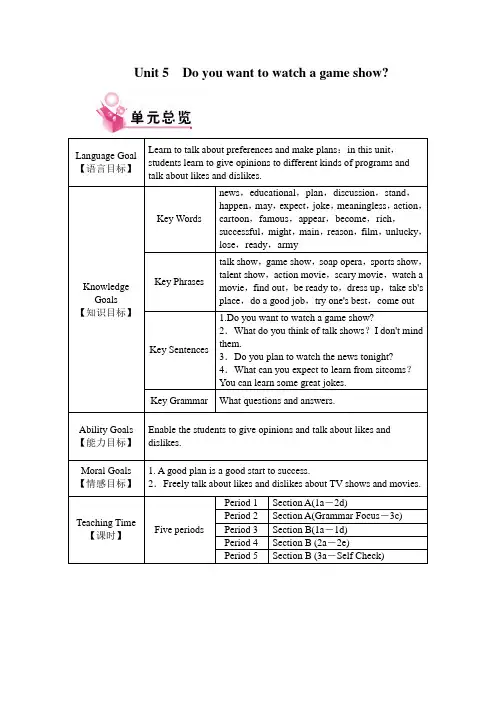
Unit 5Do you want to watch a game show?本单元教学内容以Do you want to watch a game show?为中心话题,围绕着“谈论喜好和制定计划”展开,学习和运用句式Do you want to watch...?和What questions and answers以及一些描述性形容词,表达对某些电视节目的喜好(评价)。
Section A是基本语言内容的收集和学习,要求学生掌握一些常见电视节目类型的英文名称,如talk show,sitcom,news,soap opera,game show,sports show,talent show等,结合do引导的一般疑问句和what引导的特殊疑问句,进行简单会话,表达个人对某种电视节目的喜好。
Section B在Section A的基础上,进一步拓展学生基础知识和语言综合运用能力。
Section B 1a在Section A 1a呈现的6种TV shows的基础上增加了comedy,action movie,scary movie等内容。
Section B的教学应侧重于引导学生拾记并运用一些描述性形容词,如wonderful,relaxing,meaningless,enjoyable,exciting,boring等,自由谈论电视节目并表达个人的喜好。
同时,Section B也安排了一些读、写的任务活动,教师在教学过程中可以整合本单元教学内容,引导学生尝试着写简单的影评。
本单元是实用且学生感兴趣的话题,本单元的学习对于提升学生具体语境下的语言综合运用能力大有助益,同时也可以丰富学生生活,陶冶情操,对学生德育教育也是益处良多。
第一课时Section A(1a-2d)Teaching Goals【教学目标】Key words:news,educational,plan,hope,discussion,stand,happen,may,expect Key phrases:talk show,soap opera,game show,sports show,talent show,find outKey sentences:1.What do you think of talk shows?I don't mind them.2.Do you plan to watch the news tonight?Teaching Key Points【教学重点】The vocabulary:news,educational,plan,hope,discussion,stand,happen,may,expect,talk/game/sports/talent show,soap opera,find outTarget language:What do you think of talk shows?I don't mind them.Do you plan to watch the news tonight?Yes. I like watching the news. I watch it every night.Because I hope to find out what's going on around the world.Teaching Difficult Points【教学难点】Use the target language to express likes and dislikes.Teaching Aids【教学工具】An English textbook,a tape recorder,CAI or courseware.Teaching Steps【教学过程】★Step 1Leading inPrepare some things and make sentences.Say,Hello,boys and girls. Nice to see you here again. Today we're going to learn Unit 5.We are going to give opinions. This is a watch. What do you think of it?Ask some students to repeat the two sentences several times.★Step 2Pre-taskPage 33,1a.1.Match work. Ask the students to read the words and the pictures,and then match the TV shows with the pictures (a-g).2.Encourage or help the students to say sth. about the pictures and do the match work.3.Line next to the words “soap opera”.(as shown below)4.Go on with the others in the same way. Then check the answers with the students.Page 33,1c.Pair-work. Ask students to practice:What do you think of...?Show the following:What do you think of sitcoms?I love/like them./I don't mind them./I can't stand them./I don't like them.★Step 3While-taskPage 33,1b.Listening.1.Ask students to read the verbs in Activity 1b and write the number from 1a.2.Play the recording for the first time. Let students just listen. Then point out the blank lines where students will write numbers from 1a.3.Play the recording a second time.4.Ask the students to listen to and read after the recording.Page 34,2a & 2b.Listening.1.Ask students to read the phrases in Activity 2a.Then ask them to listen to the conversation and write the answers on the line.2.Check the answers.3.Ask students to listen a second time. Then check the answers and let students read the sentences.★Step 4Post-taskPage 34,2c.1.Focus on the conversation in 2c.Read the instructions to the class.2.Pair-work:Ask students to read the four sentences in 2c.Ask students to practice the conversation using the TV show they know. Say,According to this conversation and using the TV shows you know,make up a conversation. I'll give you five minutes.3.Ask some pairs to practice.Page 34,2d.1.Make students scan the conversation in 2d.2.Teach and then make students role-play the conversation in pairs. In this part,student A will be Grace. Student B will be Sarah. As they talk,move around to monitor their work. Offer language or pronunciation support as needed.3.Have a group of students present their conversation to the class.★Step 5Homework1.Practice reading the conversation on Page 34.2.Do the exercises on Page 30 in students' book.Board Design板书设计Unit 5Do you want to watch a game show?The first period Section A(1a-2d)1.Key vocabulary:news,educational,plan,hope,discussion,stand,happen,may,expect,talk show,soap opera,game/sports/talent show,find out 2.Target language:A:What do you want to watch?B:What do you think of talk shows?A:They're OK.I don't mind them.B:Then let's watch a talk show.第二课时Section A(GF-3c)Teaching Goals【教学目标】Key words & phrases:joke,comedy,watch a movie/sitcom/sports show/game showKey sentences:1.Do you want to watch the news?Yes,I do./No,I don't.2.What do you think of talk shows?I don't mind them./I can't stand them!/I love watching them.3.What do you plan to watch tonight?I plan to watch Days of Our Past.Teaching Key Points【教学重点】Target language:Do you want to watch the news?Yes,I do./No,I don't. What do you think of talk shows?I don't mind them./I can't stand them!/I love watching them.Teaching Difficult Points【教学难点】Target language above.Teaching Aids【教学工具】An English textbook,CAI or courseware.Teaching Steps【教学过程】★Step 1Leading in1.Greetings.2.Check the homework by asking some students to read the sentences.★Step 2Pre-taskPage 35,Grammar Focus.Ask students to read the sentences in the grammar box and sum up the sentence structure.Say,Now read aloud the sentences in the grammar box. Then write down the sentence structure in your exercise books.★Step 3While-taskPage 35,3a & 3b.1.Ask the students to complete the blanks in Activity 3a.Say,I would like two students to finish 3a.Fill in the blanks.2.Choose a group to present the conversation.3.Ask students to look through 3b and then finish 3b.4.Choose 2 or 3 students to give their answers. The teacher asks the four questions and the students say their answers separately.★Step 4Post-taskPage 35,3c.1.Ask students to read the information in the left column. Then ask students to write the students' names. Say,Do you want to watch a movie?Fill in your opinions and find who agrees with you.2.Give the students a few minutes to prepare.3.Encourage the students to express their opinions.★Step 5Homework1.Revise the Grammar Focus.2.Do the exercises on Page 31 in students' book.Board Design板书设计Unit 5Do you want to watch a game show?The second period Section A(GF-3c)Target language:①A:Do you want to watch the news?B:Yes,I do./No,I don't.②A:What do you plan to watch tonight?B:I plan to watch Days of Our Past.③A:What do you think of talk shows?B:I don't mind them./I can't stand them!/I love watching them!第三课时Section B(1a-1d)Teaching Goals【教学目标】Key words & phrases:meaningless,action,cartoon,action movie,scary movieKey sentences:John wants to watch talk shows because they're enjoyable. I like to watch action movies because they're exciting.Teaching Key Points【教学重点】The vocabulary:meaningless,action,cartoon,action movie,scary movieTarget language:John wants to watch talk shows because they're enjoyable. I like to watch action movies because they're exciting.Teaching Difficult Points【教学难点】1.Enable the students to give opinions and talk about likes and dislikes on certain programmes.2.Help the students learn how to express opinions and tell the reasons using some description words such as educational,enjoyable,boring and so forth.Teaching Aids【教学工具】An English textbook,a tape recorder,CAI or courseware.Teaching Steps【教学过程】★Step 1Leading in1.Check the homework by asking some students to read the sentences in grammar box.2.Then show some TV shows and ask the students to give their opinions using the structure “What do you think of...?”★Step 2Pre-taskPage 36,1a.1.Show some new real things such as sunglasses,scarf,wallet,belt,watch and key ring to the students.Say,I have some fashionable things. I bought them yesterday. What do you think of my...?2.Help them to answer:I don't like it./I love it./I don't mind it./I can't stand it.3.Point to some things and ask a student:“What do you think of my new wallet?Then ask another student to point at the first one “What does he think of the wallet?”4.Ask the students to read the pictures. Ask the students to do the match work.5.Ask 1 or 2 students to give answers.★Step 3While-taskPage 36,1b & 1c.1.Ask the students to listen to the conversation.Say,Now let's listen to the tape. We are going to hear a conversation. And you have to write down the words you hear.2.Play the recorder. Then ask the students to write down the words to fill in the chart.3.Further activity:Ask the students to do some pair work in the following way if they can understand the listening material well.4.Then ask students to act out the conversation without the help of the recording.★Step 4Post-taskPage 36,1d.1.Point out the example in 1d.Ask a student to read it.2.Then encourage the students to ask and answer questions about what their parents think of the things in 1a.Say,I think you may like sports show. But I want to know what your parents think of it,please make up a conversation using the things in 1a.★Step 5Homework1.Ask students to remember the new words.2.Practice the structure:What does he/she think of your...?3.Do the exercises on Page 32 in students' book.Board Design板书设计Unit 5Do you want to watch a game show?The third period Section B(1a-1d)1.Key vocabulary:meaningless,cartoon,action movie,scary movie2.Sentences:John wants to watch talk shows because they're enjoyable. I like to watch action movies because they're exciting.第四课时Section B(2a-2e)Teaching Goals【教学目标】Key words & phrases:culture,famous,appear,become,rich,successful,might,main,reason,film,unlucky,lose,come out,be ready to,try one's bestKey sentences:1.When people say “culture”,we think of art and history.2.One of the main reasons is that Mickey was like a common man,but he always tried to face any danger.3.People today expect to see more than just a little mouse fighting bad guys,but many still know who he is.Teaching Key Points【教学重点】The vocabulary:culture,famous,appear,become,rich,successful,might,main,reason,lose,come out,be ready to,such as,think of,try one's bestTarget language:,but he always tried to face any danger. However,he was always ready to try his best. Today's cartoons are usually not so simple as little Mickey Mouse,but everyone still knows and loves him.Teaching Difficult Points【教学难点】1. Enable the students to read and write about their opinions and their likes and dislikes.2.Help the students learn how to read and write about their opinions and their likes and dislikes.Teaching Aids【教学工具】An English textbook,CAI or courseware.Teaching Steps【教学过程】★Step 1Leading inT:Do you like to watch cartoons?S:Yes,I do./No,I don't.T:What's your favorite cartoon?S:...T:Why do you like it?S:Because...★Step 2Pre-taskPage 37,2a & 2b.1.Project some cartoon animals,such as Mickey Mouse,Donald Duck,Tom and Jerry,Monkey King and so on. Ask Ss to talk about them.2.Project these new words on the screen or write them on the board and teach the new words. Ask students to repeat them. And make sure everyone knows the meanings.culture n.文化;famous adj.著名的;appear v.出现;become v.开始变得;rich adj.富有的;successful adj.获得成功的;might modal v.可能;main adj.主要的;reason n.原因;film(=movie)n.电影;unlucky adj.不幸的;lose v.失去,丢失;ready adj.愿意的;be ready to愿意迅速做某事;come out出版,发行3.Make students scan the passage first. Ask students to put a mark in contents that are unfamiliar to them. Then the teacher leads students to learn the passagesentence by sentence. Pay attention to the key words and phrases.4.Students complete the task before 2c.5.Practice reading.★Step 3While-taskPage 38,2c & 2d.1.Make students read the passage again. Say,Before reading,scan the questions in the chart of 2c.2.Students complete 2c.3.Choose 1 or 2 students to give answers.4.Check the answers.5.Pair-work. Discuss the questions in 2d with the partner. First student A asks the questions and student B answers them. Then exchange.★Step 4Post-taskPage 38,2e.1.Ask 2 or 3 students to tell the meanings of the phrases in the box of 2e.Make sure everyone knows each phrase.2.Make students write their own sentences or questions using the phrases.3.Choose 1 or 2 students to read their answers out.★Step 5Homework1.Practice reading the passage on Page 37.2.Do the exercises on Page 33 in students' book.Board Design板书设计Unit 5Do you want to watch a game show?The fourth period Section B(2a-2e)1.Key vocabulary:culture,famous,appear,become,rich,successful,might,main,reason,film,unlucky,lose,come out,be ready to,try one's best 2.Sentences:①When people say “culture”,we think of art and history.②One of the main reasons is that Mickey was like a common man,but he always tried to face any danger.第五课时Section B(3a-Self Check)Teaching Goals【教学目标】Key words & phrases:army,dress up,take sb.'s place,do a good jobKey sentences:She dresses up like a boy and takes her father's place to fight in the army.Teaching Key Points【教学重点】The vocabulary:dress up,take sb.'s place,do a good jobTarget language:She dresses up like a boy and takes her father's place to fight in the army.Teaching Difficult Points【教学难点】Write a movie review.Teaching Aids【教学工具】An English textbook,CAI or courseware.Teaching Steps【教学过程】★Step 1Leading inSay,Yesterday we talked about one famous symbol in American culture—the cartoon Mickey Mouse. Today we'll focus on a movie review about Mulan that is a household name.★Step 2Pre-taskPage 39,3a.1.Scan the words in the box.2.Fill in the blanks in the movie review.3.Check the answers together.4.Practice reading.★Step 3While-taskPage 39,3b & 3c.1.Complete the task in 3b.Write notes for your own movie review.2.Writing practice. Write your movie review using the notes in 3b.3.Choose 1 or 2 students to present the compositions.4.Correct the mistakes.★Step 4Post-taskPage 40,Part 4.Work in pairs to talk about likes and dislikes about these TV shows or movies in the chart. Follow the example:—What do you think of soap operas?—I think they're boring!Write down the description words for each one.★Step 5ExercisePage 40,Self Check.1.Students complete the tasks individually.2.Check the answers.★Step 6Homework1.Review the Grammar Focus on Page 35.2.Do the exercises on Page 34 in students' book.Board Design板书设计Unit 5Do you want to watch a game show?The fifth period Section B(3a-Self Check)1.Key vocabulary:army,dress up,take sb.'s place,do a good job2.Sentences:She dresses up like a boy and takes her father's place to fight in the army.。
人教版八年级英语上册Unit1 教案

人教版八年级英语上册Unit1 教案人教版八年级英语上册Unit1 教案【教案一】Section A(1a - 1c)◆学习目标1.重点短语: stay at home,go to the mountains,go to summer camp2.重点句式:—Where did Tina go on vacation ?—She went to the mountains.◆学习重点1.重点短语和句型2.一般过去时态的特殊疑问句和陈述句◆学习难点一般过去时态的特殊疑问句和陈述句◆自主学习一、认真预习1a—1c,找出下列短语和句型。
1.待在家里 ____________________2.去山区 ____________________3.去夏令营 ____________________4.去纽约城 ____________________5.—蒂娜去哪里度假了?___________________________________________________________ _____—她去山区了。
___________________________________________________________ _____________◆课堂导学Step 1情景导入Teacher:Hello,everyone.Glad to see you again.Did you have a good time during the vacation? Did you go anywhere interesting with your parents? Did you do anything special there? Can you tell us where you went on vacation ?环节说明:以学生假期旅行为话题开始本节课的教学,引起了学生的学习兴趣和用英语表达的欲望。
八年级上册英语unit1教案(共5课时)
Unit 1 How often do you do exerciseTeaching aims of this unit:Language goals :1.Vocabulary: always usually often sometimes hardly ever never ,once a day ,twice a week ,three times a month, my eating habits ,healthy /unhealthy lifestyle , keep in good health, junk food ,eat less meat, the same as, be different from ,the difference between…and…, of course ,look after, be good /bad for, sleep nine hours every night all /most /some /no students ,maybe, although exercise =do/play sports2.Ask and answer : What do you usually do on weekends?I often watch TV on weekends.How often do you watch TV?I watch TV twice a week..How long do you sleep every night?I sleep nine hours every night.What are the differences?3. Topic :My lifestyle or habitsAims of abilities:Talk about how often you do thingsAims of emotion: Get the messages from the others successfully.nguage functions: Wh-questions, What do …?, How o ften …?,Adverbs of frequency, All/most/some/none课时安排5课时Period One: Section A (1a—2c)Period Two: Section A (3—4)Period Three: Section B (1a—2c)Period Four:Section B (3a—4)Period Five: Self check and Revision (A-self check)Period OneTeaching Aims:1. Learn to talk about how often do you do things2. To learn the words of the adverbs of frequency.Teaching Difficulties:1.words: exercise, skateboard, hardly, ever, shop, once, twice, time, surf, internet, program.2.phrases:how often, on weekends, go to the movies, exercise, go skateboarding,always , usually , often , never , hardly ever , sometimes .3.Sentence patterns: What does she /he do on weekends ? She often goes to the movies .How often do you shop ? Once a week / Twice a week ··· .Teaching Aids: Tape recorder; Multi-Media.Teaching Procedures:Step 1 :Greeting.1.Welcome back: Talk about their holidays.2.Encourage Ss to share their holidays with the whole class.Step 2 :Leading – in1. Do you like watching TV? Yes ,I do.Do you watch TV every day? Yes, I do.How often do you watch TV?I watch TV every day. I watch TV twice a week.2.Introduce the key vocabulary.Ask the students to say what they see in the thought bubbles.Check the answers on the board.2.3. Name each activity.Repeat reading the following: watch TV, read, shop, go skateboarding, exercise, draw4. Look at each picture in 1c.Tell what the person does on weekends.Check the Ss orally.1) Make sure what they will hear and do .2) Read these adverbs and explain.5.Play the tape twice .Write the letters on the line.Ask Ss: Well, do you still remember your last vacation?How did you spend it?Was it the same as this summer vacation?So what do you often do in your summer vacation?Then show some phrases for Ss to practice.Then present as following:always>usually>often>sometimes>hardly ever(几乎没有) >neverand let them understand their differences at the first time.Step 3 :Guessing Presentation and Practice.always, usually, often, sometimes, hardly ever(几乎没有) or never.And during this part, present surf the net exercise and go skateboarding.How often does he take a shower?Let Ss ask and answer in pairs, using always, usually, often, sometimes, hardly ever(几乎没有) or never.Step 5: Homework1.Do exercises on pages 1-2 of the workbook to practice the language presented in this unit.课后记:Period TwoTeaching Aims:1. Students can learn to talk about activities and how often to each other2. Students can listen, talk ,read and write these words correctlyTeaching Difficulties:1. Words: high school, most, no, result, active, for as, for about2. Phrases: for as, for about3.Sentence patterns: How often do you shop? I shop once a month.How often does Cheng watch TV? He watches TV..Teaching Aids: Tape recorder; Multi-Media.Teaching Procedures:Step One :Greeting.Step Two :Leading – inDrills:T: What do you usually do on weekends ?S1: I usually play soccer .T: How often do you play soccer ?S1: I play soccer twice a week .T: How often does he play soccer ?The other Ss: He plays soccer twice a week .Repeat for three times .Step Three :Pre-taskReview the grammar box .Step Four :While-task1. Call attention to the survey .2.Make sure the Ss understand the chart .T: What activity do ninety-five percent of Green High students do every day ?3. Ss answer .If necessary , give them help .4. Review the information in the green box with Ss .5. Read the article first by the Ss .6. Check the answers .7. Practise reading .Step Five :Post-task1.T: What can you do to improve your English ?(e.g. read English books, practice reading and speaking ) How often do you ··· ?2.Think of more things you can do to improve your English and write them here .3.Ask several Ss each question .4.See: Who is the best English students in the classStep Six: Homework:1.Revise the new words .课后记:Period ThreeTeaching Aims:Learn to talk about how often they do things to keep healthy.Teaching Difficulties:1.Words:junk food, milk, coffee, chips, cola, chocolate, drink, health, how many, interviewer.2.Phrases: how many, be good for, be bad for, every day.3.Sentence patterns: How often do you drink milk, Liu Feng?How many hours do you sleep every night?She says it’s good for my health.Teaching Aids: Tape recorder; Multi-Media.Teaching Procedures:Step 1 :Greeting.Step 2 :Warm-up1.Enjoy an English song.2.Free talk. Talk with Ss about the following questions:Do you like fruit vegetables?Yes, I do.I love it/ them. It’s/They’re delicious. And it’s /they’re healthy food. It’s/They’re good for our health. Or No, I don’t. It’s awful. I can’t stand it.Ask Ss: How often do you eat fruit vegetables?Step 3: Presentation1.Teach milk. Do you like milk? Do you drink milk every day? Why /Why not?2.Then teach chip /cola/chocolate/coffee in the same way. Don’t fo rget to ask them Are they/Is ith ealthy food /drink? They’re /It’s healthy/unhealthy/ junk food.Don’t eat /drink them /it too often. Step 4: Pair workSs make a similar conversation by themselves.A: How often do you{ eat…?drink…?B : I eat/drink… every day/….A: Do you like it ?B: Yes, I do. It’s g ood for my health./No, I don’t. But my mother wants me to eat/drink it.Step5 : PresentationThe teacher asks Ss other questions:How often do you exercise/watch TV/read English/play computer games?How many hours do you exercise/watch TV/read English/sleep/play computer games?Step 6: Pair workGet Ss to make a long conversation by themselves.Step 7: Listen (work on 2a)Get the Ss to listen and circle the answers to each question .Later check the answers.Step 8: Work on 2bListen again and fill in the blanks in the survey. Then check the answers.Step 9 .Group workRole play. Student A is the interview. Student B is Katrina. Student C is Bill. Try to act the conversation out .They can use their own words.Step 10.Task Get the Ss to ask their classmates as many questions as they can about their lives. The questions above (2b) can help them. After that they can give a report in front of the class.Step 11. Homework :1. Finish the exercise in this period.2. Write the report in the exercise book.课后记:Period Four:Teaching Aims:1. Learn following expressions:2. Learn to write one’s own habits.Teaching Difficulties:1.Words:habit, try, lifestyle, grade, better, same, as, different, difference, maybe, although, for, keep, must.2.Phrases: eating habits, look after, healthy lifestyle, unhealthy lifestyle, good grades.3. Main task: How to write a composition of one’s habits.Teaching Aids: Tape recorder; Multi-Media.Teaching Procedures:Step1: Revision1. Free talk:2.Ask and answerHow often do you exercise? How often do you eat vegetables/fruit/junk food?How often do you drink milk/coffee/tea? How many hours do you sleep every day?Use he/she/they ask and answer these questions.Group worksStep 2.Presentation and Practice1.Free talk.What is a healthy lifestyle.After that, T can show a picture with healthy lifestyle and unhealthy one:eat fruit never eat vegetables/fruitvegetables drink coffee/wine too muchdrink milk never drink milksleep 9 hours sleep 5 hoursdo exercise never do exercisehealthy lifestyle unhealthy lifestyleT: And you know: Healthy lifestyle can help us get good grades. Good food and exercise help us to study better. My student Katrina has a good lifestyle. Let’s see it.Step 3.Read 3a.Compare the passage with yourselves.Explain:of course , pretty healthy/good ,unhealthy ,a healthy lifestyle, try to do sth..,look after, help sb. to do sth., study better, the same as, be different fromGive more examples.Step 4. Finish 3b.Sep 5.Homework:课后记:Period Five: Self check and Revision Step1 Greetings & free talk .Step2DiscussionWork in groups, discuss which kind of life is healthy.Do a report according the discussion.We think we should eat fruit and vegetables…Step3 Self checkFill in each blank with the correct word given.Then make your own sentence with each word.1. wants2.exercises3.help4.try5.haveStep3 Key vocabulary1.ever adv. 曾经2. once adv. 一次3. twice adv. 两次4.internet n.互联网5. program n. 节目单,(电脑)程序6. hilltop n. 山顶7. result n. 结果,成果8. key n. 提醒,提示,线索,答案9. translate v. 翻译10. song n. 歌曲11.junk n. 垃圾,破烂物,废弃的旧物12. milk n. 牛奶13. interviewer n. 采访者14.habit n.习惯,习性15.difference n. 不同,差异,区别16.grade n. 分数,成绩,年级17. although conj. 虽然,即使,纵然18. unhealthy adj.不健康的,不益健康的19.skateboarding n. 溜滑板运动Step4 Key phrases:1. how often 多久一次2. as for至于,关于3. junk food垃圾食品4.eating habit 饮食习惯5.of course当然6.look after 照顾,照看7. start with 以……开始8. make a difference使得结果不同,有重要性9. go shopping去购物10.have a party 聚会11. go to the movie去看电影12. once a week每周一次13. hardly ever很少14. twice a week每周两次15. three times a week每周三次16. watch TV看电视17.on weekend在周末18. do homework做作业19. a lot of许多20. try to do试图(努力)做某事21. help sb (to) do sth.帮助某人做某事22. the same as和……相同23.keep in good health保持身体健康Step 5 Grammar1.掌握句型:1)What do you usually do on weekends? I often go to the movies.What does she do on weekends ?She often goes to the movies.What do you usually do on weekends? I often go to the movies.(watch TV、read books 、exercise 、clean、skateboard、play basketball、wash clothes、go shopping、go to movies)How often do you exercise/… ?Task one “Find my group members.”2)在规定时间内填完活动表格,再向周围同学开始询问,找出与自己课外活动大致相同的同(1)教师指着屏幕说:“ Now let’s see my activities on weekends. How often…?屏幕上出现各项活动的图片并介绍。
新人教版八年级英语上册Unit3 教案
新人教版八年级英语上册Unit3 教案本教案针对新人教版八年级英语上册Unit3的教学内容。
该单元主要包含以下两大话题:1)时间和频率表达方式;2)日常活动及其规划。
通过教学,学生将能够熟练运用常用的时间和频率表达方式,并能够描述日常活动并做出相应的规划安排。
1.能够运用常见的时间和频率表达方式,如days of the week。
months of the year。
at。
on。
in。
every等;2.能够描述日常活动,并能够就日常活动做出规划安排;3.能够流利地使用所学词汇和句型进行交流。
1.时间和频率表达方式的准确运用;2.描述日常活动的基本句型的运用。
第一课时1.教授并练days of the week;2.学生进行日常活动的描述和规划。
1.复并巩固days of the week;2.教授并练months of the year;3.学生进行月份与日常活动的搭配练。
1.复并巩固days of the week和months of the year;2.教授并练at。
on。
in等时间表达方式;3.学生进行日常活动时间的描述练。
1.复并巩固时间表达方式;2.教授并练every的用法;3.学生进行日常活动规划的练。
1.情境教学法:通过创设真实的情境,让学生在实际生活中应用所学知识;2.合作研究法:通过小组合作研究,鼓励学生相互交流和合作,提高研究效果;3.游戏教学法:通过游戏形式激发学生的兴趣,提高研究积极性。
1.针对每一课时的研究内容,设计相应的练题进行评估;2.利用小组活动和教师提问的方式进行课堂实时评估;3.通过学生的作业和考试成绩,对研究效果进行总体评估。
1.教材:新人教版八年级英语上册Unit3;2.多媒体设备:投影仪、音响等;3.黑板和白板笔。
通过教材分析,我将采用情境教学法、合作研究法和游戏教学法等多种教学方法,来激发学生研究的兴趣,提高研究效果。
同时,将充分利用教学资源,使课堂内容更加生动有趣。
人教版八年级英语上册教案及教学反思
人教版八年级英语上册教案及教学反思Teaching Plan and Reflection on New Curriculum of Grade Eight EnglishI. Teaching Objectives1. Master the rules of Present Perfect Tense and Correct the mistakes in using the Present Perfect Tense.2. Learn more about the usage of Present Perfect and use it correctly in practice.3. Understand the difference between the present perfect and the past simple and use them accurately.4. Develop students' comprehensive ability in listening, speaking, reading, and writing.II. Teaching Content1. Present Perfect Tense: structure, formation, and rules.2. Comparing the use of Present Perfect Tense and Past Simple.3. Practice using Present Perfect Tense in different contexts.4. Listening, speaking, reading, and writing exercises related to the theme.III. Teaching Procedures1. Warm-up (10 minutes)- Review the Present Perfect Tense with some examples.- Introduce the learning objectives for today.- Play a short video or audio clip using the Present Perfect Tense for students to listen and repeat.2. Presentation (20 minutes)- Present the rules and formation of the Present Perfect Tense with examples.- Explain the difference between the Present Perfect Tense and the Past Simple Tense.- Provide exercises for students to practice forming sentences using the Present Perfect Tense.3. Practice (30 minutes)- Divide students into pairs or small groups and give them exercises to complete.- Monitor and provide feedback as students work on the exercises.- Have students share their answers and correct mistakes together.4. Application (20 minutes)- Play a listening comprehension activity using the Present Perfect Tense for students to practice listening skills.- Have students discuss in pairs or groups using the Present Perfect Tense.- Assign homework that includes writing exercises using the Present Perfect Tense.IV. ReflectionThis teaching plan focused on teaching students the Present Perfect Tense and helping them understand the difference between the present perfect and past simple. The warm-up activity was effective in engaging students and setting the tone for the lesson. The presentation was clear, and students were able to grasp the rules and formation of the Present Perfect Tense easily. The practice activities provided students with opportunities to apply what they learned, and the application activities allowed them to practice their listening, speaking, and writing skills.However, there were some challenges during the lesson. Some students struggled with forming sentences using the Present Perfect Tense correctly, especially when distinguishing it from the past simple. In the future, I would incorporate more interactive and hands-on activities to reinforce the concept of the Present Perfect Tense. I would also provide additional examples and exercises to help students practice and master the usage of the Present Perfect Tense.Overall, this teaching plan was successful in achieving its objectives and helping students improve their English language skills. With some adjustments and improvements, I believe it can be even more effective in future lessons.。
有关八年级英语教案人教版5篇
有关八年级英语教案人教版5篇八班级英语教案人教版精选篇1本节课讲授的内容是仁爱版教材八班级英语(上册)第三单元Topic I Section A。
这一单元描述hobbies,每个话题基本上与同学日常生活息息相关的内容。
第一话题I love collecting stamps 不单是谈论有关集邮方面的爱好,还有听音乐、做运动等。
这极大地丰富了同学们的业余生活,通过谈论彼此的爱好爱好,既学到了学问,又加深了师生之间的感情。
一、指导思想:从新课标的理念动身,贯彻面对全体同学,以同学的终身进展为本的指导思想。
对原教材内容重新加以处理。
力求对教学过程细心设计,接受任务型教学途径,全方位调动同学学习英语的乐观性,培育他们的综合语言运用力气。
二、教学目标1、学问与技能目标:①学会关于爱好、爱好方面的词汇②能够运用语言谈论自个儿及他人的爱好和爱好。
2、情感目标:有爱好听英语、讲英语、唱歌曲、做玩耍,乐于仿照,敢于开口,乐观参与,团结协作。
3、学习策略目标:能热忱地与他人合作。
共同完成学习任务;主动向老师和同学请教;留意力集中;乐观地运用所学英语进行表达和交际。
三、教学重点及难点1、教学重点:同学能够运用各种方式谈论爱好、爱好、并初步熟识感叹句2、教学难点:used to的用法四、教学过程1、课前热身,师生同唱一首歌:(调动同学的乐观性,拉近师生的距离)2、复习love,like,prefer,enjoy+v-ing结构,为新课作预备①老师简介家人的爱好爱好My sister likes dancing,but she doesn`t love singing,My brother enjoys skating.He also prefers swimming②师生对话谈论宠爱做的状况,反复应用What do you lovelikeenjoyprefer doing?巩固用法,增进师生间了解.3、导入:依照对话内容,老师表达Swimming is A’s hobby.Singing is B’s hobby. Reading is my hobby.老师拿出部分收集的邮票,边让同学看,边表达,Collecting stamps is my hobby, too. I love collecting stamps.导入Topic 1标题。