
(完整版)人教版八年级英语上册-Unit1-教案
Unit 1 Where did you go on vacation?教材解读本单元的核心话题是用一般过去时谈论度假等发生在过去的事情。
因此“Where did you go on vacation?”“Did you go to the beach? Yes,I did / No,I didn’t.”等是教学的重点。
通过对本单元的学习,学生能掌握本单元出现的地点名词,用于询问和回答过去发生的事情的短语和句型。
单元目标一、知识与技能1. 词汇:New York City, Central Park, exam, were, rainy, delicious,expensive, inexpensive, crowded, flew, kite, later, felt, little, corner, discuss, etc.2. 句型: Where did you go on vacation? I went to summer camp.Did she go to Central Park?Yes, she did.No, she didn’t.3. 语法:一般过去时的特殊疑问句、一般疑问句及肯、否定回答。
4. 能力目标:能用一般过去时熟练谈论假期发生的事。
二、过程与方法灵活运用教材,从所教学生的实际水平和语言能力出发,调整和取舍教学内容,合理安排本单元的课时数,设计好每课时的教学内容。
三、情感、态度与价值观1.通过描述假期发生的事,增进同学间的了解,增进感情。
2.通过图片和视频欣赏优美的风景,培养热爱祖国大好河山的思想感情,提高学生的环保意识。
3.了解自己的能力,培养情操4.培养学生们对英语的兴趣。
教法导航1. 以任务型教学作为课堂教学理念、利用整体语言教学法、情景教学法、交际教学法等。
2. 在教学中创设切实可行的任务型教学活动、突出交际性。
3. 教师为主导、学生为主体、任务为基础,注重实用性。
4. 引趣激趣策略,创设情景调节气氛,引发激发学生兴趣。
1学法导航多读善思,小组合作、探究、学习、交流。
课时支配第1课时:Section A 1a-2c第2课时:Section A 2d-3c第3课时:Section B 1a-2c第4课时:Section B 2d-Self Check课时教案第1课时Section A 1a-2c教学目标一、知识与技能1. 掌握句型:—Where did you go on vacation? —I went to the mountains. —Did you go with anyone? —Yes, I did. / No, I didn’t.2. 熟练掌握本课短语:stay at home, went to New York City, went to summer camp, went to the mountains, went to the beach, visited museums, visited my uncle.二、过程与方法通过例子Who went to the movies last Saturday?引出动词go的过去式went,从而引出一般过去时态。
大面积操练,采用学生提出间题,学生解决问题,借助多媒体来提高学生的主动性。
三、情感、态度与价值观学会用一般过去时进行信息交流,培养学生的环保意识,热爱大自然。
教学重点掌握句型:—Where did you go on vacation? —I went to the mountains/ New York City/ beach /summer camp. —Did you go with anyone? —Yes,I did. / No, I didn’t.教学难点掌握用过去时谈论假期的活动。
教法导航通过看图、看视频、听录音、问答、讨论等方法学习谈论能力和表达愿望。
学法导航通过看、听、说等各种途径,以小组合作的形式,主动探求知识,锻炼自主学习能力。
2教学准备图片,多媒体。
教学过程Step 1 GreetingsGreet the class.Step 2 Lead inAsk questions about what students did last Saturday.(1)Who went to the movies last Saturday? Point to one student who raises his or her hand. Sara went to the movies last Saturday. Repeat.Write this sentence on the board.Underline the word went.(2) Ask:Who visited a friend last Saturday?Point to one student who raises his or her hand.Carlos visited a friend last Saturday.Repeat. Write this sentence on the board. Underlin e the word “visited”.Point to the words went and visited in the sentences on the board.Say:We use these words to talk about things that happened in the past. Write these pairs of words on the board:go–went, visit –visited. Ask: Can you point out the words that talk about the past?This activity introduces the key vocabulary.Step 3 Practice1. Focus attention on the picture.Ask: What can you see?Say: Each picture shows something a person did in the past.Name each activity and ask students to repeat: went to the mountains, went to New York City, went to summer camp, visited my uncle,stayed at home, went to the beach, visited museums.2.Point to the numbered list of activities.Say each one again and ask the students to repeat.3.Now, please match each phrase with one of the pictures.Say:Write the letter of each picture next to the name of the activity.Point to the sample answer.4.Check the answers.Step 4 Listening1.Point to the picture on the screen. Say: look at Picture A,Where did Tina go on vacation? Yes,she went to the mountains.Ask:What did the person do in each scene? Say: There are three conversations. Play the recording the first time.2. The people talk about what they did on vacation.Listen to the recording and write numbers of the names in the right boxes in the picture. Please write only 5 numbers. Point out the sample answer next to the picture showing went to the mountain. Play the recording a second time.3.Correct the answers.Step 5 Pair workPoint out the example conversation. Ask two students to read the dialogue to the class. Say the dialogue in the picture with a student,Do a second example to the class. Then say:3Now work with a partner, make conversations about the people in the pictures.As they talk,move around the classroom monitoring their work. Offer language or pronunciation support as needed.Step 6 Listening1.2a. Ask: Where did the people go on vacation? And then ask the students to listen carefully and fill in the chart. Play the recording twice and then check the answers.2. Look at the form carefully, ask: Did the people do the following things? Then ask the students to listen carefully and check the anwers. Play twice and ask the students to check the answers in pairs and then check the answers together.Step 7 Role playLook at the form again carefully and make role-play conversations among Grace, Kevin and Julie. Ask one or two groups to show the conversation first and then get the students to practice in groups.Step 8 HomeworkPractice the dialogue according to the picture on Page 1课堂作业I. 翻译短语:l. 待在家里______ 2. 去纽约城_____ 3. 参加夏令营______4. 去爬山_____5. 去海滩______6. 参观博物馆_____II. 按要求完成句子。
人教版新目标八年级英语(上)unit1第三课时教案
9. Don’t worry. There’s ______ wrong with your ears.
10. There’s __________ in the box. It’s empty.
11. Maybe ______ ____ put my pencil _________. I can’t find it ___________.
2.用法:
(1)合成不定代词在句中可以作主语,宾语或表语等。
Nobody will listen to him.
He wants somet hing to e at.
(2)不定代词作主语时,谓语动词要用单数。
There is nothing wrong with the TV.
Everybody likes to be free.
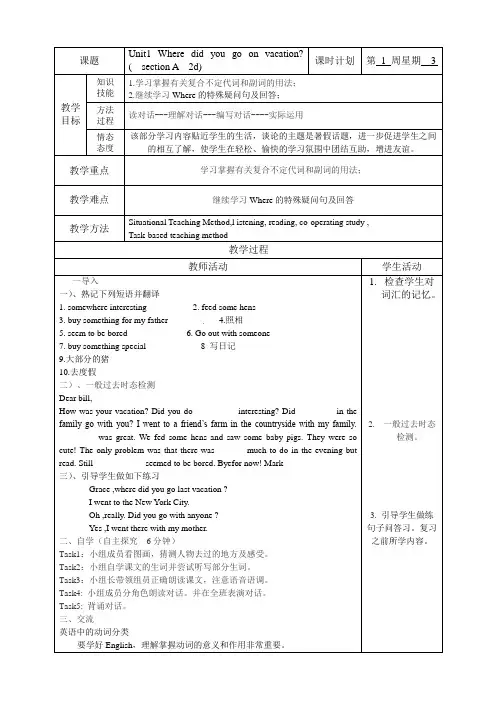
7. buy something special __________ 8写日记__________
9.大部分的猪_______________________
10.去度假____________________
二)、一般过去时态检测
Dear bill,
How was your vacation? Did you do _________ interesting? Did ________ in the family go with you? I went to a friend’s farm in the countryside with my family. _________was great. We fed some hens and saw some baby pigs. They were so cute! The only problem was that there was ______ much to do in the evening but read. Still ___________ seemed to be bored. Byefor now! Mark
人教版八年级英语Unit 1 What's the matter Section A (3a-3c)教案
Unit 1 What’s the matter? 教案Period 3 Section A (3a-3c)Teaching Aims and Demands:1、Knowledge Object:(1) Words and expressions:passenger, off, get off, to one’s surprise, onto, trouble, hit, right away, get into, bus No.26, see sb. doing sth., shout for help, thanks to,(2) Reading2、Ability Object:Train and develop the students’ reading ability.3、Emotion Object:To be a helpful person because helping others is helping yourself.Teaching Key Points:(1) Words and expressions:passenger, off, get off, to one’s surprise, onto, trouble, hit, right away, get into, bus No.26, see sb. doing sth., shout for help, thanks to,(2) ReadingTeaching Difficult Points:Train and develop the students’ reading ability.Teaching Methods:1. Talking method.2. Discussion method.Teaching Aids:CAI, A tape recorder.Teaching Procedure:Step1. Warming upChant: I have a headacheHead, head, I have a headache.I have a headache,And my eyes hurt!Stomach, stomach, I have a stomachache.I have a stomachache,And I have the flu!Ear, ear, I have an earache.I have an earache,And I have a fever!Tooth, tooth, I have a toothache.I have a toothache,And a sore throat!Back, back, I have a backache.I have a backache,And my knee hurts!I have a headache, I have an earache,A toothache, a backache,And a sore throat.My eyes hurt, my knee hurts, I have a stomach ache.I have a fever,And I have the flu!Oh, dear. Next, please!Step2. Greeting and revision1.Greet the whole class as usual.2.RevisionT: Oh! They all have matters. What about you? What’s the matter with you?S1: I have a …T: Maybe you should …but you shouldn’t…S1: That’s a good idea. (Turn to S2) What’s the matter with you?S2: I have a/an…S1: Mayb e you should /shouldn’t…S2: That’s a good idea. (Turn to S3) …Step3. Presentation1. Show the picture of accident in 3a and the title of the passage. Have a discussion about it.T: Look! The man is lying by the road.What happened to him? What was the woman next to him doing?Did the man die? Who do you think is going to save the man?2.Teach the new words.passenger, off, get off, to one’s surprise, onto, trouble, hit, right away, get into Step4. Reading1. Do 3a. Fast-reading.Do you think it comes from a newspaper or a book? How do you know?2. Careful-reading.Read the passage carefully and fill in the time line.Something happened Bus driver’s reaction Passengers’ reaction ResultDiscuss the answers in pairs.3. 3b. Check the things that happened in the story.Then check the answers together.4. 3c.Have the students discuss the questions with the partners. Give Ss some minutes to prepare and then ask some students to say out their opinions.nguage pointsHave the students summarize the expressions:1.Expressions about bus:Bus No.26, bus driver, the passengers on the bus, stop the bus without thinking twice, get off/ on the bus, help to move the man onto the bus2.Expressions about first aid:See a man on the side of the road, have a heart problem, go to the hospital, take the man to the hospital, save the man in time, only think about saving a life.3.Other expressions:to one’s surprise, in time, agree to do sth. expect to do sth. ,get into troubleStep6 Homework1.Memorize the words and expressions.2.Finish off the exercises in the workbook.Blackboard Design:Unit 1 What’s the matter?Period 3 Section A (3a-3c)3.Expressions about bus:Bus No.26, bus driver, the passengers on the bus, stop the bus without thinking twice, get off/ on the bus, help to move the man onto the bus4.Expressions about first aid:See a man on the side of the road, have a heart problem, go to the hospital, take the man to the hospital, save the man in time, only think about saving a life.3.Other expressions:to one’s surprise, in time, agree to do sth. expect to do sth., get into troubleSummary After Class:。
【人教版】八年级英语上册:Unit 1 优秀教学案(含答案解析)
Unit 1Where did you go on vacation?Section A (1a-1c)1.重点(zhòngdiǎn)短语:stay at home,go to the mountains,go to summer camp2.重点句式:—Where did Tina go on vacation?—She went to the mountains.1.重点短语和句型2.一般过去时态的特殊疑问句和陈述句一般过去时态的特殊疑问句和陈述句一、认真预习1a—1c,找出下列短语和句型。
1.待在家里____________________2.去山区____________________3.去夏令营____________________4.去纽约城____________________5.—蒂娜去哪里度假了?________________________________________________________________________ —她去山区(shānqū)了。
________________________________________________________________________Step 1情景导入Teacher:Hello,everyone.Glad to see you again.Did you have a good time during the vacation?Did you go anywhere interesting with your parents?Did you do anything special there?Can you tell us where you went on vacation?环节说明:以学生假期旅行为话题开始本节课的教学,引起了学生的学习兴趣和用英语表达的欲望。
Step 2完成教材1a—1c的任务1.学生领读1a中的单词和词组,学生识记单词和词组并且将活动和图片中的人物匹配。
人教版八年级上册英语-unit1-2教案
Unit 1 How often do you exercise?Period 1 New words learningTeaching Aims:1. Make students pronounce the words correctly.2. Make students recite the new words with Chinese meanings.Teaching procedure:1. Daily greeting2. Show teaching aims3. Teacher guides students to learn the new words.Step 1 T: Please read the new words in Unit one by yourself. Let us see who can pronounce the words best and who can read the most words. I will give you 10 minutes to do that. After that, I will ask some students to read the words.Ss learn by themselves:1. Ask Ss to read the new words by themselves by using the international alphabet.2. Make Ss listen to the tape and check if they can read the words correctly. Underline the words which they cannot pronounce or pronounce correctly.Teacher teaches:Teacher play the recoding and ask student check their pronunciations according to the tape.Step 2 T: Now you please read the words by yourselves. I will give you 10 minutes and then I will check your work.Ss learn by themselves:1. Ss read the new words, the teacher walk around the classroom and check if the Ss can read the words well.2. The teacher shows the new words on the blackboard, Ss close books and check by themselves then check with their deskmates.Teacher teaches:Check the pronunciations especially the poor students. And teacher should teach the difficult words.Step 3 T: Remember the new words. I will give you 15 minutes.Ss learn by themselves:1. Ss remember the new words2. Ss can use different ways to remember the new words.Teacher teaches:Teach some difficult words.4. Practice in classHave a dictation and ask Ss to write the new words on the exercise books.Teacher checks.Period 2 Section A(1a-2c)Teaching Aims:1. Grasp the main sentences and impressions in this period.2. Use the sentences to talk about how often you do things.Teaching procedureStep1. Daily greeting and show teaching aims. (1’)Step 2 PresentationComplete Activity 1a. (6’)1. First let the Ss discuss the picture and then ask the students to make a list of the different weekendactivities2. Next let two students talk about their own weekend activities and them tell their activities.3. Finally the teacher writes the activities on the blackboard. Teach them and let the students read loudly. Step 3 Listening practice. (8’)1. Listen to 1b twice. Write the letters from the picture. After listening ,learn the 6 words and introducethese words.2. Listen again and repeat loudly.3. Ss read loudly the listening materials for 3 minutes.Step 4 Present conversations.(5’)1. Read the conversation in pairsA: What do you usually do on weekends? B:I usually go to the movies.A: How often do you watch TV? B:I watch TV once a week .2. Make the new conversations.Step 5 Listening practice. (8’)1. Listen to 2a and 2b twice. First number the activities , then match the activities with the number of times.2. Listen again and repeat loudly (open)3. Ss read loudly the listening materials for 3 minutes.Step 6 Presentation(5’)Do Activity 2c.First let the Ss fill in the chart,then make their own dialogues according to the given conversation.Step 7 Class exersices:1)--____do you help the old man with the housework? --Once a week.A. How soonB. How longC. How oftenD. How many2) My mother _______surfs the Internet. She likes watching TV.A. doesn't hardly everB. hard everC. isn't hardly everD. hardly ever3) What are the _______ of your exams? A. answers B. problems C. results D. things4) -----What does she do on ________? -----She often go to the movies.A. Every weekB. a weekC. weekendD. weekends5) -------______do you do sports? --------I do sports every day.A. WhenB. What timeC. How longD. How often教學反思:Period 3 Section (3--4)Teaching Aims:1. Understand the main idea of this article.2. Learn to use the new words and expressions to talk about how often people do things.Teaching procedureStep 1. Daily greeting and show teaching aims. (1’)Step 2. Read the article carefully and fill in the blanks.(5’)Step 3. Read the passage again and underline some important words.(5’)Step 4. Read loudly alone for about 4 minutes. (4’)Step 5. Retell or recite (10’)Step 6. Discuss language difficulties in group to help each other.(5’)1. Discuss in groups2. Discuss in class3. The teacher explains.Step 7 Speaking and writing activities. (5’)Interview in groups and fill in the chart, then find out who is the best English student?Write a passage according to the filled chart.Step 8. Class exercisesA)根據句意,用括號內所給詞の適當形式填空。
八年级上册英语unit1教案

八年级上册英语unit1教案一、教学目标。
1. 语言知识目标。
- 学生能够正确拼写、朗读和运用本单元的重点单词,如anyone, anywhere, wonderful, few, most等。
- 掌握并能运用重点短语,如go on vacation, quite a few, of course等。
- 熟练运用一般过去时描述过去的经历。
2. 语言技能目标。
- 听:能听懂有关旅游经历的简单对话和短文。
- 说:能够用英语谈论自己或他人的旅游经历,包括去了哪里、做了什么等。
- 读:能读懂关于旅游的文章,理解文章大意并获取关键信息。
- 写:能够根据提示写出自己的旅游经历或他人的旅游故事,正确运用一般过去时。
3. 情感态度目标。
- 激发学生对旅游的兴趣,拓宽国际视野,了解不同地方的文化和风俗习惯。
- 鼓励学生积极分享自己的经历,增强自信心和表达能力。
二、教学重难点。
1. 教学重点。
- 一般过去时的用法,包括be动词和实义动词在一般过去时中的变化形式。
- 本单元重点单词和短语的记忆与运用。
- 能够运用所学知识描述旅游经历。
2. 教学难点。
- 一般过去时中不规则动词的过去式的记忆与正确使用。
- 如何引导学生在描述旅游经历时,使内容丰富、有条理。
三、教学方法。
1. 情景教学法。
通过创设旅游的情景,让学生仿佛置身于旅游场景中,更直观地学习和运用英语。
2. 任务驱动法。
布置各种任务,如对话练习、短文写作等,让学生在完成任务的过程中提高语言运用能力。
3. 交际教学法。
鼓励学生之间进行英语交流,分享旅游经历,提高口语表达能力。
四、教学过程。
1. 导入(5分钟)- 展示一些著名旅游景点的图片,如长城、埃菲尔铁塔、自由女神像等,然后提问学生:“Have you ever been to these places? Where did you go on vacation last year?”引导学生用简单的英语回答,从而引出本单元的话题——旅游经历。
英语八年级上册《Unit1(Review)》教案

3.主语+谓语+间接宾语+直接宾语。Lily gave Dave a basketball.=Lily gave a basketball to Dave.My mother bought me a pair of jeans.=My mother bought a pair of jeans for me.注意:双宾语一个指人(即间接宾语),另一个指物(即直接宾语)。一般间接宾语位于直接宾语的前面,有时它们也可交换位置,这时需要在间接宾语的前面加上介词to或for.常见的跟双宾语结构的加to的动词有:give,show,bring,pass,lend,send,leave,tell,return,write,throw,sell,take,teach等。常见的跟双宾语结构的加for的动词有:make,buy,get,sing,dance,cook,pay,build等,
1.他每天坐在电脑旁边。He ______ ______ the computer every day.
2.他们已经等了一天的时间。They ______ ______ for a day.
3.你们完成作业了吗?Have you______ ____________ ______?
4.李红的妈妈病了,她正在家里照顾她。
要求:1.80词左右,信的开头和结尾已给出不计入总词数。2.可适当增加细节,说明他/她的优势,文中不要提及真实的校名和人名。
思路点拨:1.引出话题,开头点明主题,指出要介绍的主要人物。2.具体描述人物特征。根据内容提示介绍老师的具体情况。3.总结评价。4.人称:第三人称。时态:一般现在时。
新人教版八年级英语上册教案:Unit 1 where did you go…(第4课时)
八年级Unit 1 Where did you go on vacation?Section B 1a-1e (Period four)Teaching and learning Goals:一、功能:Talk about last vacation activities; Describe vacation activities using adjectives and express personal feelings.二、词汇和常用表达:Learn to use words and sentences: “delicious, terrible, cheap, expensive, exciting, boring, sb. went to ------. How was / were ------? It was / They were------! Did you ------? Did everyone have a good time? Everything was excellent.”三、学习策略:Learn to sum up the main patterns and communicative phrases of the tape scripts; Improve listening and speaking skills by pair work and group work.四、文化知识:Help students to know about Hong Kong.Pre-listening activitiesReviewMake a survey. Ask the students to ask their classmates the questions. Where did you go on vacation? Did you go there with anyone? Did you buy anything special? How was your vacation?××went to ------ with his / her ------. He / She bought ------ for ------. He / She thought his / her vacation was ------.(设计意图:学生都喜欢搞个调查活动,这样可以提高学生的参与度,而且全面复习了上节课所学的目标语言。
2008.人教版八年级英语上册Unit 1 教案
Unit 1Where did you go on vacation?本单元教材以Where did you go on vacation?为中心话题,围绕着描述“过去发生的事情”展开,学习和运用一般过去时态的一般疑问句Did you go/see/buy...?和特殊疑问句Where/What/How...?询问过去的事件,让学生学会谈论和分享过去发生的事件。
本课教学内容与学生的实际生活密切相关,易于引发学生运用简单的英语进行交流。
在学习活动中,学生通过交换对过去发生的事情的描述及看法,促进学生之间和师生之间的情感交流,增进情谊。
Section A的主要学习内容是:复习一般过去时态和动词的规则与不规则变化,学习一般过去时态的一般疑问句:Did you...?及不定代词的用法。
Section B安排了许多听、说、读、写的任务活动,教师在教学中可以灵活运用这些活动,将其中的一些活动进行变化或整合,充分调动学生参与的积极性,提高学生的听说读写能力。
第一课时Section A(1a-2d)Teaching Goals【教学目标】Key words & phrases:anyone,anywhere,wonderful,few,most,quite a few,go on vacationKey sentences:1.Where did you go on vacation?I went to the mountains/New York City/summer camp/the beach.2.Did you...?Yes,I did./No,I didn't.Teaching Key Points【教学重点】The vocabulary:New York City,Central Park,few,most,quite a few,on vacationTarget language:Where did you/they/he/she go on vacation?I/They/He/She went to the mountains/New York City/summer camp/the beach. Did you...?Yes,I did./No,I didn't.Teaching Difficult Points【教学难点】Use the target language above to talk about past events.Teaching Aids【教学工具】An English textbook,a tape recorder,CAI or courseware.Teaching Steps【教学过程】★Step 1Leading inGreet the class and introduce what to learn in this period.Teacher:Welcome back to school!Did everyone have a good time during the summer vacation?Today we'll begin to learn the topic where you went on vacation.Teacher:Where did you go on vacation?Students:______.①I went to the mountains.②I visited museums.…★Step 2Pre-taskPage 1,1a & 1b.1.Look at the picture.2.Match each activity.3.Check the answers in 1b.4.Practice reading.Page 1,1c.1.Focus on the conversation in the box.2.Practice reading.3.Pairwork:Where did you go on vacation?I...4.Groupwork:Divide the class into groups of four or five. Make conversations.First S1 to S2:S1:Where did you go on vacation?S2:I...S1:Where did she/he go on vacation?S2:She/He...★Step 3While-taskPage 2,2a & 2b.1.Play the recording for the first time. Students complete the chart in 2a.2.Check the answers.(Point to one student who raises his or her hand.)3.Play the recording a second time and say:There are three conversations. The people talk about where they went on vacation. Listen to the recording and check(√)Yes,I did or No,I didn't for each question.4.Correct the answers.★Step 4Post-taskPage 2,2c & 2d.1.Focus on the conversation in 2c & 2d.2.Practice reading. Make students scan the conversations first.3.Teach and then make students role-play the conversation in pairs.4.Have a group of students present their conversation to the class.★Step 5Homework1.Practice the conversation on Page 2,2d.2.Do the exercises on Page 1 in students' book.Board Design板书设计Unit 1Where did you go on vacation?The first period Section A(1a-2d)1.Key vocabulary:anyone,anywhere,wonderful,quite a few,go on vacation 2.Target language:A:Where did Tina go on vacation?B:She went to the mountains.第二课时Section A(GF-3c)Teaching Goals【教学目标】Key words:something,nothing,everyone,myself,yourself,someone,seem,bored,diaryKey phrases:go out,have a good time,of course,keep a diaryKey sentences:1.Where did you go on vacation?I went to New York City.2.Did you go out with anyone?Did you buy anything special?3.How was the food?How was your vacation?Teaching Key Points【教学重点】The vocabulary:something,nothing,everyone,myself,yourself,someone,seem,bored,diary,go out,have a good time,of course,keep a diary,on vacation Target language:How was the food?Everything tasted really good!Did you go shopping?Of course!Did everyone have a good time?Oh,yes. Everything was excellent.Teaching Difficult Points【教学难点】e the target language above to talk about past events.2.The usage of someone,anyone,everyone,no one,something,anything,everything,nothing.Teaching Aids【教学工具】An English textbook,CAI or courseware.Teaching Steps【教学过程】★Step 1Leading in(T—teacher S—student)T:Where did you go last weekend?S:I went to the beach.T:Did you go there with anyone?S:Yes. I went to the beach with my brother.T:Did you have a good time there?S:...★Step 2Pre-taskPage 3,Grammar Focus.1.Review the grammar box. Work in pairs. One asks and the other answers.2.Practice reading the sentences in the chart.★Step 3While-taskPage 3,3a & 3b.1.Teach these new words:anyone,something,anything,everything,nothing,everyone,no one.2.Call students' attention to the conversation in 3a. Make students complete it individually.3.Choose a student to give his or her answers. Write the answers on the board.4.Correct the answers.5.Lead students to read this conversation.6.Have students work in pairs and role-play the conversation. As they talk,move around the classroom monitoring their work. Offer language or pronunciation support as needed.7.Make students complete the blanks in the e-mail message in 3b with the words in the box.8.Check the answers and then make students practice reading it.★Step 4Post-taskPage 3,3c.Complete the task in 3c.Ask your group questions about their last vacation. Then tell the class your results.★Step 5Homework1.Review the indefinite pronouns learned in this period.2.Do the exercises on Page 2 in students' book.Board Design板书设计Unit 1Where did you go on vacation?The second period Section A(GF-3c)1.The vocabulary:something,nothing,everyone,someone,myself,yourself,go out,of course2.Target language:①A:Where did you go on vacation?B:I went to New York City.②A:Did you buy anything special?B:Yes,I bought something for my father.3.Structure:something special4.Answers to 3a and 3b.第三课时Section B(1a-1e)Teaching Goals【教学目标】Key words:delicious,exciting,terrible,expensive,cheap,boringKey sentences:1.Where did Lisa go on vacation?2.Did she do anything special there?Did she buy anything for her best friend?Did Lisa like her vacation?3.How was/were...?Teaching Key Points【教学重点】The vocabulary:delicious,exciting,terrible,expensive,cheap,boringTarget language:Where did Lisa go on vacation?Did she do anything special there?Did she buy anything for her best friend?How was/were...?Teaching Difficult Points【教学难点】1.询问去过何地以及感受(评价)Where did you go?I went to the beaches. How was it?It was exciting.2.Use the target language to talk about your past events.Teaching Aids【教学工具】An English textbook,a tape recorder,CAI or courseware.Teaching Steps【教学过程】★Step 1Leading in1.Greetings.2.T:Where did you go on vacation?S:I went to summer camp.T:Did you do anything special there?S:Yes,I...T:Did you buy anything for your parents or friends?S:Yes,I bought...for.../No,I bought nothing.T:How was/were...?S:It was/They were...★Step 2Pre-taskPage 4,1a & 1b.1.Look at the six pictures.2.Match the words with the pictures.3.Students complete the task in 1b individually.4.Check the answers.★Step 3While-taskPage 4,1c & 1d.1.Make students scan the questions in 1c.2.Play the recording for the first time. And say:Listen to the tape. Lisa is talking about her vacation. Complete the four questions.3.Play the recording a second time. Students complete the task in 1d.4.Correct the answers.★Step 4Post-taskPage 4,1e.Ask 3 or 4 students to answer questions about Lisa's vacation. You can begin your questions with:Where did...?What did...?Did she...?How was...?How were...?★Step 5Homework1.Review these sentences:Where did...?Did...?How was/were...?2.Do the exercises on Page 3 in students' book.Board Design板书设计Unit 1Where did you go on vacation?The third period Section B(1a-1e)1.Words:delicious,exciting,terrible,expensive,cheap,boring2.Sentences:①Where did Lisa go on vacation?②Did she buy anything special?③Did she buy anything for her best friend?④Did Lisa like her vacation?3.Answers to Activity 1a:1—5f a c e b dAnswers to Activity 1b:wordsdeliciousexcitingcheapwordsterribleexpensiveboring第四课时Section B(2a-2e)Teaching Goals【教学目标】Key words:activity,decide,try,bird,bicycle,building,trader,wonder,difference,top,wait,umbrella,wet,below,enough,hungry,asKey phrases:feel like,because of,go to the beach,a lot of,a little,take the train,too many,what aboutKey sentences:1.I wonder what life was like here in the past.2.What a difference a day makes!3.We waited over an hour for the train because there were too many people.Teaching Key Points【教学重点】Learn Jane's diary entries about her vacation.1.The vocabulary:activity,decide,try,wonder,difference,wait,below,enough,hungry,as,feel like,because of2.Target language:I wonder what life was like here in the past. We waited over an hour for the train because there were too many people.Teaching Difficult Points【教学难点】1.because and because of2.What a difference a day makes!3.Learn to write a diary.Teaching Aids【教学工具】An English textbook,CAI or courseware.Teaching Steps【教学过程】★Step 1Leading in1.Greetings.2.Introduce what to learn in this period,especially the articles in 2b,Jane's diary entries. Teacher begins like this:Today we'll focus on two diary entries about Jane's vacation. Through the learning you'll know how to write a diary. Let's begin now.★Step 2Pre-taskPage 5,2a & 2b.1.Review and discuss the questions in 2a box with your partner.2.Project these new words on the screen or write them on the board and teach the new words. Ask students to repeat them. And make sure everyone knows the meanings.activity n.活动;decide v.决定;try v. & n.尝试,设法;wonder v.想知道;difference n.差异;top n.顶部;wait v. & n.等待;umbrella n.伞;below prep.& adv.在……下面;enough adj.充足的;hungry adj.饥饿的3.Make students scan the articles first. Ask students to put a mark in contents that are unfamiliar to them. Then the teacher lead students to learn these two articles sentence by sentence. Pay attention to these points:(1)decide v.决定;decide to do sth.决定做某事;(2)try v.尝试;try doing sth.尝试做某事;try to do sth.尽力做某事;(3)below prep. & adv.在……下面;(4)feel like 给……的感觉;(5)because and because of;(6)wonder v.想知道4.Practice reading.★Step 3While-taskPage 6,2c & 2d.1.Make students read Jane's diary entries again. Fill in the chart in 2c.2.Students complete the conversation in 2d using the information in Jane's dairy entries.3.Choose 3 or 4 students to give their answers.4.Correct the answers.5.Have students work in pairs. Student A will be Anna and student B will be Jane. Act the conversation out.★Step 4Post-taskPage 6,2e.1.Make students complete the blanks in 2e.2.Ask one student to write his or her answers on the board.3.Check the answers together with the class.4.Practice reading.★Step 5Homework1.Write a diary.2.Do the exercises on Page 4 in students' book.Board Design板书设计Unit 1Where did you go on vacation?The fourth period Section B(2a—2e)1.Key vocabulary:decide,try,wonder,difference,top,wait,below,enough,hungry,as,feel like,because of,too many2.Sentences:①I wonder what life was like here in the past.②And because of the bad weather,we couldn't see anything below.第五课时Section B(3a-Self Check)Teaching Goals【教学目标】Key words & phrases:duck,dislike,take photos,Tian'anmen Square,the Palace Museum,bring back,shopping center,have a fun time,school trip,come upKey sentences:1.How did you feel about the trip?2.It was so beautiful that we forgot about the last five hours!Teaching Key Points【教学重点】The vocabulary:dislike,take photos,Tian'anmen Square,the Palace MuseumTarget language:What did you like best?Did you dislike anything?How did you feel about the trip?Teaching Difficult Points【教学难点】Write a travel diary.Teaching Aids【教学工具】An English textbook,CAI or courseware.Teaching Steps【教学过程】★Step 1Leading in1.Greetings.2.T:Beijing is the capital of our country. It's famous for its long history and places of interest,such as Tian'anmen Square,the Palace Museum,the Summer Palace and so on. And Beijing duck is very delicious. Have you ever been to Beijing?Tell your travel to us.★Step 2Pre-taskPage 7,3a.1.Look at the three pictures.2.Use the words and phrases in the box to complete the blanks in the article.3.Check the answers.★Step 3While-taskPage 8,Self Check.Complete the tasks in Self Check.1.Have students complete the task of Part 1.Then Choose 2 or 3 students to give their answers. Check the answers.2.Induct students to complete the passage of Part 2.Check the answers.3.Practice reading.★Step 4Post-taskPage 7,3b & 3c.1.Make students answer the questions in 3b and take notes.2.Teach students how to write a travel diary.3.Students write a travel diary like Jane's on Page 5 using the notes in 3b.4.Choose 2 or 3 students' diaries. Make students read them out. Point out the weakness and induct the students to correct their diaries.★Step 5Homework1.Write a travel diary.2.Do the exercises on Page 5 in students' book.Board Design板书设计Unit 1Where did you go on vacation?The fifth period Section B(3a-Self Check)1.Key vocabulary:dislike,Tian'anmen Square,the Palace Museum,have a fun time,come up2.Sentences:①Did you dislike anything?②How did you feel about the trip?③My legs were so tired that I wanted to stop.(赠品不喜欢可以删除)期末学生评语选粹◆品学皆优◆你是一个全面发展的好学生。
八年级上册英语unit1教案(共5课时)
Unit 1 How often do you do exerciseTeaching aims of this unit:Language goals :1.Vocabulary: always usually often sometimes hardly ever never ,once a day ,twice a week ,three times a month, my eating habits ,healthy /unhealthy lifestyle , keep in good health, junk food ,eat less meat, the same as, be different from ,the difference between…and…, of course ,look after, be good /bad for, sleep nine hours every night all /most /some /no students ,maybe, although exercise =do/play sports2.Ask and answer : What do you usually do on weekends?I often watch TV on weekends.How often do you watch TV?I watch TV twice a week..How long do you sleep every night?I sleep nine hours every night.What are the differences?3. Topic :My lifestyle or habitsAims of abilities:Talk about how often you do thingsAims of emotion: Get the messages from the others successfully.nguage functions: Wh-questions, What do …?, How o ften …?,Adverbs of frequency, All/most/some/none课时安排5课时Period One: Section A (1a—2c)Period Two: Section A (3—4)Period Three: Section B (1a—2c)Period Four:Section B (3a—4)Period Five: Self check and Revision (A-self check)Period OneTeaching Aims:1. Learn to talk about how often do you do things2. To learn the words of the adverbs of frequency.Teaching Difficulties:1.words: exercise, skateboard, hardly, ever, shop, once, twice, time, surf, internet, program.2.phrases:how often, on weekends, go to the movies, exercise, go skateboarding,always , usually , often , never , hardly ever , sometimes .3.Sentence patterns: What does she /he do on weekends ? She often goes to the movies .How often do you shop ? Once a week / Twice a week ··· .Teaching Aids: Tape recorder; Multi-Media.Teaching Procedures:Step 1 :Greeting.1.Welcome back: Talk about their holidays.2.Encourage Ss to share their holidays with the whole class.Step 2 :Leading – in1. Do you like watching TV? Yes ,I do.Do you watch TV every day? Yes, I do.How often do you watch TV?I watch TV every day. I watch TV twice a week.2.Introduce the key vocabulary.Ask the students to say what they see in the thought bubbles.Check the answers on the board.2.3. Name each activity.Repeat reading the following: watch TV, read, shop, go skateboarding, exercise, draw4. Look at each picture in 1c.Tell what the person does on weekends.Check the Ss orally.1) Make sure what they will hear and do .2) Read these adverbs and explain.5.Play the tape twice .Write the letters on the line.Ask Ss: Well, do you still remember your last vacation?How did you spend it?Was it the same as this summer vacation?So what do you often do in your summer vacation?Then show some phrases for Ss to practice.Then present as following:always>usually>often>sometimes>hardly ever(几乎没有) >neverand let them understand their differences at the first time.Step 3 :Guessing Presentation and Practice.always, usually, often, sometimes, hardly ever(几乎没有) or never.And during this part, present surf the net exercise and go skateboarding.How often does he take a shower?Let Ss ask and answer in pairs, using always, usually, often, sometimes, hardly ever(几乎没有) or never.Step 5: Homework1.Do exercises on pages 1-2 of the workbook to practice the language presented in this unit.课后记:Period TwoTeaching Aims:1. Students can learn to talk about activities and how often to each other2. Students can listen, talk ,read and write these words correctlyTeaching Difficulties:1. Words: high school, most, no, result, active, for as, for about2. Phrases: for as, for about3.Sentence patterns: How often do you shop? I shop once a month.How often does Cheng watch TV? He watches TV..Teaching Aids: Tape recorder; Multi-Media.Teaching Procedures:Step One :Greeting.Step Two :Leading – inDrills:T: What do you usually do on weekends ?S1: I usually play soccer .T: How often do you play soccer ?S1: I play soccer twice a week .T: How often does he play soccer ?The other Ss: He plays soccer twice a week .Repeat for three times .Step Three :Pre-taskReview the grammar box .Step Four :While-task1. Call attention to the survey .2.Make sure the Ss understand the chart .T: What activity do ninety-five percent of Green High students do every day ?3. Ss answer .If necessary , give them help .4. Review the information in the green box with Ss .5. Read the article first by the Ss .6. Check the answers .7. Practise reading .Step Five :Post-task1.T: What can you do to improve your English ?(e.g. read English books, practice reading and speaking ) How often do you ··· ?2.Think of more things you can do to improve your English and write them here .3.Ask several Ss each question .4.See: Who is the best English students in the classStep Six: Homework:1.Revise the new words .课后记:Period ThreeTeaching Aims:Learn to talk about how often they do things to keep healthy.Teaching Difficulties:1.Words:junk food, milk, coffee, chips, cola, chocolate, drink, health, how many, interviewer.2.Phrases: how many, be good for, be bad for, every day.3.Sentence patterns: How often do you drink milk, Liu Feng?How many hours do you sleep every night?She says it’s good for my health.Teaching Aids: Tape recorder; Multi-Media.Teaching Procedures:Step 1 :Greeting.Step 2 :Warm-up1.Enjoy an English song.2.Free talk. Talk with Ss about the following questions:Do you like fruit vegetables?Yes, I do.I love it/ them. It’s/They’re delicious. And it’s /they’re healthy food. It’s/They’re good for our health. Or No, I don’t. It’s awful. I can’t stand it.Ask Ss: How often do you eat fruit vegetables?Step 3: Presentation1.Teach milk. Do you like milk? Do you drink milk every day? Why /Why not?2.Then teach chip /cola/chocolate/coffee in the same way. Don’t fo rget to ask them Are they/Is ith ealthy food /drink? They’re /It’s healthy/unhealthy/ junk food.Don’t eat /drink them /it too often. Step 4: Pair workSs make a similar conversation by themselves.A: How often do you{ eat…?drink…?B : I eat/drink… every day/….A: Do you like it ?B: Yes, I do. It’s g ood for my health./No, I don’t. But my mother wants me to eat/drink it.Step5 : PresentationThe teacher asks Ss other questions:How often do you exercise/watch TV/read English/play computer games?How many hours do you exercise/watch TV/read English/sleep/play computer games?Step 6: Pair workGet Ss to make a long conversation by themselves.Step 7: Listen (work on 2a)Get the Ss to listen and circle the answers to each question .Later check the answers.Step 8: Work on 2bListen again and fill in the blanks in the survey. Then check the answers.Step 9 .Group workRole play. Student A is the interview. Student B is Katrina. Student C is Bill. Try to act the conversation out .They can use their own words.Step 10.Task Get the Ss to ask their classmates as many questions as they can about their lives. The questions above (2b) can help them. After that they can give a report in front of the class.Step 11. Homework :1. Finish the exercise in this period.2. Write the report in the exercise book.课后记:Period Four:Teaching Aims:1. Learn following expressions:2. Learn to write one’s own habits.Teaching Difficulties:1.Words:habit, try, lifestyle, grade, better, same, as, different, difference, maybe, although, for, keep, must.2.Phrases: eating habits, look after, healthy lifestyle, unhealthy lifestyle, good grades.3. Main task: How to write a composition of one’s habits.Teaching Aids: Tape recorder; Multi-Media.Teaching Procedures:Step1: Revision1. Free talk:2.Ask and answerHow often do you exercise? How often do you eat vegetables/fruit/junk food?How often do you drink milk/coffee/tea? How many hours do you sleep every day?Use he/she/they ask and answer these questions.Group worksStep 2.Presentation and Practice1.Free talk.What is a healthy lifestyle.After that, T can show a picture with healthy lifestyle and unhealthy one:eat fruit never eat vegetables/fruitvegetables drink coffee/wine too muchdrink milk never drink milksleep 9 hours sleep 5 hoursdo exercise never do exercisehealthy lifestyle unhealthy lifestyleT: And you know: Healthy lifestyle can help us get good grades. Good food and exercise help us to study better. My student Katrina has a good lifestyle. Let’s see it.Step 3.Read 3a.Compare the passage with yourselves.Explain:of course , pretty healthy/good ,unhealthy ,a healthy lifestyle, try to do sth..,look after, help sb. to do sth., study better, the same as, be different fromGive more examples.Step 4. Finish 3b.Sep 5.Homework:课后记:Period Five: Self check and Revision Step1 Greetings & free talk .Step2DiscussionWork in groups, discuss which kind of life is healthy.Do a report according the discussion.We think we should eat fruit and vegetables…Step3 Self checkFill in each blank with the correct word given.Then make your own sentence with each word.1. wants2.exercises3.help4.try5.haveStep3 Key vocabulary1.ever adv. 曾经2. once adv. 一次3. twice adv. 两次4.internet n.互联网5. program n. 节目单,(电脑)程序6. hilltop n. 山顶7. result n. 结果,成果8. key n. 提醒,提示,线索,答案9. translate v. 翻译10. song n. 歌曲11.junk n. 垃圾,破烂物,废弃的旧物12. milk n. 牛奶13. interviewer n. 采访者14.habit n.习惯,习性15.difference n. 不同,差异,区别16.grade n. 分数,成绩,年级17. although conj. 虽然,即使,纵然18. unhealthy adj.不健康的,不益健康的19.skateboarding n. 溜滑板运动Step4 Key phrases:1. how often 多久一次2. as for至于,关于3. junk food垃圾食品4.eating habit 饮食习惯5.of course当然6.look after 照顾,照看7. start with 以……开始8. make a difference使得结果不同,有重要性9. go shopping去购物10.have a party 聚会11. go to the movie去看电影12. once a week每周一次13. hardly ever很少14. twice a week每周两次15. three times a week每周三次16. watch TV看电视17.on weekend在周末18. do homework做作业19. a lot of许多20. try to do试图(努力)做某事21. help sb (to) do sth.帮助某人做某事22. the same as和……相同23.keep in good health保持身体健康Step 5 Grammar1.掌握句型:1)What do you usually do on weekends? I often go to the movies.What does she do on weekends ?She often goes to the movies.What do you usually do on weekends? I often go to the movies.(watch TV、read books 、exercise 、clean、skateboard、play basketball、wash clothes、go shopping、go to movies)How often do you exercise/… ?Task one “Find my group members.”2)在规定时间内填完活动表格,再向周围同学开始询问,找出与自己课外活动大致相同的同(1)教师指着屏幕说:“ Now let’s see my activities on weekends. How often…?屏幕上出现各项活动的图片并介绍。
人教版英语八年级上册Unit1Wheredidyougoonvacation教案
Unit 1 Wheredid you go on vacati on?一.必记单词1. anyone pron.(不定代词)任何人nothin g pron. (不定代词)没有什么,没有一件东西someth ing pron.(不定代词)某事;某物everyon e pron. (不定代词)每人;人人;所有人someon e pron.(不定代词)某人anywhe re adv. (不定副词)在任何地方2. wonderful adj. 精彩的;绝妙的3. few adj. & pron. 不多;很少quite a few 相当多;不少Notice:few, a few, little,a little用法a few + 可数名词肯定句a little + 不可数名词肯定句few + 可数名词否定句little + 不可数名词否定句4. most adj., adv. & pron. 最多;大多数5. myself pron.我自己;我本人yourse lf pron.你自己;您自己yourse lvespl. 你们自己Notice:反身代词第一、二人称的反身代词由物主代词加-self构成。
第三人称的反身代词由代词宾格加-self构成。
Oursel ves 我们自己himsel f 他自己hersel f 她自己itself它自己Themsel ves他们自己6. hen n. 母鸡pig n. 猪bird n. 鸟duck n. 鸭7. seem v. 好像;似乎;看来8. boredadj. 厌倦的;烦闷的9. diaryn. 日记;记事簿10. activi ty n. 活动11. decide v. 决定;选定decide to do sth. 决定去做某事12. try v.& n. 尝试;设法;努力Notice: try to do sth.与try doingsth.辨析try to do sth.(尽力、设法去做某事)表示想尽一切办法要把某事办成,强调付出一定的努力设法去完成try doingsth.(尝试着做某事)表示一种尝试、做做看的想法,不一定付出很多努力Eg.: I tried calli n g him, but no one answe red. I ’m tryin g to learn Engli s h well. 13. bicyc l e n. 自行车;脚踏车 14. build i ng n. 建筑物;房子 Notic e: build (建造,建筑)+ ing ==== build i ng(建筑物) build (建造,建筑)+ er ==== build e r(建设者,建筑者) 15. trade r n. 商人 16. wonde r v . 想知道;琢磨 17. diffe r ence n. 差别;差异 ( diffe rent adj. 不同的,有差异的) 18. top n. 顶部;表面19. wait v . 等待;等候 (wait for sb./sth. 等待某人/某物) 20. umbre lla n. 伞;雨伞21. wet adj. 湿的;潮湿的;下雨的 22. below prep.& adv . 在···下面;到···下面 反义词 above 超过;在···之上 23. enoug h adj. & adv . 足够的(地);充足的(地);充分的(地) 巧记eno u gh 在句中的位置:修饰名词很自由,可以前来也可后, 若是修饰形或副,一定后置要记住。