
七年级上册英语课件:Unit 4《where's my backpack》period 3(人教版)
人教版七年级英语上unit4-导学案(知识点解析)
Unit 4 Where’s my backpack?
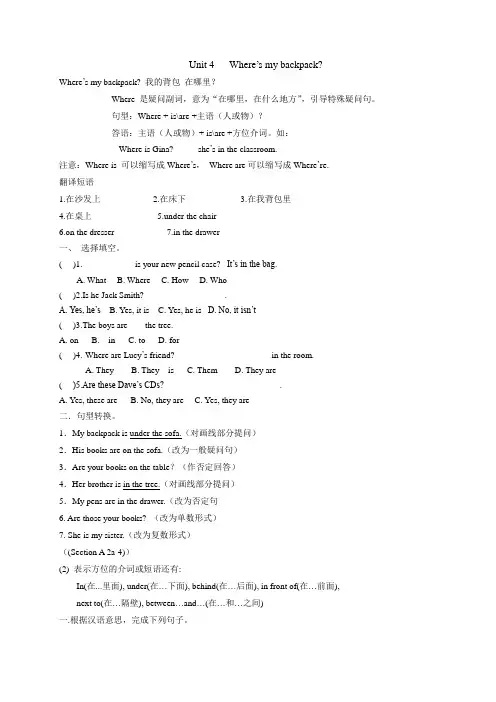
Where’s my backpack? 我的背包 在哪里?
Where 是疑问副词,意为“在哪里,在什么地方”,引导特殊疑问句。
句型:Where + is\are +主语(人或物)?
答语:主语(人或物)+ is\are +方位介词。如:
-Where is Gina? -she’s in the classroom.
注意:Where is 可以缩写成Where’s, Where are可以缩写成Where’re.
翻译短语
1.在沙发上_______ 2.在床下___ _____ 3.在我背包里__________
4.在桌上________ 5.under the chair___________
6.on the dresser________ _7.in the drawer__________
一、 选择填空。
( )1. ___________ is your new pencil case? It’s in the bag.
A. What B. Where C. How D. Who
( )2.Is he Jack Smith? _________________.
A. Yes, he’s B. Yes, it is C. Yes, he is D. No, it isn’t
( )3.The boys are ___ the tree.
A. on B. in C. to D. for
( )4.-Where are Lucy’s friend? -___ in the room.
七年级英语上册 Unit 4《Where is my backpack》教案和练习 人教新目标版
word 1 / 13 英语:Unit 4《Where is my backpack》教案和练习
(人教版七年级上)
一、学习目标:
1. 知识目标
Where is / are …?
—Is the baseball on the sofa? —Yes, it is. /No, it isn’t.
—Are his keys on the dresser? —Yes, they are. /No, they aren’t.
2. 能力目标
Talk about where things are 谈论物品的位置
二、重点、难点:
重点
1. 单词、短语:
table,math book,behind,under,next to,between
2. 句型:
—Where is my backpack? —It’s under the table.
—Where are her books? —They are on the chair.
难点
介词的使用
三、知能提升:
(一)【单词学习】
1. table
desk [desk]
【用法】
table n. 桌子;餐桌
desk n. 书桌;办公桌;写字台
辨析:
table n. 指用餐、会谈或消遣时所用的桌子。
desk n. 指读书、办公时所用的桌子,一般带有抽屉。 word 2 / 13
【例句】
There is only a table for four at the restaurant. 这个餐馆只有一X四人桌。
【考点】
at a/the table 在桌子旁
at table 在进餐,在吃饭
【例句】
My bag is at the table. 我的书包在桌子旁边。
They talk loudly at table. 他们吃饭的时候大声交谈。
【考题】
—Would you give me the chair _______, please? —OK. Here you are.
七年级上册英语unit 4知识点

七年级上册英语unit 4知识点
Unit 4是七年级上册英语的一个重要单元,主要围绕“Where's
my backpack? ”这个话题展开,涉及到词汇、语法和口语表达等方面的知识点。下面是本文对Unit 4的详细介绍。
一、词汇
1. 名词:backpack(背包)、book(书)、pencil(铅笔)、pen(钢笔)、eraser(橡皮擦)、ruler(尺子)等;
2. 形容词:old(旧的)、new(新的)、big(大的)、small(小的)等;
3. 动词:have(拥有)、need(需要)、find(找到)、look
for(寻找)、take(拿)、put(放)、give(给)等;
4. 介词:in(在……之中)、on(在……上面)、under(在……下面)、behind(在……后面)、beside(在……旁边)等。
二、语法
1. 一般现在时:主语+动词原形+其他。例如:
(1) I have a backpack.
(2) She needs a book.
(3) They look for the pencil.
(4) He takes the eraser.
2. 疑问句和肯定句的变换:将疑问句改为肯定句时,用Yes或No进行回答,动词要用助动词do或does。例如:
(1) Is your backpack new? → Yes, it is. 或 No, it isn't.
(2) Do you have a pencil? → Yes, I do. 或 No, I don't.
(3) Does she need a ruler? → Yes, she does. 或 No, she doesn't.
3. 指示代词This和That的使用:This用于指离说话者近的人、物,That用于指离说话者远的人、物。例如:
(1) This is my backpack.
人教版七年级英语上第四单元说课稿

Unit4 Where is my backpack? SectionA
说课稿
一、说教材
1、教材的地位及作用:
本单元主要围绕学习“询问物品的位置”这个话题而展开的多种任务型的教学活动,通过学习使学生学会:1、基本句型“Where’s/ Where’re ~~~? It’s/ They’re on/in/under~~~~.”和 “Yes/No”疑问句的用法;2、学会使用方位介词“on/in/under”来表达物品的位置。通过以上两个方面的学习,使学生学会使用听关键词、推测词意的学习策略,识别不同物品的位置。本单元与第五单元衔接紧密:由本单元出现的“Is/Are …?”的句型过渡到第五单元“Do …?”同属一般疑问句学习,前者为后者做了铺垫,同时本单元是以房间里的家具来展开讨论的,内容贴近生活,学生兴趣较浓,为学生交际水平和综合使用语言水平的提升打下了基础。
2、教学目标:(知识目标、水平目标、情感目标、策略目标)
A.知识目标
(1)学习和掌握相关询问物品位置的句型:
Where’s my backpack? It’s on/in/under/the chair.
Are my books on the chair? Yes,they are.No,they aren’t.
Is it on/in/under ……? Yes,it is.No,it isn’t.\
(2)学习和掌握相关家具类的单词:table, bed, dresser, bookcase ,sofa ,chair ,drawer , plant ,
bag
(3) 学会三个方位介词的用法:on ,in , under
B.水平目标:能使用所学的词语,与他人实行简单交流,进一步提升学生语言表达水平。
C.情感目标:在小组合作学习的过程中,培养学生乐于与他人合作的精神,通过多种形式的活动, 提升学生学习英语的兴趣。 D.德育目标: 促使学生了解自己和他人的家居环境,热爱自己的家,为使将来的家更加美好,激发他们勤奋学习,克服困难的道德意志。
5分钟课堂过关训练(Unit4Where's my backpack)
Unit 4 Where's my backpack?
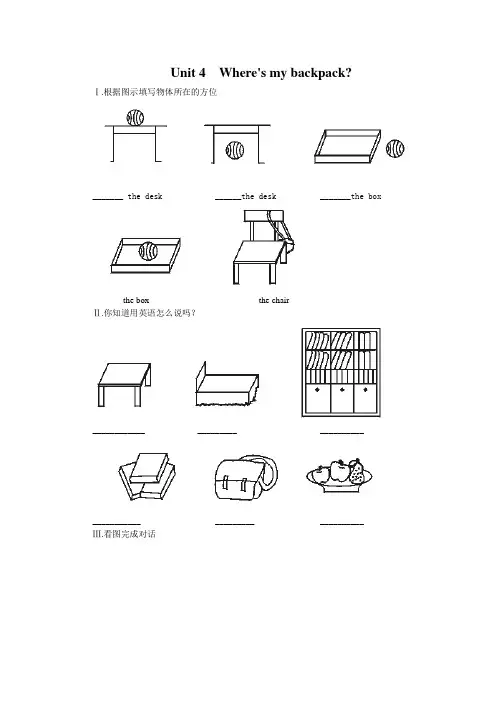
Ⅰ.根据图示填写物体所在的方位
_______ the desk ______the desk
_______the box
_______the box ______the chair
Ⅱ.你知道用英语怎么说吗?
____________ _________
__________
___________ _________ __________
Ⅲ.看图完成对话
This is Brad's room.
A.—____________?
—It's on the chair.
B.—Where are the pictures?
—____________.
C.—____________?
—One is ____________ the bed,and the other is ____________.
D.—Where is his ruler?
—____________.
参考答案
Unit 4 Where's my backpack?
Ⅰ.on,under,next to,in,behind
Ⅱ.a table,a bed,a bookcase,books,backpack,fruit
Ⅲ.Where's the ball;They are on the wall;
Where are the socks;Under;next to the backpack;It's in her backpack.
新疆生产建设兵团第五师八十六团一中七年级英语上册 U
1 Unit 4 Where’s my backpack?
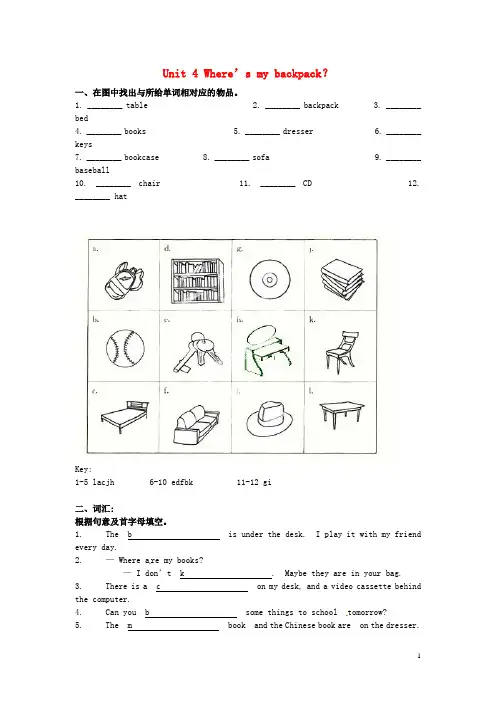
一、在图中找出与所给单词相对应的物品。
1. ________ table 2. ________ backpack 3. ________
bed
4. ________ books 5. ________ dresser 6. ________
keys
7. ________ bookcase 8. ________ sofa 9. ________
baseball
10. ________ chair 11. ________ CD 12.
________ hat
Key:
1-5 lacjh 6-10 edfbk 11-12 gi
二、词汇:
根据句意及首字母填空。
1.
The
b
is under the desk. I play it with my friend
every day.
2. — Where are my books?
— I don’t k . Maybe they are in your bag.
3. There is a c on my desk, and a video cassette behind
the computer.
4. Can you b some things to school tomorrow?
5. The m book and the Chinese book are on the dresser. 2 6. —
W
are my pen and pencil?
—
They are in the pencil case.
Unit 4 Where's my backback
人教版Go for it七年级上教案
Unit 4 Where’s my backpack?
新疆乌鲁木齐市第六十五中学 吴海燕
Ⅰ. Teaching aims:
1. Knowledge aims:
(1)words: in、on、 under、 behind
table、 bed、 dresser、 bookcase 、sofa、chair、 plant
(2)Conversations: A: Where is your backpack?
B: It’s on the bed.
It’s in the dresser.
It’s under the table.
It’s behind the sofa.
2. Ability aim: Learn to describe the positions of things.
3. Emotion aim: Learn to how to put own things.
Ⅱ. Teaching Important Points
1. Learn to how to use “in、on、under、 behind”
2. Drills: “Where is„”
“Where are„”
3.Learn Nouns“table、bed、dresser、bookcase 、sofa、chair、plant”
Ⅲ.Teaching Difficult Points:
1. Master “in、on、under、 behind” and know how to use them.
教育局视导课教学设计 七年级英语 第四单元
1 Unit 4 Where’s my backpack?
第一课时教学设计
教材:七年级上册英语(人教版新目标)
【学习目标】:
1.知识目标:A. 掌握一些表示家具的名词以及学习用品的新单词:table, bed, dresser,
bookcase, sofa, chair, drawer, plant, bag, alarm clock, CD, video, video tape,
hat, etc;
B. 熟练运用in, on, under, behind, in front of, next to等方位介词;
C. 熟练运用Where问句和一般疑问句及其回答;
D. 掌握名词单复数及人称代词they的用法。
2.能力目标:A.学会用英语准确描述物品所在的位置;
B. 学会用英语询问自己的或他人物品的具体位置;
C. 能够合理地描述和设计房间。
3.情感目标:A. 培养学生整齐地摆放自己物品的生活习惯;
B.通过小组对话、讨论、调查和设计等一系列的课堂活动,
培养学生的合作精神。
4.学习策略: A. 交际策略: 学会与他人合作交流, 并能把语言材料用到真实的生活中去;
B. 资源策略:学会利用一切可利用的学习资源,如词典,音像资料,
网络等来获取更多的学习信息;
C.认知能力:积极思考,及时反馈;
D.调控策略:在反思,顿悟和自醒中不断调整自己的学习策略。
【学习重点和难点】:
1. 重点:A. 方位介词: in, on, under, behind, in front of, near 等的用法;
B. Where 的特殊疑问句和一般疑问句:
七年级英语复习复习笔记《Unit 4 Where's my backpack 》
Unit 4 Where's my backpack ?
一、重点词汇:
table 桌子 dresser梳妆台 bookcase书橱sofa 沙发
chair 椅子 drawer 抽屉plant 植物bag 袋子、口袋 hat 帽子 need 需要take…to...把…带走 bring…to…把…拿来 I
don't know我不知道 math book数学书 alarm clock闹钟
video tape 录像带 some boys一些男孩
二、短语
1. next to 在…旁边2. don't=do not 助动词否定形式3. Goodbye.= Bye-bye 再见4. behind the computer 在电脑后面 5 .write down 写下;记下6. I'm sorry 对不起7 .alarm clock 闹钟8.video tape 录像带9. soccer ball 英式足球10. school bag 书包11. in the backpack 在书包里13 .on the chair 在椅子上14. on the dresser 在梳妆台上15. take sth to…(there/him/+地点) 把…带去16 .bring sth to …(here/me/+地点) 把…带来句型:in the
room在房间里 on the floor在地板上 under the bed在床下
句型
1. Where is my backpack? 我的背包在哪儿? Where
are the books? 那些书在哪儿?
2. It's / They're in the drawer / under the bed / on the bookcase.
它 / 它们在抽屉里 / 床底下 / 书柜上。(注意主语和be动词照应)
人教版七年级英语上 Unit 4单元教学设计
1 Unit 4 Where’s my backpack?
(人教版七年级英语上 Unit 4 )
设计人:(*******)
学情分析(和注意问题)
学生现在读初一, 开始比较完整地学习英语这一门学科. 兴趣相对来说还比较浓厚, 这一点是我们教学一个很好的切入口. 通过Start unit1-3 到正式篇unit1-3的学习, 学生已经学了一些最基本的关于“如何问候他人”, “确认物体”,“辨认颜色”, “确认物主关系”,“确认人物”等与日常生活息息相关的英语表达。因为这些知识的实用性而让同学们更愿意去学习英语。但鉴于现在他们还是初一学生,因而教师要注意对他们要求不要太高并且要有耐心,采取更适合,效果更好的方法。尽量采用直观教学与多学多练相结合的办法,这样更有利于学生吸收,在学习上也更有兴趣了。
教材分析(和整合)
本单元是人教版七年级正式篇的第四单元, 主要的语言目标是谈论物品的位置。还有一些更具体的目标:(1)如何表达相对的位置关系(主要的介词:in,
on,under)(2)单复数的正确使用(Where is my backpack?/Where are my books?)
(3)一些新单词:dresser, bookcase, chair等(4)如何写便条。
本单元Section A 首先是一些生词和句型--Where is…--It is ….--Where
are …--They are …后面的听力练习等都是围绕这个语法项目来开展活动的,有听力训练,结对操练活动,直到Section B就把情境设计成Tommy’s room 这样让大家感觉更贴近自己的生活,留言的学习使同学们更加熟悉和巩固了如何表达物体的位置,听,说, 读,写都很好地融合在一起。
单元教学安排(节数,课型和相关性分析)
本单元预计用四节课上完, 前三节是听说课和复习课交替的, 第四节是写作课.
第一节课主要导入新单词和句型--Where is …It is …\--Where are … They