
练习题及答案
1. 关于原发性肺脓肿,下列哪项正确: A.吸入口腔内需氧菌的混合感染 B.一般多发生于肺的上叶尖后段 C.形成空洞少见液平 D.与口腔,鼻咽部疾病有关 E.多发性炎症,常分布于两肺外缘 2. 最有助于临床诊断肺脓肿的症状是: A.咳嗽咯血 B.呼吸困难 C.剧烈疼痛 D.咯大量脓臭痰 E.畏寒高热 3. 支气管扩张症的常见症状: A.常有低热、盗汗、乏力和消瘦等症状 B.常为刺激性咳嗽、呈金属声调 C.慢性咳嗽、大量脓痰、反复咯血 D.乏力、咽痛、咳嗽、发热、腹泻、肌痛 E.多发生在吸烟者、慢性咳嗽、咳白色泡沫样痰 4. 成人结核菌素试验阳性说明: A.结核菌感染 B.活动性肺结核 C.结核病痊愈 D.原发综合征 E.继发性肺结核 5. 肘静脉压是反映: A.左房压力 B.肺静脉压力 C.右房压力 D.左室压力 E.肺动脉压力 6. 男性,62岁,患高血压心脏病10余年,因急性左心衰竭入院既往有 慢支炎和痛风病史,最佳治疗方案是: A.洋地黄 B.β---受体阻滞剂 C.血管紧张素转换酶抑制剂 D.α---受体阻滞剂 E.噻嗪类利尿剂 7. 男性,40岁.因剧烈活动后晕厥就诊.查体:胸骨右缘第二肋间 (R2)Ⅲ/6SM,向颈部传导,胸骨左缘第三肋间(L3)舒张期哈气 样杂音,心尖部舒张期隆隆样杂音,伴震颤,为改善病人预后 应建议他通过下述哪种方法获得最大益处: A.瓣膜置换术 B.适当限制体力活动,每半年至1年复查 C.绝对卧床休息 D.主动脉瓣球囊扩张成形术 E.二尖瓣球囊扩张成形术 8. 治疗感染性心内膜炎,应用抗生素的疗程一般应为: A.1--2周 B.2--4周 C.4--6周 D.6--8周 E.三个月以上 9. 患者男性,有风湿性心瓣膜病史,近来发热10天,疑诊为亚急性感 染性心内膜炎时,以下哪项处理最适当: A.作血培养后,根据培养结果再开始用药 B.先用抗生素3天,待观察体温后再抽血培养 C.作血培养后即开始肌肉注射普鲁卡因青霉素 D.作血培养后静脉滴注大剂量青霉素加肌肉注射链霉素 E.作血培养后静脉滴注氯霉素 10. 原发性肥厚型心肌病合并轻度心衰的治疗,常用: A.β阻滞剂和洋地黄制剂的合理配合 B.转换酶抑制剂和洋地黄制剂的合理配合 C.β阻滞剂,钙拮抗剂和洋地黄制剂的合理配合 D.利尿剂和洋地黄制剂的合理配合 E.β阻滞剂和利尿剂的合理配合
11. 慢性胃窦炎最主要的病因是: A.吸烟 B.幽门螺杆菌感染 C.饮酒 D.胆汁反流 E.非甾体类消炎药物 12. 急性胃炎的急诊的胃镜检查应在上消化道出血后: A.一周内进行 B.5天内进行 C.4天内进行 D.3天内进行 E.1-2天内进行 13. 慢性胃炎最可靠的临床诊断手段是: A.胃液分析 B.幽门螺杆菌检测 C.抗壁细胞抗体测定 D.X线钡餐检查 E.胃镜检查和胃粘膜活检 14. 对于胃炎合并幽门螺杆菌感染,下列哪种方案治疗的2~4周后根 治率可达80%以上: A.灭滴灵+螺旋霉素 B.胶体铋 C.奥美拉唑+庆大霉素 D.克拉霉素 E.胶体铋+灭滴灵+阿莫西林 15. 迷走神经促进胃酸分泌是作用于胃体部: A.壁细胞 B.主细胞 C.肥大细胞 D.粘液细胞 E.G细胞 16. 下列哪种病变是引起肾病综合征最常见的病因: A.原发性肾小球疾病 B.过敏性紫癜 C.肾静脉血栓形成 D.系统性红斑性狼疮 E.糖尿病肾病 17. 尿毒症病人,常合并高血钾,当血钾大于多少时,需要紧急处理? A.5.0mmol/L B.5.5mmol/L C.6.0mmol/L D.6.5mmol/L E.7.0mmol/L 18. 上尿路感染区别于下尿路感染的主要表现是: A.尿频.尿急.尿痛 B.腰痛 C.血尿 D.畏寒.高热 E.水肿 19. 孕妇急性肾盂肾炎(acute pyelonephritis)最宜用的抗菌药是: A.磺胺类 B.氟喹酮类 C.半合成青霉素 D.头孢类 E.氨基甙类 20. 男,32岁,全血细胞减少,一年前患过"黄疸型肝炎",半月后黄疸消 退,一周前又有尿色加深,Hb80g/L.肝肋下0.5CM,脾肋下1.0CM, RC6%,下列疾患应首先考虑的是: A.慢性肝炎,脾功亢进. B.再生障碍性贫血 C.急性白血病 D.阵发性睡眠性白红蛋白尿 E.恶性组织细胞增多症 21. 急性白血病患者,出现头痛、呕吐,颈强直,脑脊液压力增高、 蛋白增多,细胞大多为白血病细胞.鞘内注射首选药物是: A.阿霉素 B.三尖杉酯酶碱 C.长春新碱 D.氨甲蝶呤 E.6-巯基嘌呤 22. 急性粒细胞白血病的化学染色特点是: A.PAS(+++) B.非特异性酯酶染色(+++) C.NAP(+) D.pox(+++) E.pox(-)
23. 女性,26岁,农民,因多食善饥,甲状腺Ⅱ°大,突眼,在基层医院诊 断"甲亢"服碘糖丸治疗3个月,症状一度减轻后又加重,改用他巴 唑45mg/日,心得安30mg/日治疗8周,症状仍未见改善,T3,T4仍高, 下一步最佳的治疗措施是: A.继续服用他巴唑45mg/日 B.改用丙基硫氧嘧啶300mg/日 C.立即行手术治疗 D.加用甲状腺片40mg/日 E.改用强的松30mg/日 24. 高血压患者尿液检查VMA阳性,应考虑哪种继发性原因: A.嗜铬细胞瘤; B.主动脉缩窄; C.肾动脉狭窄; D.原醛; E.皮质醇增多症 25. 以下治疗甲状腺危象的方案中,哪一种最完善: A.抗甲状腺药物,强心药,镇静剂,抗生素 B.抗甲状腺药物,强心药,镇静剂,β-受体阻滞剂 C.大剂量抗甲状腺药物,糖皮质激素,镇静剂 D.大剂量丙基硫氧嘧啶,大量复方碘溶液,糖皮质激素, β-受体阻滞剂 E.大剂量复方碘溶液,糖皮质激素,β-受体阻滞剂,强心药 26. 糖尿病饮食治疗下列哪种是正确的: A.病情轻可以不用饮食治疗 B.有并发症者不用饮食治疗 C.用药治疗时,可不用饮食治疗 D.肥胖者宜给高热量饮食治疗 E.不论病情轻重都需饮食治疗 27. 1型糖尿病与2型糖尿病最主要的区别在于: A.症状轻重不同 B.发生酮症酸中毒的倾向不同 C.对胰岛素的敏感性不同 D.胰岛素的基础水平与释放曲线不同 E.血糖稳定性不同 28.停用抗甲状腺药物的主要指标是: A.甲亢症状好转 B.甲状腺肿大和突眼消失 C.TRAb转阴性 D.TSH恢复正常 E.T3、T4恢复正常 29. 年青女患,发热关节痛,贫血,口腔溃疡已数月,血中找到狼疮细胞, 抗核抗体阳性,下列哪一项资料对诊断有帮助: A.尿蛋白± B.尿蛋白+++ C.尿蛋白- D.尿白细胞3—5个/每高倍视野 E.尿白细胞5—10个/每高倍视野 30. 年轻女患,发热一月,白细胞减少,有胸腔积液,口腔溃疡,尿蛋白 +++,下列哪一项对成立诊断最有帮助: A.骨髓检查找白细胞减少的原因 B.检测抗核抗体 C.测C反应蛋白 D.查血沉 E.测肾功
31. 一女患,20岁,服敌敌畏30ml,20分钟后送入某医院,予洗胃,补液, 利尿,应用阿托品治疗,阿托品已用600mg,患者意识模糊,颜面潮 红,瞳孔散大,心率130次/分,体温39.0℃,有尿潴留,应给予: A.导尿 B.阿托品维持治疗 C.加用解磷定 D.应用抗生素 E.停用阿托品输液观察 32. 关于结核菌,下列哪项是错误: A.生长缓慢,4-6周繁殖成明显菌落 B.抗酸染色后,镜检为蓝色细长的杆菌 C.在阴湿处能生存5个月以上 D.煮沸一分钟能被杀灭 E.烈日曝晒两小时可被杀灭 33. 男性,36岁,近3个月消瘦明显,进行性气短,低热,咯血,胸片示右 侧肺门增大,最不可能的疾病: A.鳞癌 B.腺癌 C.小细胞未分化癌 D.大细胞未分化癌 E.肺门淋巴结结核 34. 哪项不是结核性腹膜炎的特征: A.低热和盗汗 B.腹胀腹水 C.有肺结核病史 D.腹痛与压痛 E.腹水为漏出液 35. 关于溃疡型肠结核的临床表现下列说法不正确: A.常引起消化道出血 B.一般不发生急性穿孔 C.常有结核毒血症表现 D.血便少见 E.右下腹可出现肿块 36. 男患17岁,浮肿尿少2天,Bp160/90mmHg,尿蛋白++,RBC20—25 个/Hp,下列哪项检查对诊断无帮助: A.血色素 B.血补体 C.尿培养 D.眼底 E.肾脏B超 37. 下列哪项无助于慢性肾炎急生发作与急性肾炎的鉴别: A.有明显的低蛋白质血症 B.贫血 C.少尿和血尿素氮升高 D.有夜尿增多 E.有多尿 38. 17岁男性,发热,贫血,肝脾大,骨髓见大量幼稚细胞,哪项不支 持诊断: A.齿龈增生 B.胸骨压痛 C.鼻纽 D.血象中可见幼稚细胞 E.血片中大量异形淋巴细胞 39. 霍奇金淋巴瘤要有下列表现,除了: A.脾大 B.颈部或锁骨上淋巴结肿大 C.周期性发热 D.全身瘙痒 E.常伴有骨痛 40. 男,28岁,毒性弥漫性甲状腺肿患者,年幼时有哮喘史,以下何种 药物为禁忌: A.丙基硫氧嘧啶 B.甲硫咪唑(他巴唑) C.卡比马唑(甲亢平) D.甲状腺素制剂 E.普奈洛尔(心得安) 41. 关于双胍类药物治疗糖尿病下列何者是错误的: A.能加速无氧酵解,抑制糖异生及抑制葡萄糖在胃肠道吸收 B.常用于2型DM患者特别是肥胖者 C.青少年发病型糖尿病不能应用 D.有严重并发症的患者不宜采用 E.能引起乳酸性酸中毒 42. 下列各项,除了哪一项外,均有助于类风湿关节炎的诊断: A.晨僵每日>2小时 B.晨僵每日1小时 C.指关节呈梭形肿胀 D.指关节呈腊肠样肿胀 E.手指畸形呈尺侧偏曲
四大名著之《西游记》练习题附答案及阅读习惯培养方法

四大名著之《西游记》练习题附答案及阅读习惯培养方法1、下面的对联各是哪部章回小说的目录?请在括号里写出这部小说的名称。
八卦炉中逃大圣,五行山下定心猿。
《_______》《西游记》2、《西游记》全书共分三大部分:前7回写_______的故事,是全书的精华部分,表现孙悟空的反抗精神;8-12回写_______的来历、魏征斩蛇、唐太宗入冥府,交待取经的缘起;第13回-100回写_________。
大闹天宫、唐僧、唐僧师徒取经途中历经81难和师徒终成正果,带经回东土大唐3、《西游记》主要记叙唐僧师徒四人______战胜各路妖魔鬼怪的故事。
去西天取经,答“取经”也可4、《西游记》中“大闹五庄观、推倒人参果树”的是______。
孙悟空5、《西游记》中,师徒一行经过千难万险,终于得正果,最后唐僧被如来佛封为______、孙悟空被封为_____ 、猪八戒封为_____、沙僧封为_____、白龙马封为_____ 。
旃檀功德佛斗战圣佛净坛使者金身罗汉八部天龙马6、有人对《西游记》道:“阳光灿烂______,百变猴头_____,憨厚老成_____,阿弥陀佛是_____。
漫漫西天取经路,除妖斗魔显真功。
若问是谁普此画,淮安才子吴承恩。
”猪八戒、孙悟空、沙和尚、唐僧7、“东胜神州海外有一国土,名曰傲来国。
海中有一名山,山上有一仙石,受日月精华,遂有灵通之意。
内遇仙胎,一日迸裂,……”这段名著出自四大名著之一的《_____》,本书中你最喜欢的一个情节是:_________。
《西游记》、大闹天宫等8、《西游记》的作者运用了________手法描绘了一个奇妙的神话世界,花果山水帘洞洞口的对联是“________,__________”。
浪漫主义、“花果山福地,水帘洞洞天”9、孙悟空的第一个师傅是_______,它的兵器原是大禹治水的_______,又唤______,大闹天宫后被如来佛祖压在_____。
后皈依佛门,唐僧为他取名_______。
统计学 第三章练习题答案及解析
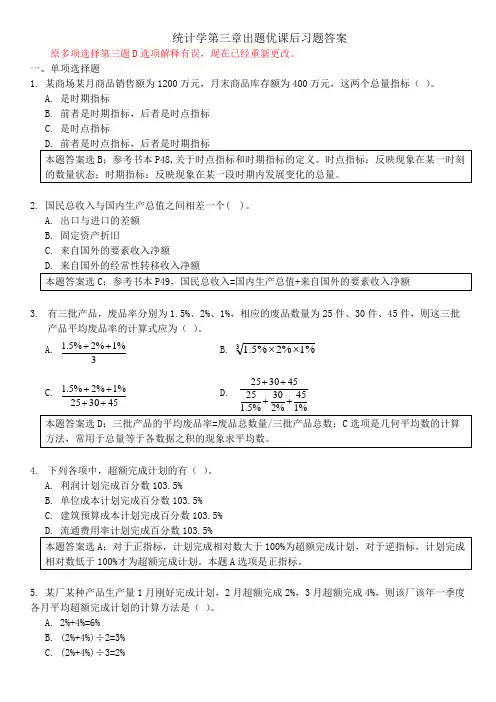
3%1%2%5.1++453025453025++++统计学第三章出题优课后习题答案原多项选择第三题D 选项解释有误,现在已经重新更改。
一、单项选择题1. 某商场某月商品销售额为1200万元,月末商品库存额为400万元,这两个总量指标( )。
A. 是时期指标B. 前者是时期指标,后者是时点指标C. 是时点指标2. 国民总收入与国内生产总值之间相差一个( )。
A. 出口与进口的差额B. 固定资产折旧C. 来自国外的要素收入净额3. 有三批产品,废品率分别为1.5%、2%、1%,相应的废品数量为25件、30件、45件,则这三批产品平均废品率的计算式应为( )。
A. B.C. D.4. 下列各项中,超额完成计划的有( )。
A. 利润计划完成百分数103.5%B. 单位成本计划完成百分数103.5%C. 建筑预算成本计划完成百分数103.5%5. 某厂某种产品生产量1月刚好完成计划,2月超额完成2%,3月超额完成4%,则该厂该年一季度各月平均超额完成计划的计算方法是( )。
A. 2%+4%=6%B. (2%+4%)÷2=3%C. (2%+4%)÷3=2%453025%1%2%5.1++++3%1%2%5.1⨯⨯6. 甲、乙两组工人的平均日产量分别为18件和15件。
若甲乙两组工人的平均日产量不变,但是甲组工人数占两组工人总数的比重下降,则两组工人总平均日产量( )。
A. 上升B. 下降C. 不变D.可能上升,也可能下降7. 当各个变量值的频数相等时,该变量的()。
A. 众数不存在B. 众数等于均值C. 众数等于中位数8. 如果你的业务是提供足球运动鞋的号码,那么哪一种平均指标对你更有用?( )A. 算术平均数B. 几何平均数9. 某年年末某地区城市和乡村平均每人居住面积分别为30.3和33.5平方米,标准差分别12.8和13.1平方米,则居住面积的差异程度( )。
A. 城市大B. 乡村大10. 下列数列的平均数都是50,在平均数附近散布程度最小的数列是( )。
药理学习题二(药物效应动力学)练习题库及参考答案
第三章受体理论与药物效应动力学练习题及参考答案一、填空题:⒈受体激动药是指与受体有___________又有_____________的药物。
部分激动药是指与受体有___________又有________________的药物,当两者合用时,部分激动药表现为___________的作用。
亲和力内在活性亲和力微弱的内在活性拮抗⒉药物的安全范围是指______________到___________之间的距离,差距越___ ___则越________。
最大有效量最小中毒量大安全⒊药物的不良反应形式有___________,______________,____________,___________。
副作用毒性反应变态反应继发反应⒋药物作用的两重性是指_____________和______________。
防治作用不良反应⒌药物的治疗作用可分为_____________和______________。
对症治疗对因治疗⒍药物的作用方式有_____________和_______________。
直接作用间接作用⒎药物在产生________作用的同时,又可出现_________作用,两者可因用药目的的不同而相互转化。
治疗副⒏用青霉素G治疗大叶性肺炎是属于________治疗,用苯巴比妥处理高热惊厥是属于__ ___治疗。
对因对症二、单项选择:A型题:⒈药物效价:( C )A值越小则强度越小 B与药物的最大效能相平行C指能引起等效反应的相对剂量 D反映药物与受体的解离度E越大则疗效越好⒉药物副作用:( B )A常在较大剂量时发生 B治疗量时发生 C与剂量无关D因为用药时间过长而引起 E并非药物效应⒊药效学是研究:( C )A药物的临床疗效 B药物在体内的变化 C药物对机体的作用及其作用机理D药物的转运 E药物的毒性⒋长期应用降压药普萘洛尔,停药后血压激烈回升,这种反应为:( E )A后遗效应 B毒性反应 C特异质反应 D变态反应 E停药反应⒌肺炎病人应用镇咳药是:( B )A对因治疗 B对症治疗 C补充治疗 D安慰治疗 E以上都不对⒍药物的治疗指数是指:( B )A ED50/LD50B LD50/ ED50C LD5/ ED95D ED95/ LD5E ED99/LD1⒎药物产生副作用的药理学基础是:( D )A药物的剂量太大 B药物代谢慢 C用药时间过久D药理效应的选择性低 E病人对药物反应敏感⒏用苯巴比妥治疗失眠症,醒后嗜睡、乏力,这是药物的:( B )A副作用 B后遗效应 C继发反应 D治疗作用的延续 E选择性低所引起的作用⒐有关变态反应的错误叙述是:( C )A与药物原有效应无关 B与剂量无关 C与剂量有关D停药后逐渐消失 E再用药时可再发生⒑药物作用是指:( D )A药理效应 B药物具有的特异性作用 C对不同脏器的选择性作用D药物与机体细胞间的初始反应 E对机体器官兴奋或抑制作用⒒药物的内在活性是指:( B )A药物穿透生物膜的能力 B受体激动时的反应强度 C药物水溶性大小D药物对受体的亲和力高低 E药物脂溶性强弱⒓半数致死量用以表示:( C )A药物的安全度 B药物的治疗指数 C药物的急性毒性D药物的极量 E评价新药是否优于老药的指标13.在下表中,安全性最大的药物是:( D )药物 LD50(mg/kg) ED50(mg/kg)A 100 5B 200 20C 300 20D 300 10E 300 4014. 药物的不良反应不包括:( D )A 副作用B 毒性反应C 过敏反应D 局部作用E 特异质反应15. 某药的量效曲线因受某种因素的影响平行右移时,表明:( E )A 作用点改变B 作用机理改变C 作用性质改变D 效能改变E 效价强度改变16. 量反应与质反应量效关系的主要区别是:( C )A 药物剂量大小不同B 药物作用时间长短不同C 药物效应性质不同D 量效曲线图形不同E 药物效能不同三、多项选择:⒈部分激动药:( CDE )A与受体亲和力小 B内在活性较大 C具有激动药与拮抗药两重特性D与激动药共存时,其效应与激动药拮抗 E单独用药时为激动作用⒉难以预料的不良反应有:( BD )A后遗效应 B变态反应 C停药反应 D特异质反应 E药源性疾病⒊可作为药物安全性指标的有:( ACE )A LD50/ ED50 B极量 C LC50/ EC50 D 常用剂量范围 E ED95 /LD5之间的距离⒋竞争性拮抗药具有以下特点:( BE )A使量效曲线平行左移 B Emax不变 C与受体呈不可逆性结合D与受体无亲和性 E与受体有亲和性,但缺乏内在活性⒌部分激动药的特点是:( BCDE )A与受体的亲和力很弱 B内在活性较弱 C单独应用时可引起较弱的生理效应D与激动药合用后,有可能拮抗激动药的部分生理效应 E与受体的亲和力不弱6.药物作用包括:( ABCDE )A 引起机体功能或形态改变B 引起机体体液成分改变C 抑制或杀灭入侵的病原微生物或寄生虫D 改变机体的反应性E 补充体内营养物质或激素的不足7.药物与受体结合的特性有:( ABCD )A 高度特异性B 高度亲和力C 可逆性D 饱和性E 高度效应力8.下列正确的描述是:( AE )A 药物可通过受体发挥效应B 药物激动受体即表现为兴奋效应C 安慰剂不会产生治疗作用D 药物化学结构相似,则作用相似E 药效与被占领的受体数目成正比9.下列有关亲和力的描述,正确的是:( AC )A 亲和力是药物与受体结合的能力B 亲和力是药物与受体结合后引起效应的能力C 亲和力越大,则药物效价越强D 亲和力越大,则药物效能越强E 亲和力越大,则药物作用维持时间越长10.药效学的内容包括:( AC )A 药物的作用与临床疗效B 给药方法和用量C 药物的剂量与量效关系D 药物的作用机制E 药物的不良反应和禁忌症四、名词解释:1.量效关系:是指药物效应在一定范围内随剂量增加(变化)而加强(变化),这种剂量与效应之间的关系称量效关系。
(完整版)习题及答案
《建筑技术经济》练习题(建筑学2010级) 第1章建筑技术经济概论1.从技术经济学的角度来看,一项工程能被接受须具备两个条件:①技术上的可行;②经济上的合理。
2.工程技术与经济的关系可简单归结为:工程技术进步是经济发展的手段和方法;经济发展是技术进步的目的和动力。
3.简述技术经济学的特点。
(5点,参考课件§1.2)1)综合性:横跨自然科学和社会科学; 跨部门、跨地区、多目标2)实用性:工程项目、研发与技术方案来源于实际需求,用于实践、被实践检验;研究成果表现为一个规划或具体方案的经济效果。
3)定量性:以定量分析为主4)比较性:研究投资效益的差别——比选5)预测性:前期论证、分析评价第2章建筑技术经济分析的基本要素1.方案经济评价应遵循的基本原则有哪些?(P15)⑴效益和费用的计算口径对应一致的原则⑵收益与风险权衡的原则⑶定量分析与风险分析相结合,以定量分析为主的原则⑷动态分析与静态分析相结合,以动态分析为主的原则⑸节约稀有资源的原则(6)从实际出发,正确处理好与其他方面关系的原则2.方案效益和费用的计算应遵循以下原则:⑴支付意愿原则;⑵受偿意愿原则;⑶机会成本原则;⑷实际价值原则。
(P14-15)3.在下列各项中属于固定成本的是(D)。
A.长期借款利息B.原材料费C.燃料费D.生产人员工资【提示】固定成本是不随产量增减发生变化的各成本费用。
第3章资金时间价值计算与单方案评价1.简述影响资金时间价值的因素。
(参考课件§3.1)⑴资金的使用时间。
⑵资金数量的大小⑶资金投入和回收的特点。
⑷资金周转速度。
总之,资金的时间价值是客观存在的,投资经营的一项基本原则就是充分地利用资金的时间价值,并最大限度地获得时间价值。
2.简述资金时间价值计算公式推导的前提基本假定条件。
①初始投资发生在方案实施初期②方案实施过程发生的现金流发生在计息期期末③本期的期末即为下期的初期④现值P假定发生在第一个计息初期或当前期开始时发生的;⑤终值F假定发生当前以后的第n期期末⑥年等值A是在考察期间间隔末发生的;当问题包括P、A时,系列的第一个A发生在P发生的后的一个期间末;当问题包括F、A时,系列的最后一个A 与F同时发生。
《思想政治教育学原理》练习题和参考答案

第一部分单项选择题1、与一般的社会科学相比,思想政治教育学具有鲜明的无产阶级(A )A、党性B、实践性C、综合性D、普遍性2、思想政治教育学的理论基础是(A )A、马克思主义的基本理论B、教育学基本理论C、伦理学基本理论D、政治学基本理论3、确定教育方针、教育目的和思想政治教育任务、目标的重要理论依据是马克思主义关于(C )A、人的本质的学说B、正确处理人民内部矛盾的学说C、个人全面发展的学说D、灌输社会主义意识的理论4、中国古代思想道德教育在道德教育原则上强调以育人为中心,A()A、德育至上B、以修身为本C、“正人必先正己”D、“学在官府”5、资本主义国家在思想道德教育目的上,强调个性发展与(A)A、人道主义B、人的全面发展C、集体意识教育D、年龄特征6、提出“儿童道德认知发展阶段论”的现代美国著名道德教育家是(D )A、夸美纽斯B、卢梭C、裴斯塔洛齐D、柯尔伯格7、无产阶级思想政治教育的开创者是(A )A、马克思恩格斯B、列宁C、斯大林D、毛泽东8、苏联把思想政治教育统称为(D)A、人生观教育B、价值观教育C、社会主义教育D、共产主义教育9、中国共产党思想政治教育成熟的标志是(A )A、《古田会议决议》B、《论持久战》C、《关于军队政治工作问题》D、党的“七大”10、社会主义建设时期思想政治工作的伟大纲领性文件是毛泽东于1957年2月发表的(D )重要讲话A、《改造我们的学习》B、《反对党八股》C、《论十大关系》D、《关于正确处理人民内部矛盾的问题》11、社会主义精神文明的核心内容是(A )A、思想道德建设B、民主政治C、依法治国D、科学文化建设12、思想品德的核心要素是(C)A、情感B、意志C、思想D、行为13、处于思想品德结构最高层次的是(D )A、人生观B、道德观C、政治观D、世界观14、在思想政治教育中,教育方法属于(C )A、教育主体B、教育客体C、教育介体D、教育环体15、思想政治教育过程的中心环节是(B )A、确定目标,制定计划B、实施影响,促成转化C、信息反馈D、评估控制16、思想政治教育的主要对象是(C )A、儿童B、少年C、青年D、领导干部17、思想政治教育的重点对象是(D)A、儿童B、少年C、青年D、领导干部18、思想政治教育的根本任务是(A )A、培育“四有”新人B、维护中国共产党的领导地位C、维护社会秩序D、发展社会主义民主19、思想政治教育的核心内容是马克思主义(B )A、人生观B、世界观C、政治观D、法制观20、共产主义人生观以实现(D)为最高理想A、人的全面发展B、无产阶级专政C、人类解放D、共产主义21、共产主义人生观与剥削阶级人生观的根本区别在于(A )A、人生目的B、人生态度C、人生结局D、人生意义22、人生观的核心问题是是人生(B)问题A、理想B、目的C、价值D、态度23、政治观教育的核心内容是(B)A、基本国情教育B、党的基本路线教育C、形势政策教育D、爱国主义教育24、社会主义和共产主义道德的基本原则是(C )A、个人主义B、利己主义C、集体主义D、泛爱主义25、反映思想政治教育本质的根本原则是(A )A、方向原则B、求实原则C、民主原则D、渗透原则26、思想政治教育方法系统性的一个表现是(D )A、科学性B、应用性C、针对性D、层次性27、思想政治教育最主要、最基本的方法是(A)A、理论教育法B、实践锻炼法C、榜样教育法D、自我教育法28、集体讨论在思想政治教育方法中属于(D )A、理论教育法B、实践锻炼法C、榜样教育法D、自我教育法29、社会考察在思想政治教育方法中属于(B )A、理论教育法B、实践锻炼法C、榜样教育法D、自我教育法30、利用大众传媒进行思想政治教育的优点一是能最大限度地扩大思想政治教育的覆盖面,二是能提高思想政治教育的(B )A、实效B、时效C、透明度D、民主作风31、在思想政治教育诸载体中,有利于更好地把思想政治教育与经济工作、业务工作结合起来的是(B)A、文化载体B、管理载体C、活动载体D、大众传媒载体32、在下列思想政治教育社会环境中,属于微观环境的是(D )A、经济制度B、政治制度C、社会文化D、学校环境33、同辈群体对思想政治教育和人的思想品德的形成和发展的影响具有(D )特点A、权威性B、计划性C、全面性D、自由性A、党性原则B、客观原则C、全面性原则D、历史性原则35、改进和加强思想政治教育,关键在于(D )A、提高课堂教学质量B、加强学校对学生工作的管理C、提高学生自主学习的能力D、加强党对思想政治教育工作的正确领导第二部分多项选择题1、思想政治教育学的学科特点是(ABC)A、阶级性B、实践性C、综合性D、广泛性E、历史性2、思想政治教育学的研究方法包括(ABCDE )A、文献法B、观察法C、实验法D、社会调查法E、总结经验法3、思想政治教育的社会功能的特点是(ABCD )A、多方面性B、多层次性C、长期性D、发展性E、模糊性4、发挥思想政治教育的导向功能,可以从(ABCD )等方面进行A、目标导向B、政策导向C、舆论导向D、自主导向E、自由导向5、思想政治教育的激励方法主要有(ABCD )A、民主激励B、榜样激励C、情感激励D、奖惩激励E、理想激励6、思想政治教育过程的显著特点是(ABCDE)A、社会性B、实践性C、同时性D、长期性E、反复性7、思想政治教育过程的具体规律有(ABCDE )A、双向互动规律B、内化外化规律C、协调控制规律D、自我教育规律E、反复递进规律8、青年个性发展特征是(ABC )A、自尊心强B、好胜心强C、上进心强D、富于幻想E、思维的批判性9、马克思主义世界观教育主要包括(ABC )A、辩证唯物主义教育B、马克思主义认识论教育C、历史唯物主义教育D、共产主义理想教育E、10、进行党的基本路线教育,就是要进行(ABD )A、以经济建设为中心的教育B、坚持四项基本原则的教育C、爱国主义教育D、坚持改革开放教育E、形势政策教育11、思想政治教育的主要原则有(ABCDE )A、方向原则B、求实原则C、民主原则D、渗透原则E、层次原则12、思想政治教育方法的主要特点是(ABCD )A、科学性B、应用性C、针对性D、系统性E、模糊性13、思想政治教育方法的系统性主要表现在(ABCDE )A、整体性B、有序性C、层次性D、动态性E、相关性14、思想政治教育理论教育法的主要方式有(ABCD )A、理论讲授法B、理论学习法C、理论宣传法D、演讲报告法E、示范教育法15、思想政治教育实践锻炼法的主要方式有(ABCDE)A、社会调查B、参观访问C、社会考察D、社会服务E、勤工俭学16、思想政治教育群体自我教育方法的主要方式有(ABCD )A、集体讨论B、辩论会C、座谈会D、民主生活会E、自我批评17、思想政治教育艺术的特点是(ABCD )A、实践性B、科学性C、创造性D、灵活性E、情感性18、思想政治教育的基本载体是(ABCDE )A、开会B、党团活动C、管理D、文化E、大众传媒19、文化环境对人的思想品德的形成和发展的影响的特点是(ABC )A、社会性B、时代性C、区域性D、权威性E、基础性20、思想政治教育评估的原则是(ABCDE )A、党性原则B、客观原则C、全面性原则D、历史性原则E、相对性原则21、思想政治教育评估实地调查评估法的具体形式是(ABCD )A、实地考查B、抽样调查C、追踪调查D、横向对比E、模拟情景22、思想政治教育者道德素质的主要要求是(ABCDE )A、大公无私B、忠于职守C、为人师表D、平等待人E、艰苦奋斗23、思想政治教育科学管理主要包括(ABCD)A、目标管理B、计划管理C、规范管理D、队伍管理E、过程管理第三部分简答题1、什么是思想政治教育及思想政治教育学?2、思想政治教育学有哪些主要特点?3、思想政治教育学的基本范畴有哪些?4、思想政治教育学的理论体系包括哪些内容?5、思想政治教育学的直接理论依据主要有哪些?6、简述社会存在与社会意识辨证关系原理对思想政治教育的指导意义。
《形式逻辑》练习题答案及逻辑知识

《形式逻辑》练习题答案及逻辑知识《形式逻辑》练习题答案及逻辑知识《形式逻辑》练习题、答案及逻辑知识道成编辑,2012.1.15.第⼀章、绪论【堂上操练】⼀、填空:1.普通形式逻辑研究的对象是:________________________________________。
2.在抽象思维、形象思维和灵感思维三者中,普通形式逻辑研究的思维属于_____________。
3.思维的逻辑形式⼜叫_______,指具有不同思维内容的思维形式所共同具有的__________。
4.思维的形式结构是________________________的符号系统。
5.思维形式结构中固定不变的部分叫___________,可以变化的部分叫__________。
⼆、指出下列命题的形式结构:1.这个学⽣是三好学⽣。
2.马克思主义不是教条,⽽是⾏动的指南。
3.这节课或者你来讲,或者我来讲。
4.如果不努⼒学习,就很难取得好成绩。
三、指出下列形式结构中的逻辑常项和逻辑变项:1.所有S是P2.p←q3.有S不是P4.(p∧q)→r【课后作业】⼀、查阅词典,指出下列各句"逻辑"⼀词的含义:1.正义终究战胜邪恶,这是社会发展的逻辑。
2."贫穷才是社会主义",这是什么逻辑?3.普及逻辑是提⾼中华民族⽂化素质的重要⽅⾯。
4.要善于逻辑地思维和明确地表达思想。
5.虽说马克思没有留下"逻辑"(⼤写字母的),但他遗留下"资本论"的逻辑,应当充分地利⽤这种逻辑来解决当前的问题。
6.任何脱离现实⽣活逻辑的⽂学作品都是没有⽣命⼒的。
7."社会主义不能搞市场经济",这⼀逻辑不能成⽴。
8.这⼏句话不合逻辑。
⼆、请⽤公式表⽰下列命题或推理,并指出哪些具有共同的逻辑形式?1.只有坚持改⾰开放,中国才有出路。
2.⽩求恩同志是⼀个⾼尚的⼈。
3.所有科学理论都具有客观性,形式逻辑是科学理论,所以,形式逻辑具有客观性。
诊断学习题及答案
.临床诊断学练习题:总论一、单选题1.非感染性发热不包括下列哪项 DA.心肌梗死后低热B.白血病C.甲状腺功能亢进D.流行性出血热E.感染后低热2.下列发热性疾病中,不伴有单纯疱疹的是BA.大叶性肺炎B.急性肾盂肾炎C.间日疟D.流行性感冒E.流行性脑脊髄膜炎3.下列发热性疾病中,不伴有肝脾肿大的是AA.急性ITPB.传染性单核细胞增多症C.病毒性肝炎D.淋巴瘤E.白血病4.下列关于弛张热的叙述正确的是 CA.体温升至39-40℃,持续数天,降至正常B.体温升至39℃以上,持续数小时,降至正常,后又升至39℃以上C.体温常至39℃以上,24小时波动范围范围大于2℃,但都在正常以上D.体温常至39℃以上,24小时波动范围范围小于2℃,均在正常以上E.体温常至39℃以上,24小时波动范围范围小于1℃5.男,58岁,咳嗽4年,2个月来痰中带血,消瘦,X线胸片示左上肺密度较高圆形阴影。
如果该病人淋巴结肿大,哪组区域的浅表淋巴结最先肿大的可能性大 DA.左颈深淋巴结上群B.右颈深淋巴结上群C.左锁骨上窝淋巴结D.右锁骨上窝淋巴结E.右颈深淋巴结下群6.下列不属于感染性发热的是 CA.大叶性肺炎B.肺脓肿C.中暑D.伤寒E.流行性脑脊髄膜炎7.正常人一天中体温最高是 BA.凌晨2-6点B.下午1-6点C.中午12点D.晚6-9点E.上午10-12点8.下列关于体温变化的叙述不正确的是 AA.妇女月经期体温较高B.青壮年体温较老年人高C.剧烈运动体温可以升高D.进餐后体温升高E.孕妇体温较高9.关于Horner’s综合症,错误的描述是患侧 DA.上眼睑下垂B.眼裂变小C.眼球塌陷D.瞳孔放大E.顔面无汗10.了解下肢和足的血循环,最重要的检查是 DA.足趾能主动活动B.足是否肿胀或发凉C.足趾被动活动是否疼痛D.足背动脉触诊E.足的感觉是否正常11.对粘液性水肿昏迷的描述,下列哪项是错误的 CA.寒冷、感染、镇静剂、麻醉剂可诱发B.多见于老年人C.表现为躁动、高热D.表现为嗜睡、低体温E.严重时休克、呼吸衰竭、心肾功能不全12.均称体型正常人肝叩诊相对浊音界,哪项是错误的 CA.右锁骨中线第5肋间B.右锁骨中线上下径约为9-11cmC.右腋中线第8肋间D.右肩胛线第10肋骨水平E.肝绝对浊音界比相对浊音界低1-2肋间13.腕关节的功能位,是背伸 CA.0°B.5°-15°C.20°-25°D.30°-40°E.40°-50°14."浮髌试验"阳性见于膝关节 BA.少量积液B.中等量积液.C.大量积液D.滑膜增生E.髌骨骨折15.肝颈回流征阳性不正确的描述是 BA.压迫肝脏使颈静脉怒张更明显B.压迫肝脏使颈静脉怒张消失C.是右心功能不全的表现之一D.肝脏淤血肿大E.左心功能不全一般无此体征16.下列哪项不符合急性心包炎有心包积液的表现 DA.心音低沉B.心界普遍扩大C.肝肿大D.心尖搏动明显E.呼吸困难17.引起颈静脉怒张常见原因中不包括AA.肺水肿B.右心衰竭C.缩窄性心包炎D.心包积液E.上腔静脉阻塞综合征18.向心性肥胖是由于下列哪一种激素分泌过多所致 CA.生长素B.胰岛素C.糖皮质激素D.盐皮质激素E.甲状腺激素19.发热伴出血疹可见于以下疾病,除了 DA.伤寒B.斑疹伤寒C.流行性脑脊髓膜炎D.麻疹E.败血症20.能直接作用于体温调节中枢的物质是 AA.白细胞致热源B.细菌毒素C.抗原抗体复合物D.坏死物质E.病毒21.哪种物质直接作用于体温调节中枢引起发热 DA.病原体产生的外源性致热原B.病原体产生的内源性致热原C.血液中白细胞产生的外源性致热原D.血液中白细胞产生的内源性致热原E.血液中白细胞及病原体的代谢产物22.下列哪种疾病不是朊病毒体感染 BA.克-雅病B.莱姆病C.库鲁病D.裘-斯综合征E.致命性家族失眠症23.中度发热的口腔温度是 CA.37-37.2℃B.37.3-37.9℃C.38-38.9℃D.39-40.9℃E.41℃以上24.以肺组织含气量由多到少为序,叩诊音的排序是 AA.鼓音-过清音-清音-浊音-实音B.鼓音-清音-过清音-浊音-实音C.过清音-鼓音-清音-浊音-实音D.过清音-鼓音-清音-实音-浊音E.鼓音-过清音-清音-实音-浊音25.正常人平卧时,颈外静脉在锁骨上缘至下颌角间的充盈水平在 BA.不显露B.下2/3以内C.下1/2以内D.下1/3以内E.以上都不对26.正常人立位或坐位时,颈外静脉在锁骨上缘至下颌角间的充盈水平是 AA.常不显露B.下2/3以内C.下1/2以内D.下1/3以内E.下2/5以内27.哪种体位时颈外静脉充盈度超过正常水平,称为颈静脉怒张 CA.10°-25°的半卧位B.20°-25°的半卧位C.30°-45°的半卧位D.40°-55°的半卧位E.50°-65°的半卧位28.颈外静脉怒张伴收缩期搏动见于 AA.三尖瓣关闭不全B.三尖瓣狭窄C.二尖瓣狭窄D.二尖瓣关闭不全.E.主动脉瓣关闭不全29.哪种情况可引起全身淋巴结肿大 DA.急性咽炎B.慢性鼻炎C.再生障碍性贫血D.链霉素过敏E.足癣合并感染30.皮下出血面积的直径多大称为紫癜 CA.<2mmB.2-3mmC.3-5mmD.>5mmE.以上均可31.皮下出血面积的直径多大称为淤斑 DA.<2mmB.2-3mmC.3-5mmD.>5mmE.以上均可32.皮下出血面积的直径多大称为淤点 AA.<2mmB.2-3mmC.3-5mmD.>5mmE.以上均可33.引起出血性疾病较常见的因素是 EA.血管外因素B.凝血因子缺乏C.肝素或香豆类药物D.抗凝血物质活性增加E.血小板因素34.内生性致热源不包括 AA.炎性渗出物B.IL-1C.TNFD.IL-6E.干扰素B1型题(35-36题共用备选答案):A.抗原抗体复合物B.中性粒细胞C.单核吞噬细胞D.白介素IL-2E.5羟色胺35.内源性致热源 D36.外源性致热源 A(37-40题共用备选答案):A.稽留热B.弛张热C.间歇热D.波状热E.不规则热37.大叶性肺炎 A38.支气管肺炎 E39.布鲁菌病D40.败血症 B(41-42题共用备选答案):A.肝性脑病B.流行性乙型脑炎C.脑出血D.癫痫E.淋巴瘤41.先昏迷后发热 C42.先发热后昏迷 BA2型题43.男,38岁,3年前患结核性渗出性心包炎,近1-2个月来呼吸困难、腹胀、水肿。
《语言学概论》练习测试题库及参考答案
《英语语言学》练习测试题及参考答案本科I. Tick off the correct or the best possible answers:1.One of the properties of language is that a language user can understand and producesentences he/she has never heard before. This property of language is called ________.A. dualityB. productivityC. displacementD. arbitrarinessKey: B2.The ______ function refers to the fact that language can be used for establishing afavorable atmosphere or maintaining social contact rather than for exchanging information or ideas.A. phaticB. directiveC. evocativeD. performativeKey: A3.From a functional approach, the _______ meaning of a language use consists of what iscommunicated of the feelings and attitudes of the speaker/writer.A. affectiveB. associativeC. stylisticD. collocativeKey: A4.When –ing in ‘gangling’ is removed to get a verb ‘gangle’, we call this way ofcreating words ________.A. suffixationB. back-formationC. blendingD. acronymyKey: B5.______ refers to the process by which words rise from humble beginnings to positionsof importance.A. DegradationB. SpecializationC. ElevationD. ExtensionKey: C6.As we know, every speaker has his own pet words and expressions and special way ofexpressing his ideas in language. This language variety of individual users is called ______.A. idiolectB. regional dialectC. temporal dialectD. social dialectKey: A7.When pitch, stress and length variations are tied to the sentence rather than to theword, they are collectively known as ________.A. intonationB. toneC. phonemeD. sentence stressKey: A8._______ refers to the change of a sound as a result of the influence of an adjacent sound.A. Addition of soundB. Loss of soundC. MetathesisD. Assimilation Key: D9.Basically, all the languages in the world can be classified in terms of language family.Vietnamese and Korean are two languages in the ______ family.A. Indo-EuropeanB. Sino-TibetanC. Hamito-SemiticD.Malayo-PolynesianKey: B10. A _______ is the minimal contrastive unit in the writing system of a language.A. morphemeB. phonemeC. graphemeD. letterKey: C11.All mono-morphemic words are constituted by free morphemes, and those poly-morphemicwords which consist wholly of free morphemes are called_________.A. hyponymsB. compoundsC. blendsD. allomorphsKey: B12.The requirement that the forms of two or more words of specific word classes which standin specific syntactic relationship with one another shall also be characterized by the same paradigmatically marked category or categories is called _______.A. concordB. governmentC. recursivenessD. cohesionKey: A13. The formation of new words by combining parts of two words or a word plus a part of anotheris called _____.A. blendingB. clippingC. acronymyD. compoundingKey: A14. The distinction of ‘linguistic potential’ and ‘actual linguistic behavior’ isproposed by _______.A. N. ChomskyB. F. de SaussureC. M. A. HallidayD. J. Austin Key: C15. The word meaning given in the dictionary is called _____ meaning.A. denotativeB. connotativeC. collectiveD. stylisticKey: A16. When we consider the variation relating to what a user is trying to do with language,we are dealing with addressee relationship—continually categori zed as “______”.A. tenor of discourseB. mode of discourseC. field of discourseD. idiolectKey: A17. According to words’ structures, Turkish is a typical ______ language.A. isolatingB. fusionalC. analyticD. agglutinativeKey: D18. ______ refer to the fact that one type of utterance is typically followed by a specialtype of utterance.A. Minimal pairsB. Illocutionary actsC. Social dialectsD. Adjacency pairsKey: D19. The relation between “dead” and “alive” is labele d as ________.A. gradabilityB. complementarityC. hyponymyD. homonymyKey: B20. The words “encore” and “au pair” are loanwords from _______.A. FrenchB. GermanC. ItalianD. SpanishKey: A21. The distinction of langue and parole is proposed by______.a. N. Chomskyb. F. de Saussurec. M. A. Hallidayd. J. AustinKey: b22.Which of the following is the exception to the feature of arbitrariness of language?a. native English wordsb. borrowed wordsc. echoic wordsd. one-syllable wordsKey: c23.Which of the following feature cannot be used to describe the phone [s]?a. voicelessb. oralc. alveolard. lateralKey: d24.In terms of place of articulation, the two consonants [f], [v] are ________.a. dentalb. alveolarc. palatald. labiodentalKey: d25.In terms of manner of articulation, the sounds [p], [b], [t], [d], [k], [g] are ________.a. affricatesb. fricativesc. bilabiald. oral stopsKey: d26.Which of the following statements about allophone is NOT correct?a. Allophones are different forms of the same phonemeb. Allophones of the same phoneme are in complementary distribution.c. Allophones distinguish meaning.d. Allophones are language specific.Key: c27.Which of the following words is not a free morpheme?a. ableb. petc. changed. dustyKey: d28.How many morphemes are there in the word discharged?a. 2b. 3c. 4d. 5Key: b29.Which of the following words is made up of bound morphemes only?a. happinessb. televisionc. ecologyd. teacherKey: c30. Language is passed on from one generation to the next by teaching and learning ratherthan by instinct. This property of language is called_____.a. interchangeabilityb. productivityc. cultural transmissiond. arbitrarinessKey: c31.The famous quotation from Shakespeare’s play Romeo and Juliet‘A rose by any other namewould smell as sweet’ well illustrates _______.A. the conventional nature of languageB. the creative nature of languageC. the universality of languageD. the big difference between human language and animal communicationKey: A32.Of the following sound combinations, only _______ is permissible according to thesequential rules in English.A. kiblB. bkilC. ilkbD. ilbkKey: A33.The sentence that has a NP and a VP can be shown in a _______ formula “S→NP VP”.A. hierarchicalB. linearC. tree diagramD. verticalKey: B34.It is the _______ on Case assignment that states that a Case assignor and a Case recipientshould stay adjacent to each other.A. Case ConditionB. Case ParameterC. Adjacent ConditionD. Adjacent ParameterKey: C35. Predication analysis is a way to analyze _______ meaning.A. phonemeB. wordC. phraseD. sentenceKey: D36. According to Searle, those illocutionary acts whose point is to commit the speaker tosome future course of action are called _______.A. commisivesB. directivesC. expressivesD. declarativesKey: A37. The term _______ linguistics may be defined as a way of referring to the approach whichstudies language change over various periods of time and at various historical stages.A. synchronicB. diachronicC. comparativeD. historical comparativeKey: B38. The way in which people address each other depends on their age, sex, social group, andpersonal relationship. The English system of address forms frequently used includes first name, last name, title+last name, _______, and kin term.A. title+first nameB. title+titleC. title aloneD. first name+last name+titleKey: C39. Language and thought may be viewed as two independent circles overlapping in some parts.When language and thought are identical or closely parallel to each other, we may regard thought as “subvocal speech,” and speech as “_______”.A. vocal thoughtB. subvocal thoughtC. covert thoughtD. overt thoughtKey: D40.Whcih of the following best states the behaviorist view of child language acquisition?A. Language acquisition is a process of habit formation.B. Language acquisition is the species-specific property of human beings.C. Children are born with an innate ability to acquire language.D. Humans are equipped with the neural prerequisites for language and language use.Key: A41. The words “kowtow” and “tea ” are loanwords from _______.A. ChineseB. GermanC. ItalianD. SpanishKey: A42. The term _______ linguistics may be defined as a way of referring to the approach whichstudies language change over various periods of time and at various historical stages.A. synchronicB. diachronicC. comparativeD. historical comparativeKey: B43. The formation of new words by combining parts of two words or a word plus a part of anotheris called _____.A. blendingB. clippingC. acronymyD. compoundingKey: A44. According to words’ structures, Latin is a typical ______ language.A. isolatingB. fusionalC. analyticD. agglutinativeKey: B45. The relation between “animal” and “lamb” is labeled as ________.A. gradabilityB. complementarityC. hyponymyD. homonymyKey: C46. One of the property of language is that there is no logical connection between meaningand sounds. This property of language is called________.A. dualityB. productivityC. displacementD. arbitrarinessKey: D47. The________ function refers to the use of language to create certain feelings in thehearer.A. phaticB. directiveC. evocativeD. performativeKey: A48. The _______ meaning of a word consists of the associations it acquires on account ofthe meanings of words which tend to occur in its environment.A. associativeB. affectiveC. stylisticD. collocativeKey: D49. When –or in editor is removed to get a verb edit, we call this way of creating words________.A. suffixationB. back-formationC. blendingD. acronymyKey:50. The relation between “rose” and “flower” is labeled as ________.A. gradabilityB. complementarityC. hyponymyD. homonymyKey: C51. Language can be used to refer to contexts removed from the immediate situations of thespeaker. This is what we mean by __________.A. dualityB. productivityC. displacementD. arbitrarinessKey: C52. When language is used to get the hearer to do something, then it serves a _______ function.A. directiveB. informativeC. interrogativeD. expressive53. The description of a language at some point in time is a ________ study.A. diachronicB. synchronicC. descriptiveD. prescriptiveKey: B54. The distinction between “competence” and “performance” was made by______ .A. N. ChomskyB. F. de SaussureC. M. A. HallidayD. L. BloomfieldKey: A55. According to the places of articulation, sounds in English such as [t], [l], and[z]can be labeled as _______ ones.A. dentalB. bilabialC. velarD. alveolarKey: D56. According to the morphological analysis, the underlined part in the word“inter nation alism” should be regarded as a ___________ .A. rootB. stemC. prefixD. suffixKey: B57. Words such as “telex” and “workfare” are created through ___________.A. affixationB. compoundingC. conversionD. blendingKey: D58. According to the syntactic construction analysis, simple sentence such as “John isa student.” belongs to __________construction.A. endocentricB. exocentricC. coordinateD. subordinateKey: B59. The sense relationship between “male” and “female” is _________.A. complementarityB. gradabilityC. relational oppositesD. hyponymyKey: A60. Componential analysis is a method of analyzing________ meaning.A. sentenceB. lexicalC. grammaticalD. utteranceKey: BII. Are the following statements true (T) or false (F)?1. A sentence cannot be a word or a fragment in strict sense, but an utterance can be a wordor a fragment of a sentence. T/FKey: T2.It doesn’t make sense to ask what language a sentence belongs to. T/FKey: F3. A stem first of all refers to any morpheme or combination of morphemes, but an affix canbe added to it. T/FKey: T4.Every word in a language can find at least one referent in the objective world. T/F Key: F5.In most cases, lexicon means vocabulary and is related to the analysis and creation ofwords, idioms and collocations. T/FKey: T6.The use of the term ‘implicature’ is different from ‘implication’ in that it usuallyindicates a rather narrowly defined logical relationship between two propositions. T/F Key: F7. A phrase means two or more words in sequence, intended to have meaning, that form asyntactic unit that is less than a complete sentence. It is actually synonymous with word group. T/FKey: F8.Collocation is a term in lexicology used by some linguists to refer to the habitualco-occurrences of individual lexical items, or collocates. This relation of co-occurrence usually cannot be accounted for. T/FKey: T9.In order to understand how conversational principles work, we may consider how each maximactually works and how people observe these maxims in daily communication. T/FKey: T10.Syntax studies the rules which govern the ways words, word groups and phrases are combinedto make grammatical sentences in a language, i.e. it deals with the relationships between elements in sentence structures. T/FKey: T11. Even in modern society, the primary medium is sound for all languages, and the fact thatchildren acquire spoken language first before they can read or write also indicates that language is primarily vocal.Key: T12.The defining properties of human language that distinguish it from any animal systemof communication are termed design features.Key: T13.There are other channels, besides language, for communicating our thoughts, so languageis only one aspect of semiotics.Key: T14.Modern linguistics regards the spoken language as primary, written language as secondary. Key: T15.Descriptive linguisti cs aims to lay down rules for ‘correct’ language use, i.e., totell people what they should say and what should not say.Key: F16.Phonology is the branch of linguistics which studies the characteristics of speech soundsand their patterns.Key: F17.The case category is used in the analysis of word classes to identify the syntacticrelationship between words in a sentence.Key: Tnguage is genetically transmitted.Key: F19.The grammar taught today to language learners is still basically descriptive.Key: F20.All the sounds produced by human are speech sounds.Key: F21.Generally speaking, pragmatics can be understood as a branch of linguistic study thatdeals with the factors that govern our choice of language in social interaction and the effects of our choice on others.Key: T22.[f], [v], [s], [z], [] and [] are all fricative in English, but [] and [] arealveolar while [f] and [v] are dental.Key: F23.In most cases, sentence is synonymous with utterance.Key: F24.Syntax exclusively deals with the study of the interrelationships between elements insentence structure, and it has nothing to do with exploring the syntactic relation beyond sentence boundary.Key: F25.The London School proposed a functional approach towards the concept of phoneme, andN. Trubetzkoy made the greatest contribution to the related study.Key: F26.A phoneme in a language is a distinctive sound which is capable of distinguishing oneword or one shape of a word from another.Key: T27.Every language is part of a culture, and it cannot but serve and reflect cultural needs. Key: T28.Sentence can be extended either by conjoining or embedding, and a construction whereconstituents have been linked through the use of conjunction indicates a paratactic relation.Key: F29.Both Chinese and English are tone languages.Key: F30.Words are the smallest meaningful units of language.Key: F31.Derivation changes always result in change of the word class of the original words. Key: T32.Pitch variations may be distinctive like phonemes, and in this function they are calledtones. Languages using tones, like Chinese, are called tone language.Key: T33.The notion of inflection just indicates the manifestation of grammatical relationships,rather than lexical ones, through the addition of inflectional affixes.Key: T34.The same morpheme always takes different forms in different contexts.Key: T35. According to P. Grice, whether a speaker follows or violates the Maxims of the CooperativePrinciple, he produces some implicature, i.e. a kind of extra meaning that is not contained in the utterance.Key: T36.In the history of any language the writing system always came into being before the spokenform. T/FKey: F37.In English, long vowels are also tense vowels because when we pronounce a long vowel suchas/i:/, the larynx is in a state of tension. T/FKey: T38.A compound is the combination of only two words. T/FKey: F39.“The student” in the sentence “The student liked the linguistic lecture”, and “Thelinguistic lecture”in the sentence “The linguistic lecture liked the student.”belong to the same syntactic category. T/FKey: T40.Linguistic forms having the same sense may have different references in differentsituations while linguistic forms with the same reference always have the same sense. T/F Key: F41.An important difference between presupposition and entailment is that presupposition,unlike entailment, is not vulnerable to negation. That is to say, if a sentence is negated, the original presupposition is still true. T/FKey: T42.The division of English into Old English, Middle English, and Modern English is non-conventional and not arbitrary. T/FKey: Fnguage reflects sexism in society. Language itself is not sexist, just as it is not obscene; but it can connote sexist attitudes as well as attitudes about social taboos or racism. T/FKey: T44.If a child is deprived of linguistic environment, he or she is unlikely to learn a languagesuccessfully later on. T/FKey: T45.When children learn to distinguish between the sounds of their language and the sounds that are not part of the language, they can acquire any sounds in their native language once their parents teach them. T/FKey: F46. Leonard Bloomfield maintained that linguistics should describe instead of prescribe what people actually say and should take a deductive approach in analyzing data.Key: F47. Chomsky believes that linguistic study and research can help explain what happens in the mind, and linguistics should be regarded as a branch of psychology.Key: F48. Halliday claims that if we are given an adequate specification of the semantic properties of the context in terms of field, tenor and mode, we should be able to predict the syntactic properties of texts.Key: F49. Onomatopoeia indicates a non-arbitrary relationship between form and meaning.Key: F50. Traffic light system has the feature of duality.Key: F51. The distinction of ‘linguistic potential’ and ‘actual linguistic behavior’ isproposed by N. Chomsky.Key: F52. In English there are three nasal sounds. They are [m], [n], and [l].Key: T53. A morpheme is the minimal contrastive unit in the writing system of a language.Key: F54. According to the functions of affixes, we can put them into groups: inflectional affixes and derivational affixes.Key: T55. Compounding is the formation of new words by joining two or more stems.Key: T56. Metathesis refers to the change of a sound as a result of the influence of an adjacent sound.Key: F57. The requirement that the forms of two or more words of specific word classes which standin specific syntactic relationship with one another shall also be characterized by the same paradigmatically marked category or categories is called concord.Key: T58. According to Searle, those illocutionary acts whose point is to commit the speaker to some future course of action are called directivesKey: F59. The term synchronic linguistics may be defined as a way of referring to the approach which studies language change over various periods of time and at various historical stages. Key: F60. In terms of manner of articulation, the sounds [p], [b], [t], [d], [k], [g] are affricates Key: FIII.Fill in the blanks:1.It is generally believed that J. Austin and _______ made the greatest contribution tothe proposition of Speech Act Theory, an important theory in pragmatic study.Key: J. Searle2.According to the positions affixes occupy in words, __________ falls into prefixationand suffixation.Key: affixation3.The signs “&”, “@”, “%” and “$” widely used today are examples of ______ wri ting.Key: word4.Two methods can be used to reconstruct an older form of a language: internalreconstruction and the _______ reconstruction.Key: external5.The Sapir-Whorf hypothesis has two major thrusts: linguistic determinism and linguistic_______ .Key: relativity6.In the course of communication, a speaker may change from the standard language to thenon-standard language, may shift his subject matter, or may move from one point on the formality scale to another point. This linguistic behavior is referred to as ______.Key: code switch7.The different types of a language as different forms to realize a mere generalizationof the language are called “sub-languages” or _______.Key: (language) varieties8._________ construction refers to a construction in which the distribution of words isfunctionally equivalent to that of one or more of its constituents.Key: Endocentric_9.It’s commonly believed that the basic function of language is that it’s used for_________.Key: human communication10.The degree to which a test measures what it is meant to measure is termed _________ inlanguage testing, and that is an important index used to evaluate the quality of a test. Key: validity11.By _______ is meant that language can refer to contexts removed from the immediatesituation of the speaker.Key: displacementnguage is a system of two sets of structures, the structure of sound and the structureof ___________.Key: meaning13.The three branches of phonetics are articulatory phonetics, auditory phonetics, and_________ phonetics.Key: acoustic14.There are two kinds of stress in English. They are word stress and ________ stress.Key: sentence15.In English there are three nasal sounds. They are [m], [n], and ________.Key: [];16.Morphology is divided in two branches: __________ morphology and derivationalmorphology.Key: .inflectional17.According to H. Paul Grice’s Cooperative Principle, that one should avoid obscurityand ambiguity accords with the ________ Maxim.Key: Manner18.The speech sounds in the production of which there is an obstruction of the airstreamat some point of the vocal tract are called_______.Key: consonants19.A linguistic study is ______ if it tries to lay down rules for the correct use of language. Key: prescriptive20.The sentence “H e married a blonde heiress.” ______ the sentence “He married a blonde.”Key: entaills21.In the course of time, the study of language has come to establish close links withother branches of ________ studies, such as sociology and psychology.Key: social22. Clear[1]and dark[1]are allophones of the same one phoneme /1/.They never take the same position in sound combinations, thus they are said to be in ________ distribution. Key: complementary23.A ________ is often seen as part of a word, but it can never stand by itself although it bears clear, definite meaning.Key: root24.A ________ sentence contains two or more clauses, one of which is incorporated in the other.Key: complex25.That the denial of one member of two words implies the assertion of the other is the characteristic of ________ antonyms.Key: complementary26.While the meaning of a sentence is abstract and decontextualized, that of an ________ is concrete and context-dependent.Key: utterance27.Phonological rules may move phonemes from one place in the string to another. For example, Modern English verb ask was Old English askian, with the /k/ preceding the/s/. Sound change as a result of sound movement is known as ________.Key: metathesis28.In many societies of the world, we find a large number of people who speak more than one language. As a characteristic of societies, ________ inevitably results from the coming into contact of people with different cultures and different languages.Key: bilingualism29.The brain’s neurological specialization for language is called linguistic ________, which is specific to human beings.Key: lateralization30.In order to acquire a second language, learners will subconsciously use their first language knowledge in learning a second language. This is known as language ________. Key: transfer31. _______ phonetics studies the physical properties of speech sounds when they aretransmitted between mouth and ear.Key: Acoustic32. The function of establishing a set of vowels is to facilitate the_______ of vowels oflanguages.Key: description33. If two sounds occurring in the same environment do not contrast, that is, the substitutionof one for the other does not produce a different word form, but merely a different pronunciation of the same word, then the two sounds are in ________variation.Key: free34. The principal _________features are stress, length, pitch and intonation, as all ofthem can be used to distinguish meaning.Key: suprasegmental35.________is the method of creating words by removing the supposed suffixes.Key: Back-formation36. Pronouns and prepositions are two kinds of ________ words to which new members arenot regularly added.Key: closed-class37. The sentence “I promise to come here earlier tomorrow morning.” can be used as anexample to indicate the ________ function of language.Key: performative38. A linguistic study is ________ if it tries to lay down rules for the correct use oflanguage.Key: perspective39. The sounds in the production of which no articulators come very close together andthe air-stream passes through the vocal tract without _________are called vowels.Key: obstruction40. The word “gentlemanly” consists of 4 syllables and ________morphemes.Key: 341. Positional ______, or word order, refers to the sequential arrangement of words ina language.Key: relation42. English gender contrast can only be observed in pronouns and a small number of nouns,and they are mainly of the _________gender type.Key: natural43. Componential analysis defines the meaning of a lexical element in terms of _______components.Key: semantic44. ________refers to the process of construction where one clause is included in thesentence (main clause) in syntactic subordination.Key: subordination45. ________ construction refers to a group of syntactically related words where none ofthe words is functionally equivalent to the group as a whole.Key: exocentric46. The _______function is the use of language to reveal something about the emotions andattitudes of the speaker.Key: expressive。
操作系统练习题 及答案
操作系统练习题第一章引言(一)单项选择题1操作系统是计算机系统的一种()。
A.应用软件B.系统软件c.通用软件D.工具软件2.操作系统目的是提供一个供其他程序执行的良好环境,因此它必须使计算机( )A.使用方便B.高效工作C.合理使用资源D.使用方便并高效工作3."允许多个用户以交互方式使用计算机的操作系统是()。
A.分时操作系统B.批处理单道系统C.实时操作系统D.批处理多道系统4."下列系统中()是实时系统。
A.计算机激光照排系统B.办公自动化系统C.化学反应堆控制系统D.计算机辅助设计系统5."操作系统是一种系统软件,它()。
A.控制程序的执行B.管理计算机系统的资源C.方便用户使用计算机D.管理计算机系统的资源和控制程序的执行6.计算机系统把进行()和控制程序执行的功能集中组成一种软件,称为操作系统A.CPU管理B.作业管理C.资源管理D.设备管理7."批处理操作系统提高了计算机系统的工作效率,但()。
A.不能自动选择作业执行B.无法协调资源分配c.不能缩短作业执行时间D在作业执行时用户不能直接干预8.分时操作系统适用于( )。
A.控制生产流水线B.调试运行程序c.大量的数据处理D.多个计算机资源共享9.在混合型操作系统中,“前台”作业往往是指()。
A.由批量单道系统控制的作业B.由批量多道系统控制的作业c.由分时系统控制的作业D.由实时系统控制的作业10."在批处理兼分时的系统中,对( )应该及时响应,使用户满意。
A.批量作业B.前台作业c.后台作业D.网络通信11."实时操作系统对可靠性和安全性要求极高,它()。
A.十分注重系统资源的利用率B.不强调响应速度c.不强求系统资源的利用率D.不必向用户反馈信息12."分布式操作系统与网络操作系统本质上的不同之处在于()。
A.实现各台计算机之间的通信B.共享网络个的资源c.满足较大规模的应用D.系统中若干台计算机相互协作完成同一任务13."SPOOL技术用于()。
100道练习题,带答案大全
100道练习题,带答案大全1.23.4.5.6.7.8.9.10.11.12.13.14.15.16. 将下面左图进行折叠后,得到的图形是17.18.19.20.21.22.23.24.25.26.字形练习纠纠武夫A 1.下列词语中,没有错别字的一组是A.涣散机 B.涉密瘴 C.陨命石 D.遴选端倪斑驳陆离肄业得鱼忘筌僭越振聋发聩纽扣摄像白内绊脚金刚钻B白内瘴--白内障;C陨命--殒命;D 纠纠武夫-- 赳赳武夫筌:捕鱼用的竹器。
捕到了鱼,忘掉了筌。
比喻事情成功以后就忘了本来依靠的东西。
2.下列各组词语中字形都正确的一组是倦”“鞍马劳神”。
指长途跋涉A.屹立妥贴亲和力或战斗中备尝困乏。
瓦釜雷鸣涵咏优游B.嬉戏坐镇迫击炮趾高气扬浅尝辄止C.肤浅蜇居座右铭攻艰挫锐置之不理D.遐想犄角嘉奖令两全齐美鞍马劳顿:骑马赶路过久,劳累疲困。
形容旅途或战斗的劳累。
同“鞍马劳B试题分析:A.妥帖涵泳优游指从容求索,深入体会。
C.蛰居攻坚挫锐D.两全其美。
3.下列词语中,没有错别字的一组是 A.煤炭姆指笑咪咪大快朵颐B.埋单搭档泊来品有错别字的一组是锄强扶弱A.演绎恻隐编纂C.赋予委屈 ?摊血见微知著D.付梓经典雷震雨惩前毙后CA项,拇指,笑眯眯;B项,舶来品;D项,雷阵雨,惩前毖后。
选C。
4.下列词语中,没再接再厉 B.敲榨暗淡集思广益 C.曼妙蛊惑闲情逸志 D.险衅狼藉斑驳陆离A试题分析:B项,敲诈 C缭绕衍生篇副项,闲情逸致D项,篇幅。
错别字的一组是要准确辨识汉字,就应从形、音、A.讳疾忌医微言大义义三者关系入手,应做到字不离词,以义正字,以义辨形;这种方法特别适用于同音字。
例如”筹”和”愁”音同而形异,”筹”有”计策、办法”的意思,”愁”是”忧愁”之义,”一筹莫展”“愁肠百结”自然就分清了。
5.下列词语中,没有万事具备,只欠东风 B.磐竹难书两全其美一言既出,驷马难追 C.掷地有声曲意逢迎桃李不言,下自成蹊 D.至高无上原型必露失之东隅,收之桑榆 C试题分析:“万事俱备” “俱”是“全”“都”的意思,而“具锐不可当B.蜇居副作用指备”是“有”的意思,A项排除;手画脚屈指可数 C.凑合哈密瓜眼花缭乱“竹难书” “罄”,是“罄尽,完”意思,而“磬“是古代石制的一种打击乐器,B项排除;“原形毕露”.下列词语中,没有错别字的是A.妥帖亲和力披沙拣金膏梁子弟D.犄角嘉奖令两全齐美仗义执言A试题分析:可根据常见的容易混淆的词语知识的积累,结合着词语意思判断。