
沪教版牛津英语六年级下册6B期中知识点总结
Module 1 City LifeUnit 1 Great cities in Asia【知识点梳理】1.方位词:east / west / north / south / north-east / north-west / south-east / south-west用法:a. 两地不相邻: e.g. A is north B. (= to the south of)b. 两地接壤: e.g. A is on the north of B.c. 所属关系,A包含B, B属于A: e.g. B is in the north of A.2. by + 交通工具表示“乘……交通工具”, 用how进行提问e.g. by bus / ferry / train / ship / underground… by plane = by air, by ship = by sea3. How far…多远(询问距离的远近,路程的长短)e.g. Hoe far is it from your home to school? 从你家到学校有多远?4. How long…多长,多久(询问时间的长短,提问一段时间)e.g. How long does it take to travel from Shanghai to Beijing by train? 坐火车从上海到北京要花多长时间?5. It takes (sb.) some time to do sth. 做某事需要花费(某人)多少时间e.g. It takes me five hours to make this modal plane. 做这个模型飞机花了我5个小时。
6. like / love / enjoy doing sth. 喜欢做某事e.g. The people in Bangkok like / love / enjoy eating spicy food. 曼谷人喜欢吃辛辣食物。
6. 词组句型at an exhibition about great cities in Asia 在一个关于亚洲大城市的展览会上Which city…? 哪个城市…?the capital of……的首都from…to…从…到…in the past 在过去travel to other places 去别的地方more than = over 超过,多于visit the Great wall 参观长城tall buildings 高楼大厦huge department stores大型的百货商店famous hotels著名的宾馆quiz cards测试卡at these beautiful beaches 在这些美丽的沙滩上Module 1 City LifeUnit 2 At the Airport【知识点梳理】1.have/has been to 去过,到过 (表示现在已经回来)have/has been in 住在 = have lived / stayed inhave/has gone to 去,到… (表示现在还没有回来)e.g. We have already been to Changfeng Park.I have lived in Shanghai for thirteen years.Where is Henry? He has gone to Japan. He will come back next week.2.already 已经(多用于肯定句,放于动词前)yet 迄今,还(多用于疑问句和否定句,放于句末)just 刚刚 (用法和位置和already相同)e.g. I have already been to Lily’s home.Have you been to Lily’s home yet?No, I haven’t been to her home yet.3.plan to do 计划做……e.g. Tom is planning to visit Rome this Spring Festival. 汤姆正计划今年春节到罗马旅行。
4.leave for 出发去……动身去……leave A 离开A地 e.g. He will leave Shanghai.leave for B 出发去B地 e.g. He will leave for Tokyo.leave A for B 离开A地去B地 e.g. He will leave Shanghai for Tokyo.5.arrive + in 大地方(如国家、城市等范围较大的地方)e.g.arrive in Chinaarrive + at 小地方 (如车站、学校等小范围的地方) e.g.arrive at the airport【近义】 get to, reach到达6.have to do…不得不做… (否定don’t have to do)e.g. I have to say it again. 我不得不再说一遍。
7.enough space 足够的空间space“空间”,不可数名词enough 修饰名词时前置,修饰形容词副词时后置 e.g. enough money, good enough8.live / stay …for…在…住/待…(时间)for +一段时间,多及现在完成时连用表示动作从过去延续到现在的一段时间,并用how long提问。
e.g. We have learned English for six years. 我们学习英语已经六年了。
9.have / has got “有、拥有”否定形式haven’t/ has n’t got…疑问形式Have/ Has…got…?10.too many + 可数名词复数“太多的…” too much + 不可数名词“太多的…”11.plenty of “许多,大量”,后面可跟不可数名词或可数名词复数12.重要词组句型this Sunday live in Los Angelesone and a half hours at eleven thirty in the morninglook at this sign over therebuy sb. sth. =buy sth. for sb. departure time / arrivaltimewrite down one’s address What time…?Module 1 City LifeUnit 3 Dragon Boat Festival【知识点梳理】1.know something about the Dragon Boat Festival了解一些关于端午节的知识know about 知道/了解关于……的事情know认识2.His job was to give advice to the king. 他的工作是给国王出谋划策。
⑴ be +to do, 不定式做表语,表示主语和表语在概念上是等同的。
e.g. His plan is to clean the room. 他的任务是打扫房间。
My wish is to be a doctor. 我的愿望是称为一名医生。
⑵ give sth. to sb. = give sb. sth. 给某人某物⑶ advice “劝告, 忠告”, 不可数名词a piece of advice 一条建议some advice 一些建议give advice to sb. 想某人提出建议take sb’s advice 采纳某人的建议3.listen to 在本文中指“听从, 听信”e.g. She never listens to me. 她从不听我的话。
4.in danger 在危险中danger n. 危险dangerous adj. 危险的5.would like to do想要做……= want to do6.---Would you like some…? 表示“你想要……吗?”,用于询问对方的意见。
---Yes, please. (肯定回答) / No, thanks. (否定回答)ter adv. 后来,以后late adj. 晚的,迟的e.g. I'll tell you later. 我以后再告诉你。
He was late for school. 他上学迟到了。
8. a salty rice dumpling with / without meat 一只(没)有肉的咸粽子with 表示“有”,without表示“没有”with还有“和……”、“用”等意思e.g. I write the report with my pen. 我用我的新钢笔写报告。
She lives with her son.她和儿子住在一起。
9.I like salty rice dumplings, but I don’t like sweet ones.我喜欢咸粽子,但我不喜欢甜粽子。
⑴ one 用来指代一个人或事物,而ones用来指代一些人或事物。
⑵ but但是,表示意思的转折。
10.would rather do 宁愿做……would rather not do 宁愿不做……e.g. He would rather stay at home at weekends. 他宁愿周末呆在家。
11.the fifth day of the fifth lunar month 农历五月初五在英语中,用序数词表达农历的第几个月和第几天。
12.重要词组句型the story of the festival be born two hundred years ago jump into a riverthe fifth day of the fifth lunar month of that year on that dayeat rice dumplings and have dragon boat races to remember himModule 1 City LifeUnit 4 Staying Healthy【知识点梳理】1.like / love / enjoy doing 喜欢做……e.g. Many children like/love/enjoy eating fried food. 许多小孩喜欢吃油炸食品。
2.stay healthy 保持健康stay 在本课中“意为”保持,为联系动词,后面只能跟形容词。
e.g. I hope the weather will stay fine.我希望天气能持续放晴。
六年级英语下册 6B Module2 Unit3(2)教案 沪教牛津版

Difficult Points: We are shopping in the market. This is a photograph of…
Teaching Aids:tape、 radio 、word cards.
1. Show your photos.
Talk in groups of four.
2. Grammar Practice Book 6B page 28
和生活相联系,来说说照片上的活动,激发学习兴趣,并积累说话素材。
读读练练中,让学生增强朗读技巧,并掌握关键句型。
通过小组练习,在互动中熟练运用句型。
3 Show the photographs you have brought to class. Talk about the place the photograph was taken, as well as what you are doing in the photograph, e.g. I’ve been to (place’s name). This is a photograph of (person’s name) and me… Write the activities on the board as you are saying them, e.g. eating lunch.
e.g. We are shopping in the market.
Using prepositions to indicate place
e.g. on Lucky Island/in Garden City
Using proper nouns to refer to places
沪教版牛津英语六年级下册 Unit6 第二课时 教学课件
1. Turn to P37 & finish conversations. 2. Check with recording and read after it.
Pair work
Boys
First, we should wash ourselves.
We need a swimsuit, a swimming cap and a pair of swimming goggles.
➢Things
We need a swimsuit.
........
➢Rules
First, we should..... Next, we should..... At last, we should.....
➢Importance
S_w_i_m_m__in_g_ is _f_u_n_____ .
swim
suit
L
M
S a swimsuit
√
Swimsuit, swimsuit. Do you need a swimsuit? Swimsuit, swimsuit. Yes, I need a swimsuit. Do you need a large one or a small one? No, not too big or too small.
Oxford English 6B
Unit 6 PE Lessons
Period
Swimming lessons
Look and read & Think and act
主讲人:
Review ( Main idea in Period 1)
...
PE lessons
PE lessons of Peter’s school are interesting .
沪教牛津版小学英语六年级下册单词(手机版)

film
胶卷
digital
数码的
street cleaner 环卫工人
sweep
扫地
broom
扫帚
drive
驾驶
street sweeper 扫地车
英中全
Unit 2 - 02
wife poor fairy wish by hand right away in a short time
妻子 贫穷的;差的;次的 仙子;小精灵 愿望;祝愿 用手 立即;马上 很快
西方的 火鸡 明亮的;鲜艳的 嘲笑 南瓜灯
英中全
Unit 12 - 01
pea
豌豆
pod
豆荚
forever 永远
bigger
更大的
excited 兴奋的
bullet
子弹
lazy
懒惰的
roof
屋顶
yard
院子
hit
碰撞;撞击
英中全
Unit 12 - 02
see the world one by one look out of
担心
follow
跟随;跟着
in the middle 在中间
look out 小心;当心
英中全
Unit 8 - 02
no smoking no swimming
get lost some time on the way
禁止吸烟 禁止游泳 迷路 一段时间 在路上
英中全
Unit 9 - 01
reuse
Unit 11
Western 西方的 turkey 火鸡 bright 明亮的;鲜艳的 laugh at 嘲笑 jack-o'-lantern 南瓜灯
沪教牛津版(深圳用)英语六年级下册Module 2 Unit6 PE lessons 课

Pair work
Boys
First, we should wash ourselves.
We need a swimsuit, a swimming cap and a pair of swimming goggles.
Girls
Pair work
Boys
Next, we should do warm-up exercises.
We should wash ourselves before and after swimming, becase it can keep us clean.
We should do warm-up exercise, because it can keep us safe.
Read and remember 笔记P36 Swimming is fun but it can also be dangerous. So keep the following tips in mind:
After swimming
笔记P36
Time
Activity
We should....
first wash ourselves
Reason
Because....
keep clean
next
do warm-up exercises
keep safe 安全
First, we should wash ourselves, because it can keep us clean.
One
, two
, three and four.
Do you need them all? Yes, I need more.
For a swimming lesson, we need...
六年级英语下册 6B Module1 Unit4(1)教案 沪教牛津版
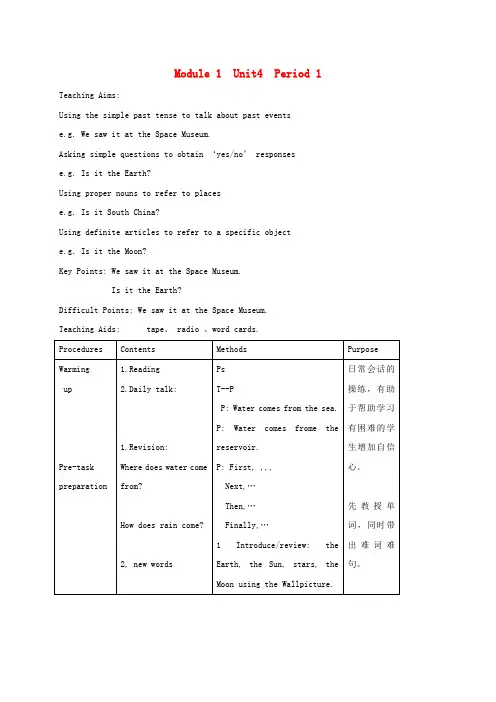
Methods
Purpose
Warming
up
Pre-task preparation
1.Reading
2.Daily talk:
1.Revision:
Where does water come from?
How does rain come?
2, new words
Ps
T--P
P: Water comes from the sea.
5 Play the recording again. Students listen and repeat.
6 Get the students to practise reading the dialogue in pairs.
7 Ask the students to then practise the questions and answers in Point, ask and answer, and Think and Answer.
Key Points: We saw it at the Space Museum.
Is it the Earth?
Difficult Points: We saw it at the Space Museum.
Teaching Aids:tape、 radio 、word cards.
Procedures
e.g. Is it the Earth?
Using proper nouns to refer to places
e.g. Is it South China?
Using definite articles to refer to a specific object
2019-2020年六年级英语下册 6B Module2 Unit1(2)教案 沪教牛津版
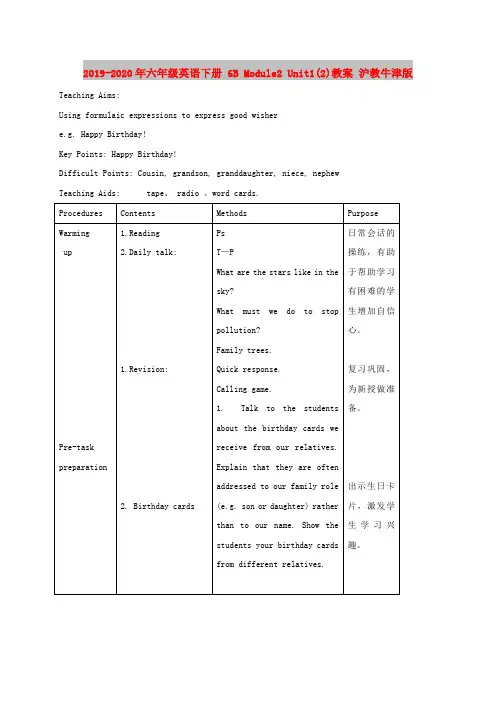
3.In pairs, the students take turns to plete Eddie’s birthday cards. They should insert Eddie’s family roles. Invite different pairs to report back to rest of the class.
Warming
up
Pre-task preparation
1.Reading
2.Daily talk:
1.Revision:
2. family roles
Ps
T—P
What is the relationship between your father and mother?
What is the relationship between your grandmother and your sister?
sister, cousin, niece.
2 In pairs, the students plete the table in Think and tick. Invite different pairs to report back to the rest of the class.
日常会话的操练,有助于帮助学习有困难的学生增加自信心。
Difficult Points: Cousin, grandson, granddaughter, niece, nephew
Teaching Aids:tape、radio、word cards.
六年级下册英语课件-Module 2 Unit 6 Lessons∣沪教牛津版(三起)(共30张)
Brain storming
上海教育出版社 六年级 | 下册
上海教育出版社 六年级 | 下册
Ask and answer
For swimming lesson, what do you need? For swimming lesson, what should you do?
上海教育出版社 六年级 | 下册
上海教育出版社 六年级 | 下册
We do the long jump and the high jump. Jill is good at the high jump. Joe is good at the long jump.
上海教育出版社 六年级 | 下册
Sometimes we play ball games. I like playing football, volley and basketball. My friends and I like playing sport. We have a lot of fun together!
We have two PE lessons at school every week. My friends and I like PE lessons very much. We run long races and short races. The races are exciting. We all want to win.
Look and learn
上海教育出版社 六年级 | 下册
high jump
上海教育出版社 六年级 | 下册
long jump
上海教育出版社 六年级 | 下册
long race
上海教育出版社 六年级 | 下册
short race
2019-2020年六年级英语下册 6B Module1 Unit1(2)教案 沪教牛津版
1.Introcuce/review:
Cave, heat, light, berries, fire
Using the wallpicture, read and elaborate on the story to the students while pointing to the pictures in each frame.
Good morning.
How are you?
How many people are there in your family? Who are they?
Do you like raw meat?
How does it taste?
What do you like to eat?
Students plete Answer True/false individually. Invite students to read aloud the true statements. Encourage the more able students to correct the false statements and read them aloud.
Procedures
Contents
Methods
Purpose
Warming
up
Pre-task preparation
While-task procedure
Post-task activity
Assignment
1.Sing songs
2.Daily talk:
1. New words: cave, heat, light, berries, fire
2019-2020年六年级英语下册 6B Module4 Unit1(3)教案 沪教牛津版
Asking ‘How’ questions to find out prices
e.g. How much were they/was it?
Key Points: Where did you buy them/it?
1.Revision:
2. Look and say
What would you like for dinner tonight?
What kind of vegetable dish would you like?
1. Where do you usually go to do your shopping?
Read Menu in English
The dishes you know.
3.Review the vocabulary items on page 63 of the Student’s Book.
4.Use picture cards to help students to refresh their memory if necessary. Make sure they know the correct pronunciation of the vocabulary items.
3 Invite some more able pairs to role-play a customer and a waiter in a restaurant setting.
Waiter: What would you like for dinner tonight?/What kind of vegetable dish would you like//What kind of meat dish or seafood dish would you like?/What kind of soup/dessert would you like?
沪教牛津版六年级英语下(Unit3 基础知识梳理)
精锐教育学科教师辅导讲义人们总是要一起吃顿团圆饭来纪念中秋节。
【知识拓展】celebration n.庆祝会,典礼e. g. birthday celebrations生日庆祝会a day of celebration庆祝日5. born v. 出生;出世e. g. She was born in 1980.她生于1980年。
The Trades Union movement was born in the early years of the century. 工会运动创始于本世纪初。
【知识拓展】be born, give birth to的区别(1) be born意为“出生”,但其主语通常只能是表示被生下的人或动物。
e. g. She was born in 1968.她生于1968年。
She was born in a very musical family.她生在音乐之家。
(2)give birth to意为“生产,生下”。
其宾语通常是表示幼畜或婴儿的词,其主语只能是表示雌性的词。
e. g. She gave birth to five children.她生了五个小孩。
6. ago adv.以前e. g. -Have you been to Beijing before? 你去过北京吗?-Yes, I went there six years ago. 去过,六年前去的。
7. country n.(1)(复数countries)国家e. g. China and Japan are Asian countries.中国和日本是亚洲国家。
【百科小贴士】世界七大洲中,除南极洲外,都有国家分布,各大洲的国家分布是不均衡的,非洲的国家最多。
面积最大的国家是俄罗斯,面积最小的国家是梵蒂冈,总面积只有0.44平方公里。
(2)乡下,农村e. g. -Where did you go yesterday, Mary? 玛丽,你昨天去哪儿了?-We went for a picnic in the country. 我们去乡下野餐了。