
译林英语六年级下册 Unit2 Good habits单元教案
译林英语6B Unit2 Good habits单元教案 第一课时 教学内容: story time 教学目标: 1. 能正确理解、朗读课文并可以根据提示复述课文内容。 2. 能听懂、会读、会说单词: tidy, messy, habits, in order, finish always sleepy bedtime. 3. 能尝试根据所学短语和句型来描述自己的习惯。 4. 能初步根据提示写出好的习惯。 5. 能分清好坏习惯,并知道以好的习惯来要求自己,让自己拥有更多好的习惯。 教学重点: 1. 能正确理解、朗读课文并可以根据提示复述课文内容。 2. 能听懂、会读、会说单词: tidy, messy, habits, in order, finish always sleepy bedtime. 3. 能尝试根据所学短语和句型来描述自己的习惯。 教学难点: 1. 能尝试根据所学短语和句型来描述自己的习惯。 2. 能初步根据提示写出好的习惯。 3. 能分清好坏习惯,并知道以好的习惯来要求自己,让自己拥有更多好的习惯。 教学准备: 挂图,头饰,多媒体(PPT) 教学过程: Step1 Warm up 1. Let’s look what do we learn today. Show the learning aims. 2. I am your new English teacher. My name is Fanny. I am thirty. Do you want to know me well? 3. Listen to my chant carefully.(初步感知新的短语词汇。) Chant: I’m Fanny,I am thirty. I get up early, never go to bed late. I keep my room clean and tidy. I often put my things in order. I finish my work before nine o’ clock. Step2 Presentation 1. T: You know in my chant , I say, I get up early ,never go to bed late. Think about :never go to bed late, means A or B?(show the pictures) Read the new word并板书。 T: Do you get up early and go to bed early? I think we should go to bed early. T: And I often put my things in order. I want to know do you often put your things in order? S: Yes, I do./No, I don’t. T: Good .Because I often put my things in order, so I can keep my room clean and tidy. Teach: clean and tidy.= not messy. T: In my chant, do you remember when do I finish my work? S: You finish your work before nine o’clock. (Show the sentence) Teach the new phrase. T: When do you always finish your homework? S: I finish my homework at… 2. Look at the four sentences. What are they about? They are about my habits. So today we’ll learn a new lesson good habits.(揭示并带读课题) 出示图片录音引导学生问答。 3. T: You know a lot about my habits. Look, here comes Liu Tao and Wang Bing. What habits do they have? (请学生讨论) T: First let’s read the choices together. S:…… T: Now, let’s listen to the tape and try to find the answer. Listen and answer: What habits do they have? Let’s discuss in groups. Then you can write the answer in the balloons. Who can answer? S: Liu Tao does his homework late at night…… 4.T: You did a very job. But I think there are more habits in the story. Please read the test again and try to find them out. S: Wang Bing brushes his teeth in the morning and before bedtime. T: Here bedtime means brushes teeth… S: He brushes teeth before he goes to bed. S: Liu Tao listens to his teachers and keeps his room clean and tidy 5. T: Good. They have a lot of habits here. But what are the good habits? And what are the bad habits? S: Talk about in groups. Then say the answer. T: We know Liu Tao often does his homework late at night and goes to bed late, so he often feels… in the morning. S: So he often feels sleepy in the morning. Step3 Reading time. T: Let’s read the test please. Look at the signs here.(注意读音的降调符号,提示学生在肯定句和感叹句要用降调来读) Listen to the tape ,read it one by one. Read it together. Step4 Retell the story. 1. T: Time to retell the story. First, let’s retell it together. T: You can choose one student to describe. Maybe you can say it one by one, or you can say it together. Please pay attention to the pronunciation and intonation. Ask some groups to retell it. Step5 Consolidation a. Think and talk T: Hello, class. We know Liu Tao has three good habits, and two bad habits. He wants to do better. Can you help him to change the bad habits? T: Now let’s talk about some good habits. What good habits do you know? Let’s discuss in groups. S: I know… is a good habit.(小组讨论然后介绍你知道的好的习惯) b. Try to write. T: You say a lot of things about good habits. Now let’s make a video to let all of us have more good habits. First, let’s open your envelope. Then, write the good habits on the card. At last, share your cards in class. Enjoy the video. Homework: 1. Review story time and retell the story. 2 .Make a poster(海报)of the good habits. 七、Blackboard design板书设计: Unit 2 Good habits Wang Bing: Liu Tao: get up early, never… listen to the teachers… brush teeth… keep the room … put things in order do homework late… finish the homework… feel sleepy…
第二课时 教学内容:Grammer time & Fun time) 教学目标: 1.能够在句子中正确应用程度副词修饰动词。 2.能够应用本课所学的句型“Do you ...”/”Yes, I do./No, I don’t.”进行问答。 3.培养学生养成良好的学习习惯和生活习惯。 教学重难点: 1.能够在句子中正确应用程度副词修饰动词。 2.能够应用本课所学的句型“Do you ...”/”Yes, I do./No, I don’t.”进行问答。 教学准备: 纸盒,单词字条、展板、调查表 教学流程: Step 1 Free talk T:Hey ,I am your new teacher today, my name is Tracy. T:Hello,what’s your name? S:... T:Do you get up early in the morning? S:... T:That’s a good/bad habit! T:I have some habits too,can you ask me?(出示动作图片) S:Do you have your meals in the morning? T:Yes, I do. I always .... S:Do you read books? T:Yes, I do. I usually.... S:Do you clean the room T:yea, i do. I sometimes .... T: I have some good habits but I have bad habits too. Look at my panda eyes, i always go to bed late at night, it is a bad habit, you should go to bed early. Step 2 Presentation
新译林六年级下册第二单元Good habits教案
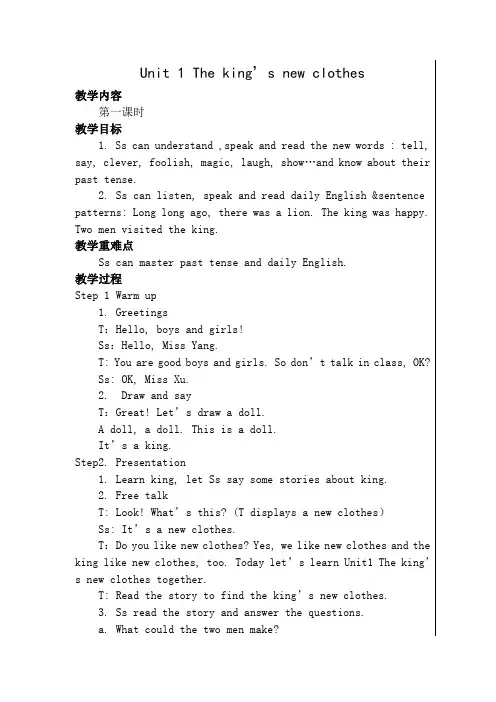
Unit 1 The king’s new clothes教学内容第一课时教学目标1. Ss can understand ,speak and read the new words : tell, say, clever, foolish, magic, laugh, show…and know about their past tense.2. Ss can listen, speak and read daily English &sentence patterns: Long long ago, there was a lion. The king was happy. Two men visited the king.教学重难点Ss can master past tense and daily English.教学过程Step 1 Warm up1. GreetingsT:Hello, boys and girls!Ss:Hello, Miss Yang.T: You are good boys and girls. So don’t talk in class, OK?Ss: OK, Miss Xu.2. Draw and sayT:Great! Let’s draw a doll.A doll, a doll. This is a doll.It’s a king.Step2. Presentation1. Learn king, let Ss say some stories about king.2. Free talkT: Look! What’s this? (T displays a new clothes)Ss: It’s a new clothes.T:Do you like new clothes? Yes, we like new clothes and the king like new clothes, too. Today let’s learn Unit1 The king’s new clothes together.T: Read the story to find the king’s new clothes.3. Ss read the story and answer the questions.a. What could the two men make?b. Who can see the clothes (according to the men)?c. What did the people shout to the king?d. What did the boy say?4. Ask Ss to answer the questions.5.Watch cartoon6.Watch again and write T or Fa. The king liked new clothes. ( )b. The two men showed the king some magic clothes. ( )c. The king was foolish. ( )d. People could see the king’s new clothes. ( )e. The boy was foolish because he could not see the king’s new clothes. ( )8. Watch again and fill in the blanks.a. The king likedb. Two men wanted to make new clothes for the king. The king was .c. The men showed the king his new clothes, but the king could not them.d. The king walked through the city in his new clothes. A laughed at him.9. Read follow the tape and imitate the pronunciation. Step 3 Consolidation1. Read freely.2. Act it out.Step 4 Summary1. Can you speak the sentence pattern in this lesson?2. Do some exercises.Homework:1.Copy the new words four times each.2.Retell the story板书设计:Unit 1 The king’s new clothes1.Who liked new clothes?2.What could the two men make?3.Who can see the clothes (according to the men)?4.What did the people shout to the king?5.What did the boy say?教学反思Unit 1 The king’s new clothes教学内容第二课时教学目标1. Ss can understand ,speak and read sentences:2. Ss can understand, speak and read daily English: Long long ago, there was a lion. The king was happy. Two men visited the king.教学重难点Ss can read and write four-skilled sentences教学过程Step1 Free talk1. What day is it today?2. What day was it yesterday?3. What was on the desk yesterday?4. Were you at home yesterday evening?Step 2 Consolidation1. Teach: clever foolishT: Yesterday , I read a story The king’s new clothes. I think you read it too. Right?The king was _______. (clever; foolish)2. Read the story quickly and write1) The king liked ______________.2) Two men wanted to make new clothes for the king. The king was ___.3) The men showed the king his new clothes, but the king couldnot_________them.4) The king walked through the city in his new clothes. A ______laughed at him.Step2 Grammar timepast tense:1.Words:laugh→laughed point→pointed like→liked shout→shoutedlook→looked walk→walked am, is→was are→were2.Sentence:Long long ago, there was a lion.The king was happy.The king liked new clothes.3.Summary the rules of past tense.Step3.Exercise &Homework.1.Review past tense.2.Retell the story.Homework:1.Make and write four dialogues about C in copybooks;2. Listen to the tape about A three times.板书设计:Unit 1 The king’s new clotheslaugh→laughed point→pointed shout→shoutedlike→liked live→lived dance→dancedam, is→was are→were tell→toldLong long ago, there was a lion.One day, two men visited the king.教学反思Unit 1 The king’s new clothes教学内容第三课时教学目标1. Ss can talk about the story , then act it out.2. Ss can understand the past tense , then do the exercise.教学重难点Ss can use the past tense to talk about the story with their partners.教学过程Step 1 Review and check1.W rite the words ’past tense.laugh→ point→ like→ shout→look→ walk→ am, is→ are→2. Retell the text with several sentences.4. Ask some questions about the story.Step 2 Fun time1.Talk about the pictures on P5.Picture 1: The king says:Picture 2 & 3: Man1:Man2: King:Picture 4: People:Boy:2. Ss try to describe the pictures.3. Ss tell the story by themselves.4.Can you say sth about the people in the story?Step 3 Checkout time1. Look at the pictures carefully and try to choose the right words .2. Ask some Ss to check the answers.3. Ask some Ss to read the story.4. Ss try to tell the story in pairs.5. Learn some words and phrases: child, turn into, shout…Step4 Summary1. What did you learn this lesson?2. Can you tell other stories in English or do you know any other stories written by Andersen?Step5 Homework1. Review the contents of this class.2. Learn other English stories.Homework:Act this story out.板书设计:Unit 1 The king’s new clothesKing: beautiful clothes, foolish, fat, rich…Men: thin and tall, short and fat, magic clothes, cheats…Boy: clever, honest, good, cute教学反思Unit 1 The king’s new clothes教学内容第四课时教学目标1. Ss can understand ,speak and read sentences:2. Ss can understand, speak and read daily English.3. Ss can understand and use the past sense.3. Ss can understand and speak the pronunciation of “ar”教学重难点Ss can read and write four-skilled sentences教学过程1.Free talk:Daily report.2. Review:a. Act out Cartoon time.b. Finish some exercise about past tense3. Checkout timea. Read and writea) Read the words.b) Finish the story.c) Read and learn the new words.d) Fun reading.b. Circle and saya) Circle the correct words.b) Prepare your own story.c) Tell your story in groups.d) Choose the best story teller of the group and let him/her tell the story in class.4. Ticking timeUnit 1 The king’s new clothesLong long ago, there was/were…Unit 1 The king’s new clothes Long long ag o, there was/were…Homework: Finish the exercise book.板书设计:Unit 1 The king’s new clothesLong long ago, there was/were…教学反思Unit 2 What a day!教学内容第一课时教学目标1. Students can read, understand the diary.2. Students get to know some new words in the story: cloudy, windy, rainy, sunny, went, became, flew, brought, could, wet.3. Students try to make a dialogue according to the diary.4. Students can know the time sequence and the weather change in the diary. 教学重难点Know the irregular past tense verbs.Make a dialogue by the diary.教学过程Step1 Warming-up1.What day is it today? What date is it? How’s the weather today? What did you do yesterday? Did you...?Ss ask me the same questions:I went to the supermarket with my daughter. Learn:wentStep2 Presentation1.Where did Su Hai and her friends go? Let’s listen to the tape. (They went to the park.)2.What did they do in the park? Let’s listen to the tape again.(They saw some interesting parrots and flew kites. ppt教saw,parrot,flew)3.listen to the tape the third time.What else happened in the park?4.Read the text and fill in the table.5.Order the sentences:a They saw some interesting parrots in the park.g It rained.b They were hungry and wet.c The children went to the park by bike.f The weather became windy and cloudy.d They flew kites in the park.e They saw ants and bees on their lunch.6.Show the key words picture by picture,Ssrecite the diary:Picture1:sunny, wentPicture2:parrot, sawPicture3:weather, became, windy, cloudy, flew, skyPicture4:brought, dumpling, honeyPicture5:saw, couldPicture6:clouds, rained, wet7.Choose1. What date was it?A. SundayB. 20th September date2. Was it sunny all the day?A. Yes, it was.B. No, it wasn’t. sunny3. What did they see in the park?A. Some parrots.B. Some butterflies. parrot4. What did they bring for lunch? bringA. Some dumplings.B. Some rice. dumpling5. Did they have lunch in the park?A. Yes, they did. No, they didn’t.Step3 Consolidation1.True or Fause(书上P18)It rained all day on 20th September. ______ rainedThe children saw a parrot show. ______They flew kites in the park. ______ flewThey brought lunch to the park. ______ broughtThey were hungry because they did not have lunch. ______2.Play a game:Brain stormgo-went, see-saw, become-became,fly-flew, bring-brought, can-couldlose-lost say-said speak-spoke read read put-put take-tookfind-foundHomework:1. Read the diary fluently to your familyor your friends.2. Look at the pictures and try to retellthe diary.板书设计:Unit 2 What a day!教学反思:Unit 2 What a day!教学内容第二课时教学目标1. To understand the irregular past tense verbs.2. To know the past tense.3. To use the past tense to play the game.4. To use the past tense to know what the others did by doing the survey. 教学重难点Past tense and irregular verbs.Use the past tense to play the game and do the survey.教学过程Step 1 Warming-upWhat’s the weather like today?Is it windy/cloudy/sunny today?Did you read Yang Ling’s diary yesterday evening?What did you do yesterday evening?Step 2 Revision1. What was the weather like yesterday?It was ...2.Play a game: magiceyes(cloudy,rainy,windy,sunny,bring,came,brought)3. Read Yang Ling’s diary and answer:How did the weather change?First, it was________.Then, it was ____________________.In the afternoon, it was__________.2. Retell the diaryLook at the pictures and try to retell the diary.Step 3 Grammar time1. This is a diary. Diary 应该用什么时态呢?一般过去式:过去发生的事情。
六年级下册英语教案-Unit 2 Good habits 课时5 译林三起
六年级下册英语教案-Unit 2 Good habits 课时5 译林三起教学目标知识与技能1. 让学生能够理解并运用有关好习惯的词汇和句型。
2. 培养学生通过阅读寻找关键信息的能力。
过程与方法1. 通过小组合作和情景模拟,提高学生的英语口语表达能力。
2. 通过对好习惯的讨论,引导学生形成正确的生活态度和行为习惯。
情感态度价值观1. 培养学生养成良好习惯的意识。
2. 增强学生的合作意识和团队精神。
教学内容重点词汇- habit- early- late- lazy- energetic重点句型- "I have a habit of..."- "It's good/bad to..."- "Early to bed and early to rise makes a man healthy, wealthy and wise."教学重点与难点重点1. 学生能够正确使用重点词汇和句型表达个人习惯。
2. 学生能够通过阅读理解文章大意,并找出关键信息。
难点1. 正确运用好习惯和坏习惯的相关词汇。
2. 引导学生理解并运用习惯对个人生活的影响。
教具与学具准备1. 多媒体教学设备2. PPT课件3. 教学卡片4. 学生手册教学过程导入1. 利用PPT展示不同习惯的图片,引导学生讨论好习惯和坏习惯。
2. 提问学生:"Do you have any good habits? What are they?"新课内容1. 学习并练习重点词汇和句型。
2. 通过情景模拟,让学生运用所学表达个人习惯。
阅读理解1. 分发阅读材料,指导学生阅读并找出关键信息。
2. 讨论文章中的好习惯和坏习惯,引导学生思考习惯对个人生活的影响。
小组活动1. 学生分组,每组选择一个好习惯或坏习惯进行讨论。
2. 每组准备一份报告,介绍他们讨论的习惯及其影响。
总结与反思1. 学生分享他们的报告,其他学生进行评价。
六年级英语下册Unit2《Goodhabits》单元教学设计(新版)牛津译林版〔精品篇〕
六年级英语下册Unit2《Goodhabits》单元教学设计(新版)⽜津译林版〔精品篇〕Unit2 Good habits单元⽬标:1.能听懂、会说、会读课⽂Good habits2.能听懂、会说、会读常⽤语及句型He/She gets up / goes to school inthe morning. He/She never goes to bed late.3.能听懂、会说、会读、会写词汇put…in order, bad ,sleepy, last night,go into, slowly, badly4.能听懂、会说、会读词汇child, habit, never, late, finish, tidy, fast5.能听懂、会唱歌曲This is the way6.能听懂会说且准确发⾳字母or在单词中的读⾳单元重点:1.能听懂、会说、会读常⽤语及句型He/She gets up / goes to school in themorning. He/She never goes to bed late.2.能听懂、会说、会读、会写词汇put…in order, bad ,sleepy, last night,go into, slowly, badly3.能听懂、会说、会读词汇child, habit, never, late, finish, tidy, fast4.能听懂、会唱歌曲This is the way5.能听懂会说且准确发⾳字母or在单词中的读⾳单元难点:1.能听懂、会说、会读常⽤语及句型He/She gets up / goes to school in themorning. He/She never goes to bed late.2.能听懂、会说、会读、会写词汇put…in order, bad ,sleepy, last night,go into, slowly, badly3.能听懂、会说、会读词汇child, habit, never, late, finish, tidy, fast 学法指导:课时安排:五课时第⼀课时:Story time第⼆课时:Grammar time and Fun time第三课时:Sound time and Cartoon time第四课时:Culture time , Checkout time and Ticking time第五课时:Review and do some exercisesThe first period Date:教学内容:Story time教学⽬标:1. 能正确理解、朗读课⽂并可以根据提⽰复述课⽂内容。
译林版六下教案Unit 2 Good habits Period 2
Unit 2 Good habits Period 2(Grammar time Fun time& Song time)【课堂活动】Step 1 Greeting and RevisionT:Yesterday we learned Story time and we know liu Tao and wang Bing have a lot of habits.First,let's review Story time. You can look at pictures and try to retell. Please work in two,each student chooses one to retell左边:Wang Bing is a good boy.He has many...He gets up …and never …He …and ...At home, Wang Bing always ... He usually ...右边:Liu Tao is a good boy too. He listens ...He also does... He ...He also ...But Liu Tao has ...He often ... He sometimes ...Step 2 Presentation1 Brain stormT: Wang Bing and liu Tao,they have a lot of habits,some are good habits, same are bad habits. Today we are going to talk about more good habits.课件呈现一张思维导图,分为左右两边,下方画上不同色块格子,主题分别是living habits,learning habits 色块可以分粉色,代表good habits 蓝色代表bad habits.T: When we are at home,we should have some good living habits, for example:I get up early.(课件上呈现词组)and when we are at school we should have some good learning habits,for example,I listen to the teachers.Now work in four, choose one part to discuss. The more, the better.学生分组汇报。
六年级下册英语优质教案-Unit2 Good habits Sound time |译林版(三起)

Unit 2 Good habits (Period 3)Teaching contents教学内容:sound time & cartoon timeTeaching aims and learning objectives教学目标:1. 能理解并体会字母组合or在单词中的发音,并适当扩展不同的发音。
2. 能理解Cartoon time的内容并动手实践3. 能意识到good habits的重要性并付诸于实际生活Focus of the lesson and predicted area of difficulty教学重难点:1. 能理解并体会字母组合or在单词中的发音,并适当扩展不同的发音。
2. 能意识到good habits的重要性并付诸于实际生活3. 能锻炼运用英语及与他人合作的能力Preparation教学准备:Text paper, exercise paper, PPT, flowers and applesTeaching procedures教学过程:Step 1 Preparation1 Greeting and make a self-introductionShow a picture of me and let Ss ask me questions about my English name, hobby, best friend, and favourite colour.2 Tina’s e-mailMy best friend Tina invited me and other friends to her house.We should bring some presents. Encourage the Ss to get my apples and flowers for Tina.Step 2 Presentation1. Sound timeChallenge1: Reading.Rule: You can get my flowers by reading the words correctly and well.Let’s enjoy a rhyme about my favourite animal —horses.Let’s read some words in the rhyme and think the pronunciation of “or”.Make a conclusion: or /ɔ:/Let’s read the rhyme and words in four. ( Flowers)Challenge2: Picking apples.Rule: You can get my apples by knowing the different pronunciations of “or”.Find and discuss in 4. 摘下or 字母组合发/ɔ:/的苹果。
译林英语六下教案Unit 2 Good habits 第一课时

译林英语六下教案Unit 2 Good habits 第一课时Unit 2 Good habits 第一课时本课时的主题是好习惯,通过学习此课时,学生将会了解什么是好习惯,了解如何建立和养成好习惯。
本节课主要围绕阅读、讨论和写作展开。
教学目标:1. 了解什么是好习惯,如何建立和养成好习惯。
2. 通过阅读文章和讨论,锻炼学生的英语阅读和口语表达能力。
3. 提高学生的书面表达能力,通过写一篇短文来表达自己对好习惯的理解。
教学重点:1. 了解什么是好习惯,如何建立和养成好习惯。
2. 通过阅读文章和讨论,锻炼学生的英语阅读和口语表达能力。
3. 提高学生的书面表达能力,通过写一篇短文来表达自己对好习惯的理解。
教学难点:1. 如何描述和举例说明好习惯的重要性。
2. 如何让学生掌握合理的养成好习惯的方法。
教学准备:1. 教师准备PPT或者黑板,能够展现教学重点和难点。
2. 学生准备笔记和听讲纸。
3. 学生和教师准备口语和书面表达相关的词汇。
Step 1:引入主题1. 教师引导学生回想在家中或学校里,一天中能见到的明显的好习惯。
2. 教师向学生引入好习惯的概念,告诉学生好习惯的重要性。
3. 通过引入,让学生对好习惯有了初步的了解和认识。
Step 2:阅读和讨论文章1. 教师发放阅读材料,让学生阅读一篇关于好习惯的文章,帮助学生更好地理解和认识好习惯。
2. 查看学生理解和记忆文章的程度,询问问题,让学生表达自己的观点和想法。
3. 让学生以小组为单位,商讨如何养成好习惯以及如何改掉坏习惯,通过讨论,让学生掌握养成好习惯的方法和技巧。
Step 3:写作训练1. 教师安排书面表达训练,让学生写一篇关于好习惯的文章。
2. 教师提供好习惯的题目,引导学生围绕主题展开文章的写作。
3. 让学生互相交换文章,帮助祥或者改进,提高写作水平。
Step 4:总结和反馈1. 教师让学生回顾本课阶段,总结好习惯的重要性和如何养成好习惯的方法。
Unit 2 Good habits 说课稿-六年级英语下册同步备课 译林版(三起)
Unit 2 Good Habits 说课稿一、教学内容:《英语六年级下册》第二单元 Good Habits。
二、教学目标:1.了解正确的生活习惯;2.掌握运用句型“I usually/always/sometimes…” 描述自己的日常生活习惯;3.听懂并能用英语表述生活习惯。
三、教学重点难点1.教学重点:学生能够用简单的英语语言描述自己的日常生活习惯。
2.教学难点:学生能够听懂并学会用英语表达生活习惯。
四、教学准备:充电器、扩音器、教材及PPT稿件。
五、教学过程:1. Warming up先借鉴学生对于自然环境和健康食品的认识引入活动,使得讨论活动空前热烈。
然后逐一展现本次教学活动的主题:良好的生活习惯。
通过学生的讨论,让他们了解什么是良好的生活习惯,如何形成良好的生活习惯。
2. Learning words这部分主要针对单元中的词汇及短语,如brush teeth, wash face, get dressed 等。
通过幻灯片呈现的方式展现生活中的日常习惯,结合相关图片和真实案例,让学生能够更好地理解和记忆单词和短语。
可以让学生自己在课堂上创造场景,模拟日常生活中的个别情况,以加深记忆。
3. Listening and speaking通过听力和口语训练来加强学生对于英语听说的理解能力,让学生在听到有关日常生活习惯的话题时,能够更好地理解所听到的内容。
在此基础上,利用基础小问答的方式,让学生能够在课堂上用英语自如地描述自己的日常生活习惯。
4. Reading and writing利用单元中的阅读内容和写作任务,让学生能够更好地运用自己所学的英语知识,亲身体验英语阅读的乐趣。
5. Homework指定作业,要求学生在晚间自己亲自写下英语日记,写下自己的日常生活习惯,以巩固课堂所学知识。
六、教学评估1.课堂表现;2.书面作业成果。
七、教学机构基于学生的英语水平和程度,本单元的教学需要注重理论和实践相结合的机构。
Unit2Goodhabits第三课时(教案)译林版(三起)英语六年级下册
Step3 Consolidation〔用时:10分钟〕
1.Sound time
or for por bor sor sorn hor hort short shorts
horse horses short
2.Sound time
板书设计
2. Make a new story with your parents/friends.
教学反思
come to do来做某事
show ab. Around…带某人参观
let sb.do让某人做某事
go into走进,进入
whose+单数+ is…?
Whose+复数+ are…?
Can not=can’t
put… in order
5. Imitate reading.
强调语音语调
6. Fill the blanks.
3.能理解Cartoon time的内容并动手实践。
4.能意识到good habits的重要性并付诸于实际生活。.
教学板块
课中探学
教师活动
作业评价
Step1Warming up〔用时:5分钟〕
1. Song time: This is the way
2. Let’s talk:
They are Tina and her friends.
Unit 2 Good habits(3)
or /ɔː//ɜː/
Room
How is it?
living room
big and clean
Tina’s bedroom
small but nice
Unit 2 Good habits(单元解读)六年级英语下册(译林版三起)
六年级下册Unit 2 Good habits单元解读一、单元内容体现的新课标理念本单元在英语核心素养的育人价值下进行,围绕单元主题“人与习惯”展开教学。
本单元学习的主题主要是学习如何用一般现在时和频率副词表述一个人的好习惯和坏习惯等。
二、单元信息单元分为Story time、Grammar time、Fun time、Sound time、Song time、Cartoon time、Checkout time、Ticking time八部分组成。
主要学习关于习惯的一些表达。
在教学上,对本单元内容进行整合以及重组,分为四个课时进行教授。
1.Story time,这一部分是一篇文章,主要介绍了Wang Bing和Liu Tao的一些习惯。
文章首先介绍了Wang Bing有许多好习惯,比如早起等。
接着介绍了Liu Tao也是一名好学生,但是他也有许多坏习惯。
本节课当做一节阅读课进行授课,通过提问题来学习本篇文章,有目的的进行阅读,提升学生的阅读技能,以及学习如何表述习惯。
2.Grammar time&Fun time, 这两个部分作为一课时按照语法课进行教授,主要用副词如何形容一个人的习惯,以及频率副词放在一般现在时中如何使用。
并且进行练习巩固。
3.Song&Cartoon time,这两个部分作为一课时按照对话课进行教授。
Song time主要是时一首歌曲,在欣赏歌曲的同时,让学生们学唱,提高学生的兴趣,并且活跃课堂氛围。
Cartoon time是一篇对话,主要讲述了Tina的朋友们去她家拜访,对比了Tina和Bobby的卧室,一个很干净整洁,一个却很杂乱,形成了鲜明的对比。
本课时也是按照阅读课进行授课。
4.Sound time, Checkout time&Ticking time这三个部分作为一课时按照语音和复习课进行教授。
Sound time主要教授or组合在单词中的发音规则。
译林版六年级下册英语Unit 2 Good habits教案
Unit 2 Good habitsThe 1st period 一、教学内容Unit 2 Good habits Story time二、教学目标1. 能正确理解、朗读课文并可以根据提示复述课文内容。
2. 能听懂、会读、会说单词: tidy, messy, habits, in order, finish always sleepy bedtime.3. 能尝试根据所学短语和句型来描述自己的习惯。
4. 能初步根据提示写出好的习惯。
5. 能分清好坏习惯,并知道以好的习惯来要求自己,让自己拥有更多好的习惯。
三、教学重点1. 能正确理解、朗读课文并可以根据提示复述课文内容。
2. 能听懂、会读、会说单词: tidy, messy, habits, in order, finish always sleepy bedtime.3. 能尝试根据所学短语和句型来描述自己的习惯。
四、教学难点1. 能正确理解、朗读课文并可以根据提示复述课文内容。
2.能尝试根据所学短语和句型来描述自己的习惯。
五、教学准备:头饰,板书制作,PPT六、教学过程Step1 Warming-upT: L et’s look what do we learn today. S how the learning aims.T: Do you want to know me well?Listen to my chant carefully. (初步感知新的短语词汇。
)Step2 Presentation1. T: You know in my chant, I say, I get up early, never go to bed late. Think about: never go to bed late, means A or B? (show the pictures)Read the new word并板书。
T: Do you get up early and go to bed early? I think we should go to bed early. T: And I often put my things in order. I want to know do you often put your things in order.S: Yes, I do. /No, I don’t.T: Good .Because I often put my things in order, so I can keep my room clean and tidy.Teach: clean and tidy = not messy.2. Look at the four sentences. What are they about? They are about my habits. So today we’ll learn a new lesson, good habits. (揭示并带读课题)出示图片录音引导学生问答。