
专八翻译真题(2002-2012)
2012八级翻译真题1.泊珍到偏远小镇的育幼院把生在那里养到1岁的孩子接回来。
但泊珍看他第一眼,仿似一声雷劈头而来。
令她晕头胀脑,这l岁的孩子脸型长得如此熟悉,她心里的第一道声音是,不能带回去!痛苦纠聚心中,眉心发烫发热,胸口郁闷难展,胃里一股气冲喉而上。
院长说这孩子发育迟缓时,她更是心头无绪。
她在孩子所待的房里来回踱步,这房里还有其他小孩。
整个房间只有一扇窗,窗外树影婆娑。
就让孩子留下来吧,这里有善心的神父和修女,这里将来会扩充为有医疗作用的看护中心,这是留住孩子最好的地方。
这孩子是她的秘密,她将秘密留在这树林掩映的建筑里。
她将秘密留在心头。
参考答案:With pains gathering in her heart, she felt something burning hot between her eyebrows. Her chest was brimmed with depression and sorrow which was about to run out of her throat in any moment. She could not think straight when the headmaster told her that the child suffered from developmental retardation. She strode up and down in the room where other children were staying. There was only one window in the room, out of which some shady trees were dancing. ―Just leave it here‖, she t hought to herself, ―This might be the best choice. There are kind-hearted priests and nuns and the place will be renovated into a Medicare C enter‖. The child would be her secret kept in the buildings behind the woods. 2.英译中In some cases, intelligent people implementing intelligent policies are responsible for producing a "boomerang effect"; they actually create more of whatever it is they seek to reduce in the first place.The boomerang effect has been achieved many times in recent years by men and women of goodwill. State legislatures around the nation have recently raised the drinking age back to 21 in an effort to reduce the prevalence of violent deaths among our young people. But such policies seem instead to have created the conditions for even more campus violence. Some college students who previously drank in bars and lounges under the watchful supervision of bouncers (夜总会,酒吧等保安人员) (not to mention owners ea~er to keep their liquor licenses) now retreat to the sanctuary of their fraternity houses and apartments, where they no longer control their behaviour - or their drinking.The boomerang effect has also played a role in attempts to reduce the availability of illicit drugs. During recent years, the federal government has been quite successful in reducing the supply of street drugs. As fields are burned and contraband (违禁品)confiscated, the price of street drugs has skyrocketed to a point where cheap altematives have begun to compete in the marketplace. Unfortunately, the cheap alternatives are even more harmful than the illicit drugs they replace.boomerang: a curved flat piece of wood that can be thrown so as to return to the thrower 回飞镖参考答案:相反的是,上述政策似乎引发了更多的校园暴力。
以前,一些大学生会在夜总会的酒吧饮酒,那是处于酒吧保安人员严密的监控之下(酒吧老板们这样做当然只是为了保住自己的营业执照)。
现在,大学生们会躲到兄弟会会所和公寓中酗酒, 他们根本不会控制自己的行为。
在打击非法毒品方面,政府采取的措施同样适得其反。
近年来,联邦政府卓有成效地抑制了街头毒品。
毒品种植地被烧毁,违禁品被没收,直接导致街头毒品价格暴涨,一些便宜的替代品开始进入市场。
不幸的是,便宜替代品带来的危害远比非法毒品更大。
2011年专八真题1.现代社会无论价值观的持有还是生活方式的选择都充满了矛盾。
而最让现代人感到尴尬的是,面对重重矛盾,许多时候你别无选择。
匆忙与休闲是截然不同的两种生活方式。
但在现实生活中,人们却在这两种生活方式间频繁穿梭,有时也说不清自己到底是“休闲着”还是“忙碌着”。
譬如说,当我们正在旅游胜地享受假期,却忽然接到老板的电话,告诉我们客户或工作方面出了麻烦——现代便捷先进工具在此刻显示出了它狰狞、阴郁的面容——搞得人一下子兴趣全无。
接下来的休闲只能徒有其表,因为心里已是火烧火燎了。
Being hasty and at leisure are two quite distinct lifestyles. But in the real world, people have to frequently shuttle between these two lifestyles, sometimes not sure whether they are ―at ease‖ or ―in a rush‖.For example, we are enjoying our holidays in the resort while su ddenly we receive phone calls from the boss who tells us there are some troubles with our customers and work--so at this moment the modern, convenient and advanced device shows its vicious and gloomy features--and we lose all our interest. The subsequent leisure is the mere showy for we are in a restless and anxious state of mind.2.英译中When flying over Nepal, it's easy to soar in your imagination and pretend you're tiny-a butterfly - and drifting above one of those three-dimensional topographical maps archite cts use, the circling contour lines replaced by the terraced rice paddies that surround each high ridge.Nepal is a small country, and from the windows of our plane floating eastward at 12,000 feet, one can see clearly the brilliant white mirage of the high Himalayas thirty miles of the left window. Out the right window, the view is of three or four high terraced ridges giving sudden way to the plains of India beyond.Three were few roads visible below, most transportation in Nepal being by foot along ancient trails that connect and bind the country together. There is also a network of dirt airstrips, which was fortunate for me, as I had no time for thetwo-and-a-half week trek to my destination. I was in a flight to the local airport.飞机飞越尼泊尔上空时,你很容易天马行空起来,假想自己很渺小----像只蝴蝶----在建筑师所使用的某个三维地形图上方漂浮着,在这里,地形图一圈圈的轮廓线变成了环绕高耸的山脊成阶梯状的稻田。
2012年专八英语翻译

飞机飞过尼泊尔上空时,你可以放飞自己的想象,把自 己想成一只渺小的蝴蝶,飞在建筑师绘的三维地形图上, 但图中不再是一圈圈的等高线,而是一层层环绕着山脊的 稻田。 尼泊尔是个小国。我们的飞机正在12,000英尺的高空 向东飞行。透过左侧舷窗,30英里外的地方,可以清晰地 看到洁白的喜马拉雅山上如梦幻般壮观的景色。 从右侧舷窗望去,三四座层叠的山脊倏忽之间从飞机 一侧掠过,把我们带到开阔的印度平原之上。 俯瞰地面,很少能看到马路。尼泊尔的主要交通体系 是由境内众多的步行古道构成的,这些古道将全国连成一 体。此外尼泊尔还有空中交通网络,虽然是简易的泥地机 场,但对我来说却是一件事,因为我没时间花上十天半个 月长途跋涉去我的目的地,我(以前)去当地的机场是坐 飞机去的。
• Nepal's a small country, and from the windows of our plane floating eastward at 12,000 feet, one can see clearly the brilliant white mirage of the high Himalayas thirty miles of the left window. Out the right window, the view is of three or four high terraced ridges giving sudden way to the plains of India beyond.
2011专八 英译汉
• When flying over Nepal, it's easy to soar in your imagination and pretend you're tiny-a butterfly - and drifting above one of those three-dimensional topographical maps architects use, the circling contour lines replaced by the terraced rice paddies that surround each high ridge.
英语专八翻译试题及答案

英语专业八级考试翻译部分历届试题及参考答案1995年英语专业八级考试--翻译部分参考译文C-E原文:简.奥斯丁的小说都是三五户人家居家度日,婚恋嫁娶的小事。
因此不少中国读者不理解她何以在西方享有那么高的声誉。
但一部小说开掘得深不深,艺术和思想是否有过人之处,的确不在题材大小。
有人把奥斯丁的作品比作越咀嚼越有味道的橄榄。
这不仅因为她的语言精彩,并曾对小说艺术的发展有创造性的贡献,也因为她的轻快活泼的叙述实际上并不那么浅白,那么透明。
史密斯夫人说过,女作家常常试图修正现存的价值秩序,改变人们对“重要”和“不重要”的看法。
也许奥斯丁的小说能教我们学会转换眼光和角度,明察到“小事”的叙述所涉及的那些不小的问题。
参考译文:However, subject matter is indeed not the decisive factor by which we judge a novel of its depth as well as (of ) its artistic appeal and ideological content (or: as to whether a novel digs deep or not or whether it excels in artistic appeal and ideological content). Some people compare Austen’s works to olives: the more you chew them, the more tasty (the tastier) they become. This comparison is based not only on (This is not only because of ) her expressive language and her creative contribution to the development of novel writing as an art, but also on (because of ) the fact that what hides behind her light and lively narrative is something implicit and opaque (not so explicit and transparent). Mrs. Smith once observed, women writers often sought (made attempts) to rectify the existing value concepts (orders) by changing people’s opinions on what is “important”and what is not.E-C原文I, by comparison, living in my overpriced city apartment, walking to work past putrid sacks of street garbage, paying usurious taxes to local and state governments I generally abhor, I am rated middle class. This causes me to wonder, do the measurement make sense? Are we measuring only that which is easily measured--- the numbers on the money chart --- and ignoring values more central to the good life?For my sons there is of course the rural bounty of fresh-grown vegetables, line-caught fish and the shared riches of neighbours’orchards and gardens. There is the unpaid baby-sitter for whose children my daughter-in-law baby-sits in return, and neighbours who barter their skills and labour. But more than that, how do you measure serenity? Sense if self?I don’t want to idealize life in small places. There are times when the outside world intrudes brutally, as when the cost of gasoline goes up or developers cast their eyes on untouched farmland. There are cruelties, there is intolerance, there are all the many vices and meannesses in small places that exist in large cities. Furthermore, it is harder to ignore them when they cannot be banished psychologically to another part of town or excused as the whims of alien groups --- when they have to be acknowledged as “part of us.”Nor do I want to belittle the opportunities for small decencies in cities --- the eruptions of one-stranger-to-another caring that always surprise and delight. But these are,sadly,more exceptions than rules and are often overwhelmed by the awful corruptions and dangers that surround us.参考译文:对我的几个儿子来说,乡村当然有充足的新鲜蔬菜,垂钓来的鱼,邻里菜园和果园里可供分享的丰盛瓜果。
近十英语专业八级考试翻译原题及参考答案

2007年英语专业八级考试翻译原题及参考答案C-E:暮色中,河湾里落满云霞,与天际的颜色混合一起,分不清哪是流云哪是水湾。
也就在这一幅绚烂的图画旁边,在河湾之畔,一群羊正在低头觅食。
它们几乎没有一个顾得上抬起头来,看一眼这美丽的黄昏。
也许它们要抓紧时间,在即将回家的最后一刻再次咀嚼。
这是黄河滩上的一幕。
牧羊人不见了,他不知在何处歇息。
只有这些美生灵自由自在地享受着这个黄昏。
这儿水草肥美,让它们长得肥滚滚的,像些胖娃娃。
如果走近了,会发现它们那可爱的神情,洁白的牙齿,那丰富而单纯的表情。
如果稍稍长久一点端详这张张面庞,还会生出无限的怜悯。
Beside this picture with profusions of colors, a group of sheep are lowing their heads, eating by the river bank. Hardly none of them would spare some time to raise their eyes to have a glance at the beautiful dusk. They are, perhaps, taking use of every minute to enjoy their last chew before being driven home. This is a picture of the Yellow River bank, in which the shepherd disappears, and no one knows where he is resting himself. Only the sheep, however, as free creatures, are joyfully appreciating the dusk. The exuberant water plants have nutrited the sheep, making them grow as fat as balls. When approaching near, you would find their lily-white teeth and a variety of innocent facial impressions.2008年英语专业八级考试翻译原题及参考答案都市寸土千金,地价炒得越来越高。
2002年英语专业八级试题及答案
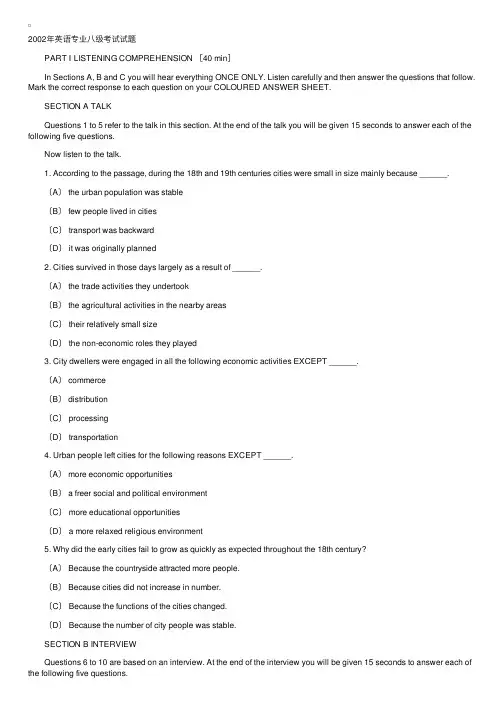
2002年英语专业⼋级考试试题 PART Ⅰ LISTENING COMPREHENSION [40 min] In Sections A, B and C you will hear everything ONCE ONLY. Listen carefully and then answer the questions that follow. Mark the correct response to each question on your COLOURED ANSWER SHEET. SECTION A TALK Questions 1 to 5 refer to the talk in this section. At the end of the talk you will be given 15 seconds to answer each of the following five questions. Now listen to the talk. 1. According to the passage, during the 18th and 19th centuries cities were small in size mainly because ______. 〔A〕 the urban population was stable 〔B〕 few people lived in cities 〔C〕 transport was backward 〔D〕 it was originally planned 2. Cities survived in those days largely as a result of ______. 〔A〕 the trade activities they undertook 〔B〕 the agricultural activities in the nearby areas 〔C〕 their relatively small size 〔D〕 the non-economic roles they played 3. City dwellers were engaged in all the following economic activities EXCEPT ______. 〔A〕 commerce 〔B〕 distribution 〔C〕 processing 〔D〕 transportation 4. Urban people left cities for the following reasons EXCEPT ______. 〔A〕 more economic opportunities 〔B〕 a freer social and political environment 〔C〕 more educational opportunities 〔D〕 a more relaxed religious environment 5. Why did the early cities fail to grow as quickly as expected throughout the 18th century? 〔A〕 Because the countryside attracted more people. 〔B〕 Because cities did not increase in number. 〔C〕 Because the functions of the cities changed. 〔D〕 Because the number of city people was stable. SECTION B INTERVIEW Questions 6 to 10 are based on an interview. At the end of the interview you will be given 15 seconds to answer each of the following five questions. Now listen to the interview. 6. According to Janet, the factor that would most affect negotiations is ______. 〔A〕 English language proficiency 〔B〕 different cultural practices 〔C〕 different negotiation tasks 〔D〕 the international Americanized style 7. Janet's attitude towards the Americanized style, as a model for business negotiations is ______. 〔A〕 supportive 〔B〕 negative 〔C〕 ambiguous 〔D〕 cautious 8. Which of the following can NOT be seen as a difference between Brazilian and American negotiators? 〔A〕 Americans prepare more points before negotiations. 〔B〕 Americans are more straightforward during negotiations. 〔C〕 Brazilians prefer more eye contact during negotiations. 〔D〕 Brazilians seek more background information. 9. Which group of people seems to be the most straightforward? 〔A〕 The British. 〔B〕 Germans. 〔C〕 Americans. 〔D〕 Not mentioned. 10. Which of the following is NOT characteristic of Japanese negotiators? 〔A〕 Reserved. 〔B〕 Prejudiced. 〔C〕 Polite. 〔D〕 Prudent. SECTION C NEWS BROADCAST Question 11 is based on the following news. At the end of the news item, you will be given 15 seconds to answer the question. Now listen to the news. 11. The news item is mainly about ______. 〔A〕 a call for research papers to be read at the conference 〔B〕 an international conference on traditional Tibetan medicine 〔C〕 the number of participants at the conference and their nationalities 〔D〕 the preparations made by the sponsors for the international conference Questions 12 and 13 are based on the following news. At the end of the news item, you will be given 30 seconds toanswer the questions. Now listen to the news. 12. The news item mainly concerns ______ in Hong Kong. 〔A〕 Internet centres 〔B〕 an IBM seminar 〔C〕 e-government 〔D〕 broadcasting 13. The aims of the three policy objectives include all the following EXCEPT ______. 〔A〕 improvement of government efficiency 〔B〕 promotion of e-commerce 〔C〕 integration of service delivery 〔D〕 formulation of Digital 21 Strategy Questions 14 and 15 are based on the following news. At the end of the news item, you will be given 30 seconds to answer the questions. Now listen to the news. 14. Which of the following records was the second best time of the year by Donovan Bailey? 〔A〕 9.98. 〔B〕 9.80. 〔C〕 9.91. 〔D〕 9.95. 15. The record shows that Bailey was ______. 〔A〕 still suffering from an injury 〔B〕 getting back in shape 〔C〕 unable to compete with Greene 〔D〕 less confident than before SECTION D NOTE-TAKING & GAP-FILLING Fill in each of the gaps with ONE word. You may refer to your notes. Make sure the word you fill in is both grammatically and semantically acceptable. Study Activities in University In order to help college and university students in the process of learning, four key study activities have been designed and used to encourage them to make knowledge their own. 1. essay writing: central focus of university work esp. in the humanities, e.g. (1)______ Benefits : 1)helping to select interesting content in books and to express understanding. 2) enabling teachers to know progress and to offer(2) ______. 3)familiarizing students with exam forms. 2. seminars and classroom discussion: another form to internalize knowledge in specialized contexts. Benefits: 1)(3)______ enables you to know the effectiveness of and others response to your speech immediately. 2) Within the same period of time, more topics can be dealt with than in(4)______. 3) The use of a broader range of knowledge is encouraged. 3. individual tutorials : a substitute for group discussion. Format: from teacher (5)______to flexible conversation. Benefit: encouraging ideas and interaction. 4. lectures: a most (6) ______used study activity. Disadvantages: 1) less (7) ______ than discussions or tutorials. 2) more demanding in note-taking. Advantages: 1) providing a general (8)______ of a subject under discussion. 2) offering more easily understood versions of a theory. 3) updating students on(9)______ developments. 4) allowing students to follow different (10)______. PART Ⅱ PROOFREADING & ERROR CORRECTION [15 min] The passage contains TEN errors. Each indicated line contains a maximum of ONE error. In each case, only ONE word is involved. You should proofread the passage and correct it. There are great impediments to the general use of a standard in pronunciation comparable to that existing in spelling (orthography). One is the fact that pronunciation is learnt "naturally" and uncon- sciously, and orthography is learnt deliberately and (1)______ consciously. Large numbers of us, in fact, remain throughout our lives quite unconscious with what (2)______ our speech sounds like when we speak out, and (3)______ it often comes as a shock when we firstly hear a (4)______ recording of ourselves. It is not a voice we recog- nize at once, whereas our own handwriting is some- thing which we almost always know. We begin the (5)______ "natural" learning of pronunciation long before we start learning to read or write, and in our early years we went on unconsciously imitating and practicing (6)______ the pronunciation of those around us for many more hours per every day than we ever have to spend (7)______ learning even our difficult English spelling. This is (8)______ "natural", therefore, that our speech-sounds should be those of our immediate circle; after all, as we have seen, speech operates as a means of holding a community and to give a sense of "belonging". We (9)______ learn quite early to recognize a "stranger", someone who speaks with an accent of a different comm- unity - perhaps only a few miles far. (10)______ PART Ⅲ READING COMPREHENSION [40 min] SECTION A READING COMPREHENSION [30min] In this section there are four reading passages followed by a total of fifteen multiple-choice questions. Read the passages and then mark your answers on your COLOURED ANSWER SHEET. TEXT A Do you ever feel as though you spend all your time in meetings? Henry Mintzberg, in his book The Nature of Managerial Work, found that in large organizations managers spent 22 per cent of their time at their desk, 6 per cent on the telephone, 3 per cent on other activities, but a whopping 69 per cent in meetings. There is a widely-held but mistaken belief that meetings are for "solving problems" and "making decisions". For a start, the number of people attending a meeting tends to be inversely proportional to their collective ability to reach conclusions and make decisions. And these are the least important elements. Instead hours are devoted to side issues, playing elaborate games with one another. It seems, therefore, that meetings serve some purpose other than just making decisions. All meetings have one thing in common: role-playing. T h e m o s t f o r m a l r o l e i s t h a t o f c h a i r m a n . H e s e t s t h e a g e n d a , a n d a g o o d c h a i r m a n w i l l k e e p t h e m e e t i n g r u n n i n g o n t i m e a n d t o t h e p o i n t . S a d l y , t h e o t h e r , i n f o r m a l , r o l e - p l a y e r s a r e o f t e n a b l e t o g a i n t h e u p p e r h a n d . C h i e f i s t h e " c o n s t a n t t a l k e r " , w h o j u s t l o v e s t o h e a r h i s o r h e r o w n v o i c e . T h e n t h e r e a r e t h e " c a n t d o " t y p e s w h o w a n t t o m a i n t a i n t h e s t a t u s q u o . S i n c e t h e y h a v e o f t e n b e e n i n t h e o r g a n i z a t i o n f o r a l o n g t i m e , t h e y f r e q u e n t l y q u o t e h i s t o r i c a l e x p e r i e n c e a s a n e x c u s e t o b l o c k c h a n g e : " I t w o n t w o r k , w e t r i e d t h a t l a s t y e a r a n d i t w a s a d i s a s t e r . " A m o r e s u b t l e v e r s i o n o f t h e " c a n ' t d o " t y p e , t h e " y e s , b u t & & " , h a s e m e r g e d r e c e n t l y . T h e y h a v e l e a r n t a b o u t t h e n e e d t o s o u n d p o s i t i v e , b u t t h e y s t i l l c a n t b e a r t o h a v e t h i n g s c h a n g e . A n o t h e r w h o l e s u b - s e t o f c h a r a c t e r s a r e p e o p l e w h o l o v e m e e t i n g s a n d w a n t t h e m t o c o n t i n u e u n t i l 5 6" 3 0 p m o r b e y o n d . I r r e l e v a n t i s s u e s a r e t h e i r s p e c i a l i t y . T h e y n e e d t o c a l l o r a t t e n d m e e t i n g s , e i t h e r t o a v o i d w o r k , o r t o j u s t i f y t h e i r l a c k o f p e r f o r m a n c e , o r s i m p l y b e c a u s e t h e y d o n o t h a v e e n o u g h t o d o . T h e n t h e r e a r e t h e " c o u n t e r - d e p e n d e n t s " , t h o s e w h o u s u a l l y d i s a g r e e w i t h e v e r y t h i n g t h a t i s s a i d , p a r t i c u l a r l y i f i t c o m e s f r o m t h e c h a i r m a n o r t h r o u g h c o n s e n s u s f r o m t h e g r o u p . T h e s e p e o p l e n e e d t o f i g h t a u t h o r i t y i n w h a t e v e r f o r m . M e e t i n g s c a n a l s o p r o v i d e a t t e n d e r s w i t h a s e n s e o f i d e n t i f i c a t i o n o f t h e i r s t a t u s a n d p o w e r . I n t h i s c a s e , m a n a g e r s a r r a n g e m e e t i n g s a s a m e a n s o f c o m m u n i c a t i n g t o o t h e r s t h e b o u n d a r i e s o f t h e i r e x c l u s i v e c l u b : w h o i s " i n " , a n d w h o i s n o t . B e c a u s e s o m a n y m e e t i n g s e n d i n c o n f u s i o n a n d w i t h o u t a d e c i s i o n , a n o t h e r g a m e i s p l a y e d a t t h e e n d o f m e e t i n g s , c a l l e d r e a c h i n g a f a l s e c o n s e n s u s . S i n c e i t i s i m p o r t a n t f o r t h e c h a i r m a n t o a p p e a r s u c c e s s f u l i n p r o b l e m s o l v i n g a n d m a k i n g a d e c i s i o n , t h e g r o u p r e a c h e s a f a l s e c o n s e n s u s . E v e r y o n e i s h a p p y , h a v i n g s p e n t t h e i r t i m e p r o d u c t i v e l y . T h e r e a l i t y i s t h a t t h e d e c i s i o n i s s o a m b i g u o u s t h a t i t i s n e v e r a c t e d u p o n , o r , i f i t i s , t h e r e i s c o n t i n u i n g c o n f l i c t , f o r w h i c h a n o t h e r m e e t i n g i s n e c e s s a r y . I n t h e e n d , m e e t i n g s p r o v i d e t h e o p p o r t u n i t y f o r s o c i a l i n t e r c o u r s e , t o e n g a g e i n b a t t l e i n f r o n t o f o u r b o s s e s , t o a v o i d u n p l e a s a n t o r u n s a t i s f y i n g w o r k t o h i g h l i g h t o u r s o c i a l s t a t u s a n d i d e n t i t y . T h e y a r e , i n f a c t , a n e c e s s a r y t h o u g h n o t n e c e s s a r i l y p r o d u c t i v e p s y c h o l o g i c a l s i d e s h o w . P e r h a p s i t i s o u r c i v i l i z e d w a y t o m o d e r a t i n g , i f n o t p r e v e n t i n g , c h a n g e . / p > p b d s f i d = " 2 1 1 " > 0 0 1 6 . O n r o l e - p l a y i n g , t h e p a s s a g e s e e m s t o i n d i c a t e t h a t c h a i r m a n _ _ _ _ _ _ . / p > p b d s f i d = " 2 1 2 " > 0 0 0 A 0 t a l k s a s m u c h a s p a r t i c i p a n t s / p > p b d s f i d = " 2 1 3 " > 0 0 0 B 0 i s u s u a l l y a " c o n s t a n t t a l k e r " / p > p b d s f i d = " 2 1 4 " > 0 0 0 C 0 p r e f e r s t o t a k e t h e r o l e o f a n o b s e r v e r / p > p b d s f i d = " 2 1 5 " > 0 0 0 D 0 i s f r e q u e n t l y o u t s h o n e b y p a r t i c i p a n t s / p > p b d s f i d = " 2 1 6 " > 0 0 1 7 . W h i c h o f t h e f o l l o w i n g i s N O T a d i s t i n c t c h a r a c t e r i s t i c o f t h e t h r e e t y p e s o f p a r t i c i p a n t s ? / p > p b d s f i d = " 2 1 7 " > 0 0 0 A0 S u b m i s s i v e n e s s . / p > p b d s f i d = " 2 1 8 " > 0 0 0 B 0 S t u b b o r n n e s s . / p > p b d s f i d = " 2 1 9 " > 0 0 0 C 0D i s o b e d i e n c e . / p > p b d s f i d = " 2 2 0 " > 0 0 0 D 0 L a c k o f f o c u s . / p > p b d s f i d = " 2 2 1 " > 0 0 1 8 . T h e p a s s a g e s u g g e s t s t h a t a f a l s e c o n s e n s u s w a s r e a c h e d a t t h e e n d o f a m e e t i n g i n o r d e r t o _ _ _ _ _ _ . / p > p b d s f i d = " 2 2 2 " > 0 0 0 A 0 m a k e r o o m f o r a n o t h e r m e e t i n g / p > p b d s f i d = " 2 2 3 " > 0 0 0 B 0 b r i n g a n i l l u s o r y s e n s e o f a c h i e v e m e n t / p > p b d s f i d = " 2 2 4 " > 0 0 0 C 0 h i g h l i g h t t h e i m p o r t a n c e o f a m e e t i n g / p > p b d s f i d = " 2 2 5 " > 0 0 0 D 0 g o a h e a d w i t h t h e a g r e e d p r o g r a m m e / p > p b d s f i d = " 2 2 6 " > 0 0 TE X T B / p > p b d s f i d = " 2 2 7 " > 0 0 C o o p e r a t i v e c o m p e t i t i o n . C o m p e t i t i v e c o o p e r a t i o n . C o n f u s e d ? A i r l i n e a l l i a n c e s h a v e t r a v e l l e r s s c r a t c h i n g t h e i r h e a d s o v e r w h a t s g o i n g o n i n t h e s k i e s . S o m e f o l k s v i e w a l l i a n c e s a s a b l e s s i n g t o t r a v e l l e r s , o f f e r i n g s e a m l e s st r a v e l , r e d u c e d f a r e s a n d e n h a n c e d f r e q u e n t - f l y e r b e n e f i t s . O t h e r s s e e a c o n s p i r a c y o f b i g b u s i n e s s e s , c a u s i n g d e c r e a s e d c o m p e t i t i o n , i n c r e a s e d f a r e s a n d f e w e r c h o i c e s . W h a t e v e r y o u r o p i n i o n , t h e r e ' s n o e s c a p i n g a i r l i n e a l l i a n c e s : t h e m a r k e t i n g h y p e i s u n r e l e n t i n g , w i t h e a c h o f t h e t w o m e g a - g r o u p i n g s , O n e w o r l d a n d S t a r A l l i a n c e , p r o m o t i n g i t s e l f a s t h e b e s t c h o i c e f o r a l l t r a v e l l e r s . A n d , e v e n i f y o u t u r n a w a y f r o m t h e i r a d s , c h a n c e s a r e t h e y w i l l f i g u r e i n a n y o f y o u r t r a v e l p l a n s . B y t h e e n d o f t h e y e a r , O n e w o r l d a n d S t a r A l l i a n c e w i l l b e t w e e n t h e m c o n t r o l m o r e t h a n 4 0 % o f t h e t r a f f i c i n t h e s k y . S o m e p u n d i t s p r e d i c t t h a t f i g u r e w i l l b e m o r e l i k e 7 5 % i n 1 0 y e a r s . / p >。
专八历年翻译真题

1995年英语专业八级考试--翻译部分参考译文C-E原文:简.奥斯丁的小说都是三五户人家居家度日,婚恋嫁娶的小事。
因此不少中国读者不理解她何以在西方享有那么高的声誉。
但一部小说开掘得深不深,艺术和思想是否有过人之处,的确不在题材大小。
有人把奥斯丁的作品比作越咀嚼越有味道的橄榄。
这不仅因为她的语言精彩,并曾对小说艺术的发展有创造性的贡献,也因为她的轻快活泼的叙述实际上并不那么浅白,那么透明。
史密斯夫人说过,女作家常常试图修正现存的价值秩序,改变人们对“重要”和“不重要”的看法。
也许奥斯丁的小说能教我们学会转换眼光和角度,明察到“小事”的叙述所涉及的那些不小的问题。
参考译文:However, subject matter is indeed not the decisive factor by which we judge a novel of its depth as well as (of ) its artistic appeal and ideological content (or: as to whether a novel digs deep or not or whether it ex cels in artistic appeal and ideological content). Some people compare Austen’s works to olives: the more you chew them, the more tasty (the tastier) they become. This comparison is based not only on (This is not only because of ) her expressive language and her creative contribution to the development of novel writing as an art, but also on (because of ) the fact that what hides behind her light and lively narrative is something implicit and opaque (not so explicit and transparent). Mrs. Smith once observed, women writers often sought (made attempts) to rectify the existing value concepts (orders) by changing people’s opinions on what is ―important‖ and what is not.E-C原文: I, by comparison, living in my overpriced city apartment, walking to work past putrid sacks of street garbage, paying usurious taxes to local and state governments I generally abhor, I am rated middle class. This causes me to wonder, do the measurement make sense? Are we measuring only that which is easily measured--- the numbers on the money chart --- and ignoring values more central to the good life?For my sons there is of course the rural bounty of fresh-grown vegetables, line-caught fish and the shared riches of neighbors’’ orchards and gardens. There is the unpaid baby-sitter for whose children my daughter-in-law baby-sits in return, and neighbors who barter their skills and labor. But more than that, how do you measure serenity? Sense if self?I don’t want to idealize life in small places. There are times when the outside world intru des brutally, as when the cost of gasoline goes up or developers cast their eyes on untouched farmland. There are cruelties, there is intolerance, there are all the many vices and meannesses in small places that exist in large cities. Furthermore, it is harder to ignore them when they cannot be banished psychologically to another part of town or excused as the whims of alien groups --- when they have to be acknowledged as ―part of us.‖Nor do I want to belittle the opportunities for small decencies in cities --- the eruptions of one-stranger-to-another caring that always surprise and delight. But these are,sadly,more exceptions than rules and are often overwhelmed by the awful corruptions and dangers that surround us.参考译文:对我的几个儿子来说,乡村当然有充足的新鲜蔬菜,垂钓来的鱼,邻里菜园和果园里可供分享的丰盛瓜果。
2012年专业英语八级真题及答案解析
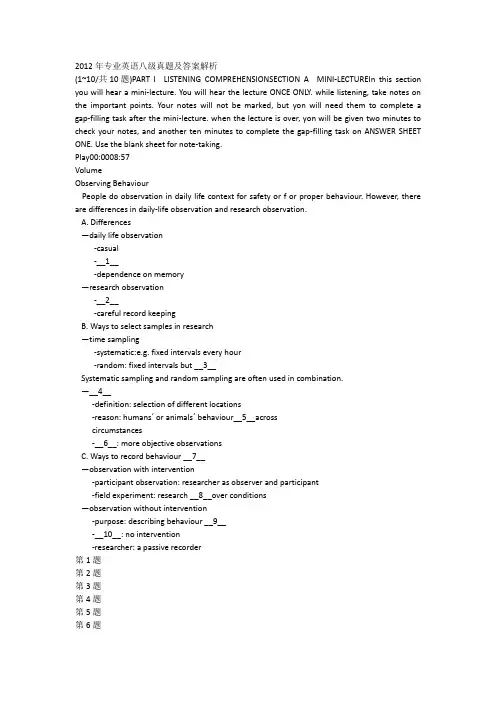
2012年专业英语八级真题及答案解析(1~10/共10题)PART I LISTENING COMPREHENSIONSECTION A MINI-LECTUREIn this section you will hear a mini-lecture. You will hear the lecture ONCE ONLY. while listening, take notes on the important points. Your notes will not be marked, but yon will need them to complete a gap-filling task after the mini-lecture. when the lecture is over, yon will be given two minutes to check your notes, and another ten minutes to complete the gap-filling task on ANSWER SHEET ONE. Use the blank sheet for note-taking.Play00:0008:57VolumeObserving BehaviourPeople do observation in daily life context for safety or f or proper behaviour. However, there are differences in daily-life observation and research observation.A. Differences—daily life observation-casual-__1__-dependence on memory—research observation-__2__-careful record keepingB. Ways to select samples in research—time sampling-systematic:e.g. fixed intervals every hour-random: fixed intervals but __3__Systematic sampling and random sampling are often used in combination.—__4__-definition: selection of different locations-reason: humans´ or animals´ behaviour__5__acrosscircumstances-__6__: more objective observationsC. Ways to record behaviour __7__—observation with intervention-participant observation: researcher as observer and participant-field experiment: research __8__over conditions—observation without intervention-purpose: describing behaviour __9__-__10__: no intervention-researcher: a passive recorder第1题第2题第3题第4题第5题第6题第7题第8题第9题第10题下一题(11~15/共5题)SECTION BIn this section you will hear everything ONCE ONLY. Listen carefully and then answer the questions that follow. Mark the correct answer to each question on your ANSWER SHEET.Play00:0006:55Volume第11题Which of the following statements about creativity is INCORRECT?A.Creativity stems from human beings´ novel thinking.B.The duration of the creative process varies from person to person.C.Creative people focus on novel thinking rather than on solutions.D.The outcome of human creativity comes in varied forms.第12题The interviewee cites the Bach family to show that creativityA.seems to be attributable to genetic makeup.B.appears to be the result of the environment.C.appears to be more associated with great people.es from both environment and genetic makeup.第13题How many types of the creative process does the interviewee describe?A.One.B.Two.C.Three.D.Four.第14题Which of the following features of a creative personality is NOT mentioned in the interview?A.Unconventional.B.Critical.C.Resolute.D.Original.第15题The interviewee´s suggestion for a creativity workout supports the view thatA.brain exercising will not make people creative.B.most people have diversified interests and hobbies.C.creativity can only be found in great people.D.the environment is significant in the creative process.上一题下一题(1/5)SECTION CIn this section you will hear everything ONCE ONLY. Listen carefully and then answer the questions that follow. Mark the correct answer to each question on your ANSWER SHEET.Play00:0001:27Volume第16题What is the news item mainly about?A.A problem in the cooling system was solved.B.A 350-kilogram ammonia pump was removed.C.U.S. astronauts made three space walks.D.An international space station was set up.上一题下一题(17~18/共5题)SECTION CIn this section you will hear everything ONCE ONLY. Listen carefully and then answer the questions that follow. Mark the correct answer to each question on your ANSWER SHEET.Play00:0001:39Volume第17题In which country would parents often threaten to punish children by leaving them outside?A.India.B.Egypt.C.The Philippines.D.Not mentioned.第18题What is the main purpose of the study?A.To reveal cultural differences and similarities.B.To investigate ways of physical punishment.C.To analyze child behaviour across countries.D.To expose cases of child abuse and punishment.上一题下一题(19~20/共5题)SECTION CIn this section you will hear everything ONCE ONLY. Listen carefully and then answer the questions that follow. Mark the correct answer to each question on your ANSWER SHEET.Play00:0001:15Volume第19题According to the news item, Japan´s economic growth in the second quarter was ______ less than the first quarter.A.4 percentB.3 percentC.0.6 percentD.3.4 percent第20题How many reasons does the news item cite for Japan´s slow economic growth?A.2.B.3.C.4.D.5上一题下一题(21~26/共20题)PART II READING COMPREHENSION (30 MIN)Directions: In this section there are four reading passages followed by a total of 20 multiple-choice questions. For each of them there are four choices marked A, B, C and D. You should decide on the best choice.I used to look at my closet and see clothes. These days, whenever I cast´my eyes upon the stacks of shoes and hangers of shirts, sweaters and jackets, I see water.It takes 569 gallons to manufacture a T-shirt, from its start in the cotton fields to its appearance on store shelves. A pair of running shoes? 1,247 gallons.Until last fall, I´d been oblivious to my "water footprint", which is defined as the total volume of freshwater that is used to produce goods and services, according to the Water Footprint Network. The Dutch nonprofit has been working to raise awareness of freshwater scarcity since 2008, but it was through the "Green Blue Book" by Thomas M. Kostigen that I was able to see how my own actions factored in.I´ve installed gray-water systems to reuse the wastewater from my laundry machine and bathtub and reroute it to my landscape-systems that save, on average, 50 gallons of water per day. I´ve set up rain barrels and infiltration pits to collect thousands of gallons of storm water cascading from my roof. I´ve even entered the last bastion of greendom-installing a composting toilet.Suffice to say, I´ve been feeling pretty satisfied with myself for all the drinking water I´ve saved with these big-ticket projects.Now I realize that my daily consumption choices could have an even larger effect-not only on the local water supply but also globally: 1.1 billion people have no access to freshwater, and, in the future, those who do have access will have less of it.To see how much virtual water 1 was using, I logged on to the "Green Blue Book" website and used its water footprint calculator, entering my daily consumption habits. Tallying up the water footprint of my breakfast, lunch, dinner and snacks, as well as my daily dose of over-the-counter uppers and downers- coffee, wine and beer- I´m using 512 gallons of virtual water each day just to feed myself.In a word: alarming.Even more alarming was how much hidden water I was using to get dressed. I´m hardly a clotheshorse, but the few new items I buy once again trumped the amount of water flowing from my faucets each day. If I´m serious about saving water, I realized I could make some simple lifestyle shifts. Looking more closely at the areas in my life that use the most virtual water, it was food and clothes, specifically meat, coffee and, oddly, blue jeans and leather jackets.Being a motorcyclist, I own an unusually large amount of leather-boots and jackets in particular. All of it is enormously water intensive. It takes 7,996 gallons to make a leather jacket, leather being a byproduct of beef. It takes 2,866 gallons of water to make a single pair of blue jeans, because they´ re made from water-hogging cotton.Crunching the numbers for the amount of clothes I buy every year, it looks a lot like my friend´s swimming pool. My entire closet is borderline Olympic.Gulp.My late resolution is to buy some items used. Underwear and socks are, of course, exempt fromthis strategy, but I have no problem shopping less and also shopping at Goodwill. In fact, I´d been doing that for the past year to save money My clothes´ outrageous water footprint just reinforced it for me.More conscious living and substitution, rather than sacrifice, are the prevailing ideas with the water footprint. It´s one I´m trying, and that´s had an unusual upside. I had a hamburger recently; and I enjoyed it a lot more since it is now an occasional treat rather than a weekly habit.(One gallon =3.8 litres)第21题According to the passage, the Water Footprint NetworkA.worked for freshwater conservation for nonprofit purposes.B.collaborated with the Green Blue Book in freshwater conservation.C.made the author aware of freshwater shortage.D.helped the author get to know the Green Blue Book.第22题Which of the following reasons can best explain the author´s feeling of self-satisfaction?A.His house was equipped with advanced water-saving facilities.B.Money spent on upgrading his household facilities was worthwhile.C.He made contribution to drinking water conservation in his own way.D.He could have made even greater contribution by changing his lifestyle.第23题According to the context, "...how my own actions factored in" meansA.how I could contribute to water conservation.B.how much of what I did contributed to freshwater shortage.C.what behaviour could be counted as freshwater-saving.D.what efforts I should make to save fresh water第24题According to the passage, the author was more alarmed by the fact thatA.he was having more meat and coffee.B.his lifestyle was too extravagant.C.globally there will be less fresh water.D.his clothes used even more virtual water.第25题"My entire closet is borderline Olympic" is an example ofA.analogy.B.exaggeration.C.understatement.D.euphemism.第26题What is the tone of the author in the last paragraph?A.Sarcastic.B.Ironic.C.Critical.D.Humorous.上一题下一题(27~31/共20题)PART II READING COMPREHENSION (30 MIN)Directions: In this section there are four reading passages followed by a total of 20 multiple-choice questions. For each of them there are four choices marked A, B, C and D. You should decide on the best choice.In her novel of "Reunion, American Style", Rona Jaffe suggests that a class reunion "is more than a sentimental journey. It is also a way of answering the question that lies at the back of nearly all our minds. Did they do better than I?"Jaffe´s observation may be misplaced but not completely lost. According to a study conducted by social psychologist Jack Sparacino, the overwhelming majority who attend reunions aren´t there invidiously to compare their recent accomplishments with those of their former classmates. Instead, they hope, primarily, to relive their earlier successes.Certainly, a few return to show their former classmates how well they have done; others enjoy observing the changes that have occurred in their classmates (not always in themselves, of course). But the majority who attend their class reunions do so to relive the good times they remember having when they were younger. In his study, Sparacino found that, as high school students, attendees had been more popular, more often regarded as attractive, and more involved in extracurricular activities than those dassmates who chose not to attend. For those who turned up at their reunions, then, the old times were also the good times!It would appear that Americans have a special fondness for reunions, judging by their prevalence. Major league baseball players, fraternity members, veterans groups, high school and college graduates, and former Boy Scouts all hold reunions on a regular basis. In addition, family reunions frequently attract blood relatives from faraway places who spend considerable money and time to reunite.Actually, in their affection for reuniting with friends, family or colleagues, Americans are probably no different from any other people, except that Americans have created a mind-boggling number and variety of institutionalized forms of gatherings to facilitate the satisfaction of this desire. Indeed, reunions have increasingly become formal events that are organized on a regular basis and, in the process, they have also become big business.Shell Norris of Class Reunion, Inc., says that Chicago alone has 1,500 high school reunions each year. A conservative estimate on the national level would be 10,000 annually. At one time, all high school reunions were organized by volunteers, usually female homemakers. In the last few years, however, as more and more women have entered the labour force, alumni reunions are increasingly being planned by specialized companies rather than by part-time volunteers.The first college reunion was held by the alumni of Yale University in 1792. Graduates of Pennsylvania, Princeton, Stanford, and Brown followed suit. And by the end of the 19th century, most 4-year institutions were holding alumni reunions.The variety of college reunions is impressive. At Princeton, alumni parade through the town wearing their class uniforms and singing their alma mater. At Marietta College, they gather for a dinner-dance on a steamship cruising the Ohio River.Clearly, the thought of cruising on a steamship or marching through the streets is usually not, by itself, sufficient reason for large numbers of alumni to return to campus. Alumni who decide to attend their reunions share a common identity based on the years they spent together as undergraduates. For this reason, universities that somehow establish a common bond - for example, because they are relatively small or especially prestigious - tend to draw substantialnumbers of their alumni to reunions. In an effort to enhance this common identity, larger colleges and universities frequently build their dass reunions on participation in smaller units, such as departments or schools. Or they encourage "affinity reunions" for groups of former cheerleaders, editors, hatemity members, musicians, members of military organizations on campus, and the like.Of course, not every alumnus is fond of his or her alma mater. Students who graduated during the late 1960s may be especially reluctant to get involved in alumni events. They were part of the generation that conducted sit-ins and teach-ins directed at university administrators, protested military recruitment on campus and marched against "establishment politics." If this generation has a common identity, it may fall outside of their university ties - or even be hostile to them. Even as they enter their middle years, alumni who continue to hold unpleasant memories of college during this period may not wish to attend class reunions.第27题According to the passage, Sparacino´s studyA.found that interest in reunions was linked with school experience.B.found evidence for attendees´ intense desire for showing off success.C.showed that attendees tended to excel in high school study.D.provided strong evidence for Jaffe´s statement.第28题Which of the following is NOT mentioned as a distinct feature of U.S. class reunions?A.Class reunions have become a profitable business.B.Class reunions have brought about a variety of activities.C.Reunions are regular and formal events organized by professional agencies.D.U.S. class reunions are usually occasions to show off one´s recent success.第29题What mainly attracts many people to return to campus for reunion?A.Shared experience beyond the eampus.B.Shared undergraduate experience on campus.C.The special status their university enjoys.D.The variety of activities for class reunion.第30题The rhetorical function of the first paragraph is toA.serve as prelude to the author´s argument.B.present the author´s counterargument.C.introduce Rona Jeffe´s novel.D.bring into foeus contrasting opinions.第31题What is the passage mainly about?A.Alumni reunions and American university traditions.B.Alumni reunion and its soeial and eeonomie implieations.C.Reasons for popularity and (non)attendance for alumni reunions.D.A historical perspective for alumni reunions in the United States.上一题下一题(32~35/共20题)PART II READING COMPREHENSION (30 MIN)Directions: In this section there are four reading passages followed by a total of 20 multiple-choice questions. For each of them there are four choices marked A, B, C and D. You should decide on the best choice.One time while on his walk George met Mr. Cattanzara coming home very late from work. He wondered if he was drunk but then could tell he wasn´t. Mr. Cattanzara, a stocky, bald-headed man who worked in a change booth on an IRT station, lived on the next block after George´s, above a shoe repair store. Nights, during the hot weather, he sat on his stoop in an undershirt, reading the New York Times in the fight of the shoemaker´s window. He read it from the first page to the last, then went up to sleep. And all the time he was reading the paper, his wife, a fat woman with a white face, leaned out of the window, gazing into the street, her thick white arms folded under her loose breast, on the window ledge.Once in a while Mr. Cattanzara came home drunk, but it was a quiet drunk. He never made any trouble, only walked stiffly up the street and slowly climbed the stairs into the hall. Though drunk he looked the same as always, except for his tight walk, the quietness, and that his eyes were wet. George liked Mr. Cattanzara because he remembered him giving him nickels to buy lemon ice with when he was a squirt. Mr. Cattanzara was a different type than those in the neighbourhood. He asked different questions than the others when he met you, and he seemed to know what went on in all the newspapers. He read them, as his fat sick wife watched from the window. "What are you doing with yourself this summer, George?" Mr. Cattanzara asked. "I see you walkin´ around at night."George felt embarrassed. "I like to walk.""What are you doin´ in the day now?""Nothing much just now. I´m waiting for a job." Since it shamed him to admit that he wasn´t working, George said, "I´m reading a lot to pick up my education.""What are you readin´?"George hesitated, then said, "I got a fist of books in the library once and now I´m gonna read them this summer." He felt strange and a little unhappy saying this, but he wanted Mr. Cattanzara to respect him."How many books are there on it?""I never counted them. Maybe around a hundred."Mr. Cattanzara whistled through his teeth."I figure if 1 did that," George went on earnestly, "it would help me in my education. 1 don´t mean the kind they give you in high school. I want to know different things than they learn there, if you know what I mean."The change maker nodded. "Still and all, one hundred books is a pretty big load for one summer.""It might take longer."´After you´re finished with some, maybe you and I can shoot the breeze about them?" said Mr Cattanzara."When I´m finished," George answered.Mr. Cattanzara went home and George continued on his walk. After that, though he had the urge to, George did nothing different from usual. He still took his walks at night, ending up in the little park. But one evening the shoemaker on the next block stopped George to say he was a good boy, and George figured that Mr. Cattanzara had told him all about the books he wasreading. From the shoemaker it must have gone down the street, because George saw a couple of people smiling kindly at him, though nobody spoke to him personally. He felt a little better around the neighbourhood and liked it more, though not so much he would want to live in it forever. He had never exactly disliked the people in it, yet he had never liked them very much either. It was the fault of the neighbourhood. To his surprise, George found out that his father and his sister Sophie knew about his reading too. His father was too shy to say anything about it - he was never much of a talker in his whole life -but Sophie was softer to George, and she showed him in other ways she was proud of him.第32题In the excerpt, Mr. Cattanzara was described as a man whoA.showed a wide interest.B.was fond of drinking.C.often worked overtime.D.liked to gossip after work.第33题It can be inferred from the passage thatA.George lied at the beginning and then became serious.B.George was forced to tell a lie and then regretted.C.Mr. Cattanzara was doubtful about George throughout.D.Mr. Cattanzara was surprised at George´s reading plan.第34题After the street conversation with Mr. Cattanzara, GeorgeA.remained the same as usual.B.became more friendly with Mr. Cattanzara.C.began to like his neighbours more than ever.D.continued to read the books from the list.第35题We can tell from the excerpt that GeorgeA.found his neighbours liked to poke their nose into him.B.found that his sister remained skeptical about him.C.was dissatisfied with his life and surroundings.D.had a neither close nor distant relationship with his father.上一题下一题(36~40/共20题)PART II READING COMPREHENSION (30 MIN)Directions: In this section there are four reading passages followed by a total of 20 multiple-choice questions. For each of them there are four choices marked A, B, C and D. You should decide on the best choice.Abraham Lincoln turns 200 this year, and he´s beginning to show his age. When his birthday arrives, on February 12, Congress will hold a special joint session in the Capitol´s National Statuary Hall, a wreath will be laid at the great memorial in Washington, and a webcast will link school classrooms for a "teach-in" honouring his memoryAdmirable as they are, though, the events will strike many of us Lincoln fans as inadequate, even halfhearted - and another sign that our appreciation for the 16th president and his towering achievements is slipping away And you don´t have to be a Lincoln enthusiast to believe that this issomething we can´t afford to lose.Compare this year´s celebration with the Lincoln centennial, in 1909. That year, Lincoln´s likeness made its debut on the penny, thanks to approval from the U.S. Secretary of the Treasury Communities and civic associations in every comer of the country erupted in parades, concerts, balls, lectures, and military displays. We still feel the effects today: The momentum unloosed in 1909 led to the Lincoln Memorial, opened in 1922, and the Lincoln Highway, the first paved transcontinental thoroughfare.The celebrants in 1909 had a few inspirations we lack today. Lincoln´s presidency was still a living memory for coundess Americans. In 2009 we are farther in time from the end of the Second World War than they were from the Civil War; families still felt the loss of loved ones from that awful national trauma.But Americans in 1909 had something more: an unembarrassed appreciation for heroes and an acute sense of the way that even long-dead historical figures press in on the present and make us who we are.One story will illustrate what I´m talking about.In 2003 a group of local citizens arranged to place a statue of Lincoln in Richmond, Virginia, former capital of the Confederacy. The idea touched off a firestorm of controversy. The Sons of Confederate Veterans held a public conference of carefully selected scholars to "reassess" the legacy of Lincoln. The verdict - no surprise - was negative: Lincoln was labeled everything from a racist totalitarian to a teller of dirty jokes.I covered the conference as a reporter, but what really unnerved me was a counter-conference of scholars to refute the earlier one. These scholars drew a picture of Lincoln that only our touchy- feely age could conjure up. The man who oversaw the most savage war in our history was described - by his admirers, remember-as "nonjudgmental," "unmoralistic," "comfortable with ambiguity."I felt the way a friend of mine felt as we later watched the unveiling of the Richmond statue in a subdued ceremony: "But he´s so small!"The statue in Richmond was indeed small; like nearly every Lincoln statue put up in the past half century, it was life-size and was placed at ground level, a conscious rejection of the heroic - approachable and human, yes, but not something to look up to.The Richmond episode taught me that Americans have lost the language to explain Lincoln´s greatness even to ourselves. Earlier generations said they wanted their children to be like Lincoln: principled, kind, compassionate, resolute. Today we want Lincoln to be like us.This helps to explain the long string of recent books in which writers have presented a Lincoln made after their own image. We´ve had Lincoln as humorist and Lincoln as manic-depressive, Lincoln the business sage, the conservative Lincoln and the liberal Lincoln, the emancipator and the racist, the stoic philosopher, the Christian, the atheist - Lincoln over easy and Lincoln scrambled.What´s often missing, though, is the timeless Lincoln, the Lincoln whom all generations, our own no less than that of 1909, can lay claim to. Lucky for us, those memorializers from a century ago - and, through them, Lincoln himself- have left us a hint of where to find him. The Lincoln Memorial is the most visited of our presidential monuments. Here is where we find the Lincoln who endures: in the words he left us, defining the country we´ve inherited. Here is the Lincoln who can be endlessly renewed and who, 200 years after his birth, retains the power to renew us.The author thinks that this year´s celebration is inadequate and even halfhearted becauseA.no similar appreciation of Lincoln will be seen.B.no activities can be compared to those in 1909.C.no Lincoln statue will be unveiled.D.no memorial coins will be issued.第37题According to the passage, what really makes the 1909 celebrations different from this year´s?A.Structures constructed in memory of Lincoln.B.Variety and magnitude of celebration activities.C.Respect for great people and their influence.D.Temporal proximity to Lincoln´s presidency.第38题In the author´s opinion, the counter-conferenceA.rectified the judgment by those carefully selected scholars.B.resulted in similar disparaging remarks on Lincoln.C.came up with somewhat favourable conclusions.D.offered a brand new reassessment perspective.第39题According to the author, the image of Lincoln conceived by contemporary peopleA.reveals the variety of current opinions on heroes.B.shows the present-day desire to emulate Lincoln.C.reflects the present-day tendency of worship.D.conforms to traditional images.第40题Which of the following best explains the implication of the last paragraph?A.The memorial is symbolic of the great man´s achievements.B.Lincoln´s greatness remains despite the passage of time.C.Each generation has it own interpretation of Lincoln.D.People get to know Lincoln through memorializers.上一题下一题(1/10)PART III GENERAL KNOWLEDGE (10 MIN)Directions: There are ten multiple-choice questions in this section. Choose the best answer to each question.第41题The Maori people are natives ofA.Australia.B.Canada.C.Ireland.D.New Zealand.上一题下一题(2/10)PART III GENERAL KNOWLEDGE (10 MIN)Directions: There are ten multiple-choice questions in this section. Choose the best answer to each question.。
专八历年翻译真题详解
【2001年8级测试英译汉】Possession for its own sake or in competition with the rest of the neighborhood would have been Thoreau’s idea of the low levels1. The active discipline of heightening one’s perception of what is enduring in nature would have been his idea of the high2. What he saved from the low was time and effort he could spend on the high. Thoreau certainly disapproved of starvation, but he would put into feeding himself only as much effort as would keep him functioning for more important efforts.Effort is the gist of it3. There is no happiness except as we take on life-engaging difficulties. Short of the impossible, as Yeats put it, the satisfaction we get from a lifetime depends on how high we choose our difficulties4. Robert Frost was thinking in something like the same terms when he spoke of “The pleasure of taking pains”5. The mortal flaw in the advertised version of happiness is in the fact that it purports to be effortless6.We demand difficulty even in our games. We demand it because without difficulty there can be no game. A game is a way of making something hard of the fun of it. The rules of the game are an arbitrary imposition of difficulty7. When someone ruins the fun, he always does so by refusing to play by the rules. It is easier to win at chess if you are free, at your pleasure, to change the wholly arbitrary rules, but the fun is in winning within the rules. No difficulty, no fun.【概述】这是一篇说理性的议论文,文章评论美国19世纪哲学家、思想家、作家亨利·大卫·梭罗对人生幸福的看法。
2012年英语专业八级真题解析
专八 2012 - 1 1
classified as "observation with intervention" or "observation without intervention". Observation with inter vention can be made in at least two ways, [ 11]participant observation and field experiment. In participant observation, observers, that is researchers, play a dual role: They observe people's behaviour and they par ticipate actively in the situation they are observing. If individuals who are being (!bserved lmow that the ob server is present to collect information about their behaviour, this is undisguised participant observation. But in disguised participant observation, those who are being observed do not lmow that they are being ob served.
历年英语专业八级翻译真题以及答案
1995简.奥斯丁的小说都是三五户人家居家度日,婚恋嫁娶的小事。
因此不少中国读者不理解她何以在西方享有那么高的声誉。
但一部小说开掘得深不深,艺术和思想是否有过人之处,的确不在题材大小。
有人把奥斯丁的作品比作越咀嚼越有味道的橄榄。
这不仅因为她的语言精彩,并曾对小说艺术的发展有创造性的贡献,也因为她的轻快活泼的叙述实际上并不那么浅白,那么透明。
史密斯夫人说过,女作家常常试图修正现存的价值秩序,改变人们对“重要”和“不重要”的看法。
也许奥斯丁的小说能教我们学会转换眼光和角度,明察到“小事”的叙述所涉及的那些不小的问题。
参考译文:However, subject matter is indeed not the decisive factor by which we judge a novel of its depth as well as (of ) its artistic appeal and ideological content (or: as to whether a novel digs deep or not or whether it excels in artistic appeal and ideological content). Some people compare Austen’s works to olives: the more you chew them, the more tasty (the tastier) they become. This comparison is based not only on (This is not only because of ) her expressive language and her creative contribution to the development of novel writing as an art, but also on (because of ) the fact that what hides behind her light and lively narrative is something implicit and opaque (not so explicit and transparent). Mrs. Smith once observed, women writers often sought (made attempts) to rectify the existing value concepts (orders) by changing people’s opinions on what is “important” and what is not.1996近读报纸,对国内名片和请柬的议论颇多,于是想起客居巴黎时经常见到的法国人手中的名片和请柬,随笔记下来,似乎不无借鉴之处。
专业英语八级真题2002年
专业英语八级真题2002年PART Ⅰ LISTENING COMPREHENSIONIn Sections A, B and C you will hear everything once only. Listen carefully and then answer the questions that follow.SECTION A TALKQuestions 1 to 5 refer to the talk in this section. At the end of the talk you will be given 15 seconds to answer each of the following five questions. Now listen to the talk.1、According to the passage, during the 18th and 19th centuries cities were small in size mainly becauseA. the urban pupulation was stable.B. few people lived in cities.C. transport was backward.D. it was originally planned.2、Cities survived in those days largely as a result ofA. the trade activities they undertook.B. the agricultural activities in the nearby areas.C. their relatively small size.D. the non-economic roles they played.3、Cities survived in those days largely as a result ofA. the trade activities they undertook.B. the agricultural activities in the nearby areas.C. their relatively small size.D. the non-economic roles they played.4、Urban people left cities for the following reasons EXCEPTA. more economic opportunities.B. a freer social and political environment.C. more educational opportunities.D. a more relaxed religious environment.5、Why did the early cities fail to grow as quickly as expected throughout the 18th century?A. Because the countryside attracted more people.B. Because cities did not increase in number.C. Because the functions of the cities changed.D. Because the number of city people was stable.SECTION B INTERVIEWQuestions 6 to 10 are based on an interview. At the end of the interview you will be given 15seconds to answer each of the following five questions. Now listen to the interview.6、According to Janet, the factor that would most affect negotiations isA. English language proficiency.B. different cultural practices.C. different negotiation tasks.D. the international Americanized style.7、Janet's attitude towards the Americanized style as a model for business negotiations isA. supportive.B. negative.C. ambiguous.D. cautious.8、Which of the following can NOT be seen as a difference between Brazilian and American negotiators?A. Americans prepare more points before negotiations.B. Americans are more straightforward during negotiations.C. Brazilians prefer more eye contact during negotiations.D. Brazilians seek more background information.9、Which group of people seems to be the most straightforward?A. The British.B. Germans.C. Americans.D. Not mentioned.10、Which of the following is NOT characteristic of Japanese negotiators?A. Reserved.B. Prejudiced.C. Polite.D. Prudent.SECTION C NEWS BROADCASTQuestion 11 is based on the following news. At the end of the news item, you will be given 15 seconds to answer the question. Now listen to the news.11、The news item is mainly aboutA. a call for research papers to be read at the conference.B. an international conference on traditional Tibetan medicine.C. the number of participants at the conference and their nationalities.D. the preparations made by the sponsors for the international conference.Questions 12 and 13 are based on the following news. At the end of the news item, you will be given 30 seconds to answer the questions. Now listen to the news.12、The news item mainly concerns _________ in Hong Kong.A. Internet centresB. an IBM seminarC. e-governmentD. broadcasting13、The aims of the three policy objectives include all the following EXCEPTA. improvement of government efficiencyB.promotion of e-commerce.C. integration of service delivery.D. formulation of Digital 21 Strategy.Questions 14 and 15 are based on the following news. At the end of the news item, you will be given 30 seconds to answer the questions. Now listen to the news.14、Which of the following records was the second best time of the year by Donovan Bailey?A. 9.98.B. 9.80.C. 9.91.D. 9.95.15、The record shows that Bailey wasA. still suffering from an injury.B. getting back in shape.C. unable to compete with Greene.D. less confident than before.SECTION D NOTE-TAKING AND GAP-FILLINGIn this section you will hear a mini-lecture. You will hear the lecture once only. While listening to the lecture, take notes on the important points. Your notes will not be marked, but you will need them to complete a 15-minute gap-filling task on ANSWER SHEET after the mini-lecture. Use the blank sheet for note-taking.Fill in each of the gaps with ONE word. You may refer to your notes. Make sure the word you fill in is both grammatically and semantically acceptable.Study Activities in UniversityIn order to help college and university students in the process of learning, four key study activities have been designed and used to encourage them to make knowledge their own.1. Essay writing: central focus of university work esp. in the humanities, e.g 16benefits:l) Helping to select interesting content in books and to express understanding. 2)Enabling teachers to know progress and to offer 17 . 3) Familiarizing students with exam forms.2. Seminars and classroom discussion: another form to internalize knowledge in specialized contexts. benefits:l) 18 enables you to know the effectivess of and others' response to your speech immediately.2) Within the same period of time, more topics can be dealt with than in 19 .3) The use of a broader range of knowledge is encouraged.3. Individual tutorials:a substitute for group discussion.format: from teacher 20 to flexible conversation, benefit: encouraging ideas and interaction.4. Lectures: a most 21 used study activity.disadvantages:16 Less 22 than discussions or tutorials. 2) More demanding than note-taking. advantages: 1) Providing a general 23 of a subject under discussion. 2) Offering more easily understood versions of a theory. 3) Updating students on 24 developments. 4) Allowing students to follow different 25PART Ⅱ PROOFREADING AND ERROR CORRECTIONProofread the given passage on ANSWER SHEET as instructed.The passage contains TEN errors. Each indicated line contains a maximum of ONE error. In each case, only ONE word is involved. You should proofread the passage and correct it.There are great impediments to the general use of a standard inpronunciation comparable to that existing in spelling.(orthography). One is the fact that pronunciation is learnt'naturally' and unconsciously, and orthography is learnt 26______deliberately and consciously. Large numbers of us, in fact,remain throughout our lives quite unconscious with what 27______our speech sounds like when we speak out, and it often 28______comes as a shock when we firstly hear a recording of ourselves. 29______It is not a voice we recognize at once, whereas our own handwritingis something which we almost always know. We begin the 'natural' 30______learning of pronunciation long before we start learning to read orwrite, and in our early years we went on unconsciously imitating and 31______practicing the pronunciation of those around us for many more hoursper every day than we ever have to spend learning even our difficult 32______English spelling. This is ' natural', therefore, that our speech-sounds 33______should be those of our immediate circle;after all, as we have seen,speech operates as a means of holding a community and 34______giving a sense of 'belonging'. We learn quite early to recognize a'stranger', someone who speaks with an accent of a differentcommunity — perhaps only a few miles far. 35______PART Ⅲ READING COMPREHENSIONSECTION A READING COMPREHENSIONIn this section there are four reading passages followed by a total of fifteen multiple-choice questions. Read the passages and then answer the questions.TEXT A1 Do you ever feel as though you spend all your time in meetings?2 Henry Mintzberg, in his book The Nature of Managerial Work, found that in large organizations managers spent 22 per cent of their time at their desk, 6 per cent on the telephone,3 per cent on other activities, but a whopping 69 per cent in meetings.3 There is a widely-held but mistaken belief that meetings are for "solving problems"and "making decisions". For a start, the number of people attending a meeting tends to be inversely roportional to their collective ability to reach conclusions and make decisions. And these are the least important elements.4 Instead hours are devoted to side issues, playing elaborate games with one another. It seems, therefore, that meetings serve some purpose other than just making decisions.5 All meetings have one thing in common: role-playing. The most formal role is that of chairman. He sets the agenda, and a good chairman will keep the meeting running on time and to the point. Sadly, the other, informal, role-players are often able to gain the upper hand. Chief is the "constant talker", who just loves to hear his or her own voice.6 Then there are the "can't do" types who want to maintain the status quo. Since they have often been in the organization for a long time, they frequently quote historical experience as an excuse to block change: "It won't work, we tried that last year and it was a disaster. "A more subtle version of the "can't do" type, the "yes, but... ," has emerged recently. They have learnt about the need to sound positive, but they still can't bear to have things changed.7 Another whole sub-set of characters are people who love meetings and want them to continue until 5: 30 p.m. or beyond. Irrelevant issues are their speciality. They need to call or attend meetings, either to avoid work, or to justify their lack of performance, or simply because they do not have enough to do.8 Then there are the "counter-dependents", those who usually disagree with everything that is said, particularly if it comes from the chairman or through consensus from the group. These people need to fight authority in whatever form.9 Meetings can also provide attenders with a sense of identification of their status and power. In this case, managers arrange meetings as a means of communicating to others the boundaries of their exclusive club: who is "in", and who is not.10 Because so many meetings end in confusion and without a decision, another game is played at the end of meetings, called reaching a false consensus. Since it is important for the chairman to appear successful in problem-solving and making a decision, the group reaches a false consensus. Everyone is happy, having spent their time productively. The reality is that the decision is so ambiguous that it is never acted upon, or, if it is, there is continuing conflict, for Which another meeting is necessary.11 In the end, meetings provide the opportunity for social intercourse, to engage in battle in front of our bosses, to avoid unpleasant or unsatisfying work, to highlight our social status and identity. They are, in fact, a necessary though not necessarily productive psychological sideshow. Perhaps it is our civilized way of moderating, if not preventing, change.36、On role-playing, the passage seems to indicate that chairmanA. talks as much as participants.B. is usually a "constant talker".C. prefers to take the role of an observer.D. is frequently outshone by participants.37、Which of the following is NOT a distinct characteristic of the three types of participants?A. Submissiveness.B. Stubbornness.C. Disobedience.D. Lack of focus.38、The passage suggests that a false consensus was reached at the end of a meeting in order toA. make room for another meeting.B. bring an illusory sense of achievement.C. highlight the importance of a metting.D. go ahead with the agreed programme.TEXT B1 Cooperative competition. Competitive cooperation. Confused? Airline alliances have travellers scratching their heads over what's going on in the skies. Some folks view alliances as a blessing to travellers, offering seamless travel, reduced fares and enhanced frequent- flyer benefits. Others see a conspiracy of big businesses, causing decreased competition, increased fares and fewer choices. Whatever youropinion, there's no escaping airline alliances: the marketing hype is unrelenting, with each of the two mega-groupings, Oneworld and Star Alliance, promoting itself as the best choice for all travellers. And, even if you turn away from their ads, chances are they will figure in any of your travel plans. By the end of the year, Oneworld and Star Alliance will between them control more than 40% of the traffic in the sky. Some pundits predict that figure will be more like 75%in 10 years.2 But why, after years of often ferocious competition, have airlines decided to band together? Let's just say the timing is mutually convenient. North American airlines, having exhausted all means of earning customer loyalty at home, have been looking for ways to reach out to foreign flyers. Asian carriers are still hurting from the region-wide economic downturn that began two years ago — just when some of the airlines were taking delivery of new aircraft. Alliances also allow carriers to cut costs and increase profits by pooling manpower resources on the ground (rather than each airline maintaining its own ground crew) and code-sharing — the practice of two partners selling tickets and operating only one aircraft.3 So alliances are terrific for airlines — but are they good for the passenger? Absolutely, say the airlines: think of the lounges, the joint FFP (frequent flyer programme) benefits, the round-the-world fares, and the global service networks. Then there's the promise of "seamless" travel: the ability to, say, travel trom Singapore to Rome to New York to Rio de Janiero, all on one ticket, without having to wait hours for connections or worry about your bags. Sounds utopian? Peter Buecking, Cathay Pacific's director of sales and marketing, thinks that seamless travel is still evolving. "It's fair to say that these links are only in their infancy. The key to seamlessness rests in infrastructure and information sharing. We're working on this." Henry Ma, spokesperson for Star Alliance in Hong Kong, lists some of the other benefits for consum ers: "Global travellers have an easier time making connections and planning their itineraries." Ma claims alliances also assure passengers consistent service standards.4 Critics of alliances say the much-touted benefits to the consumer are mostly pie in the sky, that alliances are all about reducing costs for the airlines, rationalizing services and running joint marketing programmes. Jeff Blyskal, associate editor of Consumer Reports magazine, says the promotional ballyhoo over alliances is much ado about nothing. "I don't see much of a gain for consumers: alliances are just a marketing gimmick. And as far as seamless travel goes, I'll believe it when I see it. Most airlines can't even get their own connections under control, let alone coordinate with another airline."5 Blyskal believes alliances will ultimately result in decreased flight choices and increased costs for consumers. Instead of two airlines competing and each operating a flight on the same route at 70% capacity, the allied pair will share the route and run one full flight. Since fewer seats will be available, passengers will be obliged to pay more for tickets.6 The truth about alliances and their merits probably lies somewhere between the travel utopia presented by the players and the evil empires portrayed by their critics. And how much they affect you depends on what kind of traveller you are.7 Those who've already made the elite grade in the FFP of a major airline stand to benefit the most when it joins an alliance: then they enjoy the FFP perks and advantages on any and all of the member carriers. For example, if you're a Marco Polo Club "gold"member of Cathay Pacific's Asia Miles FFP, you will automatically be treated as a valuable customer by all members of Oneworld, of which Cathay Pacific is a member — even if you've never flown with them before.8 For those who haven't made the top grade in any FFP, alliances might be a way of simplifying the earning of frequent flyer miles. For example, I belong to United Airline's Mileage Plus and generally fly less than 25,000 miles a year. But I earn miles with every flight I take on Star Alliance member — All Nippon Airways and Thai Airways.9 If you fly less than I do, you might be smarter to stay out of the FFP game altogether. Hunt for bargains when booking flights and you might be able to save enough to take that extra trip anyway. The only real benefit infrequent flyers can draw from an alliance is an inexpensive round-the-world fare.10 The bottom line: for all the marketing hype, alliances aren't all things to all people — but everybody can get some benefit out of them.39、Which is the best word to describe air travellers' reaction to airline alliances?A. Delight.B. Indifference.C. Objection.D. Puzzlement.40、According to the passage, setting up airline alliances will chiefly benefitA. North American airlines and their domestic travellers.B. North American airlines and their foreign counterparts.C. Asian airlines and their foreign travellers.D. Asian airlines and their domestic travellers.41、Which of the following is NOT a perceived advantage of alliances?A. Baggage allowance.B. Passenger Comfort.C. Convenience.D. Quality.42、One disadvantage of alliances foreseen by the critics is that air travel may be more expensive as a result ofA. less convenience.B. higher operation costs.C. less competition.D. more joint marketing.43、According to the passage, which of the following categories of travellers will gain most from airline alliances?A. Travellers who fly frequently economy class.B. Travellers who fly frequently business class.C. Travellers who fly occasionally during holidays.D. Travellers who fly economy class once in a while.TEXT C1 It is nothing new that English use is on the rise around the world, especially in business circles. This also happens in France, the headquarters of the global battle against American cultural hegemony. If French guys are giving in to English, something really big must be going on. And something big is going on.2 Partly, it's that American hegemony. Didier Benchimol, CEO of a French e-commerce software company, feels compelled to speak English perfectly because the Internet software business is dominated by Americans. He and other French businessmen also have to speak English because they want to get their message out to American investors, possessors of the world's deepest pockets.3 The triumph of English in France and elsewhere in Europe, however, may rest on something more enduring. As they become entwined with each other politically and economically, Europeans need a way to talk to one another and to the rest of the world. And for a number of reasons, they've decided upon English as their common tongue.4 So when German chemical and pharmaceutical company Hoechst merged with French competitor Rhone-Poulenc last year, the companies chose the vaguely Latinate Aventis as the new company name —and settled on English as the company's common language. When monetary policymakers from around Europe began meeting at the European Central Bank in Frankfurt last year to set interest rates for the new Euroland, they held their deliberations in English. Even the European Commission, with 11 official languages and a traditionally French-speaking bureaucracy, effectively switched over to English as its working language last year.5 How did this happen? One school attributes English's great success to the sheer weight of its merit. It'sa Germanic language, brought to Britain around the fifth century A. D. During the four centuries ofFrench-speaking rule that followed Norman Conquest of 1066, the language morphed into something else entirely. French words were added wholesale, and most of the complications of Germanic grammar were shed while few of the complications of French were added. The result is a limguage with a huge vocabulary and a simple grammar that can express most things more efficiently than either of its parents. What's more, English has remained ungoverned and open. to change — foreign words, coinages, and grammatical shifts — in a way that French, ruled by the purist Academie Francaise, had not.6 So it's a swell language, especially for business. But the rise of English over the past few centuries clearly owes at least as much to history and economies as to the language's ability to economically express the concept win-win. What happened is that the competition first Latin, then French, then briefly, German — faded with the waning of the political, economic, and military fortunes of, respectively, the Catholic Church, France, and Germany. All along, English was increasing in importance: Britain was the birthplace of the Industrial Revolution, and London the world's most important financial centre, which made English a key language for business. England's colonies around the world also made it the language with the most global reach. And as that former colony the U.S. rose to the status of the world's preeminent political, economic, military, and cultural power, English became the obvious second language to learn.7 In the 1990s more and more Europeans found themselves forced to use English. The last generation of business and government leaders who hadn't studied English in school was leaving the stage. The European Community was adding new members and evolving from a paper-shuffling club into a serious regional government that would need a single common language if it were ever to get anything done. Meanwhile, economic barriers between European nations have been disappearing, meaning that more and more companies are begining to look at the whole continent as their domestic market. And then the Internet came along.8 The Net had two big impacts. One was that it was an exciting, potentially lucrative new industry that had its roots in the U. S. , so if you wanted to get in on it, you had to speak some English. The other was that by surfing the Web, Europeans who had previously encountered English only in school and in pop songs were now coming into contact with it daily.9 None of this means English has taken over European life. According to the European Union, 47% of Western Europeans (including the British and Irish) speak English well enough to carry on a conversation. That's a lot more than those who can speak German (32%) or French (28%), but it still means more Europeans don't speak the language. If you want to sell shampoo or cell phones, you have to do it in French or German or Spanish or Greek. Even the U. S. and British media companies that stand to benefit most from the spread of English have been hedging their bets — CNN broadcasts in Spanish; the Financial Times had recently launched a daily German-language edition.10 But just look at who speaks English: 77% of Western European college students, 69% of managers, and 65% of those aged 15 to 24. In the secondary schools of the European Union'snon-English-speaking countries, 91% of students study English, all of which means that the tran sition to English as the language of European business hasn't been all that traumatic, and it's only going to get easier in the future.44、In the author's opinion, what really underlies the rising status of English in France and Europe isA. Americ an dominance in the Internet software business.B. a prae tical need for effective communication among Europeans.C. Europe ans' eagerness to do business with American businessmen.D. there cent trend for foreign companies to merge with each other.45、Europeans began to favour English for all the following reasons EXCEPT itsA. inherent linguistic properties.B. association with the business world.C. links with the United States.D. disassociation from political changes.46、Which of the following statements forecasts the continuous rise of English in the future?A. About half of Western Europeans are now proficient in English.B. U.S. and British media companies are operating in Western Europe.C. Most secondary school students in Europe study English.D. Most Europeans continue to use their own language.47、The passage mainly examines the factors related toA. the rising status of English in Europe.B. English learning in non-English-speaking E.U. nations.C. the preference for English by European businessmen.D. the switch from French to English in the European Commission.TEXT D1 As humankind moves into the third millennium, it can rightfully claim to have broken new ground in its age-old quest to master the environment. The fantastic achievements of modern technology and the speed at which scientific discoveries are translated into technological applications attest to the triumph of human endeavour.2 At the same time, however, some of these applications threaten to unleash forces over which we have no control. In other words, the new technology Man now believes allows him to dominate this wider cosmos could well be a Frankenstein monster waiting to turn on its master.3 This is an entirely new situation that promises to change many of the perceptions governing life on the planet. The most acute challenges facing the future are likely to be not only those pitting man against his fellow man, but those involving humankind's struggle to preserve the environment and ensure the sustainability of life on earth.4 A conflict waged to ensure the survival of the human species is bound to bring humans closer together. Technological progress has thus proved to be a double-edged sword, giving rise to a new form of conflict: a clash between Man and Nature.5 The new conflict is more dangerous than the traditional one between man and his fellow man, where the protagonists at least shared a common language. But when it comes to the reactions of the ecosystems to the onslaught of modern technology, there is no common language.6 Nature reacts with weather disturbances, with storms and earthquakes, with mutant viruses and bacteria—that is, with phenomena having no apparent cause and effect relationship with the modern technology that supposedly triggers them.7 As technology becomes ever more potent and Nature reacts ever more violently, there is an urgent need to rethink how best to deal with the growing contradictions between Man and Nature.8 For a start, the planet, and hence all its inhabitants, must be perceived as an integral whole, not as a dichotomous mass divided geographically into the rich and developed and the poor and underdeveloped.9 Today, globalization encompasses the whole world and deals with it as an integral unit. It is no longer possible to say that conflict has shifted from its traditional east-west axis to a north-south axis. The real divide today is between summit and base, between the higher echelons of the international political structure and its grassroots level, between governments and NGOs, between state and civilsociety, between public and private enterprise.10 The mesh structure is particularly obvious on the Internet. While it is true that to date the Internet seems to be favouring the most developed sectors of the international community over the less developed, this need not always be the case. Indeed, it could eventually overcome the disparities between the privileged and the underdeveloped.11 On the other hand, the macro-world in which we live is exposed to distortions because of the unpredictable side-effects of a micro-world we do not and cannot totally control.12 This raises the need for a global system of checks and balances, for mandatory rules and constraints in our dealings with Nature, in short, for a new type of veto designed to manage what is increasingly becominga main contradiction of our time: the one between technology and ecology.13 A new type of international machinery must be set in place to cope with the new challenges. We needa new look at the harnessing of scientific discoveries, to maximize their positive effects for the promotion of。