
人教版新目标英语中考一轮复习 九年级 Unit 9 复习教案设计
初中英语人教版九年级
Unit 9一轮复习教学设计
Part1、Analysis of the teaching material
My teaching plan is from Grade 9 Unit 9 , it’s a revision lesson. The topic is about music. This unit talks about entertainment . It is related to their daily life . It can help students to understand attributive clause .It can also help students to attain four skills request of listening, speaking, reading and writing, so they’re in the important position of the teaching material.
Part 2、Analysis of the students
Students of Grade 9 have certain vocabulary and reading skills, so I will let them finish the tasks by themselves as much as they can to develop their English autonomy learning.
Part 3、Teaching aims and demands
(1)Knowledge objects::
1.To revise the words and expressions:
2. revise attributive clause
Part 5、The teaching methods and studying ways:
(1)Teaching methods:
municative teaching methods
2.Audio-visual teaching method
3.Task-based teaching method.
4.Situational language learning
Purpose: Cultivate students abilities of listening, speaking reading and writing and their good sense of English language.
(2)Studying ways:
1.Let students pass “Observation-Imitation-Practice” to study language.
2.Teach students writing skills
Part 6、Teaching aids:
Muti-media computer, Software: power-point.
Part 7、Teaching procedures:
Step 1 Warm-up and lead-in
Free talk
Purpose: Use games to attract their attention and lead to the topic.
Step 2. Review the words
1.Australia→________________ (adj./n.) 澳大利亚(人)的;澳大利亚人2.electricity (n.)→ ________________(adj.)电子的;电子设备的______________ (adj.)电的;发电的
3. pain (n.) → ________________(adj.) 令人痛苦的;令人疼痛的
4. total (n/adj) → ________________(adv) 完全,全部地
5. sad (adj) →________ (n.)悲伤→_________(adv) 难过地
_______比较级________最高级
6. smooth (adj) →____________ (adv) 悦耳地; 平滑地
7.perform (v.)→_____________(n.)表演;演出
_________ (n.)表演者;演出者
8. wound(n) → ________________(adj.)受伤的
9. prefer (v)v→ ________________(过去式,过去分词) 更喜欢
10. direct (v.) → ________________(n) 导演;部门负责人
11.shu t (v.)→(过去式/过去分词)(现在分词)关闭;关上
12. stick→________(过去式) ________ (过去分词)
13. shut→________(过去式) ________ (过去分词) ________(现在分词)
14. painful →__________ (n.) 痛苦,疼痛
Step 3. Review the phrases
重点短语
1. 应该;被期望2.既然那样
3.总共;合计
4.偶尔地;间或5.大量;充足6.(使)振作起来;(使)高兴起来
7.害怕
8. ____________随之跳舞
9.关闭;停止运转10.坚持;固守
1. ____________想干某事(3)
2.____________坚持,固守
3.____________依靠,取决于
4.____________鼓舞我,使我振作
5.____________中国民乐
6.____________被某人写
7.____________一位民间音乐家
8.____________教某人干某事
9.____________得了一场重病
10.____________变瞎
11.____________结婚/和某人结婚
12.____________通过这种方式
13.____________在他一生中
Step 4. Review the passage
Read the passage by themselves
Step 5 Review the grammar
Attributive clause
定语从句
定语从句是指在复合句中作定语的
从句,定语从句所修饰的名词或代词叫先行词。
定语从句通常放在先行词的后面,由关系代词或关系副词引导。
I like music that I can dance to.
我们将学习由关系代词that或which及who引导的定语从句。
that , which 和who是定语从句中重要的引导词。
下面的例句是由that , which和who引导的定语从句。
请仔细观察,补全结论部分所缺内容。
e.g. A plane is a machine that can fly. (作主语,指物)
This is the book that you lent me yesterday. (作宾语,指物)
Who are the men that are talking together over there? (作主语,指人)
The girl that we saw yesterday is Sara’s sister. (作宾语,指人)
e.g. I love music which / that has great lyrics.
This is the book which / that my mother bought me yesterday.
Step6.Writing
Step7. Summary
What have we learned today? Summarize the language points and sentence structures and grammar. Share together.
Step 8. Homework
For all:
1.Try to make notes
2.Finish the homework sheet.
Feedback.。
2020年春人教新目标英语九年级英语unit9单元复习学案
2020年春人教新目标英语九年级英语unit9单元复习学案2020年春人教新目标英语九年级英语Unit9: I like music that I can dance to. 学案语法:定语从句:一).先行词分两类:1.关系代词who(主语), whom(宾语), whose(定语)----人which(主语、宾语----物), that(作主语、宾语---人、物).2.关系副词when, where, why=in/on/for+whicheg. 1)The boy ____ /_____is standing under the tree is Jim. 站在树下的那个男孩是Jim.2)Do you know the girl ______mother is a driver? 你认识那个妈妈是司机的女孩吗?3)Have you been to the factory __ your father works? 你去过你爸爸工作的工厂吗?二).修饰人或物只用that的情况:a. 先行词为指物的不定代词all , much , little, few , everything , something等b.先行词前有最高级、序数词及last , only , very , all , no时eg.1)Is there anything _______ I can do for you? 有让我做的事吗?2)He is the only one __ can help us at the moment. 他是现在能帮助我们的唯一的人。
3) This is the best gift______ I have ever received. 这是我收到的最好的礼物。
三).关系副词引导的定语从句:1.when指时间,在定语从句中做时间状语。
e.g. I still remember the day_______ I first came to the school.I still remember the day on _______ I first came to the school.2. where 指地点,在定语从句中做地点状语。
人教新目标九年级英语全册Unit 9教案

精品基础教育教学资料,请参考使用,祝你取得好成绩!Unit 9 I like music that I can dance to第1课时【课题】 1. Learn the new words: prefer, lyric, gentle2. Express preferences3. Be able to use “Attributive clau se withthat and who.”教师复备栏【教学目标】1.Key Vocabulary :prefer, lyric, gentle2.Relative clauses with that and who3.The listening practice【教学重点难点】1. Learn the new words: prefer, lyric, gentle2. Express preferences3. Be able to use “Attributive clause with that and who.”【学法指导】交际型教学法任务型教学法分组活动法【教学过程】Step1 Warm-up Ⅰ.Talk about the schoolPresent the relative clauses:Ⅱ.定语从句:修饰某一名词或代词的从句。
I like the school that is clean .Step2 PresentationⅠ.1a 1. Listen some pop music that students like, and learn some new words. Lyrics, gentle.2.Ask the students to look at the picture in 1a and circle the sentences they agree with, then write their own sentence.3.Do a survey: Ask the students to do a survey about their friends’favourite music, then do a report: For example:Mary likes music that she can sing along with.Ⅱ 1b Listening practice:This activity gives students practice in understanding the target language ,Point to the three headings in the chart.Read each heading to the class.Read the instructionsYou will hear Tony and Betty talking about the kinds of music each one likes.Listen to what Tony and Betty say and check the correct boxes. Play the recording. Check the answersⅢ.1.Group work 1C2. Extension, prefer=like … betterI prefer music that has great lyrics.It means I like music that has great lyrics better.Get them to discuss in pairs. Ask a pair of the students to sharetheir conversations with the class.Step3 Consolidation and extensionI. Do activity 3a.Ask the students to read the review and match the sentences part bythemselves, then check the answers.II.3b Pair workAsk a pair of students to read the model conversation in the box first,Then make the students make up a similar dialogue .talk with your partner about a CD you listened to recently. Ask andanswer the questions in activity 3a.III Part 41. Show some pictures of the popular singers or groups among thestudents.2.Let the students complete the sentences with their own words.3. Move around the classroom and ask questions who feels the sameway you do about each thing. And write down the student’s name inthe blank .4.Ask some pairs to say their c onversations to the class.5plete this survey. Then find classmates who agree with you..Step 4 Summary【教学反思】第 3 课时【课题】Unit 9 I like music that I can dance to.教师复备栏【教学目标】 1.Learn the new word: sink.2. Express preferences.3.Learn to use the relative clauses【教学重点难点】1.Help the students express preferences on different things in daily life,using the target language.2.Talk about why they like the band, the bookand the movie, using the sentences with relative clauses.【学法指导】活动教学法TPR活动教学法合作教学法五步教学法【教学过程】Step1 Warm-up1.Ask some questions on CDs, groups, singers and musicians. Help the students to answer with the target language.2.Ask the students to make a survey of the students around them and do some notes.3.Ask several students to report their results of thesurvey .Step2 PresentationⅠ.part1 Fill in the char t.Ask some questions about band/ book/ movie. Let some of the studentsto answer it.Ask the students to complete the chart on their own and share the favorite book with the classmates after class.Ⅱ.2a listening1. Tell the students to have a look at the picture and let them guesswhat they are talking about.2.Listen to the tape carefully , there are two boys, Michael and Ali, they are talking about some of the things they see in the room. The task of us is to write out the three things that they are talkingabout.3. Check the answers.Ⅲ. 2b listeningThis activity gives students listening and writing practice in thetarget language.Read the instructions. Then point to the two columns in the chart. Say, In the first column you will write what Michael likes. In the second column you will write why he likes it.Point out the sample answers. Ask a student to read these answersto the class.Answer any questions students may have.Say: Listen to the recording again. Now fill in the answers.Correct the answers.Ask the students to have a look at the chart in Activity 2b. Tell them to note the sample answers.Check the answersStep3 Consolidation and extensionⅠ.2c Group workThis activity provides guided oral practice using the target language Read the instructions. Point to activity 1 and say, Look at activity1 as you give your answers.Point to the example in the box. Ask two students to read the questionsandanswers to the class.Have students work in pairs. Move around the room checking theprogress ofthe pairs and offering help as needed.Ask some pairs to present their conversations to the class.Ask the students to discuss their favorite bands, books and moviesin groups of four. Try to use the sentences with the relative clausewe have met in this unit to help to make conversations. 3.Ask oneor two groups to say their conversations to the class.Step4 Summary【教学反思】第 4 课时【课题】Unit 9 I like music that I can dance to .教师复备栏【教学目标】 1. Help students to learn to read the article and get the informationfrom it.2. Contents: From 3a to Self Check.【教学重点难点】1.Key Vocabulary.2. The main ideas of the three short articles.3. Write a review.【学法指导】合作教学法分组活动法任务型教学法【教学Step Ⅰ RevisionRevise the contents of last class by asking some questions about the students’favorite clothes, movies writers and so on.Step2 PresentationⅠ. 3a 1.Ask the students to read the review and answer the questions, then check the answer.(1) Is Yellow River Fishermen Hung Tao’s latest movie?(2) What has Hung Tao done over the years?(3) What does the reviewer suggest you doing if you are looking for entertainment?(4) What good feature does the movie have?(5)What are the photos about?过程】(6)What’s the name of the band?(7)Are the songs loud or gentle?(8)Are the lyrics of the songs very nice?2.Let students read the reviews of 3a by themselves, and try tocomplete 3b and then check the answers.3.Read after the tape, then discuss the words and sentences theydon’t understand of 3a in groups. Let students find out some usefulphrases and sentences, and make their own sentences.Ⅱ. 3c1.Ask the students to decide what review they will write first, areview of a book, a CD or a movie?2.Write a list of questions they plan to answer in their review.(1) Who wrote the book/made the movie/sang the songs?(2)What kind of people the writer/director/singer is?(3)What do I think of the writer/ director/ singer?(4)What do I think of the book/Movie/ songs(5)What do I like and dislike?(6)What suggestions will I give the readers?Step3 Consolidation and extensionGroup work 4Sept 4 summary【教学反思】。
人教新目标九年级英语课件 Unit9.1学案设计
义务教育基础课程初中教学资料Unit 9 I like music that I can danceto.Period 1 Section A 1a-2d学习目标1.学生能读写并正确使用以下单词及短语:prefer,lyrics,Australian,electronic,suppose,smooth,spare,director,in that case,war。
2.学生能掌握以下句型:I prefer music that/which has great lyrics.I only like movies that/which are funny.She likes musicians who play different kinds of music.3.学生能初步运用定语从句表达自己对于音乐、音乐家及电影的喜好。
4.学生能在定语从句中选用合适的关系词。
学习过程【自主学习】1.复习并总结已经学过的表达喜好的几种方式。
2.在课前和同伴们相互讨论自己喜欢的音乐、音乐家、电影等,尝试用英语表达。
3.预习本课要学到的单词。
【新课导入】Listen to different kinds of music,talk about the music with the teacher and learn some words and phrases about music.Ask students what kind of music they like,and encourage them to try to use attributive clauses.【新知呈现】Work on1a,understand the four sentences and pay attention to the attributive clauses.Then students write their own sentences.【新知学习】(1)Listen to1b and check the kinds of music Tony and Betty like.(2)Check the answers with the teacher.(3)Listen again and answer the following questions:What kind of music does Tony prefer?What’s Tony’s favorite band?What does Tony think of the Cool Kids?Does Betty like the Cool Kids?Why?(4)Read after the tape.【拓展提升】1.(1)Look at1c and make dialogues according to preference.(2)Students show their dialogues.2.Talk about musicians with the teacher.3.(1)Read the four sentences in2a.(2)Listen to the tape and circle T or F.(3)Check the answers with the teacher.Correct the false information in the second sentence.Then read the four right sentences.(4)Look through the chart in2b and then listen to the tape again.(5)Check the answers.(6)Answer the questions that the teacher asked.T:Does Xu Fei like the Modern?S:No,he doesn’t.He prefers groups that play quiet and slow music.4.(1)Practice in pairs.Talk freely according to2a and2b.(2)Show dialogues.5.(1)Work on2d and answer the following questions:What is Scott going to do?Why?What kind of movies do Scott and Jill like?Why?What kind of movies do you like?Why?(2)Read2d again and fill in the diagram.About music About moviesScottJill(3)Check the answers.(4)Underline the attributive clauses in2d.(5)Role-play2d.观察与思考仔细观察本课所学习的含有定语从句的句子,它们都有一个关系词,这些关系词分别是/ / 。
人教新目标九年级英语全册教案:Unit9 教学设计(2)
教材版本人教版学段九年级学科英语章节第九单元课题名I like music that Ican dance to.课时1课时执教教师单位东平县旧县乡中学教师姓名贺怀忠教学目标1、能够用定语从句表达对音乐的喜好。
2、能够正确选择定语从句的连接词(which that who),并结合实际生活理解和运用。
教学重点能够用定语从句表达对音乐的喜好。
教学难点能够正确选择定语从句的连接词教具多媒体音频设备教学设计教学过程教师活动学生活动设计意图创设情境,导入新课 What do you like? Do youlike music? Do you likemovies?板书:课题学生根据教师提出的问题思考,回答。
通过熟悉的话题,引起学生的思考,激发学生的学习兴趣。
阅读观察,合作探究问题展示‘多媒体出示学习目标教师指导学生阅读(见ppt课件)。
教师指导学生阅读1a请同学们读教材65页1b,仔细听录音。
教师根据回答,让学生提出疑问。
教师指导学生阅读66页2a,进一步训练听力。
让学生阅读66页2b,写出答案。
教师引导学生2c口语训练,激发学习兴趣在听力口语训练的基础上,理解掌握2d的内容。
教师点拨,让学生口语训练,解答疑问。
一生读学习目标学生阅读教材,回答下列问题,扩展思维。
学生完成听力任务,提出疑问。
小组讨论,核对答案。
学生阅读2a句子,带着问题去听。
学生阅读教材66页2b,讨论所听内容,找出答案。
学生根据2a,2b所听内容,进行口语训练。
学生先同位对话,然后释义。
学生两两对话,登台表演。
让学生知道通过本节课的学习需要达成的目标有哪些。
做到学习时心中有数。
通过阅读1a,激发学生的竞争意识,让学生体验收获的成功。
在听力训练中,提取有效信息。
增强合作意识。
训练学生的听力,检索有效信息的能力、归纳总结的能力。
培养学生学归纳总结提炼信息的能力、培养学的团队合作意识。
通过与他人的交流,增强自信,大胆表达自己的思想。
解惑释疑教师通过乐学好思,要点探究,学以致用,归纳拓展,深化知识点的认识。
2022年中考一轮复习人教版英语九年级Units9-10课件
A. that B. who C. which D. where
Unit 9 I like music I can dance to.(9)
6. He prefers people ______ are friendly to others.
A.whom B.whose C.which D.who
v. n. n./v. n./adj.
n./v. v./n.
v. n./v. adj.
Unit 9 I like music that I can dance to.(9)
31 perform
v.
表演;执行
32 lifetime
n.
一生;有生之年
33 pity
n./v. 遗憾;怜悯;/同情;怜悯
34 total
Unit 9 I like music that I can dance to.(9)
1 dance to 2 sing along with
(1) prefer … to … 3
(2) prefer to do rather than do 4 What kind of music do you like? 5 in that case 6 feel like doing sth. 7 stick to 8 depend on 9 cheer up 10 try one's best to do sth. 11 plenty of
5. 既然那样,我去问别人吧。 ___I_n____ ___t_h_a_t__ __c_a_s_e___, I’ll ask other people.
Unit 9 I like music I can dance to.(9)
人教版九年级英语Unit 9教案
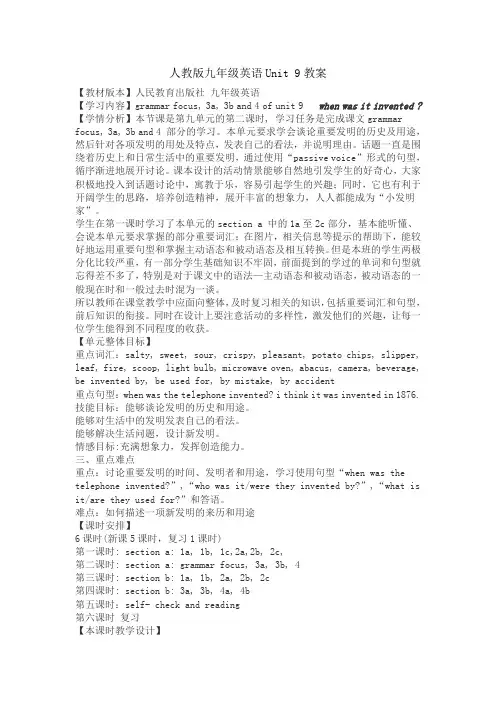
人教版九年级英语Unit 9教案【教材版本】人民教育出版社九年级英语【学习内容】grammar focus, 3a, 3b and 4 of unit 9 when was it invented ? 【学情分析】本节课是第九单元的第二课时, 学习任务是完成课文grammar focus, 3a, 3b and 4 部分的学习。
本单元要求学会谈论重要发明的历史及用途,然后针对各项发明的用处及特点,发表自己的看法,并说明理由。
话题一直是围绕着历史上和日常生活中的重要发明,通过使用“passive voice”形式的句型,循序渐进地展开讨论。
课本设计的活动情景能够自然地引发学生的好奇心,大家积极地投入到话题讨论中,寓教于乐,容易引起学生的兴趣;同时,它也有利于开阔学生的思路,培养创造精神,展开丰富的想象力,人人都能成为“小发明家”。
学生在第一课时学习了本单元的section a 中的1a至2c部分,基本能听懂、会说本单元要求掌握的部分重要词汇;在图片,相关信息等提示的帮助下,能较好地运用重要句型和掌握主动语态和被动语态及相互转换。
但是本班的学生两极分化比较严重,有一部分学生基础知识不牢固,前面提到的学过的单词和句型就忘得差不多了,特别是对于课文中的语法—主动语态和被动语态,被动语态的一般现在时和一般过去时混为一谈。
所以教师在课堂教学中应面向整体,及时复习相关的知识,包括重要词汇和句型,前后知识的衔接。
同时在设计上要注意活动的多样性,激发他们的兴趣,让每一位学生能得到不同程度的收获。
【单元整体目标】重点词汇:salty, sweet, sour, crispy, pleasant, potato chips, slipper, leaf, fire, scoop, light bulb, microwave oven, abacus, camera, beverage, be invented by, be used for, by mistake, by accident重点句型:when was the telephone invented? i think it was invented in 1876. 技能目标:能够谈论发明的历史和用途。
新目标英语九年级unit9精品教学案
第 课时教学案U9第 1 课时(周课时)课时(周课时) 课题 Unit 9 When was it invented ? 课型New lesson 教法Teaching and learning 教学 目标 及重难点1. 学习掌握本节要求的词汇:invent , calculator, be used for , scoop, adjustable, heel, battery-operated, slippers , scoop, 等2. 学习运用以下句型:When was the car invented ?It was invented in 1885. When were electric slippers invented ? They were invented last year. Who were they invented by ? They were invented by …What are they used for ? They are used for seeing in the dark.3.语法方面学习运用被动语态的一般过去时。
Was /were +done教学 准备 Tape and CAI 教 学 过 程教学 步骤教师活动学生活动Step One Revision Step 2 Presentation Step 3 2a, 2b 1.提问检查前单元课文的背诵。
2.师生通过问答引入新课:T:Life was difficult for people in the past,But now it is easy for us because of some new inventions.for examples, TV ,cars , telephone, mobile phone, computer,calculator,microwave oven … 1.提问:Do Do you you you know know know when when when the the the TV TV TV was was invented ? TV was invented in 1927. The telephone was invented in 1876. The car was invented in 1885. The computer was in 1976. 2.教学1b 的内容,播放录音,然后记下每样发明物的发明时间:提名请学生填写表格,然后操练朗读对话。
九年级英语-人教版新目标初中英语unit9_when_was_it_inventedAqqwUM
人教版新目标初中英语unit9 when was it invented?第一课时听力教学案例分析一、教学内容分析及反思。
这节课是听说课,主要是依靠口头训练,检验与促进语言的吸收与听力能力。
听力材料内容是有关学生比较感兴趣的话题:生活中常见的发明。
如电视,小汽车,电脑等。
唤醒学生、激起学生的表达欲望,从而不断发展学生的听、说、读、写的能力。
大家都知道听说课就是一个对语言的感知、解析、和应用的过程。
我记得美国认识心理学家安德森(Anderson)曾认为:听力理解过程可划分为三个阶段,即感知过程(perceptual processing)、解析过程(parsing)和应用过程(utilization)。
这三个过程相互交迭、循环往复、不断修正。
案例中,教师通过展示图片和问题讨论,引入本节课学习的话题——When was…invented ?从学生身边的发明—电话切入话题,引出重点句型。
继而引导学生谈论生活中常见的发明。
比较直观的方法,另外这节课在听力之前应先让学生进行一个“Free talk”,让学生自由发挥谈论有关一些常见的发明。
这看似是一个口语活动,与听力无关,其实不然。
它是听力训练中的一个重要环节。
这个free talk就是语言的感知过程。
然后引出本节课的语言目标When was it invented?让学生带着问题去听,其实这是一个对语言目标的解析过程。
最后再利用对话的形式(work in pairs)对一些常见发明进行对话,这是对目标语言的应用。
在应用过程中,输入到学生大脑中的话语意义和学生的现有知识相互联系起来,于是学生就对整个口头语篇产生丰富的先前知识,并能把先前的知识更好地组织起来,加以更策略地运用。
应用过程既是对听力理解力的检测,又是对听力理解力的促进,为听力能力的进一步发展提供了可能。
因此,在听力教学中必须要有口头训练来检验与促进语言的吸收与思维能力(即听力能力)的发展。
唯有听的语言输入活动之后,进行必要的语言输出活动,听力教学活动才算完整、有效。
九年级英语全册Unit9Whenwasitinvented教案人教新目标版
Unit 9: When was it invented? Part 1: Teaching Design第一部分:教学设计(The telephone was invented in 1876・)Objectives•To learn to understand and use passive voice (questions and statements) •To listen and speak about inventions which were made in the past Procedures■Warming up by learn about passive voice (questions and statements) Hello, class・ What is this? Yes, it is a telephone.Let* s go on to other inventions・la Grouping and speakingIn groups of four, look at the things on page 68. Number them in the order of their invention. A:I think the telephone was invented before the car・B:Well, I think the telephone was invented after the car・A:I think the television was invented before the computer・B:Well, I think the television was invented after the computer.A:I think the calculator was invented before the plane・B:Well, I think the calculator was invented after the planer・lb Listening and matchingListen to the recording and match the inventions with the dates.The things in the pictures were invented in the following order.Now go page 132 to read the conversation・ While reading try to find all the sentences withthe °make/s me + infinitive, make/s me + adjective structure"・ And also cut/ the sentence into thought groups, study all the predicates, circle all the linking words and underline all the expressions・ That* s grammar study, in deed・Now read the conversation again to turn it into an article.lc Pairing and speakingIn pairs, one covers the dates and the other asks him when the things in the pictures on page68 were invented. Then change roles and practice again.Period 2: Listening and Speaking (Page 69)(What arc they used for?)Objectives•To learn to understand and use passive voice (questions and statements)•To listen and speak about what inventions were used forProcedures■Warming up by studying the ^Target Language MHello, class・ What is this? Yes, it is a TV set? What is it used for? Right, you are right・ It is used for watching reports and films and so on at home・Look at the sentences again and note the structure・2a Listening and numbering文档从网络中收集,已重新整理排版.word版本可编辑•欢迎下载支持.Next you are going to listen to a conversation and number the inventions in the order that you hear them・The inventions are heard in the following order・battery-operated slippers-*heated ice cream scoop-*shoes with adjustable heelsNow go page 133 to read the conversation・ While reading try to find all the sentences with the passive voice structure・And also cut/ the sentence into thought groups, study all the predicates, circle all the linking words and underline all the expressions・ That* s grammar study, indeed・Now read the conversation again to turn it into an article・2b Listening and matchingYou shall listen to the recording again and match the items in the chart on page 69 in columnsA, B, and C・Role play the conversations using the information in the chart in the middle of page 69. Payattention to the formation of passive voice・Period 3: Writing and Speaking (Page 70)(Helpful inventions and annoying inventions)Objectives•To learn to understand and use passive voice (questions and statements)•To listen and speak about helpful inventions and annoying inventionsProcedures■Warming up by telling about inventions made in 20'** centuryHello, class・ What is this? It is a radio. When was it invented? Right it was invented in 1901・ Then what is this?Then what do you think are the most helpful inventions? What do you think are the most annoying inventions?3a Pairing and writingThere are two kinds of inventions・ One is helpful invention, and the other is annoying invent io n. Now in pairs make a list of five helpful inventions and five annoying inventions ・In pairs discuss your opinions in 3a with your partner.A:What do you think is the most helpful invention?B:I think the most helpful invention is the light bulb・A: Why is that?B: Well, it gives people more time to work and play every day.A:What do you think is the most annoying invention?B: I think the most helpful invention is the atomic bomb.A: Why is that?B: Well, it gives people more power to kill others・A:What do you think is the less helpful invention?B: I think the less helpful invention is the car・A: Why is that?B: Well, it makes it possible for people to move to distant places faster・4 Grouping and speakingIn groups of four imagine you are left alone on a small island in the sea・ If you are allowed to takefive inventions along with you, what would you take?I like to take the followings with me.A : I *d like to have a flashlight because I could light the way ・ B: I * dlike to have a hand phone because I could call 110 if I have problems ・ A : I * d like to have a gun because I could kill animals for food ・• • •Period 4: Reading, Writing, Listening and Speaking(Potato chips were invented by mistakes •丿Objectives•To learn to understand and use passive voice (questions and statements) • To listen and speak about how inventions were madeProcedures■Warming up by making passive sentencesHello, everyone ・ This week we are learning to use passive voice (questions and statements)・ Now we shall begin by making passive sentences (questions and statements) with verbs learned so far in this book ・On page 71 you will find some adjectives used to describe how food tastes ・ Look at the pictures and write them under the correct picture ・ Note that some pictures have more than one word ・I like to drink sour milk・These oranges are as sour as lemons・lb Thinking and writingOn page 71 you will find in the box some adjectives used to describe food・ Now read each of them and write the name of a different food after each of them.Sweet apple-^ crispy crackers-^ salty water-* sour :rice2a Listening and circlingOn page 71 in the middle of the page you will find 6 statements・ Listen to the recording and tick/ T or F・(Keys: 1. T 2・ F 3・ T 4・ F 5・ F 6. T)Go to page 133 and read the conversation・ While reading try to find all the sentences with passive voice structure・ And also cut/ the sentence into thought groups, study all the predicates, circle all the linking words and underline all the expressions・ That * s grammar study, too.be invented by mistake, on the bag, back in 1853, one day, in the restaurant, send… back, a plate of fried potatoes, be cut too thick, in a bad mood, cut…:really, really thin, cook***a long time, sprinkle••- onhate…,asked foxtell…about•••, thinly-sliced, crispy, salty potato chips, a cool story Now read the conversation again to fill in the following cloze with one word・10 hate 11 asked 12 about 13 crispy 14 And 15 cool2b Listening and completingYou are going to listen to the conversation and complete the sentences on page 71 in the box・2c Pairing and speakingNext you are going to role play the conversations about the invention of the potato chip・ Use the information from the activities above・文档从网络中收集,已重新整理排版.word版本可编辑•欢迎下载支持. Period 5: Reading, Writing and Speaking (Page 72)(Who invented tea?)Objectives•To learn to understand and use passive voice (questions and statements)•To read and speak about what people inventedProceduresKWarming up by reading aloud the textHello, class・ The single most important activity for learning English is reading the text aloud to the tape・ Now open your book to page 72. Read aloud the text while listening to the tape・3a Reading and answeringNow go to page 72 to read the text・ While reading try to find all the sentences in passive voice. And also cut/ the sentence into thought groups, study all the predicates, circle all the linking words and underline all the expressions・ That, s grammar study, indeed・After you read, answer the four questions following the article・Read the text and turn it into a conversation.3b Reading and writingOn page 72 you will find notes in the box on the left・ Write an article using the notes about the invention of the flying disk・4a Thinking and inventingWe all have things that we don' t liking doing・ Why not think of an invention that could help you. Write the details of your invention in the chart on page 72.In pairs ask each other questions about inventions, and try to sell your invention to your partner・You may begin as is shown in the box on page 72.。
人教新目标九年级英语全册教案Unit9教案(1)
Unit 9 I like music that I can dance to. 教案教学内容分析本单元以music为中心话题,让学生学会由关系代词that and who引导的定语从句谈论自己所喜爱,学习表达自己的爱好。
话题从音乐扩展到生活的其他内容,和学生的生活联系紧密,学生会有参与的积极性。
而语法核心项目定语从句是初中阶段必需了解的一种句法结构。
本单元将此语法的学习渗透到话题中步步递进展开来达到学习目的,完成学习任务。
学情分析1、学生英语基础比较薄弱。
之前已经学习了用简单的形容词描述各种事物,也基本学会了如何表达自己的爱好。
2、此时的九年级学生对从句的特点有一定的理解。
对定语从句也接触教多,只是没有系统展开学习;但是,学习定语从句时候容易受母语影响,教师要考虑展开适当的深度,不能增加学生的学习负担。
教学目标1.知识目标词汇: V ocabulary语言结构:Rosa likes music that’s quiet.I love singers who write their own music.We prefer music that has great lyrics.语法:掌握who和that引导的定语从句2.能力目标1)学会用定语从句表达自己对某事物的好恶2)用定语从句介绍自己喜欢的书籍.音乐.电影等话题3)学会表达自己的好恶。
3.文化意识目标了解基本的西方音乐类型。
理解音乐,饮食和文化之间是相互影响,相互促进的。
学会理解不同人的音乐喜好及其他艺术形式的鉴赏喜好.4.学习策略目标1)交际策略:通过讨论自己的爱好,对事物做出评论等方式,交流彼此的观点,相互学习。
2)资源策略:充分利用各种媒体资源,感受不同的音乐和电影,为语言学习创造更多的情境与机会。
5.情感目标1)通过讨论自己的喜好,促进养成健康向上的生活习惯。
如健康的饮食习惯。
2)通过学习写评论,学习正确评论事物,形成健康的审美情趣。