
英汉翻译中的词类转换
On weekends, they usually give the classroom a thorough cleaning. 他们通常在周末把教室彻底地打扫一番。
切坏事的化身。
转换成名词的情况——形容词转换成名词
1)英语中,当形容词前加上定冠词the 时,常 转换成名词
They did their best to help the sick and the wound. 他们尽了最大的努力帮助病号和伤员。
The rich or the poor, all share the equal rights of receiving higher education. 不论是富人还是换成名形容词
2)英语动词译成汉语名词时,修饰该动词的副 词可译作形容词。
The sun affects tremendously both the mind and body of a man. 太阳对人的身体和精神都有极大的影响。
转换成形容词的情况—副词和名词的相互转换
了他们的一些好感。
other forms
其它词类的转换——形容词和副词的相互转换
由于英语的名词或动词可以分别转换为汉 语的动词和名词,而修饰名词的形容词和修饰 动词的副词也可以随之转换为汉语的副词和形 容词。
转换成形容词的情况——副词转换成名形容词
1)英语名词译作汉语动词时, 修饰该名词的形 容词可译作汉语副词。
英语中的很多介词有很强的动作感。 虽然理论上属于虚词,但在实践中常 常可以表示动作行为的进展状态和程 度,发挥动词的作用。
转换成动词的情况——介词转换成动词
Millions of the people in the mountainous areas are finally off poverty. 千百万山区人终于摆脱了贫困
The sight and sound of so many cute babies reminded her of her own two-year-old. 看到这么多可爱的宝宝,听到他们的声音,她不
由想起了自己两岁的孩子。
转换成动词的情况——名词转换成动词
3) 英语中有些以-er 或-or 结尾的名词,不表身份 和职业,而是含有较强动作含义时也可译作动词
医生说他们不敢肯定能否救得了他的命。 They were suspiciousand resentfulof him.
他们不信任他,讨厌他。
转换成动词的情况——副词转换成动词
英语中某些在形式上与介词相同的副词,可以 译作汉语动词
The manager let the experts in and others out. 经理让专家们进来,让其他人出去。
转换成形容词的情况——名词转换成名形容词
1)形容词派生的名词可转换成形容词
Independent thinking is an absolute necessity in study. 学习中的独立思考是绝对必需的。
We found difficulty in solving these matters alone. 我们觉得独自解决这些问题是困难的。
Every day he drives her to and from work. 他每天开车接送她上下班。
This proposal was against the spirit of group. 这个提议违背了集体主义精神。
转换成动词的情况——形容词转换成动词
英语中表示知觉、情感、欲望等心理 状态的形容词,在系动词之后作表语时, 可转译成汉语动词,如confident, certain,careful, cautious, angry, sure, ignorant, afraid, doubtful, aware,concerned, glad, delighted, sorry, ashamed, thankful, anxious,grateful, able 等。
I can’t teach you English. I think my little brother is a better teacher than I. 我不能够教你英语,我认为我弟弟比我教得好。
She is a lover of Chinese food. 她很喜欢吃中国菜。
转换成动词的情况——介词转换成动词
This textbook will be out pretty soon. 这本教材很快就要出版了
to Noun
转换成名词的情况——动词转换成名词
英语中有些动词,特别是名词派生的动词,在汉语中 很难找到相应的动词,翻译中常将这类动词转换成汉 语的名词。
As the war progressed, he would symbolize their frustrations, the embodiment of all evils. 随着战争的进行,他成了他们受挫的象征,成了一
词类转换在英汉翻译中的体现
转换成动词的情况 转换成名词的情况 转换成形容词的情况 其它词类的转换
to Verb
转换成动词的情况——名词转换成动词
1)由动词派生的名词转译成动词
The government called for the establishment of more technical schools. 政府号召建立更多的技术学校。
转换成名词的情况——形容词转换成名词
2)英语中,有些表事物特征的形容词用作表语 时,往往转换成汉语名词
Computers are more flexible, and can do a greater variety of jobs. 计算机的灵活性比较大,因此能做更多种不
同的工作。
to Adjective
转换成形容词的情况——名词转换成名形容词
2)某些名词加不定冠词作表语时,往往可以转 换成形容词
The blockade was a success. 封锁很成功。
转换成形容词的情况——副词转换成名形容词
英语中的副词比汉语中的副词用得更广泛,许 多副词可以转换成形容词。
Earthquakes are closely related to faulting。 地震与地层断裂有密切的关系。
1)副词转换成名词
It was officially announced that Paris is invited to the meeting. 官方宣布,巴黎应邀出席会议。
转换成形容词的情况—副词和名词的相互转换
2)名词转换成副词
The new mayor earned some appreciation by the courtesy of coming to visit the city poor. 新市长有礼貌地前来访问城市贫民,获得
转换成动词的情况——形容词转换成动词
They are quite content with the data obtained from the experiment.
他们满足于在实验中获得的数据。 Doctors have said that they are not sure they can save his life.
The book is a reflection of Chinese society in the 1930s. 这本书反映了30年的中国社会。
转换成动词的情况——名词转换成动词
2)具有动作意义的名词可以转译成动词
My suggestion is that he should quit smoking at once. 我建议他立即戒烟。
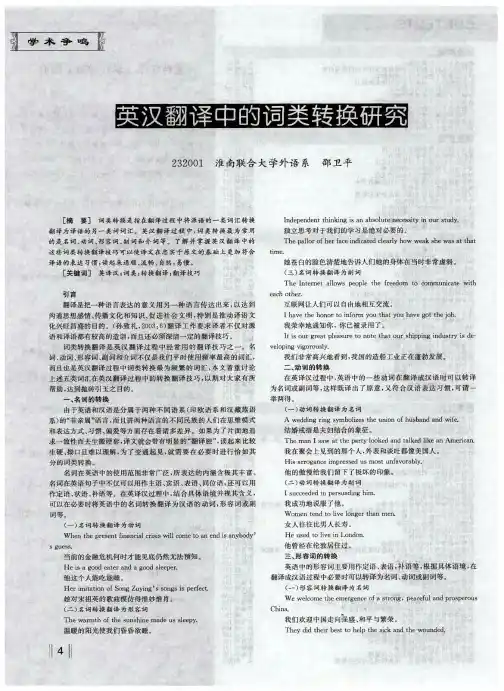
英汉翻译中的词类转换研究
a r r o
。
分 的词 类转换
g
a n c e
im p
r e s s e
d
U S
m o s t
u n
fa
。
v o r a
b ly
.
名 词 在 英 语 中 的 使 用 范 围非 常 广 泛 所 表 达 的 内 涵 含 极 其 丰 富
,
、 、 、
。
他 的 傲 慢 给 我 们 留 下 了 极 坏 的 印象
、
一
种 语 言传 达 出 来 以 达 到
, ,
互 联 网 让 人 们 可 以 自由地 相 互 交 流
I ha
v e
。
沟 通 思 想 感 情 传播 文 化 和 知 识 促 进 社 会 文 明 特 别 是 推 动 译 语 文
、
t
he ho
n o r
to
,
in fo
m r
y
o u
t
ha
。
t yo
u
ha v
r s u a
din g h im
.
可 以 在 必 要 时 将英 语 中 的 名 词 转 换 翻 译 为 汉 语 的 动 词 形 容 词 或 副
我成 功 地 说 服 了他
W
o m
e n
。
词等
。
t
e n
d
to
liv
e
lo
。
n
g
e r
t
ha
n
m
e n
.
(
一
) 名 词 转 换 翻 译 为动 词
n
女 人 往 往 比男 人 长 寿
英汉翻译中的词性转换
英汉翻译中的词性转换一、本文概述翻译,作为语言交流的桥梁,在跨文化、跨语言的交流中扮演着至关重要的角色。
英汉翻译,作为其中最为常见和重要的分支之一,其技巧与方法对于提高翻译质量和效率具有深远的影响。
在英汉翻译实践中,词性转换是一种常见的翻译技巧,其运用得当与否直接影响到译文的质量。
本文旨在探讨英汉翻译中的词性转换现象,分析其必要性、常见类型及其在英语汉语言特点下的应用,以期为翻译实践提供有益的参考和指导。
本文将简要介绍英汉翻译中词性转换的必要性,阐述为何在翻译过程中需要进行词性转换,以及这种转换对于提高翻译质量的重要性。
本文将详细分析英汉翻译中常见的词性转换类型,包括名词与动词之间的转换、形容词与副词之间的转换等,并结合具体实例进行说明。
本文将探讨英汉翻译中词性转换的应用策略,结合英语和汉语的语言特点,分析如何在实际翻译中灵活运用词性转换技巧,以实现译文的准确、流畅和地道。
通过本文的阐述和分析,希望能够帮助读者更好地理解和掌握英汉翻译中的词性转换技巧,提高翻译实践中的应变能力和翻译质量,推动英汉翻译事业的不断发展和进步。
二、词性转换的基本概念词性转换,即在翻译过程中,将源语言中的某一词类转换为目标语言中的另一词类,而不改变其原意,是英汉翻译中一种常见的翻译技巧。
这种技巧的运用,旨在使译文更加地道、流畅,更符合目标语言的表达习惯。
在英汉翻译中,由于两种语言的语法结构和表达习惯存在差异,因此,翻译时常常需要进行词性转换。
例如,英语中的动词在汉语中可能需要转换为名词、形容词或副词;同样,汉语中的名词在英语中也可能需要转换为动词、形容词或副词。
这种转换并不是随意的,而是需要基于对源语言和目标语言的理解和掌握,以及对翻译原则的遵循。
词性转换的翻译技巧可以分为两类:一是完全转换,即源语言中的某一词类完全转换为目标语言中的另一词类;二是部分转换,即源语言中的某一词类在转换为目标语言时,仍然保留部分原词类的特性。
浅析英汉翻译中词类转换法的运用
浅谈英译汉中的英汉词性的转换英汉两种语言在词汇和语法结构方面有许多不同之处。
因此,在英译汉过程中,不能逐词逐句翻译。
一方面,汉语词大部分是一词一类,而英语常用词有许多都是一词多类,有的甚至多达五类。
另一方面,汉语一个词能充当的句子成分较多,一般无须转换词类;而英语一个词能充当的句子成分较少,充当不同成分需要转换词类。
翻译时,在忠实原意的前提下,可以把一些英语词性作适当调整,如英文的名词可以转为汉语的动词、副词以及形容词;英文的动词可以转为汉语的名词及副词等。
学过英语的人都知道,英语属于印欧语系,汉语属于汉藏语系。
英汉两种语言在词汇和语法结构方面有许多不同之处。
因此在英译汉的过程中,有些句子可以逐词翻译,有些句子则由于英汉两种语言的表达方式不同,就不能以“挖个坑填个萝卜”方法来逐词对译。
翻译时原文的有些词在译文中需要转换词类,才能使汉语译文通顺自然,即翻译时不必拘泥于原文的表层结构,可以在忠实原意的前提下将原文中有些词的词性转换为汉语的其他词性。
现将英语中的四类主要词性和汉语词性之间的转换介绍如下:一、英语名词的转换(一)英语的名词译成汉语的动词英语和汉语比较起来,汉语中动词用的比较多一些,在英语句中只用一个谓语动词,而在汉语句中可以几个动词连用,因此在一些情况下可以把英语的名词译成汉语的动词,这主要有下列两种情况:作为习语主体的名词往往可以转化为动词。
如:to have a rest中的rest,make no mention of中的mention,pay attention to中的attention,又如take care of中的care这几个词都是短语中的中心词,这些词虽然是名词,但几个短语表达的都是一种动作,再者,rest,mention和care本身既可作名词又可作动词,因此这样有动作意味的名词可以翻译成汉语的动词。
因此这几个英语短语中的名词可以翻译成汉语动词休息、提及、注意和照顾。
浅析英汉翻译中的词类转换

浅析英汉翻译中的词类转换【摘要】英汉两种语言属于不同语系,两种语言在表达方式上存在巨大差异。
在英汉翻译过程中,由于语法和表达习惯上的差异,必须改变英语原文中某些词语的词类才能传达出原文的准确意思。
本文对主要的词类转换方式在英汉翻译中的应用进行了分析和归纳。
【关键词】语言;英汉翻译;词类转换A Brief Study of Conversion in English-Chinese Translation【Abstract】Owing to the syntactical differences between English and Chinese, it is impossible to keep the original word class of the English words and convey their meanings precisely in the process of English-Chinese translation. Therefore, a word belonging to a word class has to be converted to another word class in order to produce a readable and coherent sentence. In this paper, the major forms of conversion in English-Chinese translation are analyzed and summarized.【Key words】Language;English-Chinese translation;Conversion0引言翻译,是用不同的符号系统来表达相同意思的一种语言活动[1]。
作为一种语言活动,翻译涉及不同的语言与文化,其实质是将一种语言转换成另一种语言,用一种语言把另一种语言所表达的思想、感情、风格等忠实地重新表现出来。
英汉翻译的技巧转换法共37页PPT资料
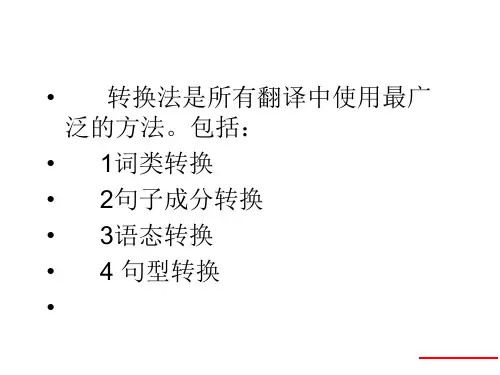
• 3、英语表示感觉和心里状态的形容词 汉语动词
• They are quite content with the data obtained from the experiment.
• 9,英语副词 汉语形容词
• Sulphuric acid is one of the extremely reactive agents.
• 硫酸是极强烈的反应剂之一。
• He is rightly accepted the doctor’s advice.
• 他接受医生的建议是正确的。
• The electronic computer is chiefly characterized by accurate and quick computation.
sweetness of light. • 追求完美就是追求美好和光明。 • There is an unseemly exposure of the mind,
as well as of the body. • 一个人赤裸身体是不体面的;同样,暴露着思想
也是不体面的。 • I was ever of opinion, that the honest man
• She married a man of her own choice against her parents’ will.
• 她违背父母的意愿,嫁给了一个自己选择的男人。 • “coming!” away she skimmed over the lawn,
8.词类转译
12
8. 词类转译——汉译英的词类转换
2. 名词转译为动词
1) 结婚戒指是夫妇结合的象征。 A wedding ring symbolizes the union of husband and wife. 2) 工厂必须把增加产量作为自己的目标。 The factory must aim at an increase in production.
3
8. 词类转译——英译汉的词类转换
2. 动词转译为名词
A. 名词派生的动词 1) An interest in people’s deepest feelings characterizes all her writings. 对人们最深沉感情的关注,是她所有著作的特征。 2) She personifies beauty and grace.
她是美丽与优雅的化身。
B. 名词转用的动词 1) You can see what a Dodo looked like from the picture. 你可从照片中得知渡渡鸟的模样。 2) These exercises are designed to strengthen the muscles. 这些锻炼的目的是为了增强肌肉。
1) We have ruled out tool use and invention as ways of telling animal behavior from human behavior.
我们已经把使用和发明工具,从区分动物和人类行为的方法 中排除出去了。 2)Another way of dealing with enemies is either to have a very good protection or to be able to escape quickly. 还有一种对付敌人的方式是,要么防卫可靠,要么能够迅 速逃跑。
初中汉译英词类转译法的例子
初中汉译英词类转译法的例子一、什么是汉译英词类转译法汉译英词类转译法是在翻译中,将汉语中的词类转换成英语中对应的词类的一种翻译方法。
由于中英两种语言的词类体系存在差异,采用该方法可以更准确地表达原文的意思。
二、例子1:汉语中的名词转译成英语中的动词1.汉语句子:他飞了起来。
英译:He flew up.2.汉语句子:她唱歌跳舞。
英译:She sings and dances.3.汉语句子:他坐了下来。
英译:He sat down.三、例子2:汉语中的动词转译成英语中的名词1.汉语句子:开会的时候,请关掉手机。
英译:Please turn off yourphone during the meeting.2.汉语句子:他在学校读书。
英译:He studies at school.3.汉语句子:请别打扰我。
英译:Please don’t disturb me.四、例子3:汉语中的形容词转译成英语中的副词1.汉语句子:她穿得很漂亮。
英译:She looks very beautiful.2.汉语句子:这件事情做得很好。
英译:This thing is done very well.3.汉语句子:他说得有道理。
英译:He speaks persuasively.五、例子4:汉语中的副词转译成英语中的形容词1.汉语句子:他跑得很快。
英译:He runs very fast.2.汉语句子:她说话听得懂。
英译:Her speech is understandable.3.汉语句子:她笑得很开心。
英译:She laughs happily.六、例子5:汉语中的数词转译成英语中的名词或形容词1.汉语句子:他过了六十岁生日。
英译:He had his 60th birthday.2.汉语句子:我买了十本书。
英译:I bought ten books.3.汉语句子:那个村庄有一千多人。
英译:There are over a thousandpeople in that village.七、例子6:汉语中的量词转译成英语中的of短语1.汉语句子:一杯咖啡英译:a cup of coffee2.汉语句子:一把椅子英译:a chair3.汉语句子:一条狗英译:a dog八、总结汉译英词类转译法是一种有效的翻译方法,特别适用于将中文翻译成英文时,准确表达原文意思。
英语翻译之词类转译法
名词→ 转译成动词
再如: Xu Beihong’s paintings of horses are exceptionally good. 原顺序:徐悲鸿的马的画像特别好。 改为:徐悲鸿画马画得特别好。 试译: Insulin is used in the treatment of diabetes. 胰岛素用于治疗糖尿病。 The government called for the establishment of more technical schools. 政府号召建立更多的技术学校。
名词→ 转译成动词
单击此处可添加副标题
英含有动作意思的名词转译成动词。 如:The thought of fat meat makes me sick. 一想到肥肉我就恶心。 A view of the village can be obtained from the tower. 从塔上可以看见这个村庄。 Tom looked his good-bye at the garden. 汤姆看了看园子,跟它告别。
1、英语中很多名词派生的动词或由名词转用的动词,在汉语中往往不易找到合适的动词,这时可以转译成名词。 例:The earth is shaped like a big ball. 地球的形状像个大球。 His speech impressed(使…印象深刻) the audience deeply. 他的演讲给听众的印象很深刻。 Socialist revolution aims (瞄准)at liberating the productive forces. 社会主义革命的目的是为了解放生产力。
英语翻译转换法
n.—adj.
四). 其它词类转译
参考译文: 1. We took brief, restless naps.
我们短短地,不安地睡了几次.adj.—adv.
一、词类转换
概念:将源语中属于一种词类的词语翻译成为目 标语中属于另一类词类的词语的翻译方法。
转译为动词 转译为名词 转译为形容词 其它词类转译
(一) 英语名词、介词、形容词或副词转换为汉语动词
1. An acquaintance of world history is helpful to the study of current affairs. 读一点世界史,对学习时事是有帮助的.
2. A view of Mt. Fuji can be obtained from here. 从这里可以看到富士山。
3. Up the street they went, past stores, across a broad square, and then into a huge building. 他们沿着大街走去,经过许多商店,穿过一个大广场,然后进入了一 座大厦.
2. This film impressed me deeply. 这部电影给了我深刻的印象adv.—adj.
3. He is physically weak but mentally sound. 他身体虽弱,但思想健康。adv.—n.
Reference:
1. He is no smoker, but his father is a chainsmoker.
英汉互译八种技巧
mathematics subtle; natural philosophy deep; moral grave; logic and rhetoric able to contend. ❖ 读史使人明智,读诗使人灵秀,数学使人周密,科 学使人深刻,伦理使人庄重,逻辑修辞之学使人善 辩。
thought and thought it over and over. 他有又上床去,左思右想,想个不停。
8
这种人闹什么东西呢?闹名誉,闹地位,闹出风头。 What are they after? They are after name, after position, and they want to cut smart figure.
of success. ❖ 不要害怕失败。失败是成功之母。 ❖ Translation from Chinese into English is not
so easy as that from English into Chinese. ❖ 汉译英不像英译汉那么容易。 ❖ A large family has its difficulties. ❖ 大(家庭)有大(家庭)的难处。
常用的翻译技巧
1. 重复法 (repetition) 2. 增译法 (amplification) 3. 减译法 (omission) 4. 词类转换法 (conversion) 5. 词序调整法 (inversion) 6. 分译法 (division) 7. 正说反译, 反说正译法 (negation)(反译法) 8. 语态 变换法 (the change of the voices)