
英语中的16种时态.备课讲稿
(完整版)16种时态及语态总结
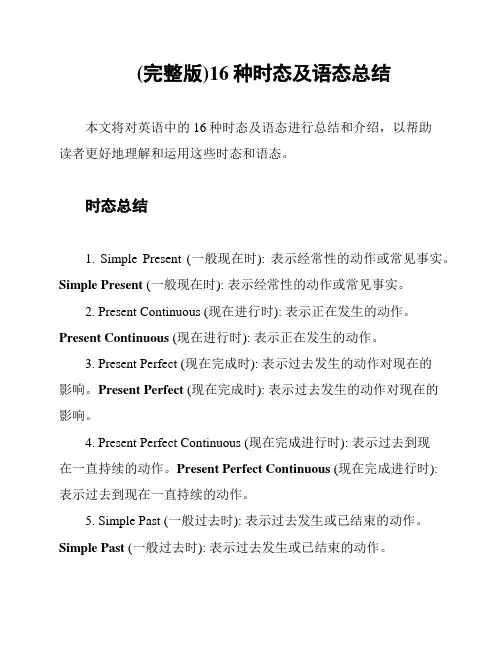
(完整版)16种时态及语态总结本文将对英语中的16种时态及语态进行总结和介绍,以帮助读者更好地理解和运用这些时态和语态。
时态总结1. Simple Present (一般现在时): 表示经常性的动作或常见事实。
Simple Present (一般现在时): 表示经常性的动作或常见事实。
2. Present Continuous (现在进行时): 表示正在发生的动作。
Present Continuous (现在进行时): 表示正在发生的动作。
3. Present Perfect (现在完成时): 表示过去发生的动作对现在的影响。
Present Perfect (现在完成时): 表示过去发生的动作对现在的影响。
4. Present Perfect Continuous (现在完成进行时): 表示过去到现在一直持续的动作。
Present Perfect Continuous (现在完成进行时): 表示过去到现在一直持续的动作。
5. Simple Past (一般过去时): 表示过去发生或已结束的动作。
Simple Past (一般过去时): 表示过去发生或已结束的动作。
6. Past Continuous (过去进行时): 表示过去某个时间段内正在进行的动作。
Past Continuous (过去进行时): 表示过去某个时间段内正在进行的动作。
7. Past Perfect (过去完成时): 表示过去某个时间点之前已经完成的动作。
Past Perfect (过去完成时): 表示过去某个时间点之前已经完成的动作。
8. Past Perfect Continuous (过去完成进行时): 表示过去某个时间点之前一直持续的动作。
Past Perfect Continuous (过去完成进行时): 表示过去某个时间点之前一直持续的动作。
9. Simple Future (一般将来时): 表示将来要发生的动作。
英语十六种时态表格总结课件.doc

WORD格式整理一般现在时、一般过去时时态名称结构常连用的词主要用法例句陈述句:I am an office worker.1 be动词用He is so lazy. They are at home now. am/is/are 表否定句:I am not Tim.示,之后接名She is not very beautiful.词,形容词或They are not in the office.介词。
often;usually; 一般现在时表一般疑问句:Are you an officeassistant?Is she beautiful?every ⋯;2 行为动词用V原形或sometimes;一般always;V-s/es ,引导现在never;疑问句和否定时once/twice/ ⋯ a句,用do或week/month/year;ondon’t ;第三人称时用doesSundays/Mondays/⋯.;或doesn’t,有does 出现动词用原形;第三人称陈述句V s后加或es. 示没有时限的持久存在的习惯性的动作或陈述句:I work in Shanghai.状态,或现阶He works at home.段反复发生的动作或状态,或一般真理Davy never watches TV at home.否定句: I don ’t like the food in KFC.Davy doesn’t like the food in KFCeither. 一般疑问句:Do you want a cup of coffee? Does shelivenear thesubway station?陈述句:I was a big boss.He was beautiful.一般过去时。
1.be动词用过去式was或yesterday;the day beforeyesterday;lastwere 表示。
16种时态及语态总结
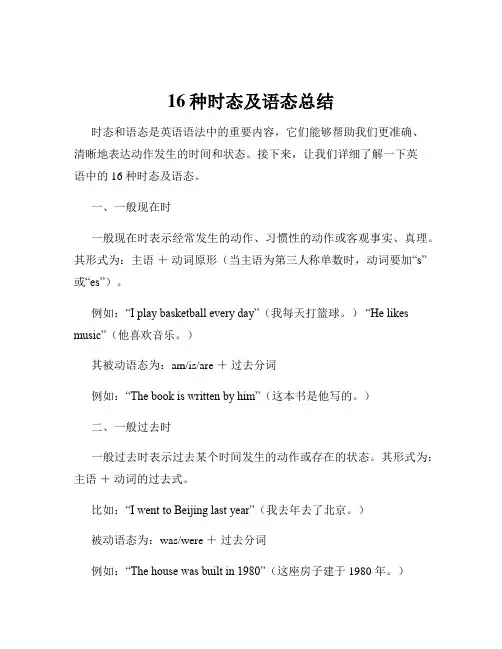
16种时态及语态总结时态和语态是英语语法中的重要内容,它们能够帮助我们更准确、清晰地表达动作发生的时间和状态。
接下来,让我们详细了解一下英语中的 16 种时态及语态。
一、一般现在时一般现在时表示经常发生的动作、习惯性的动作或客观事实、真理。
其形式为:主语+动词原形(当主语为第三人称单数时,动词要加“s”或“es”)。
例如:“I play basketball every day”(我每天打篮球。
)“He likes music”(他喜欢音乐。
)其被动语态为:am/is/are +过去分词例如:“The book is written by him”(这本书是他写的。
)二、一般过去时一般过去时表示过去某个时间发生的动作或存在的状态。
其形式为:主语+动词的过去式。
比如:“I went to Beijing last year”(我去年去了北京。
)被动语态为:was/were +过去分词例如:“The house was built in 1980”(这座房子建于 1980 年。
)三、一般将来时一般将来时表示将来要发生的动作或存在的状态。
常见形式有:will +动词原形;be going to +动词原形。
例如:“I will visit my grandparents next week”(下周我将看望我的祖父母。
)“She is going to have a party”(她打算举办一个聚会。
)其被动语态为:will be +过去分词;be going to be +过去分词例如:“The meeting will be held tomorrow”(会议将在明天举行。
)“The sports meeting is going to be cancelled”(运动会将要被取消。
)四、过去将来时过去将来时表示从过去的某一时间来看将来要发生的动作或存在的状态。
其形式为:would +动词原形;was/were going to +动词原形。
16种英语时态总结归纳-高中.docx

16种英语时态总结归纳时态(Tense)是表示行为、动作和状态在各种时间条件下的动词形式。
因此,当我们说时态结构的时候,指的是相应时态下的动词形式。
英语时态分为 16 种:一般现在、一般过去、一般将来、过去将来时,以及这四者的进行时、完成时和完成进行时。
1. 一般现在时基本结构:①否定形式:①( do)be 动词;②行为动词am/is/are not; ②此时态的谓语动词若为行为动词,则在其前加don't, 如主语为第三人称单数,则用doesn't,同时还原行为动词。
一般疑问句:①把be 动词放于句首;②用助动词do 提问,如主语为第三人称单数,则用does,同时,还原行为动词。
用法:A) 表示现在发生的动作、情况、状态和特征。
B) 习惯用语。
C) 经常性、习惯性动作。
always, usually, often, sometimes, every week (day, year, month⋯ ), once a week, on Sundays, etc.例: He always helps others.(他总是帮助别人。
)D) 客观事实和普遍真理。
例: Earth runs around the sun. (地球绕着太阳转)E) 表示一个按规定、计划或安排要发生的动作(仅限于某些表示“来、去、动、停、开始、结束、继续”等的动词)可以与表示未来时间的状语搭配使用。
常见的用法是:飞机、火车、轮船、汽车等定期定点运行的交通方式。
例: The next train leaves at 3 o'clock this afternoon.(下一趟火车今天下午 3 点开车。
)How often does this shuttle bus run?(这班车多久一趟?)F)在时间和条件状语从句里经常用一般现在(有时也用现在完成时)表示将来事情。
例: When you have finished the report, I will have waited for about 3 hours. (等你完成这份报告的时候,我就已经等了将近 3 个小时了。
英语16种时态详细讲解
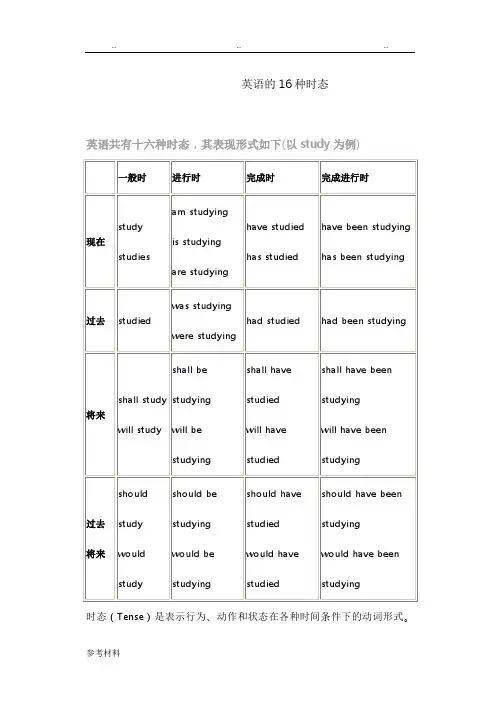
英语的16种时态英语共有十六种时态,其表现形式如下(以study为例)时态(Tense)是表示行为、动作和状态在各种时间条件下的动词形式。
因此,当我们说时态结构的时候,指的是相应时态下的动词形式。
1. 一般现在时英语时态分为16种:一般现在、一般过去、一般将来、过去将来时,以及这四者的进行时、完成时和完成进行时。
用法:A) 表示现在发生的动作、情况、状态和特征。
B) 习惯用语。
C) 经常性、习惯性动作。
例:He always helps others. (他总是帮助别人。
)D) 客观事实和普遍真理。
尤其要注意,如果前后文不是一般现在时,则无法保持主句、从句时态一致。
E) 表示一个按规定、计划或安排要发生的动作,(仅限于某些表示“来、去、动、停、开始、结束、继续”等的动词)可以与表示未来时间的状语搭配使用。
常见的用法是:飞机、火车、轮船、汽车等定期定点运行的交通方式。
例:The next train leaves at 3 o'clock this afternoon.(下一趟火车今天下午3点开车。
)How often does this shuttle bus run? (这班车多久一趟?)F) 在时间和条件状语从句里经常用一般现在(有时也用现在完成时)表示将来事情。
例:When you have finished the report, I will have waited for about 3 hours.(等你完成这份报告的时候,我就已经等了将近3个小时了。
)2. 现在进行时(be doing)用法:现在正在进行的动作。
3. 现在完成时(have done)用法:A) 表示动作到现在为止已经完成或刚刚完成。
例:I bought a new house, but I _________ my old one yet, so at the moment I have two houses.A) didn't sell B) sold C) haven't sold D) would sell答案是C) haven't sold。
英语时态讲解讲义PPT课件

★表示主语现在的状态、能力、爱好、职业、性格。
His mother is a doctor. ★表示客观真理、科学真理、自然界的普片现象或众人所知的
客观事实。
The moon goes around the earth. ★表示格言或警句。
All men die. ★在when, as soon as, before, while, so (as) long as等引导的时间
实意动词
V-s
主语是第三人称单数 + V-es
V-ies
have的第三人称单数为has
2021
7
1. He often __g_oe_s__ (go) to school on foot. 2. His character __is__ (be) like his father. 3. I will tell you when he _c_o_m_e_s(come) back. 4. Good begun __is__ (be) half done. 5. Bitter pills __h_a_v_e(have) wholesome effects. 6. As the old saying _g_o_e_s_ (go). 7. Light _tr_a_v_e_ls(travel) faster than sound. 8. Here c_o_m__es_ (come) the bus. 9. There __go_e_s__ (go) the bell. 10. If it d_o_e_s_n_’t_r_a_in( not rain) tomorrow, we’ll go to have a picnic.
16种时态
时。
例:Columbus proved that the earth is round:哥伦布证明了地球是圆的4) 现在时刻的状态、能力、性格、个性。
I don't want so much:我不想那么多Ann Wang writes good English but does not speak well:Ann Wang 的英文写得很好但说得不好比较:Now I put the sugar in the cup:现在我在杯子里放了糖I am doing my homework now(含义:我正在做我的家庭作业)注:用于操作演示或指导说明的示范性动作,表示言行的瞬间动作。
再如:Now watch me,I switch on the current and stand back. 第二句中的now是进行时的标志,表示正在进行的动作的客观状况,所以后句用一般现在时。
5﹞主将从现﹝主句用将来时从句用现在时表将来﹞①I will tell you,When Li Ming comes(含义:当李明来的时候我会告诉你)②I'll e-mail you as soon as I get to Beijing(含义:我一到达北京就发电子邮件给你)注:一般从句为时间状语从句「由When As soon as...引导的从句」条件状语从句「由If...引导的从句」6)表示按计划,规定要发生的动作,但仅限于少数动词如:begin,come,leave,go等The meeting begins at seven:会议七点开始一般过去时1)在确定的过去时间里所发生的动作或存在的状态。
时间状语有:yesterday,last week,an hour ago,the other day,in 1982等。
Where did you go just now(含义:你刚才去哪里了?)2)表示在过去一段时间内,经常性或习惯性的动作。
16种英语时态总结归纳.doc
16种英语时态总结归纳16种英语时态总结归纳英语时态分为16种:一般现在、一般过去、一般将来、过去将来时,以及这四者的进行时、完成时和完成进行时。
1.一般现在时用法:A)表示现在发生的动作、情况、状态和特征。
B)习惯用语。
C)经常性、习惯性动作。
例:Healwayshelpsothers.(他总是帮助别人。
)D)客观事实和普遍真理。
尤其要注意,如果前后文不是一般现在时,则无法保持主句、从句时态一致。
E)表示一个按规定、计划或安排要发生的动作,(仅限于某些表示“来、去、动、停、开始、结束、继续”等的动词)可以与表示未来时间的状语搭配使用。
常见的用法是:飞机、火车、轮船、汽车等定期定点运行的交通方式。
例:Thenexttrainleavesat3oclockthisafternoon.(下一趟火车今天下午3点开车。
)Howoftendoesthisshuttlebusrun?(这班车多久一趟?)F)在时间和条件状语从句里经常用一般现在(有时也用现在完成时)表示将来事情。
例:Whenyouhavefinishedthereport,Iwillhavewaitedforabout3hours.(等你完成这份报告的时候,我就已经等了将近3个小时了。
)2.现在进行时(bedoing)用法:现在正在进行的动作。
3.现在完成时(havedone)用法:A)表示动作到现在为止已经完成或刚刚完成。
例:Iboughtanewhouse,butI_________myoldoneyet,soatthemomentIhav etwohouses.A)didntsellB)soldC)haventsoldD)wouldsell答案是C)haventsold。
B)表示从过去某时刻开始,持续到现在的动作或情况,并且有可能会继续延续下去。
此时经常用延续性动词。
时间状语常用since加一个过去的时间点,或for加一段时间,或by加一个现在时间。
16种英语时态综述
16种英语时态综述 14. 时态综述.mp311:6 来自Jerry的英语课堂 打开今日头条,体验完整音频内容 时态:就是在各种时间条件下的不同动作状态,表现在动词的形式上。
16种英语时态 时态-Tense 1、一般现在时(the present tense) 结构:主语+do / does+其他 I teach English everyday. He studies English evertday. 2、一般过去时(the past tense) 结构:主语+did+其他 I taught him English just now. I studied English in Xi'an 7 years ago. 3、一般将来时(the future tense) 结构:主语+will / be going to do+其他 She will teach me math later. I am going to study English next year. 4、过去将来时(the past future tense) 结构:主语+would do+其他 I knew he would teach us in the summer vocation. I said I would study English the next day. 5、现在进行时(the present continuous tense) 结构:主语+be doing+其他 He is teaching English now. I am studying English now. 6、过去进行时(the past continuous tense) 结构:主语+was/were doing+其他 Mum was teaching me English at this time yesterday. I was studying English when you called yesterday. 7、将来进行时(the future continuous tense) 结构:主语+will be doing+其他 I will be teaching Englsih when my parents come tomorrow morning. I will be studying English when you arrive tonight. 8、过去将来进行时(the past future continuous tense) 结构:主语+would be doing+其他 He said he would be teaching when you came this morning. I said I would be studying Englsih when you arrived at my home. 9、现在完成时(the present perfect tense) 结构:主语+have done+其他 He has taught English for ten years. I have studied English in several different countries. 10、过去完成时(the past perfect tense) 结构:主语+had done+其他 He had taught English for two yeas before he came to Shenzhen. I had studied a little English before I moved to America. 11、将来完成时(the future perfect tense) 结构:主语+will have done+其他 He will have taught English for three years by the end of this year. I will have studied every tense by the time I finish this course. 12、过去将来完成时(the past future perfect tense) 结构:主语+would have done+其他 A year ago, he told me he wolud have taught English for four years by the end of 2018. In the year of 2004. I said I would have studied English for 10 years by 2014. 13、现在完成进行时(the present perfect continuous tense) 结构:主语+have been doing+其他 Miss Liu has been teaching English for 16 years. I have been studying English for ten years. 14、过去完成进行时(the past perfect continuous tense) 结构:主语+had been doing+其他 He had been teaching English for 5 years since he came to this city. I had been studying English for ten years before I moved to Ameica. 15、将来完成进行时(the future perfect continuous tense) 结构:主语+would have done+其他 I will have been teaching English for 8 years by 2018. I will have been studying English for 3 hours by the time you arrive. 16、过去将来完成进行时(the past future perfect continuous tense) 结构:主语+would have been doing+其他 Miss Liu said she would have been teaching English for 17 years by this summer. I said by the end of the term Frieda would have been studying Englsih for 3 years.
英语16种时态
高中英语16种时态用法详解时态(Tense)是表示行为、动作和状态在各种时间条件下的动词形式。
因此,当我们说时态结构的时候,指的是相应时态下的动词形式。
英语时态分为16种:一般现在、一般过去、一般将来、过去将来时,以及这四者的进行时、完成时和完成进行时。
下面是16种时态的谓语动词形式和具体用法,高考必考的是前10种时态,同学们需要重点掌握。
①表示现在的情况、状态或特征。
例:He is a student.他是一个学生。
②表示经常性、习惯性动作。
例:He always helps others.他总是帮助别人。
③客观事实和普遍真理。
例:The earth moves the sun.地球绕着太阳转。
④表示一个按规定、计划或安排要发生的动作。
仅限于某些表示“来、去、动、停、开始、结束、继续”等的动词,可以与表示未来时间的状语搭配使用。
常见的用法是:飞机、火车、轮船、汽车等定期定点运行的交通方式。
例:The next train leaves at 3 o'clock this afternoon.下一趟火车今天下午3点开车。
⑤在时间、条件和让步状语从句中经常用一般现在(有时也用现在完成时)表示将的来事情。
(即:主将从现原则)例:I will call you as soon as I arrive at the airport.我一到机场就会给你打电话。
When you have finished the report, I will have waited for about 3 hours.等你完成这份报告的时候,我就已经等了将近3个小时了。
①表示此时此刻正在发生的事情。
例:He is listning to the music now.他现在正在听音乐。
②表示目前一段时间内一直在做的事情,但不一定此时此刻正在做。
例:I am studying computer this term.这个学期我一直在学习计算机。