
现代语言学
全国2011年1月自学考试现代语言学试题课程代码:00830I . Directions: Read each of the following statements carefully. Decide which one of the four choices best completes the statement and put the letter A, B, C, or D in thebrackets. (2% × 10=20% )1.There is a difference between what we know, which is our linguistic competence, and how we use this knowledge in actual speech production and______, which is our linguistic performance. ( )A. creationB. communicationC. comprehensionD. perception2.The sounds that begin and end the words church and judge are voiceless and voiced ______,respectively. ( )A. affricatesB. stopsC. velarsD. palatals3.Morphemes which represent such grammatical categories as number, tense, gender, and case are called _______ morphemes. ( )A. freeB. boundC. derivationalD. inflectional4.XP may contain more than just X. Phrases that are formed of more than one word usually contain head, ______and complement. ( )A. modifierB. determinerC. qualifierD. specifier5. ______ is concerned with the inherent meaning of the linguistic form while _______ deals with the relationship between the linguistic element andnon-linguistic world of experience. ( )A. Reference, senseB. Sense, referentC. Sense, referenceD. Referent, sense6. According to John Austin’s theory of speech act, a(n) ______ act is the act of expressing the speaker’s intention. ( )A. prelocutionaryB. locutionaryC. illocutionaryD. perlocutionary7. Sound changes may include the loss of a sound or sounds. The so-called apocope refers to the omission of a vowel segment________. ( )A. in word-initialB. in word-middleC. in word-finalD. in syllable-initial8. In contrast to Standard American English, Black English is the distinct variety of English native to black populations in the USA. We regard Black English as________. ( )A. a regional dialectB. a social dialectC. a situational dialectD. an ethnic dialect9. Among the language centers, ______is responsible for physical articulation of utterances. ( )A. the motor areaB. Broca’s areaC. Wernicke’s areaD. the angular gyrus10. The language at ________ stage begins to reflect the distinction between sentence-types, such as negative sentences, imperatives, and questions. ( )A. prelinguisticB. one-wordC. two-wordD. multiwordII. Directions: Fill in the blank in each of the following statements with one word, the first letter of which is already given as a clue. Note that you are to fill in ONE word only, and you are not allowed to change the letter given.( 1%×10=10% )11. A is one of the defining properties of human language, which means there is in general no natural relation between meanings and sounds.12. Among the three branches of phonetics, the study of the physical properties of the streams of sounds produced in speech is known as a phonetics.13. In using the morphological rules, we must guard against o in that different words may require different affixes to create the same meaning change. 14. Universal Grammar is a set of principles and p of grammar which, according to Chomsky, is inherited genetically by all human beings.15. The synonyms such as economical, thrifty,and stingy are different in their e meaning.16. Most of the violations of the four maxims under the Cooperative Principle give rise to conversational i .17. When there is a need to reduce ambiguity and increase communicative clarity or expressiveness, then rule e occurs.18. A pidgin is a m language developed as a medium of trade, or through other extended but limited contact, between groups of speakers who have no otherlanguage in common.19. The localization of cognitive and perceptual functions in a particular hemisphere of the brain is called 1 .20. Language acquisition is concerned with language development in humans. Generally speaking, it refers to children’s development of their f language.III. Directions: Judge whether each of the following statements is true or false. Put a T for true or F for false in the brackets in front of each statement. If you think a statement is false, you must explain why you think so. ( 2% × 10=20% ) 21. ( ) “There’s a motorcycle coming" is seen as, out of context, a statement that a motorcycle is coming. But in a particular context, it might be a warning to a pedestrian not to step onto a road. When the study of meaning is considered in the context of use, it becomes a branch of linguistics called pragmatics.22.( )To distinguish between phonemes and phones,linguists use slashes//for phonetic segments and square brackets [ ] for phonemic segments.23.( )Prefixes modify the meaning of the stem and also change the part of speech of the original word.24.( )In addition to sentences and clauses,a syntactic category usually refers to a 1exical category or a phrasal category that performs a particular grammatical function.25.( )The word“flower”and “flour”,which are identical in sound,but different in spelling and meaning,are homophones.26.( )As the process of communication is essentially a process of conveying meaning in a certain context,pragmatics can be regarded as a kind of meaning study. 27.( )The meaning representation of words may change,becoming broader, narrower, or shifted.The word knight once meant “youth”,but was elevated in meaning in the age of chivalry;When Juliet tells Romeo,“I’m too fond.”She is not claiming she likes Romeo too much.She means “I am too foolish.”These are two examples of semantic broadening.28.( ) In sociolinguistics,speech community refers to a group of speakers who constitute a community and share the same language or a particular variety of language.Speakers of English in general might be treated as such a community. 29.( )Generally speaking,the left hemisphere of the brain controls voluntary movements of, and responds to signals from,the right side of the body.30.( )The optimum age for SLA always accords with the maxim of’“the younger the better”.IV. Directions: Explanin the following terms and give examples for illustration where appropriate. (3% × 10=30% )31.displacement32.voicing33.morpheme34.finite clauseponential analysis36.declarations37.epenthesis38.speech variety39.linguistic relativism40.the nativist view of language acquisitionV. Directions: Answer the following questions.(10% × 2=20% )41. What is the distinction between langue and parole? Why did Saussure make sucha distinction?42. What are the differences between sentence meaning and utterance meaning? And give examples to illustrate them.全国2004年10月Ⅰ.Directions: Read each of the following statements carefully. Decide which one of the four choices best completes the statement and put the letter A,B,C orD in the brackets.(2%×10=20%)1.Chomsky uses the term ( ) to refer to the actual realization of a language user’s knowledge of the rules of his language in linguistic communication.A. langueB. competenceC. paroleD. performance2.In terms of the place of articulation, the following sounds [t][d][s][z][n] share the feature of ( ).A. palatalB. alveolarC. bilabialD. dental3.Transformational Generative Grammar was introduced by ( ) in 1957.A. L. BloomfieldB. F. SaussureC. N. ChomskyD.M. A. K. Halliday4.Natural languages are viewed to vary according to ( ) set on UG principles to particular values.A. Adjacent ConditionB. parametersC. Case ConditionD. Case requirement5. Synonyms are classified into several kinds. The kind to which“girl”and“lass” belong is called ( ) synonyms.A. stylisticB. dialectalC. emotiveD. collocational6. The illocutionary point of ( ) is to express the psychological state specified in the utterance.A. representativesB. commissivesC. expressivesD. declaratives7. Modern English words man, woman, child, eat, fight, etc. originate from ( ).A. Middle EnglishB. Old EnglishC. FrenchD. Norman French8. In a diglossic country, the two diglossic forms of a language are generally two varieties of the same language, but there are situations in which the H-variety may have no ( ) relationship with the L-variety.A. geneticB. socialC. directD. close9.Many aphasics do not show total language loss. Rather, different aspects of language are impaired. Aphasics in ( ) area reveal word-finding difficulties and problems with syntax.A. Werniker’sB. visualC. motorD. Broca’s10. ( ) motivation occurs when the learner desires to learn a second language in order to communicate with native speakers of the target language.A. InstrumentalB. FunctionalC. IntegrativeD. SocialⅡ. Directions: Fill in the blank in each of the following statements with one word, the first letter of which is already given as a clue. Note that you are to fill in ONE word only, and you are not allowed to change the letter given.(1%×10=10%)11. If a linguistic study describes and analyzes the language people actually use, it is said to bed .12. Stops, fricatives, affricates, liquids, and glides all have some degree of o and are therefore consonants.13. M is the smallest meaningful unit of language.14. A is the movement of an auxiliary verb to the sentence-initial position, such as “be”, “have”, “do” etc.15. R is what a linguistic form refers to in the real world; it is a matter of the relationship between form and the reality.16. In Austin’s early speech act theory, c were statements that either state or describe, and were thus verifiable.17. In the process of first language acquisition, children usually construct their personal grammars, and their language develops in stages until it a the grammatical rules of the adult language.18. A s community is one group, all of whose members share the same language or at least a single language variety.19. People may communicate their feelings or thoughts via n signals such as facial expressions, gestures, postures, or proxemic space.20. Although the development of a communicative system is not unique to human beings, the natural acquisition of l as a system of highly abstract rules and regulations for creative communication is what distinguishes humans from all other animal species.Ⅲ.Directions: Judge whether each of the following statements is true or false. Put a T for true or F for false in the brackets in front of each statement. If you think a statement is false, you must explain why you think so and give the correct version. (2%×10=20%)21. ( ) The writing system of a language is always a later invention used to record speech; thus there are still many languages in today’s world that can only be spoken, but not written.22. ( ) In such sound combinations as /bi:p/, /geip/ and /su:p/, the voiceless stop /p/, occurring in the final position, is unaspirated, i.e. pronounced with the strong puff of air withheld to some extent.23. ( ) The part of speech of the compound is always determined by the part of speech of the second element, without exception.24. ( ) The relationship between the embedded clause and its matrix clause is one of a part to the whole.25. ( ) The contextualist view of meaning holds that meaning should be studied in terms of the situational context and linguistic context.26. ( ) Searle’s classification of illocutionary acts is based on the classification of performative verbs.27. ( ) One kind of language change results in an increase of the number of exceptional or irregular morphemes. This kind of change has been called internal borrowing—that is, we “borrow” from one part of the grammar and apply the rule generally.28. ( ) There are differences in the way people of various age categories speak. The differences most easily noted by the layman are likely to be grammatical in nature.29. ( ) The left hemisphere of the brain is superior to the right hemisphere because the left hemisphere is language-dominant.30 ( ) A child born to a Chinese or English speaking family takes about the same number of years to acquire their native tongue, regardless of their general intelligence.Ⅳ.Directions: Explain the following terms, using one or two examples for illustration.(3%×10=30%)31. assimilation rule32. root33. bound morphemes34. surface structure35. grammaticality36. elaboration37. bilingualism38. creole39. the Sapir-Whorf hypothesis40. fossilizationⅤ. Answer the following questions.(10%×2=20%)41. The phonological features that occur above the level of individual sounds are called suprasegmental features. Discuss the main suprasegmental features, illustrating with examples how they function in the distinction of meaning.42. Explain and give examples to show in what way componential analysis is similar to the analysis of phonemes into distinctive features.全国2010年10月I. Directions: Read each of the following statements carefully. Decide which one of the four choices best completes the statement and put the letter A, B, C, or D in the brackets. (2%×10=20% )1. The purpose of Chomsky’s definition is to focus attention on the purely ______ properties of language, and these properties can be studied from a mathematically precise point of view.A. lexicalB. grammaticalC. semanticD. structural2. We refer to the limited range of sounds as the phonic medium of language and individual sounds within that range as ______.A. vowelsB. consonantsC. soundsD. speech sounds3. A(n) ______ refers to the existing form to which a derivational affix can be added.A. rootB. stemC. affixD. morpheme4. All sentences in all languages can be represented by constituent structure trees, and all have syntactic rules that determine the linear order of words and their ______ structure.A. linearB. hierarchicalC. constituentD. syntactic5. In semantic analysis of a sentence, a(n) ______ is a logical participant in a predication, largely identical with the nominal element in a sentence. ()A. argumentB. subjectC. objectD. predicate6. Speaker A: Can you answer the telephone?Speaker B: I’m in the bath.Speaker B is violating the maxim of ______.()A. quantityB. qualityC. relationD. manner7. New words may be formed from existing words by the removal of a suffix thought to be part of the old word. Such a process is called ______, e.g., caretake from caretaker.A. back-formationB. clippingC. blendingD. abbreviating8. It is insulting to a woman to be called a spinster, but it is not insulting to a man to be called a bachelor. There is nothing inherently ______ about the word spinster. The connotations reflect the sexist views society has about an unmarried woman as opposed to an unmarried man.A. importantB. unusualC. pejorativeD. commendatory9. Human linguistic ability depends primarily on human ______. ()A. brainB. vocal cordsC. tongueD. articulatory organs10. In the ______ stage, children begin to produce longer utterances with more complex grammatical structures. ()A. prelinguisticB. one-wordC. two-wordD. multi-wordⅡ. Directions: Fill in the blank in each of the following statements with one word, the first letter of which is already given as a clue. Note that you are to fill in ONE word only, and you are not allowed to change the letter given. ( 1%×10=10% )11. D linguistics is the systematic description and elucidation of all linguistic changes through time. It studies the historical development of language over aperiod of time. For example, a study of the changes English has undergone since the time of Shakespeare would be a diachronic study.12. The phonemes of a language cannot be strung together in any random order to form words. The phonological system determines which phonemes can begin a word, end a word, and follow each other, in other words, there are s rules that govern the combination of sounds in a particular language.13. Morphology can be divided into two sub-branches: inflectional morphology andd morphology.14. Syntax consists of a set of abstract rules that allow words to be combined with other words to form grammatical sentences. It is universally found that syntactic rules comprise a speaker’s system of i linguistic knowledge known as linguistic competence.15. Pairs of words which exhibit the reversal of a relationship between the lexical items are called r opposites.16. Pragmatics and semantics are both linguistic studies of m , but what distinguishes them is whether the context of use is considered.17. In Old English the word order is different from that of Modern English, and there are two negatives, “ne”(“not”) and “næfre”(“not”+“ever”=“never”). So d rule is one of the grammatical rules in Old English.18. When a pidgin comes to be adopted by a community as its native tongue and is learned by children as their first language, it becomes c .19. The c age for the acquisition of the first language coincides with theperiod of brain lateralization.20. In second language learning, instrumental motivation occurs when the learner’s goal is f , and integrative motivation occurs when the learner’s goal is social. III. Directions: Judge whether each of the following statements is true or false. Put a T for true or F for false in the brackets in front of each statement. If you think a statement is false, you must explain why you think so and then give the correct version. (2%×10=20% )21.()Language is arbitrary by nature. And it is entirely arbitrary.22.()In producing stops or plosives, the obstruction created by the speech organs is total or complete, with the obstruction audibly released and the air passing out again, such as English stops [p] and [t] in pit. In producing [p] and [t] the flow of air is blocked through the mouth only.23.()From the semantic point of view, the meaning of a compound is always perceived from the meanings of its components.24.()According to the “principles-and-parameters”theory, “principles”refer to highly abstract properties of grammar which are applied to language in general and which generate phrases and at the same time restrain the power of Move a, while “parameters”allow general principles to operate in certain restricted ways, according to which particular grammars of natural languages vary.25.()In discussing the sense relations between sentences, Y is a prerequisite of X. So if Y is true, X must be true.26.()According to Austin’s classification of perlocutionary acts, speech actsfall into five general categories, which are representatives, directives, commissives, expressives and decalrations.27.()For some speakers of American English, the word ask is pronounced [æks], but the word asking is pronounced [æskIŋ]. It is interesting that in Old English the verb ask was aksian, with the/k/preceding the/s/. This means that a historical metathesis rule switched these two consonants, producing ask in most dialects of English. Metathesis is the phonological process that reorders segments, often by transposing two adjoining sound segments.28.()Language varieties may be standard and nonstandard. Nonstandard varieties are regarded as substandard languages. Only standard varieties are regarded as the only correct, logical and pure, and are effective in expressing ideas in communication.29.()Language is the only means of expressing thought.30.()The Error Analysis approach shows that there are striking similarities in the ways in which different L2 learners acquire a new language.Ⅳ. Directions: Explain the following terms and give examples for illustration where appropriate. (3%×10=30% )31. descriptive linguistics32. diphthong33. morphological rules34. case condition35. collocational synonyms36. declarations37. Grimm’s Law38. registers39. language centers40. formal instructionV. Directions: Answer the following questions. (10%×2=20% )41. Explain syntactic movement, NP-movement and WH-movement with examples.42. Explain the term “euphemism”with examples. Describe the use of euphemismsin social communication. What will result in euphemistic clichés?。
现代语言学的特点

现代语言学的特点现代语言学是研究语言的学科,它具有多方面的特点和发展趋势。
在这篇文章中,我们将深入探讨现代语言学的特点,并在标题中心扩展下进行描述。
现代语言学是一门跨学科的学科,它融合了语言学、心理学、认知科学、计算机科学等多个学科的研究成果。
现代语言学倡导跨学科的合作研究方法,以促进对语言现象的深入理解。
通过跨学科的研究,现代语言学可以更全面地分析语言的结构、功能和发展规律。
现代语言学具有实证主义的特点。
实证主义是一种科学研究方法,强调通过观察、实验和数据分析来验证学说和理论。
现代语言学倡导通过大量语言数据的收集和分析,来验证语言理论和模型的有效性。
实证主义方法使现代语言学更加客观和科学。
现代语言学注重语言的多样性和变化。
语言是一个活跃的系统,不断发展变化。
现代语言学研究不同语言之间的异同,探讨语言的演变和变化规律。
现代语言学还关注语言在不同社会、文化背景下的使用情况,研究语言的社会功能和意义。
现代语言学倡导认知转向。
认知语言学是现代语言学的一个重要分支,它研究语言习得、语言理解和语言生产等认知过程。
现代语言学通过研究认知机制,揭示语言的认知基础和心理机制,深化对语言习得和语言加工的理解。
现代语言学注重语料库的应用。
语料库是存储语言数据的电子数据库,是现代语言学研究的重要工具。
通过语料库的建立和利用,现代语言学可以更准确地分析语言现象,验证语言理论,开展语言教学和语言技术的研究。
在总结中,现代语言学具有跨学科、实证、多样、认知和语料库等特点。
现代语言学通过这些特点,不断推动语言研究的深化和发展,为我们更好地理解和使用语言提供了重要的理论和方法支持。
希望本文对现代语言学的特点有所启发和帮助,让我们共同关注语言研究的进展,推动语言学科的发展和进步。
现代语言学
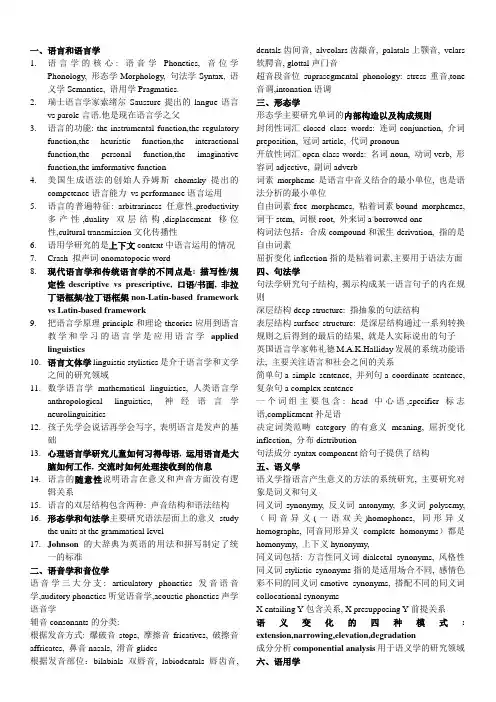
一、语言和语言学1.语言学的核心: 语音学Phonetics, 音位学Phonology, 形态学Morphology, 句法学Syntax, 语义学Semantics, 语用学Pragmatics.2.瑞士语言学家索绪尔Saussure提出的langue语言vs parole言语.他是现在语言学之父3.语言的功能: the instrumental function,the regulatoryfunction,the heuristic function,the interactional function,the personal function,the imaginative function,the imformative function4.美国生成语法的创始人乔姆斯chomsky提出的competence语言能力vs performance语言运用5.语言的普遍特征: arbitrariness任意性,productivity多产性,duality双层结构,displacement移位性,cultural transmission文化传播性6.语用学研究的是上下文context中语言运用的情况7.Crash 拟声词onomatopoeic word8.现代语言学和传统语言学的不同点是: 描写性/规定性descriptive vs prescriptive, 口语/书面, 非拉丁语框架/拉丁语框架non-Latin-based framework vs Latin-based framework9.把语言学原理principle和理论theories应用到语言教学和学习的语言学是应用语言学applied linguistics10.语言文体学linguistic stylistics是介于语言学和文学之间的研究领域11.数学语言学mathematical linguistics, 人类语言学anthropological linguistics, 神经语言学neurolinguisitics12.孩子先学会说话再学会写字, 表明语言是发声的基础13.心理语言学研究儿童如何习得母语, 运用语言是大脑如何工作, 交流时如何处理接收到的信息14.语言的随意性说明语言在意义和声音方面没有逻辑关系15.语言的双层结构包含两种: 声音结构和语法结构16.形态学和句法学主要研究语法层面上的意义studythe units at the grammatical level17.Johnson 的大辞典为英语的用法和拼写制定了统一的标准二、语音学和音位学语音学三大分支: articulatory phonetics发音语音学,auditory phonetics听觉语音学,acoustic phonetics声学语音学辅音consonants的分类:根据发音方式: 爆破音stops, 摩擦音fricatives, 破擦音affricates, 鼻音nasals, 滑音glides根据发音部位:bilabials双唇音, labiodentals唇齿音, dentals齿间音, alveolars齿龈音, palatals上颚音, velars 软腭音, glottal声门音超音段音位suprasegmental phonology: stress重音,tone 音调,intonation语调三、形态学形态学主要研究单词的内部构造以及构成规则封闭性词汇closed class words: 连词conjunction, 介词preposition, 冠词article, 代词pronoun开放性词汇open class words: 名词noun, 动词verb, 形容词adjective, 副词adverb词素morpheme是语言中音义结合的最小单位, 也是语法分析的最小单位自由词素free morphemes, 粘着词素bound morphemes, 词干stem, 词根root, 外来词a borrowed one构词法包括:合成compound和派生derivation, 指的是自由词素屈折变化inflection指的是粘着词素,主要用于语法方面四、句法学句法学研究句子结构, 揭示构成某一语言句子的内在规则深层结构deep structure: 指抽象的句法结构表层结构surface structure: 是深层结构通过一系列转换规则之后得到的最后的结果, 就是人实际说出的句子英国语言学家韩礼德M.A.K.Halliday发展的系统功能语法, 主要关注语言和社会之间的关系简单句a simple sentence, 并列句a coordinate sentence, 复杂句a complex sentence一个词组主要包含: head中心语,specifier标志语,compliement补足语决定词类范畴category的有意义meaning, 屈折变化inflection, 分布distribution句法成分syntax component给句子提供了结构五、语义学语义学指语言产生意义的方法的系统研究, 主要研究对象是词义和句义同义词synonymy, 反义词antonymy, 多义词polysemy, (同音异义(一语双关)homophones, 同形异义homographs, 同音同形异义complete homonyms)都是homonymy, 上下义hynonymy,同义词包括: 方言性同义词dialectal synonyms, 风格性同义词stylistic synonyms指的是适用场合不同, 感情色彩不同的同义词emotive synonyms, 搭配不同的同义词collocational synonymsX entailing Y包含关系, X presupposing Y前提关系语义变化的四种模式: extension,narrowing,elevation,degradation成分分析componential analysis用于语义学的研究领域六、语用学英国哲学家John.Austin发明了言语行为理论speech act theory区分语义学和语用学的最本质因素是是否考虑了语言使用过程中的语境言语行为的三种次行为: 言内行为locutionary, 言外行为illocutionary, 言后行为perlocutionary act美国哲学语言学家john searle约翰舍尔把言外行为分为五大类: representative描述性功能, directive指示性功能(包括invitng,suggesting,requesting,advising,warning,threatening ,ordering), commissive承担性功能, expressive表达性功能, declarative宣告性功能美国哲学家格莱斯Grice认为言语交际要包含以下四条准则:数量准则quantity maxim, 质量准则quality maxim, 关联准则relation maxim, 方式准则manner maxim情境因素contextual features包括时间, 地点和参与人, 不包括目的。
现代语言学 复习要点
现代语言学复习要点现代语言学是研究语言的本质、结构、演化和使用的学科,涉及到语音学、语法学、语义学、语用学等多个方面。
下面是现代语言学中的重要知识点,帮助您进行复习。
语音学音位与音素音位是语音学中的基本单位,是被感知为一种有区别的声音的语音单位。
音素是语音学中的一个概念,是语音中能够起差别作用的最小单位。
一种语音中可能存在多个音位,但其对应的音素数量通常比较少。
### 调值语音学中通常使用调值来表示声音的高低的。
不同的语言中可能有不同数量的调,比如汉语中有四个音调,英语中没有固定的调值。
### 音系音系是指一种语言中所有音位(包括所有音素)的总体,包括其音位的数量、种类和分布等方面。
语法学句子成分句子成分是指构成句子的基本单词、短语或从句。
一般来说,句子成分包括主语、谓语、宾语、定语、状语等。
### 句子结构句子结构是指句子内不同成分的组成方式。
对于不同语言,其句子结构可能存在明显差异,如英语中主语一般出现在谓语前,而在汉语中通常是在谓语后。
### 语法关系语法关系是指句子中不同成分之间的关系,如主语与谓语之间的关系、宾语与谓语之间的关系等。
语义学词义词义是单词所表达的概念或意义。
不同的单词可能存在相同或相似的词义,因此在语义学中通常需要进行词义分类和比较。
### 语义关系语义关系是指单词、短语、句子等之间的意义相互联系。
常见的语义关系包括同义关系、反义关系、上下位关系等。
### 语篇意义语篇意义是指句子及其上下文所构成的整体意义。
在语篇分析中,不仅要关注句子内部的语义关系,还需考虑句子与上下文之间的语义关系。
语用学言语行为言语行为是指言语交流过程中所体现的具体行为,如陈述、命令、请求、批评等。
不同类型的言语行为具有不同的功能和表达方式。
### 语用礼貌语用礼貌是指在言语交际过程中对他人尊重、友好的表达方式。
常见的语用礼貌策略包括委婉语、礼貌用语、双重否定等。
### 上下文依存言语交际过程中,具体表达的含义通常需要依赖于上下文信息。
自考本科现代语言学
自考本科现代语言学自考本科现代语言学现代语言学是语言学的一个分支,也是对语言进行科学研究的一门学科。
它主要研究语言的结构、功能、变化和演化等方面的问题。
现代语言学包括很多研究领域,其中最重要的是语音学、语法学、语义学和语用学。
语音学研究语言的音素和音节结构,是语言的音韵学部分;语法学研究语句的结构和句子的构成成分,是语言的结构学部分;语义学研究语句的意义和修辞特点,是语言的意义学部分;语用学研究语句的使用和交际功能,是语言的交际学部分。
现代语言学的研究方法主要有描述方法、分析方法和比较方法。
描述方法是通过对语言的结构和功能进行描述,来了解语言的本质和规律。
分析方法是通过对语言中的语言单位和语义关系进行分析,来研究语言的结构和功能。
比较方法是通过对不同语言之间的对比和比较,来研究语言的变化和演化。
在现代语言学的研究中,有一些重要的理论框架和方法论。
其中最重要的是结构主义、生成语法和认知语言学。
结构主义是现代语言学的先驱,它认为语言是一个独立的系统,通过对语言的结构进行分析来了解语言的本质和规律。
生成语法是对结构主义的发展,它认为语言是由一个生成系统产生的,通过分析语言的生成过程来了解语言的结构和功能。
认知语言学是对生成语法的发展,它认为语言是人类思维的一种表达方式,通过对语言和思维的关系进行研究来了解语言的结构和功能。
现代语言学的研究成果对于语言教学和语言翻译具有重要意义。
通过对语言的结构和功能进行研究,可以帮助人们更好地理解和掌握语言,提高语言能力。
通过对语言的变化和演化进行研究,可以了解不同语言之间的关系和相互影响,方便语言的翻译和交流。
总之,现代语言学是对语言进行科学研究的一门学科,它研究语言的结构、功能、变化和演化等方面的问题。
它的研究方法主要有描述方法、分析方法和比较方法,其中最重要的理论框架和方法论是结构主义、生成语法和认知语言学。
现代语言学的研究成果对于语言教学和语言翻译具有重要意义。
现代语言学 当代语言学

现代语言学当代语言学现代语言学是研究语言本质、结构和功能的学科,是语言与社会、人类认知、文化、心理等多个领域的交叉学科。
它关注语言的发展、变化、运用等方面,通过系统性的分析和研究,揭示语言背后的规律和机制。
在现代语言学中,有几个重要的理论学派和概念需要我们了解。
其中,结构主义学派是广义语言学研究的奠基者,它强调语言的内部结构,并以语言形式的规则和体系为研究对象。
生成语法学派则认为语言可以通过生成规则来构建,强调语言的创造性和生成过程。
功能语言学派则关注语言的功能和意义,认为语言是为了交际和意义传递而存在的。
在现代语言学的研究方法上,主要有描述性语言学和比较语言学两种。
描述性语言学致力于对具体语言现象的描写和分析,以搜集语料、构建语言模型为主要手段。
比较语言学则是对多个语言进行对比研究,通过比较语言的共性和差异,揭示语言的普遍规律。
现代语言学的研究领域非常广泛,包括语音学、音系学、语法学、语义学、语用学、社会语言学、认知语言学、心理语言学等。
语音学研究语音的产生、传播和接收等方面,音系学研究语音系统和语音单位等。
语法学关注的是语言的句法结构,语义学研究语言的意义和表达方式,语用学研究语言在具体交际语境中的运用。
社会语言学则研究语言与社会的关系,认知语言学和心理语言学关注语言与人类认知和心理过程的相互关系。
现代语言学的研究对于我们理解语言、交际和文化具有重要的指导意义。
通过对语言规律和机制的研究,我们可以更好地理解语言的内在结构和运作方式,更好地掌握语言表达和沟通的技巧。
此外,现代语言学的研究也可以帮助我们深入了解语言与社会、人类认知、文化等方面的关系,推动人类语言研究和应用的发展。
总之,现代语言学是一门生动、全面、富有指导意义的学科,通过系统分析和研究语言,可以深入了解语言的本质特征和规律,为我们更好地理解和运用语言提供了重要的理论基础。
现代语言学自考 pdf
现代语言学自考一、语言学基础语言学基础是现代语言学自考的重要组成部分,主要包括语言学的定义、语言学的研究对象、语言学的分支学科等内容。
学生需要掌握语言学的基本概念、基本理论和基本方法,为后续深入学习打下坚实的基础。
二、语音学与音系学语音学与音系学是研究语言的发音、音素、音节、音韵等规律的学科。
学生需要掌握语音的发音机制、音素的分类与区别、音节的结构与变化、音韵的规则与变化等内容,能够正确地分析和描述语言的语音现象。
三、形态学形态学是研究语言中词汇的构成与变化的学科。
学生需要掌握词素、词根、词缀等基本概念,了解词汇的构成方式与变化规律,能够正确地分析和描述语言的词汇现象。
四、句法学句法学是研究语言的句子结构与变化的学科。
学生需要掌握句子的基本结构、句法规则、句型变化等内容,能够正确地分析和描述语言的句子结构现象。
五、语义学语义学是研究语言中词汇和句子的意义与变化的学科。
学生需要掌握语义的基本概念、语义关系、语义变化等内容,能够正确地分析和描述语言的语义现象。
六、语用学语用学是研究语言在实际运用中的意义与功能的学科。
学生需要掌握语境、话语、交际等基本概念,了解语言在实际运用中的功能与意义,能够正确地分析和描述语言的语用现象。
七、社会语言学社会语言学是研究语言与社会因素的相互关系的学科。
学生需要掌握社会因素对语言的影响、语言的社会功能与变化等内容,能够正确地分析和描述语言的社会现象。
八、第二语言习得研究第二语言习得研究是研究人们如何学习第二语言的学科。
学生需要掌握第二语言学习的过程、影响因素、学习方法等内容,能够正确地分析和描述第二语言学习的现象。
九、语言习得理论语言习得理论是研究人们如何习得语言的学科。
学生需要掌握语言习得的基本理论、习得机制、习得过程等内容,能够正确地分析和描述语言习得的现象。
十、认知语言学认知语言学是研究语言与认知关系的学科。
学生需要掌握认知的基本概念、认知语言学的理论与方法等内容,能够正确地分析和描述语言与认知的关系。
现代语言学
第一章:绪 论 1.
什么是语言学? 1.1定义 语言学常被定义为是对语言进行系统科学研究的学科。语言学研究的不是某一种特定的语言,而是人类所有的语言。为了揭示语言的本质,语言学家首先要对语言实际使用进行观察,并在此基础上形成有关语言使用的概括性假设,这些初步形成的假设要在语言使用中进行进一步的检验,最终形成一条语言理论。 1.2语言学的研究范畴: 语言学研究有不同的侧重。对语言体系作全面研究的语言学研究称为普通语言学。语音学主要是对语言声音媒介的研究,它不只是研究某一特定的语言的声音媒介,而是所有语言的声音媒介。音系学与语音学不同,它主要研究特定语言的语音体系,即音是如何结合在一起产生有意义的单位。形态学主要研究单词的内部语义结构,及这些叫做词素的语义最小单位是如何结合构成单词。句法学主要研究构成潜在句子的句法规则。语义学以研究语义为目的,传统语义学主要研究抽象的意义,独立于语境之外的意义,语用学也是研究语义,但是它把语义研究置于语言使用语境中加以研究。 语言不是一个孤立的现象,而是一种社会现象,各种社会因素都会对语言的使用产生影响。从社会的角度来研究语言的科学被称之为社会语言学。语言和社会之间的关系是社会语言学研究的主要内容。心理语言学主要从心理学的角度来研究语言。它要研究人们在使用语言时大脑的工作机理,如人是如何习得母语的,人的大脑是如何加工和记忆语言信息等问题。把语言学的研究成果应用到实践中的科学形成了应用语言学。狭义上,应用语言学指把语言理论和原则运用于语言教学的科学,在广义上,它指把语言理论与原则应用于解决实际问题的科学。除此之外还有人类语言学、神经语言学、数学语言学、计算语言学等。 1.3语言学研究中的几对基本概念 1.3.1规定性和描述性 语言学研究是描述性的,不是规定性的。这是语言学和传统语法的一个重要区别。语言学研究的目的是对人们使用的语言进行客观描述与分析,而不是对语言的使用作出规定。传统语法是规定性的,它主要建立在笔头语言基础之上,旨在规定一系列的语法规则,并且把这些语法规则强加给语言使用者。一切符合规定规则的被认为是“正确的”,否则就被冠为“错误的”。 1.3.2共时性和历时性 对语言的研究分为共时研究和历时研究。共时研究是对语言的静态特征的研究。它主要对某个时间点上的语言状态的描述。历时研究主要是对语言变化和发展的研究。现代语言学研究主要是共时性研究。 1.3.3口头语和书面语 现代语言学把书面语看作是口头语的记录,认为口头语是第一性的,是语言交际最基本的方式。这是因为从人类社会交际的发展来看,口头语先于笔头语,笔头语是对口头语的记录。从交际的功能来看,人们交际主要采取口头形式。此外,即使是在当今世界,仍然有不少语言只有口头形式,没有笔头形式。所以语言学研究的语料应从口头语中采集。传统语法学家过分重视笔头语料,轻视口头语料。 1.3.4语言和言语 语言和言语的区别是瑞士语言学家索绪尔在20世纪初提出来的。 语言是语言社区所有成员所共有的抽象的语言系统,是一个语言社区所有的人应该遵守的一套约定俗成的规则,它相对稳定,因此索绪尔指出语言学只能研究语言系统本身,既语言。言语是语言体系的实际使用,是具体的。它因人而异,千变万化,所以索绪尔认为无法对言语进行系统的研究。 1.3.5能力和运用 能力和运用的区别由乔姆斯基在20世纪50年代后期提出的。“能力”指一个理想的语言使用者所具有的语言规则的知识,它是一整套内在化语言使用者脑海中的语言规则。“使用”是“能力”的具体使用,是在交际活动中语言知识具体的体现。乔姆斯基认为,语言学家应该研究“能力”,揭示人脑中已经内在化的语言规则,而不是研究“使用”,因为“使用”会受到各种偶然因素的影响,如口误等,因而是不体系的。 乔姆斯基的能力和使用之分与索绪尔的语言和言语之分有其相似性,两人都强调把语言体系与语言的使用区分开来,但是索绪尔是从社会的角度来分析语言,把语言看成社会的约定,而乔姆斯基则是从心理学的角度出发,把语言看成是个人人脑的特性。 2.1语言的定义 语言学家对语言作了不同的定义, 比较普遍地为语言学家所接受的一个定义是“语言是一种用于人类交际的任意的语音符号系统。”这一定义包涵了语言的一些最重要的特征,即语言是一个受规则制约的体系,语言的符号是任意的,语言是有声的。 2.2语言的识别性特征 美国语言学家 C. Hockett提出了人类语言的 12种识别性特征,其中最重要的识别性特种有5种: 即语言的任意性、创造性、二重性、移位性和文化传递性。这些特征是所有人类语言所共有的。人类语言的识别性特征是动物“语言”所不具有的。 1)
现代语言学的特点及发展趋势
现代语言学的特点及发展趋势现代语言学的特点可以总结为以下几点:1. 跨学科性:现代语言学融合了多个学科的理论和方法,如心理学、计算机科学和认知科学等。
这种综合性使得语言学能够更全面地研究语言现象。
2. 实证性:现代语言学注重对语言现象的实证研究,通过大量的语料分析、实验和调查等方法,揭示出语言规律和语言变化的实际情况。
3. 语言普遍性:现代语言学研究的对象不再局限于某一种语言,而是关注人类语言的普遍特征和共同规律。
这种研究方式使得我们能够更好地了解人类语言的本质。
4. 全球化视角:随着全球化的发展,现代语言学也越来越关注不同语言之间的联系和影响。
比如研究语言接触、语言变异以及语言政策等领域。
现代语言学的发展趋势可以预测为以下几点:1. 认知科学的影响:随着认知科学的快速发展,现代语言学趋向于更深入地研究人类语言的认知机制和处理过程。
比如探索语义、语法和语用等方面的认知基础,以及语言与思维之间的关系等。
2. 数字化和计算化:随着计算机技术的不断进步,现代语言学趋向于更加数字化和计算化。
通过自然语言处理、机器学习和语料库语言学等技术,可以更快速、更准确地处理语言数据,并得出更精确的结论。
3. 跨文化语言学:随着全球化的进程,跨文化语言学将成为重要研究领域。
这种研究将注重不同语言和文化之间的异同,以及不同语境下语言使用的变化和适应性。
4. 社会认知语言学:社会认知语言学将成为现代语言学的一大发展方向。
通过研究语言的社会因素和社会语言学,可以更好地理解语言和社会的相互作用,如语言地位、社会规范和身份认同等。
综上所述,现代语言学的发展趋势是多元化、综合化和应用化。
通过整合多个学科的理论和方法,实证研究语言现象,关注语言的普遍特征和全球化影响,不断推动语言学相关领域的创新和发展。
现代语言学教程
现代语言学教程
现代语言学是研究如何使用语言的结构、语言的变化以及如何沟通信息的研究领域。
现代语言学不但包括语言本身的研究,也包括语言的教学,交流,正确性,方言的文化,语言的演变,以及社会语言学,声学,口头传统等等。
现代语言学可以帮助人们更好地了解语言和语言文化。
现代语言学教程中,一般会让学生熟悉现代语言学的概念和技巧,以及发展自己在这门学科中的理解。
基本知识包括概念、术语、定义、历史和趋势,其中还包括构成语言和来源,以及各派系的特点,并让学生对比学习。
学习现代语言学的学生会渐渐了解其使用的语言的规则和架构,让语言的理解和表达更加丰富,更有效地交流。
现代语言学教程还会让学习者探索学习外语的策略和感受,着眼于文化的影响,在多语种的语境中,对对话中改变的视角,对多个文化地区的社会性别结构的理解,系统性学习,抓住语言表达中细小而重要的细节,以及掌握与文化有关的习惯用法等。
现代语言学教程既可以应用于学习外语,也可以用于学术研究,通过现代语言学的概念和方法,引入的思想可以更加深入地对多种语言文化进行探索和深入研究,使得语言学习和研究整体发展得更加完整且更有趣,更丰富饱满。
现代语言学的特点
现代语言学的特点
一、现代语言学的特点
1、现代语言学是一门多学科体系:
首先,现代语言学是一门多学科体系,其形成的多学科体系可以从狭义的语言学(包括语音学、语法学、语义学、句法学、修辞学等)、广义的语言学(包括社会语言学、翻译学、教育语言学、语音疗法学等)以及与语言保持联系的其他学科(比如史学、社会学、文化学、神学、心理学等)等方面来看。
2、现代语言学是一门与众多学科有关的学科:
现代语言学的研究离不开与其他学科的交流,这种交流使其与其他学科发生了深刻的联系。
它的研究内容也出现了多样化的发展,其形成了与发展历史、文化、社会、心理学等文科学科之间的紧密关系。
3、现代语言学是一门把“理论”和“实践”有机地结合起来的学科:
现代语言学不仅强调理论的深入,同时也关注实际的运用,强调理论和实践应该紧密结合,应该实事求是地加以实践。
4、现代语言学有自己的独特的观点:
现代语言学不仅研究语言,而且也关注社会文化及其发展历史,以及任何语言活动所涉及的一切重要的社会现象,他们具有自己独特的观点,其核心思想是以社会性的语用观点来探讨语言,强调语言的实际运用而非纯粹的理论探讨。
- 1 -。