
八大时态及被动语态对照表
学习必备 欢迎下载 八大时态对照表 时态 概念 时间状语 基本结构 例句 一般现在时 事实或状态。习惯或状态、普遍存在的真理 always, usually, often, sometimes, every week (day, year, month…), once a week, on Sundays, +be(am,is,are) +V.原形 第三人称单数 He is always ready to help others.
一般过去时 过去某个时间里发生的动作或状态;过去习惯性、经常性的动作、行为 ago, yesterday, the day before yesterday, last week(year, night, month…), in 1989, just now, at the age of 5, one day, long long ago, once upon a time, etc. 主+ be(was were) 主语+V过去式 She often came to help us in those days.
现在进行时 正在进行的动作及行为。 now, at this time, these days, etc. 主+be(am/is/are)+doing He is doing well in his lessons. 过去进行时 表示过去某段时间或某一时刻正在发生或进行的行为或动作。 at this time yesterday, at that time 主+be(was/were)+doing When he came in, I was reading a newspaper.
现在完成时 在过去不确定的时间里发生的动作,但是结果对现在有影响 recently, lately, since…for…,in the past few years, etc. 主+ have/has +done It has been raining these days.
过去完成时 表示在过去某一时刻或动作以前完成了的动作,也可以说过去的时间关于过去的动作。 before, by the end of last year(term, month…), 主+had + V过去分词. By the end of last month. We had reviewed four books
一般将来时 表示将要发生的动作或存在的状态及打算、计划或准备做某事。 tomorrow, next day(week, month, year…),soon, in a few minutes, by…,the day after tomorrow, etc. 主+be(am/is/are)+ going to + do 主+will/shall + do It is going to rain.
过去将来时 立足于过去某一时刻,从过去看将来要发生的动作或状态 the next day(morning, year…),the following month(week…),etc. was/were/going to + do would/should + do He said he would go to Beijing the next day 学习必备 欢迎下载 八大时态及被动语态对照表 时态 主动语态 被动语态 被动语态例句 一般现在时 +be(am,is,are) +V.原形 第三人称单数 am/is/are + 过去分词 People grow rice in the south of the states.
Rice is grown in the south of the states.
一般过去时 主+ be(was were) 主语+V过去式 was/were + 过去分词 They agreed on the building of a new car factory last
month. The building of a new car factory was agreed on last month. 现在进行时 主+be(am/is/are)+doing am/is/are being + 过去分词 The radio is broadcasting English lessons.
English lessons are being broadcasted on the radio. 过去进行时 主+be(was/were)+doing was/were being + 过去分词 This time last year we were planting trees here.
Trees were being planted here this time last year. 现在完成时 主+ have/has +done have/has been + 过去分词 We have brought down the price.
The price has been brought down 过去完成时 主+had + V过去分词. had been + 过去分词 When I got to the theatre, I found they had already sold
out the tickets. When I got to the theatre, I found the tickets had already been sold out. 一般将来时 主+be(am/is/are)+ going to + do 主+will/shall + do will/shall be + 过去分词 或 am/is/are going to be + 过去分词 They will send cars abroad by sea.
Cars will be sent abroad by sea.
过去将来时 was/were/going to + do would/should + do would be + 过去分词 或 was/were going to be + 过去分词 The workers told me they would mend the car as soon as
possible. The workers told me that the car would be mended as soon as possible 学习必备 欢迎下载 常见英语过去式和过去分词
规则的动词 begin(开始) began begun drink(喝) drank drunk ring(铃响) rang rung sing (唱) sang sung swim(游泳) swam swum blow(吹) blew blown draw(画) drew drawn fly(飞) flew flown grow(生长) grew grown know(知道) knew known throw(投掷) threw thrown show(出示) showed shown break(打破) broke broken choose(选择) chose chosen forget(忘记) forgot forgotten (forgot) speak(说,讲) spoke spoken wake(醒) woke woken drive(驾驶) drove driven eat(吃) ate eaten fall(落下) fell fallen give(给) gave given rise(升高) rose risen take(取) took taken mistake(弄错)mistook mistaken ride(骑) rode ridden write(写) wrote written do(做) did done 学习必备 欢迎下载 go(去) went gone lie(平躺) lay lain see(看见) saw seen wear (穿) wore worn
不规则的动词 cost(花费)cost cost cut(割) cut cut hit(打) hit hit hurt(伤害) hurt hurt let(让) let let put(放) put put read(读) read read (2) AAB型(动词原形与过去式同形) beat(跳动) beat beaten (3) ABA型(动词原形与过去分词同形) become(变成) became become come(来) came come run(跑) ran run (4) ABB型(过去式与过去分词同形) dig(挖) dug dug get(得到) got got hang(吊死) hanged hanged hang(悬挂) hung hung hold(抓住) held held shine(照耀) shone shone sit(坐) sat sat win(赢) won won meet(遇见) met met keep(保持) kept kept sleep(睡) slept slept sweep(扫) swept swept feel(感觉) felt felt
8种基本时态及其被动结构
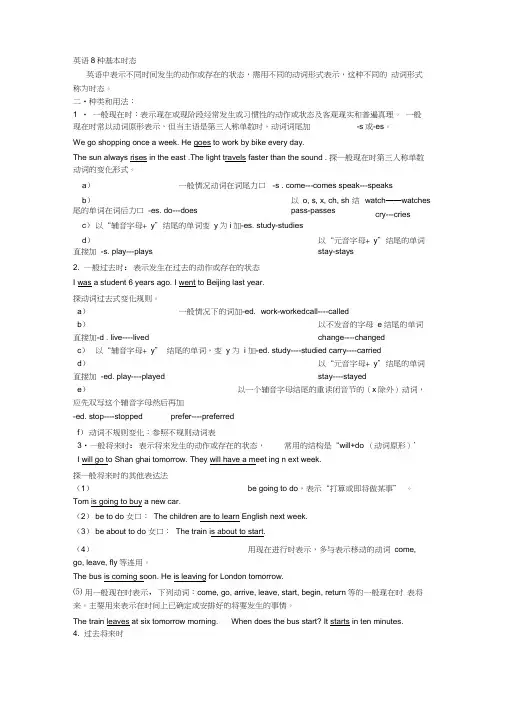
英语8种基本时态英语中表示不同时间发生的动作或存在的状态,需用不同的动词形式表示,这种不同的 动词形式称为时态。
二•种类和用法:1 • 一般现在时:表示现在或现阶段经常发生或习惯性的动作或状态及客观现实和普遍真理。
一般现在时常以动词原形表示,但当主语是第三人称单数时,动词词尾加 -s 或-es 。
We go shopping once a week. He goes to work by bike every day.The sun always rises in the east .The light travels faster than the sound . 探一般现在时第三人称单数动词的变化形式。
a )一般情况动词在词尾力口 -s . come---comes speak---speaksb )以 o, s, x, ch, sh 结尾的单词在词后力口 -es. do---doespass-passes c ) 以“辅音字母+ y ”结尾的单词变 y 为i 加-es. study-studiesd )以“元音字母+ y ”结尾的单词直接加 -s. play---playsstay-stays2. —般过去时:表示发生在过去的动作或存在的状态 I was a student 6 years ago. I went to Beijing last year. 探动词过去式变化规则。
a ) 一般情况下的词加-ed. work-worked c all----calledb )以不发音的字母 e 结尾的单词直接加-d . live----lived change----changedc ) 以“辅音字母+ y ” 结尾的单词,变 y 为 i 加-ed. study----studied carry----carriedd )以“元音字母+ y ”结尾的单词直接加 -ed. play----played stay----stayede )以一个辅音字母结尾的重读闭音节的( x 除外)动词,应先双写这个辅音字母然后再加 -ed. stop----stoppedprefer----preferredf ) 动词不规则变化:参照不规则动词表3•—般将来时:表示将来发生的动作或存在的状态,常用的结构是“will+do (动词原形)’I will go to Shan ghai tomorrow. They will have a meet ing n ext week. 探一般将来时的其他表达法 (1)be going to do ,表示“打算或即将做某事” 。
英语八大基本时态和被动语态要点指南+
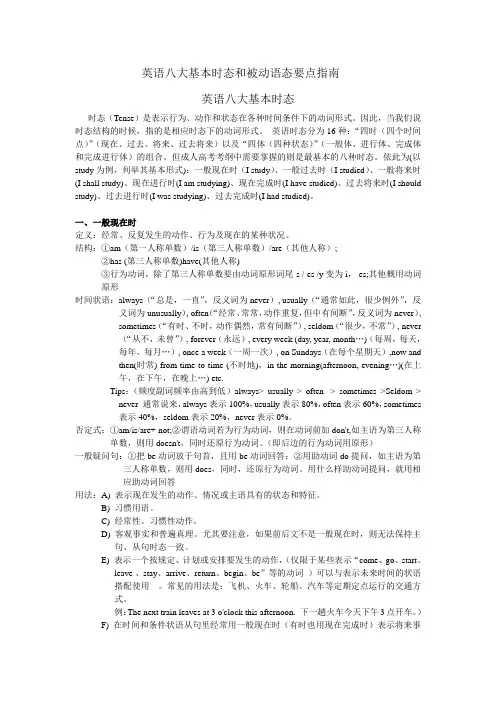
英语八大基本时态和被动语态要点指南英语八大基本时态时态(Tense)是表示行为、动作和状态在各种时间条件下的动词形式。
因此,当我们说时态结构的时候,指的是相应时态下的动词形式。
英语时态分为16种:“四时(四个时间点)”(现在、过去、将来、过去将来)以及“四体(四种状态)”(一般体、进行体、完成体和完成进行体)的组合。
但成人高考考纲中需要掌握的则是最基本的八种时态。
依此为(以study为例,列举其基本形式):一般现在时(I study)、一般过去时(I studied)、一般将来时(I shall study)、现在进行时(I am studying)、现在完成时(I have studied)、过去将来时(I should study)、过去进行时(I was studying)、过去完成时(I had studied)。
一、一般现在时定义:经常、反复发生的动作、行为及现在的某种状况。
结构:①am(第一人称单数)/is(第三人称单数)/are(其他人称);②has (第三人称单数)have(其他人称)③行为动词,除了第三人称单数要由动词原形词尾-s /-es /y变为i,-es;其他概用动词原形时间状语:always(“总是,一直”,反义词为never), usually(“通常如此,很少例外”,反义词为unusually), often(“经常、常常,动作重复,但中有间断”,反义词为never),sometimes(“有时、不时,动作偶然,常有间断”), seldom(“很少,不常”), never(“从不,未曾”), forever(永远), every week (day, year, month…)(每周,每天,每年,每月…), once a week(一周一次), on Sundays(在每个星期天),now andthen(时常) from time to time (不时地),in the morning(afternoon, evening…)(在上午,在下午,在晚上…) etc.Tips:(频度副词频率由高到低)always> usually > often > sometimes >Seldom >never 通常说来,always表示100%,usually表示80%,often表示60%,sometimes表示40%,seldom表示20%,never表示0%。
(完整版)被动语态表格
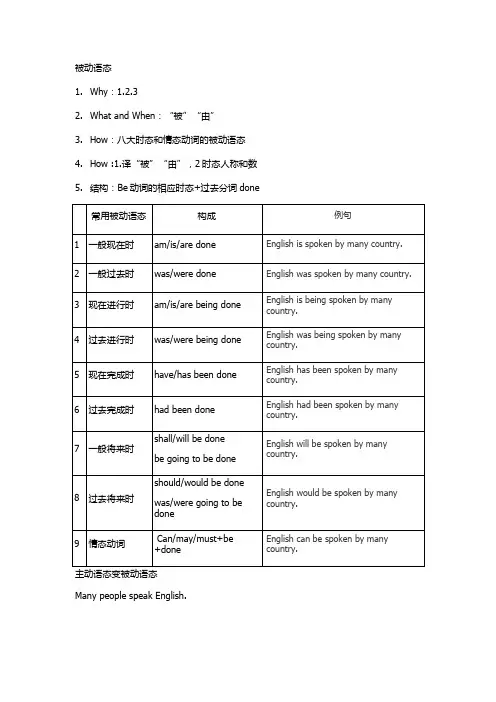
被动语态1.Why:1.2.32.What and When:“被”“由”3.How:八大时态和情态动词的被动语态4.How :1.译“被”“由”,2时态人称和数5.结构:Be动词的相应时态+过去分词doneMany people speak English.1.将主句中的宾语变被动语态主语,如果是代词将代词宾格变主格,2.将主句中主语变被动语态中宾语用by引导,如果主语时代词由主格变宾格。
3.谓语动词变被动语态形式。
注意事项:1.接双宾语的短语被动语态变法: ask sb sth, give sb sth.区分哪个是间接宾语,哪个是直接宾语。
He gives me a book.I am given a book by him.A book is given to me by him.2.原词组中省略To的短语被动语态要恢复to. Help sb do, watch sb do, hear sbdo. Notice sb do.let sb do, make sb do.I saw him help the child.He was seen to help the child.3.主动表被动的词:当主语是物,谓语动词时 open, write,read, sell,clean,wash, cut, burn, drive.用主动表示被动。
This kind of shirt sells well.4.感官动词无被动: look, feel, taste, sound, smell5.Want /need/require+doing相当于 want/need/require to be done. To bedone表示的是不定时的被动语态。
This watch need to be repaired=This watch need repairing.6.当主句的主语是反身代词或each other 时,不用被动语态。
8初中八大时态,被动语态

自从我们来这儿已经20年了.
It is 20 years since we lived here.
自从我们不在这儿住已经20年了.
常见的瞬间动词有: come, go, get to/reach/arrive at, leave, buy, sell, open, close, get up, join/take part in, begin/start, return/give, borrow/lend, become/turn, bring/take, jump, die, finish/end, receive/hear from, marry, break, lose。
e.g. He will be back in a few days.
注意将来时几种形式的区别:
will(shall) do, be going to do, be about to do, be doing, be to do, do/does
(1)will(shall) do 表示将来要出现的动作或状态; 表示事物的必然趋势; 表示主语的 “意愿”.will还有临时决定去做.
e.g. My birthday falls on May 2.
The ship leaves at 9:00 a.m
(5) 图片说明、电影说明、解说戏剧内容及场景等。
(6)由here, there, now, then开头的句子
e.g. There goes the bell.
Now comes your turn.
e.g. I was having breakfast at 7 in the morning.
英语16种时态中的被动语态

1 一般现在时 am/is/are done
2 一般过去时 was/were done
3 现在进行时 am/is/are being do being done
5 一般将来时 will be done
6 过去将来时 would be done
13 将来完成时 will have been done
14 过去将来完成时 would have been done
15 将来完成进行时 will have been being done
16 过去将来完成进行时 would have been being done
1一般现在时amisaredone2一般过去时wasweredone3现在进行时amisarebeingdone4过去进行时waswerebeingdone5一般将来时willbedone6过去将来时wouldbedone7现在完成时havehasbeendone8过去完成时hadbeendone9现在完成进行时havehasbeenbeingdone10过去完成进行时hadbeenbeingdone11一般将来进行时willbebeingdone12过去将来进行时wouldbebeingdone13将来完成时willhavebeendone14过去将来完成时wouldhavebeendone15将来完成进行时willhavebeenbeingdone16过去将来完成进行时wouldhavebeenbeingdone
7 现在完成时 have/has been done
8 过去完成时 had been done
9 现在完成进行时 have/has been being done
10 过去完成进行时 had been being done
英语八大时态及被动语态汇编

英语八大时态及被动语态时态主动结构被动结构主动例句被动例句一般现在时do/does am/is/are+done We clean the classroom. The classroom is cleaned by us. 一般过去时did was/were+done He made a kite. The kite was made by him.一般将来时will be will be+done They will plant treestomorrow. The trees will be planted by them tomorrow.现在进行时am/is/are+doing am/is/are+being done She is watering flowers. The flowers are being watered by her.过去进行时was/were+doing was/were+being done She was writing a letter thistime yesterday. A letter was being written by her this time yesterday.现在完成时have/has+done have/has+been done Jim has finished the work. The work has been finished by Jim. 过去完成时had done had+ been done Jim had finished the work. The work had been finished by Jim. 过去将来时would do would be+done He said he would make a kite. He said a kite would be made by him.更多精品文档更多精品文档。
32种主被动英语时态表
to be doing
完成进行时
to have beendoing
动词不定式
1.不定式的语态:
1)主动:to do (不定式与其逻辑主语为主动关系)
2)被动:to be done (不定式与其逻辑主语为被动关系)
2.不定式的时态:
1)一般式:to do
2)完成式:to have done (不定式动作先于谓语动作)
被动
should/would
be done
should/would
be being done
should/would
have been done
should/would
have been being done
时态语态
主动语态
被动语态
一般时
to do
to be done
完成时
done
3)进行式:to be doing
4)完成进行式:to have been doing
had
been being done
将来
(future)
主动
will/shall do
will/shall be doing
will/shall
have done
will/shall
have been doing
被动
will/shall be done
will/shall
be being done
will/shall
英语时态表
(以do为例)
一般
(simple)
进行
(continuous)
完成
(perfect)
完成进行
(perfectcontinuous)
各种时态的被动语态
各种时态的被动语态各种时态的被动语态一、八大时态的被动语态的构成:1.一般现在时的被动语态构成:(am/is/are +done)如:I am asked to study hard. 我被请求努力学习。
This shirt is washed once a week. 这件T恤一周洗一次。
These songs are usually sung by boys. 这些歌曲通常是男生唱的。
2.一般过去时的被动语态构成:(was/were done)如:The soldier was killed, but the train was saved. 这位战士牺牲了,然而列车得救了。
Some notes were passed up to the speaker. 有人给讲演者递上来一些纸条。
3.一般将来时的被动语态构成:(shall/will be done)如:We shall be asked a lot of strange questions. 我们将被问许多怪题。
My son will be sent to school next September. 来年九月我将送我儿子去读书。
4.过去将来时的被动语态构成:(should/would be done)如:The news would be sent to him as soon as it arrived. 消息一到就会转给他的。
He told us that the new railway would be built the next year. 他告诉我新铁路将在明年修建。
5.现在完成时的被动语态构成:(has/have been done)如:The work has just been finished. 工作刚刚结束。
The old rules have been done away with by us. 旧规章已经被我们废除了。
(完整版)被动语态表格
被动语态1.Why :2.What and When :“被”“由”3.How :八大时态和神情动词的被动语态4.How :1. 译“被”“由”, 2 时态人称和数5.结构: Be 动词的相应时态 + 过去分词 done常用被动语态构成例句1一般现在时2一般过去时3现在进行时4过去进行时5现在完成时6过去完成时7一般将来时8过去将来时9神情动词主动语态变被动语态am/is/are donewas/were doneam/is/are being donewas/were being donehave/has been donehad been doneshall/will be done begoing to be doneshould/would be donewas/were going tobe doneCan/may/must+be+doneEnglish is spoken by many country.English was spoken by many country.English is being spoken bymany country.English was being spoken bymany country.English has been spoken bymany country.English had been spoken bymany country.English will be spoken by manycountry.English would be spoken by manycountry.English can be spoken by manycountry.Many people speak English.1.将主句中的宾语变被动语态主语,若是是代词将代词宾格变主格,变被动语态中宾语用 by 引导,若是主语时代词由主格变宾格。
语态形式。
(完整word版)初中英语八大时态表
展宏学校中考英语常考八大时态与被动语态类别一般现在时现在进行时现在完成时一般将来时用途谓语结构(动词形式 ) 被动结构时态标志1.表示经常性、习惯性的动作;表示现在(说话瞬间)正2.表示客观事实或永恒真理;在进行或发生的动作。
3.表示特征、爱好、状态和能力等。
V.原或 V.三单 (he/she/it 或能够用he/she/it 代替的人或物后用三单 )am / is / are + 过分am / is / are +being+过分1. 频率副词: often;sometimes=(at 1. now = at present = righttimes); always; usually; every day now = at the moment(every + 时间 ) 2. look, listen开头的句2. 次数: twice a week子。
3. on Sundays:在每一个星期天例句 :例句 :She is watering the treesHe often cleans the room. 主(动 )now. (主动 )The roomoften by him.The trees by(被动 )her now. (被动 )1. 表示发生在过去的动表示将来某个时间要发生的作一直持续到现在; 2.动作或存在的状态。
表示发生在过去的动作对现在造成的影响或结果。
have/has + 过分 1.will + V .原2.be going to + V.原have / has been + 过分will be + 过分1. for / since+时间; 1.将来的时间: tomorrow;the day2. 副词 ever, never, yet,after tomorrow;next week ;in a fewalready 等;days;in 3 years;in the future ;this3. so far = by now=up to evening/year/weeknow; 2. at once=in a minute=right away3.soon4.in the last/past few 例句 :years;She will do it tomorrow. ( 主动 )It by her5.over the years= in tomorrow. (被动 )recent years在主从复合句中,当主句为一般将来It ’s 7 o’clock + 现在进行时、主句为祈使句、主句含有情态动时。