
最常用9个介词的用法
中学英语最常用9个介词的用法介词在英语里出现非常频繁,它的搭配众多且意义丰富。
在整个中学阶段,介词的搭配是同学们感到较为棘手的问题之一。
在多年高中英语教学中,笔者总结了常用介词的各种搭配,这里把它们归纳起来,供同学们复习备考参阅。
一、about1.动词+about+sth.。
about在此表示“论及,谈起,涉及,着手”等意思:arrange about安排,argue about辩论, ask about询问,bring about带来,chat about 闲聊,care about在意,complain about报怨,go about着手,hear about听说, inquire about打听,know about了解,quarrel about争论,read about读到, see about负责处理,set about开始, speak about谈起, talk about谈论, think about考虑, trouble about担心,tell about讲述,worry about着急。
现举例说明其中一些短语的用法:She inquired about my brother. 她向我打听有关我兄弟的情况。
I must set about my packing. 我必须开始收拾行装。
What are you chatting about? 你们在聊什么呢?2. be +形容词+about+sth.。
about在此意思是“为…,对…”,接表原因的词:be anxious about为…着急, be bad about对…感到不舒服,be busy about忙于…,be careful about小心…, be certain about对…有把握, be concerned about关心…,be crazy about为…发狂,be excited about为…感到激动, be happy about 为…而高兴,be mad about为…发疯,be nervous about对…感到紧张, be particular about挑剔…,be pleased about为…兴奋,be strict about对…严格,be thoughtful about对…考虑周到的,be uneasy about为…感受到不安。
请看例句:What have you been busy about today? 今天在忙些什么?You are certainly very thoughtful about others. 你为别人想得太周到了。
I’m strict about such things. 对这些事我是很严格的。
注:come about发生,get about(疾病、谣言)流行,turn about转身,leave about到处乱放,lie about随便堆放,put about打扰;传播,put oneself about使…发愁。
这些词组中about作副词,此时about不能接宾语。
二、after1.动词+ after。
介词after有“追赶,问候,效仿”之意:ask after问候, be after 寻求,do(sth.)after学着做,go after设法得到, inquire after问候, look after寻找,run after追求, seek after追逐, take after长得像。
例如:Every afternoon he called to ask after his girl friend.他每天下午都打电话问候他的女朋友。
The boy takes after his father. 这男孩长得像他父亲。
The dogs went after the wounded deer. 一群狗在追赶那只受伤的鹿。
2.after构成的其它短语。
after在不同的短语中意思各异:after a little/moment/while过了一会,after all毕竟,after dark天黑以后,after one’s heart合…的心, after school放学后,after service售后服务,after the fashion 勉强,day after day日复一日,one after another一个接一个,year after year年复一年。
例如:Don’t be too strict with him. After all he is still a child.不要太苛刻了,毕竟他还是个孩子。
He can speak and write English after a fashion.他多少会说和写一点英语,但不太好。
三、at1.动词+ at。
at表示“指向某一目标,到达某地”:arrive at抵达,call at访问某地, catch at(it)当场抓住, come at攻击, fire at向…开火,glance at瞟一眼, glare at怒目而视, grieve at忧伤,knock at敲,laugh at嘲笑, look at看一眼, pull at拉扯, rejoice at对…高兴,smile at向某人微笑, shoot at朝…射击, stare at怒目而视,thrust at刺向, tear at撕, tremble at颤抖,wonder at吃惊,work at工作。
例如:Don’t let me catch you again at it.不要再让我当场逮住你。
We must “shoot the arrow at the target”. 我们必须有的放矢。
They trembled at the sight of the peasant’s spears.看到农民的梭标,他们阵阵发抖。
2. be +形容词/过去分词+ at。
其中at表示“情绪、情感的原因,或对某物具有某种感情”:be angry at恼怒于, be alarmed at对…保持警觉,be astonished at对…吃惊, be bad at不擅长, be clever at对某事很灵巧,be delighted at高兴,be disgusted at厌恶, be disappointed at对…失望,be good at擅长, be impatient at对…不够耐心, be mad at狂热于,be pleased at对…感到高兴, be present at出席, be satisfied at 满意,be surprised at吃惊, be shocked at对…非常震惊,be terrified at受到…的恐吓,be quick at对…很机敏。
例如:They were overjoyed at his return to work. 他们对他重返工作感到欣喜。
They are alarmed at the growth of the liberation movement in the colonies.他们对殖民地日益壮大的解放运动警觉起来。
3.at+名词构成的词组:at a distance在一定距离,at a loss不知所措,at a time一次,at all一点也不,at any cost不惜一切代价,at best最好也只是,at first起初,at hand手头,at heart在内心里,at home在家;无拘束,at last 最后,at least至少,at most最多,at once马上,at present目前,at sea不知所措,at times有时,at will任意地,at work起作用,at worst最坏。
4.其它含有at的短语:work hard at勤奋工作,drop in at顺路拜访。
四、for1.动词+fora)动词+for。
for表原因、目的:account for解释;说明, answer for对…负责,apply for申请;请求, apologize for为…而道歉, beg for请求, call for要求,care for在意, enter for报名参加, fight for为…而战, hope for希望,inquire for查询;求见, leave for离开某地到另一地, look for寻找, long for盼望,mistake for误认为, plan for计划做某事, prepare for为…作准备,provide for为…提供, reach for伸手去拿, run for 竞选, stand for象征,search for搜寻, send for派人去请, speak for陈述意见、愿望, take for当作, wish for希望, wait for等待。
例如:His illness accounts for his absence. 他因病缺席。
The baby reached for the apple but couldn’t reach it.那婴儿伸手去苹果,但够不着。
He who would search for pearls must dive below.要想找到珍珠,必须潜到海底。
b)动词+sb.+ for +sth.。
for表示原因或目的:ask for要求得到,blame for因…责备, excuse for宽恕, forgive for谅解, pardon for原谅,pay for花钱买, praise for称赞, punish for对…进行惩罚,push for催逼,reward for酬谢, thank for对…表示谢意。
例如:Please excuse me for my being late. 请原谅我的迟到。
Forgive me for my keeping you waiting. 请见谅,让你久等了。
2. be +形容词+for。
for表作用、目的、对人或物有某种情绪等:be anxious for急于做, be eager for渴望, be bad for有害于,be convenient for便于, be good for利于, be famous for以…出名,be fit for适合于, be grateful for对…心存感激, be impatient for对…不耐烦,be late for迟到, be necessary for有必要, be ready for作好准备,be sorry for为…而后悔, be responsible for对…负责,be suitable for适合于, be unfit for不适合, be useful for对…有作用。
常用介词的用法
常用介词的主要用法1.abou t(1)关于Tell me something ab out your life.a story abou t Lei Feng 一个关于雷锋的故事---Which subject should I talk abou t?---C hoose any subject.Something abou t England,for example.(2)大约I usually get up at abou t six o'clock every morning.At the beginning of the twentieth century,the world's population was abou t 1,700 million.(3)到处,在周围He looked ab out himself.Is Jim anywhere abou t?吉姆在这儿吗?2.above(与below相反)(1)在......上头,高出Above the blackboard there is a clock.(2)以上,超过(数量,年龄等)In the Northeast it will be fine.The temperature will stay abovezero in the day time,but at night it will fall below zero again.3.Across(1)横过There is a new bridge across the river.China has built a new Great W all across the northern part of the country.(2)在......对面,在那一边The toilet is across the street.4.after 在......之后(与before相反)Read after me ,please.Is playing basketball after lunch g ood or bad for your health?5.Against(1)Don't stand against the door.不要靠墙站着。
英语介词用法最全总结
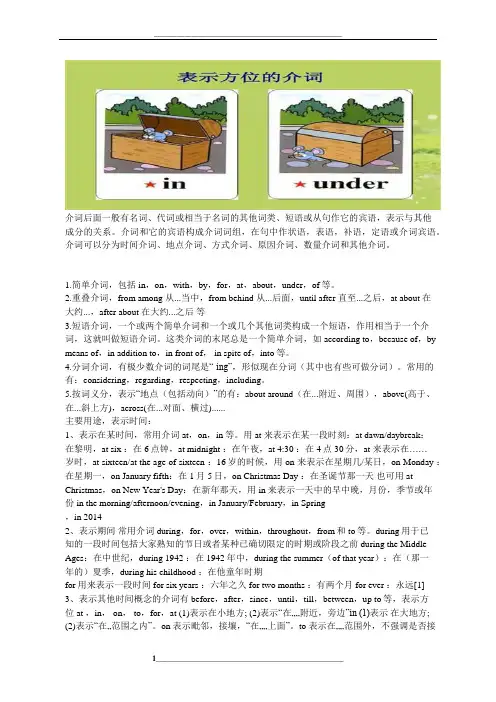
介词后面一般有名词、代词或相当于名词的其他词类、短语或从句作它的宾语,表示与其他成分的关系。
介词和它的宾语构成介词词组,在句中作状语,表语,补语,定语或介词宾语。
介词可以分为时间介词、地点介词、方式介词、原因介词、数量介词和其他介词。
1.简单介词,包括in,on,with,by,for,at,about,under,of等。
2.重叠介词,from among 从...当中,from behind 从...后面,until after 直至...之后,at about 在大约...,after about 在大约...之后等3.短语介词,一个或两个简单介词和一个或几个其他词类构成一个短语,作用相当于一个介词,这就叫做短语介词。
这类介词的末尾总是一个简单介词,如 according to,because of,by means of,in addition to,in front of, in spite of,into等。
4.分词介词,有极少数介词的词尾是“-ing”,形似现在分词(其中也有些可做分词)。
常用的有:considering,regarding,respecting,including。
5.按词义分,表示“地点(包括动向)”的有:about around(在...附近、周围),above(高于、在...斜上方),across(在...对面、横过)......主要用途,表示时间:1、表示在某时间,常用介词at,on,in等。
用 at 来表示在某一段时刻:at dawn/daybreak:在黎明,at six :在6点钟,at midnight :在午夜,at 4:30 :在4点30分,at 来表示在……岁时,at sixteen/at the age of sixteen :16岁的时候,用 on 来表示在星期几/某日,on Monday :在星期一,on January fifth:在1月5日,on Christmas Day :在圣诞节那一天也可用at Christmas,on New Year's Day:在新年那天,用in来表示一天中的早中晚,月份,季节或年份in the morning/afternoon/evening,in January/February,in Spring,in 20142、表示期间常用介词during,for,over,within,throughout,from和to等。
英语常见介词的用法

Only的用法一、only用作形容词1. 与the连用,意为“惟一的”,作定语。
如:John is the only boy in his family.约翰是家里惟一的男孩。
She is the only girl here who knows how to drive a car.她是这儿惟一会开车的姑娘。
2. only可修饰复数名词,意为“仅有的、惟一的一些”,作定语。
如:They were the only people present.出席的只有他们这些人。
3. 与an连用,意为“单独的”,作定语。
如:Jim was an only son of his parents.吉姆是他父母的独子。
4. 与the连用,意为“最好的、最适当的”,作定语。
如:She is the only person for the job.她是做这项工作的最佳人选。
He is the only man for me.对于我来说,他是最合适的人。
The only thing to do on a hot day is to go swimming.在热天最理想的事就是去游泳。
二、only用作副词1. 常位于所修饰的动词、短语或从句前,意为“只是、仅仅”。
如:At present we can only wait and see.目前我们只好等一等看。
I only touched it.我只不过摸了它一下。
I only regret that I have but one life to lose for my country.我惟一遗憾的是:我仅有一次生命可以贡献给我的祖国。
He only walks to save money��he doesn”t really l ike walking.他只是为了省钱而步行,并不是真正喜欢步行。
Father gave me this computer only for my birthday.只是因为我过生日,父亲才送给我这台电脑。
常用36个英语介词

常用36个英语介词英语介词是我们学习英语过程中非常重要的一部分。
介词大多用来连接句子中的不同部分,并确定它们之间的关系。
介词有很多种类,本文将重点介绍英语中36个最常用的介词及其用法。
一、关系介词1. ofOf用于表示关系或归属关系。
例句:This is a picture of my family.2. fromFrom表示来源或者离开某个地方。
例句:I came from China.3. withWith表示附带的、一起的意思,有时也表示带着。
例句:I went to London with my friend.4. aboutAbout表示大体上、关于等含义。
例句:We talked about the weather.5. inIn 表示在某个时间段、地点、状态内。
例句:I am in the office now.6. onOn 表示在某个具体的物体、时间、场合上。
例句:The book is on the table.7. toTo 表示方向、目标。
例句:She goes to school every day.二、时间介词8. atAt 表示时间的具体点,通常与钟表时间连用。
例句:I will meet you at 2 o'clock.9. onOn 表示在某个具体的时间点。
例句:My birthday is on May 1st.10. inIn 表示在某个时间段内。
例句:I will return to China in six months.三、方向介词11. in front ofIn front of 表示前面。
例句:There are two chairs in front of the desk.12. behindBehind 表示后面。
例句:The cat is hiding behind the sofa.13. aboveAbove 表示在上方。
例句:The sun is above the clouds.14. belowBelow 表示在下方。
介词的常见用法及注意事项

介词的常见用法及注意事项介词是连接词与词之间关系的一类词语,常见于英语语法中,它在句子中起到了定位、方向、时间、原因等各种作用。
了解介词的常见用法及注意事项对于掌握英语语法和提高语言表达能力至关重要。
本文将详细介绍介词的常见用法及需要注意的事项。
1. 介词的定义和基本用法介词是一种虚词,通常位于名词或代词前,用于限定名词或代词的关系。
介词也可以位于介词短语的前面。
在句子中,介词通常与名词、代词、动词或副词等其他词语结合,构成介词短语来表达特定的含义。
常见的介词包括:"in"、"on"、"at"、"by"、"with"、"to"、"from"、"over"等。
介词的使用取决于特定的语境和含义。
例如,我们使用"in"表示在某个位置内,"on"表示在某个表面上,"at"表示在某个具体地点等等。
2. 介词的常见用法2.1 表示地点介词常用来表示地点,用于描述人或物所在的位置。
例如:- The book is on the table.(这本书在桌子上。
)- The cat is under the chair.(猫在椅子下面。
)2.2 表示时间介词还常用来表示时间,用于描述事件发生的时间。
例如:- I will meet her at 8 o'clock.(我将在8点钟见她。
)- They usually have dinner on Sundays.(他们通常在星期天吃晚饭。
)2.3 表示方式或原因有些介词可以表示某个动作的方式或原因。
例如:- He broke the vase with a hammer.(他用锤子打碎了花瓶。
)- She cried because of the sad news.(她因为这个悲伤的消息而哭了。
介词的用法总结语文
介词的用法总结语文一、介词的定义和作用介词是语法中的一类虚词,常常用来表达两个词语之间的关系。
它可以连接名词、代词、动名词、动词不定式等成分,并且在句子中充当状语或补足语的作用。
二、介词的分类和特点1. 位置类型介词:表示地点或方向关系,如在、上、下。
2. 时间类型介词:表示时间关系,如在、经过、从。
3. 方式类型介词:表示方式和手段,如用、靠。
4. 陪衬类型介词:表示伴随关系,如和、与。
5. 条件让步类型介词:表示条件和让步关系,如如果、尽管。
6. 目的结果类型介词:表示目的和结果关系,如为了、以便。
三、常见介词及其使用方法1. "在"、“向”、“往”的区别:在:表示位置,在某个范围内或某个具体位置。
例如:“我在图书馆学习。
”向:表示移动行为,动态意义较强。
例如:“他向北走去。
”往:表示行进方向,并无具体动作。
例如:“她往西走了。
”2. “对于”、“对”、“于”的区别:对于:表达对某人或某事的看法、态度或观点。
例如:“对于他的行为,我们表示谴责。
”对:表示方向、目标等。
例如:“我很喜欢对你微笑。
”于:用在名词前面,起到修饰或说明作用。
例如:“他是于先生。
”3. “因为”和“由于”的区别:因为:表示因果关系,引出原因。
例如:“她迟到了,因为路上出了交通事故。
”由于:表示某种情况导致结果。
例如:“由于天气恶劣,比赛被取消。
”4. “跟”和“与”的区别:跟:表示陪伴、随着的意思。
例如:“我跟朋友一起去旅游。
”与:表示并列或相比较的关系。
例如:“成功与失败都是自己去争取的结果。
”5. “根据”和“依据”的区别:根据:指以某个事物作为判断、决策等的依据和根本。
例如:“我们制定计划要根据实际情况来进行。
”依据:指以某种法规、规定等作为依托和参照。
例如:“我们进行工作要依据公司的规章制度。
”四、常用短语及搭配1. 按照:按照某种标准、方法或要求进行。
例如:“我们要按照客户的需求来生产产品。
常用介词大全
常用介词大全以下是常用的介词列表:1. 关于 - 表示对某个主题或话题的讨论或描述2. 在 - 表示某个位置、场所或时间点3. 和 - 表示两个或多个事物之间的关系、连接或比较4. 由于 - 表示某个原因或起因5. 对于 - 表示对某人或某事的看法、态度或行动6. 在......之间 - 表示两者之间的关系或区别7. 通过 - 表示途径、方法或手段8. 根据 - 表示某个依据、准则或规定9. 比 - 表示比较或对比10. 在......中 - 表示某个范围、领域或环境11. 为了 - 表示目的、目标或意图12. 靠 - 表示依靠、依赖或信任13. 在......上 - 表示某个表面、平台或层面14. 自从 - 表示某个时间点或事件之后15. 到 - 表示朝向某个目标或地点16. 除了 - 表示排除、不包括或否定17. 按照 - 表示按照某个顺序、方式或规定18. 对 - 表示对某人或某事的影响、作用或表示19. 针对 - 表示对某个问题、情况或对象的专门处理或考虑20. 通过 - 表示途径、方法或手段21. 由 - 表示某个主体或来源22. 除了 - 表示排除、不包括或否定23. 跟 - 表示随着或陪伴24. 围绕 - 表示围绕某个中心、议题或话题25. 按照 - 表示按照某个顺序、方式或规定26. 从 - 表示起点、来源或过程27. 被 - 表示被动或接受某种行为或影响28. 靠近 - 表示在某个附近或接近某个地点29. 对于 - 表示对某人或某事的看法、态度或行动30. 关于 - 表示对某个主题或话题的讨论或描述31. 经过 - 表示经过某个过程或阶段32. 缺乏 - 表示某种不足或短缺33. 离 - 表示距离或关系的远近34. 据 - 表示根据或依据某种信息或来源这些介词在不同语境中可能有略微的变化和用法,请根据具体的情况来选择合适的介词。
最好通过阅读和练习来熟悉它们的用法和规则。
介词常见11个用法归纳
介词1.介词的含义,介词(虚词),不能在句子中独立充当成分。
它总是用于名词、代词、或相当于名词的其它词类或短语活从句前。
中考需要掌握的11个介词:in、on、at、to、from、by、with、for、about、after、before表示时间的介词A.典型例题:1.in 1996 / in 2002 / in 1847(年份)2.in October / in February / in March (月份)3.in spring / in summer / in autumn / in winter (季节)4.in a week / in a year 在1周/ 年中5.in the morning / in the afternoon / in the evening 在上午/ 下午/ 晚上in those days 在当时/ in no time 立刻/ in the daytime 在白天/ in the future 在将来/ in one minute 在1分钟内/ 最后in the end表示较长时间(长于一天或短于一天)如:年、年份、月份、季节、周、上午、下午、晚上以及一些习惯用法中要用介词“in”。
-------------------------------------------------------------------------------------------------------------------------------- B.典型例题:1.at ten o’clock / at seven thirty. (表示某一钟点)2.at noon / at night / at midnight (在中午、晚上、半夜――一天中相对短暂的时间)3.at the age of twenty / at the age of thirty-five (表示某一年龄)4.at that time 在那时/ at the moment 这时、那时、此刻/ at first 首先/ at last 最后=in the end/ at once 立刻、马上/ at / on (the) weekends 在周末/ 在一年中的这个时候at this time of year / 在……开始/结束时at the beginning /end of表示时间的某一点(或表示某时刻)如:钟点、年龄或其它的习惯用法中要用“at”。
介词用法详解常见介词的正确搭配与固定搭配
介词用法详解常见介词的正确搭配与固定搭配介词是英语语法中非常重要的一部分,它用来表示名词、代词或动词与其他词之间的关系。
正确使用介词能够使语言更加地准确、自然。
本文将详细介绍一些常见介词的正确搭配与固定搭配,以帮助读者更好地理解和掌握这些用法。
一、关于in的用法:1. 表示地点:in表示在某个范围、界限或地方之内。
例如:in the park(在公园里)、in the room(在房间里)。
2. 表示时间:in常用来表示具体的某个时间段。
例如:in the morning(在上午)、in the summer(在夏季)。
3. 表示状态、情感:in用于表示某种状态或情感。
例如:in love(恋爱中)、in a hurry(匆忙)。
二、关于on的用法:1. 表示位置:on用于描述某事物所在的位置或表面。
例如:on the table(在桌子上)、on the wall(在墙上)。
2. 表示时间:on主要用于表示某一天、星期或具体的时间点。
例如:on Monday(在星期一)、on Christmas Day(在圣诞节)。
3. 表示方式、状态:on常用来表示某种方式或状态。
例如:on foot (步行)、on fire(着火)。
三、关于at的用法:1. 表示地点:at用于表示具体的某个地点或位置。
例如:at the airport(在机场)、at the bus stop(在公交车站)。
2. 表示时间:at用于表示具体的某一时刻。
例如:at 8 o'clock(在8点钟)、at midnight(在午夜)。
3. 表示某种状态、情感:at常用来表示某种状态或情感。
例如:at peace(和平)、at a loss(困惑)。
四、关于to的用法:1. 表示方向、目的地:to用于表示某个方向或目的地。
例如:go to school(去学校)、fly to Beijing(飞往北京)。
2. 表示时间:to用于表示某个时间点或一段时间之后。
所有介词的用法
所有介词的用法介词的定义和分类介词是一类用于连接名词、代词、动词或形容词与其他词语之间关系的词语。
它们在句子中起到连接、修饰和补充的作用。
介词种类众多,根据其不同的意义和用法,可以进行如下分类:1.地点介词:表示位置、方位关系的介词,例如:at、in、on、over等。
2.时间介词:表示时间关系的介词,例如:at、in、on、before、after等。
3.方式介词:表示方式、手段、条件等的介词,例如:by、with、through等。
4.目的介词:表示目的、结果关系的介词,例如:for、to、in order to等。
5.原因介词:表示原因关系的介词,例如:because of、due to等。
6.比较介词:表示比较关系的介词,例如:than、as等。
7.修饰介词:表示修饰、补充关系的介词,例如:of、with、without、about等。
地点介词的用法at1.表示在某个具体的地点或位置,例如:at home、at school、at the busstop等。
2.表示在某个特定事件或场合,例如:at the party、at the meeting等。
3.表示在某个空间范围内,例如:at the front、at the back等。
in1.表示在内部或边界之内,例如:in the house、in the room、in the car等。
2.表示在某个区域、城市、国家等,例如:in Beijing、in China等。
3.表示在某个特定时间段,例如:in the morning、in July等。
on1.表示在某个表面或平面上,例如:on the table、on the floor、on thewall等。
2.表示在某个日期或具体的时间点,例如:on Monday、on January 1st等。
3.表示在某个交通工具上,例如:on the bus、on the train等。
over1.表示在某个位置的上方,例如:over the bridge、over the sky等。