
《Python程序设计》习题与答案
《Python 程序设计》习题与参考答案第1章基础知识1.1简单说明如何选择正确的Python版本。
答:在选择Python的时候,一定要先考虑清楚自己学习Python的目的是什么,打算做哪方面的开发,有哪些扩展库可用,这些扩展库最高反复安装和卸载上。
同时还应该注意,当更新的Python版本推岀之后,不要急于更新,而是应该等确定自己所必须使用的扩展库也推岀了较新版本之后再进行更新。
尽管如此,Python 3毕竟是大势所趋,如果您暂时还没想到要做什么行业领域的应用开发,或者仅仅是为了尝试一种新的、好玩的语言,那么请毫不犹豫地选择Python 3.x系列的最高版本(目前是Python 343 )。
1.2为什么说Python采用的是基于值的内存管理模式?答:Python采用的是基于值的内存管理方式,如果为不同变量赋值相同值,则在内存中只有一份该值,多个变量指向同一块内存地址,例如下面的代码。
>>> x = 3>>> id(x)>>> y = 3>>> id(y)>>> y = 5>>> id(y)>>> id(x)1.3在Python中导入模块中的对象有哪几种方式?答:常用的有三种方式,分别为import模块名[as别名]from 模块名import对象名[as别名]from math import *1.4使用pip命令安装numpy、scipy模块。
答:在命令提示符环境下执行下面的命令:pip in stall n umpypip in stall scipy1.5编写程序,用户输入一个三位以上的整数,输岀其百位以上的数字。
例如用户输入1234,则程序输岀12。
(提示:使用整除运算。
)答:x = in put('Please in put an in teger of more tha n 3 digits:')try:x = in t(x)x = x//100if x == 0:pri nt('You must in put an in teger of more tha n 3 digits.')else:pri nt(x)except BaseExcepti on:prin t('You must in put an in teger.')import typesx = in put('Please in put an in teger of more tha n 3 digits:')if type(x) != types .In tType:print 'You must in put an in teger.'elif le n( str(x)) != 4:print 'You must in put an in teger of more tha n 3 digits.'else:print x//100第2章Python数据结构2.1为什么应尽量从列表的尾部进行元素的增加与删除操作?答:当列表增加或删除元素时,列表对象自动进行内存扩展或收缩,从而保证元素之间没有缝隙,但这涉及到列表元素的移动,效率较低,应尽量从列表尾部进行元素的增加与删除操作以提高处理速度。
2.2编写程序,生成包含1000个0到100之间的随机整数,并统计每个元素的岀现次数。
(提示:使用集合。
)答:import ran domx = [ran dom.ra ndin t(0,100) for i in ran ge(1000)]d = set(x)for v in d:prin t(v, ':', x.cou nt(v))import ran domx = [ran dom.ra ndin t(0,100) for i in ran ge(1000)]d = set(x)print v, ':', x.cou nt(v)2.3编写程序,用户输入一个列表和2个整数作为下标,然后输岀列表中介于2个下标之间的元素组成的子列表。
例如用户输入[1,2,3,4,5,6]和2,5,程序输岀[3,4,5,6]。
答:x = in put('Please in put a list:')x = eval(x)start, end = eval( in put('Please in put the start positi on and the end positi on:'))pri nt(x[start:e nd])x = in put('Please in put a list:')start, end = input('Please in put the start position and the end position:')pri nt x[start:e nd]2.4设计一个字典,并编写程序,用户输入内容作为键,然后输岀字典中对应的值,如果用户输入的键不存在,则输岀“您输入的键不存在!”答:d = {1:'a', 2:'b', 3:'c', 4:'d'}v = in put('Please in put a key:')v = eval(v)print(d.get(v,'您输入的的键不存在’))d = {1:'a', 2:'b', 3:'c', 4:'d'}v = in put('Please in put a key:')print(d.get(v,'您输入的的键不存在’))2.5编写程序,生成包含20个随机数的列表,然后将前10个元素升序排列,后10个元素降序排列,并输岀结果。
答:import ran domx = [ran dom .randin t(0,100) for i in ran ge(20)]pri nt(x)y = x[0:10]y.sort() x[0:10] = y y = x[10:20] y.sort(reverse=True) x[10:20] = y pri nt(x)import ran domx = [ran dom .randin t(0,100) for i in ran ge(20)]pri nt xy = x[0:10]y.sort()y = x[10:20]y.sort(reverse=True)x[10:20] = ypri nt x2.6在Python中,字典和集合都是用一对大括号作为定界符,字典的每个元素有两部分组成,即_键和值,其中键不允许重复。
2.7假设有列表a = ['name','age','sex']和b = ['Dong',38,'Male'],请使用一个语句将这两个列表的内容转换为字典,并且以列表 a中的元素为键,以列表b中的元素为值,这个语句可以写为 c = dict(zip(a,b))。
2.8假设有一个列表a,现要求从列表a中每3个元素取1个,并且将取到的元素组成新的列表b,可以使用语句b = a[::3]。
2.9使用列表推导式生成包含10个数字5的列表,语句可以写为 [5 for i in range(10)]。
2.10不可以(可以、不可以)使用del命令来删除元组中的部分元素。
第3章选择结构与循环结构3.1分析逻辑运算符“ or”的短路求值特性。
答:假设有表达式“表达式 1 or表达式2”,如果表达式1的值等价于True,那么无论表达式2的值是什么,整个表达式的值总是等价于True。
因此,不需要再计算表达式2的值。
3.2编写程序,运行后用户输入4位整数作为年份,判断其是否为闰年。
如果年份能被400整除,则为闰年;如果年份能被4整除但不能被100整除也为闰年。
答:x = in put(卩 lease in put an in teger of 4 digits mea ning the year:')x = eval(x)if x%400==0 or (x%4==0 and not x%100==0):prin t('Yes')else:prin t('No')x = in put('Please in put an in teger of 4 digits mea ning the year:')if x%400==0 or (x%4==0 and not x%100==0):print 'Yes'else:print 'No'3.3编写程序,生成一个包含50个随机整数的列表,然后删除其中所有奇数。
(提示:从后向前删。
)答:import ran domx = [ran dom .randin t(0,100) for i in ran ge(50)]pri nt(x)i = len( x)-1while i>=0:if x[i]%2==1:del x[i]i-=1pri nt(x)把上面的代码中第三行和最后一行改为print x即可。
34编写程序,生成一个包含20个随机整数的列表,然后对其中偶数下标的元素进行降序排列,奇数下标的元素不变。
(提示:使用切片。
)答:import ran domx = [ran dom .randin t(0,100) for i in ran ge(20)]pri nt(x)y = x[::2]y.sort(reverse=True)x[::2] = ypri nt(x)把上面的代码中第三行和最后一行改为print x即可。
35编写程序,用户从键盘输入小于1000的整数,对其进行因式分解。
例如,10=2 X 5,60=2 X 2 X 3X 5 答:x = in put('Please in put an in teger less tha n 1000:')x = eval('x')t = xi = 2result =[]while True:if t==1:breakif t%i==0:result.appe nd(i)t = t/ielse:i+=1Print x,'=','*'.joi n( map(str,result))x = in put('Please in put an in teger less tha n 1000:')t = xi = 2result =[]while True:if t==1:breakif t%i==0:result.appe nd(i)t = t/ielse:i+=1pr int x,'=','*'.joi n( map(str,result))3.6编写程序,至少使用2种不同的方法计算100以内所有奇数的和x = [i for i in range(1,100) if i%2==1]pri nt(sum(x))prin t(sum(ra nge(1,100)[::2]))3.7编写程序,实现分段函数计算,如下表所示。
《Python程序设计》课后习题参考答案
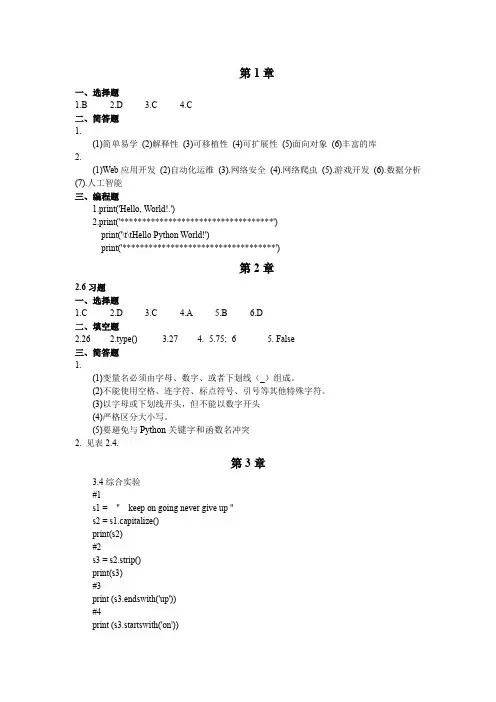
第1章一、选择题1.B2.D3.C4.C二、简答题1.(1)简单易学(2)解释性(3)可移植性(4)可扩展性(5)面向对象(6)丰富的库2.(1)Web应用开发(2)自动化运维(3).网络安全(4).网络爬虫(5).游戏开发(6).数据分析(7).人工智能三、编程题1.print('Hello, World!.')2.print('***********************************')print('\t\tHello Python World!')print('***********************************')第2章2.6习题一、选择题1.C2.D3.C4.A5.B6.D二、填空题2.26 2.type()3.274. -5.75; -6 5. False三、简答题1.(1)变量名必须由字母、数字、或者下划线(_)组成。
(2)不能使用空格、连字符、标点符号、引号等其他特殊字符。
(3)以字母或下划线开头,但不能以数字开头(4)严格区分大小写。
(5)要避免与Python关键字和函数名冲突2. 见表2.4.第3章3.4综合实验#1s1 = " keep on going never give up "s2 = s1.capitalize()print(s2)#2s3 = s2.strip()print(s3)#3print (s3.endswith('up'))#4print (s3.startswith('on'))#5print (s3.replace('e','aa'))#6print (s3.split('n'))#7print (s3.upper())#8n1 = 'Lily'print ('%s says: %s.'%(n1,s3))#9print (s3.center(40,'#'))#10print (s3.count('e'))#11print (s3.split())#12print ('/'.join(s4))#13print (' '.join(s4[::-1]))3.5 习题一、选择题1.B2.D3.C4.C二、填空题1. 'moon'2. 'shipfriend'3. 54. 'bEIjING'5. spam三、编程题1.str1 = 'I want to go to Beijing, Berli and Beijing this year. How about you?' str2 = str1.split()str2 = ' '.join(str2)print (str2)2.思路:(1).变量名的第一个字符是否为字母或下划线(2).如果是,继续判断--> 4(3).如果不是,报错(4).依次判断除了第一个字符之外的其他字符(5).判断是否为字母数字或者下划线while True:s = input('请输入字符(q退出):')if s == 'q':exit()#判断字符串第一个变量是否满足条件if s[0].isalpha() or s[0] == '_':for i in s[1:]:#判断判断除了第一个元素之外的其他元素是否满足条件if i.isalnum() or i == '_':continueelse:print('不合法')breakelse:print('合法')else:print('不合法')3.#!/usr/bin/env python#coding:utf-8s = input("输入:")s1 = s.split(" ")s2 = s1[0].upper()s3 = s1[-1].upper()print (s2.count(s3))4.s = input('input a string:\n')letters, space, digit, others = 0,0,0,0for c in s:if c.isalpha():letters += 1elif c.isspace():space += 1elif c.isdigit():digit += 1else:others += 1print ('char = %d,space = %d,digit = %d,others = %d' % (letters,space,digit,others))第4章4.4 综合实验#01fav_city = []#02fav_city.append('Qinghai')fav_city.append('Chengdu')fav_city.append('Dalian')fav_city.append('Xizang')fav_city.append('Haerbin')print (fav_city)#03fav_city[0] = 'Qingdao'#04fav_city.insert(2,'Kunming')#05del fav_city[0]#06fav_city.remove('Xizang')#07fav_city.sort()#08fav_city.reverse()#09for city1 in fav_city:print (city1)#10tuple_city = tuple(fav_city)#11len(tuple_city)4.5 习题一、选择题1.D2.A3.B4.D5.C二、填空题1.[123,22, 123,22]2.x = [1,3,5,7,9]3. [11,22,33,11]4. Flase5. b= [::2]6. (6,)三、编程题#1import randomx = [random.randint(0,100) for i in range(10)]x.sort()print (x)#2.list1 = ['Hollywood', 'Mexico', 'New Delhi', 'Tokyo'] item = list1.pop(0)list1.append(item)print (list1)#3a = int(input('a:'))for b in x:if a < b:x.insert(x.index(b),a)breakelse:x.append(a)print (x)#3x.pop()x[:5] = sorted(x[:5] ,reverse = True)x[5:] = sorted(x[5:])print (x)4.#列表推导法list1 = [22,11,33,22,44,33]temp_list=[]for x in list1:if x not in temp_list:temp_list.append(x)print (temp_list) #输出结果未排序#排序方法list1 = [22,11,33,22,44,33]list2 = sorted(list1)temp_list = []i = 0while i < len(list2):if list2[i] not in temp_list:temp_list.append(list2[i])else:i += 1print (temp_list) #输出结果已排序第5章字典综合实验1.Qing_Hai = ['qinghai','xining','青',8,'810000']Si_Chuan = ['sichuan','chengdu','川',21,'610000']Gan_Su = ['gansu','lanzhou','陇',14,'730000']Ning_Xia = ['ningxia','yinchuan','宁',5,'750000']Nei_MengGu = ['neimenggu','huhehaote','内蒙古',12,'010000'] Shaan_Xi = ['shaanxi','xian','陕',10,'710000']Shan_Xi = ['shanxi','taiyuan','晋',11,'030000']He_Nan = ['henan','zhengzhou','豫',18,'450000']Shan_Dong = ['shandong','jinan','鲁',16,'250000']provinces = [Qing_Hai,Si_Chuan,Gan_Su,Ning_Xia,Nei_MengGu,Shaan_Xi,Shan_Xi,He_Nan,Shan_Dong] Yellow_River_basin = {}for province in provinces:Yellow_River_basin[province[0]] = province[1:]print(Yellow_River_basin)2.# 遍历嵌套字典的键for key in Yellow_River_basin.keys():print(key)# 遍历嵌套字典的值for value in Yellow_River_basin.values():print(value)# 遍历嵌套字典的键值对for key, value in Yellow_River_basin.items():print(key+"'s Capital is : %s "%value[0]+" For_short is : %s "%value[1]+"Area_manage is : %d个"%value[2]+"Postal_code is : %s"%value[3])3.for provinc in Yellow_River_basin.keys():if provinc == 'sichuan':Yellow_River_basin[provinc] = ['chengdu', '蜀', 21, '610000']elif provinc == 'gansu':Yellow_River_basin[provinc] = ['lanzhou', '甘', 14, '730000']elif provinc == 'shaanxi':Yellow_River_basin[provinc][1] = '秦'print(Yellow_River_basin)4qinghai = {'name':'QingHai','capital':'XiNing','for_short':'青','area_manage':8}sichuang = {'name':'SiChuan','capital':'ChengDu','for_short':'川','area_manage':21}gansu = {'name':'GanSu','capital':'LanZhou','for_short':'陇','area_manage':14}ningxia = {'name':'NingXia','capital':'YinChuan','for_short':'宁','area_manage':5}neimenggu = {'name':'Neimenggu','capital':'HuheHaote','for_short':'内蒙古','area_manage':12} shaanxi= {'name':'ShaanXi','capital':'XiAn','for_short':'陕','area_manage':10}shanxi = {'name':'ShanXi','capital':'TaiYuan','for_short':'晋','area_manage':11}henan = {'name':'HeNan','capital':'ZhengZhou','for_short':'豫','area_manage':18}shandong = {'name':'ShanDong','capital':'JiNan','for_short':'鲁','area_manage':16}basin_list = [qinghai,sichuang,gansu,ningxia,neimenggu,shaanxi,shanxi,henan,shandong] Postal_Code = ['810000','610000','730000','750000','010000','710000','030000','450000','250000']print(basin_list)5for province_num in range(len(basin_list)):basin_list[province_num]['postal_code'] = Postal_Code[province_num]print(basin_list)第5章综合实验一、选择题1.B2.C3.B4.D5.D二、简答题1.(1)字典的键(key)具有唯一性。
《Python程序设计》习题与答案

x
y
x<0
0
0<=x<5
x
5<=x<10
3x-5
10<=x<20
0.5x-2
20<=x
0
x = input('Please input x:')
x = eval(x)
if x<0 or x>=20:
print(0)
elif 0<=x<5:
print(x)
2.2 编写程序,生成包含1000个0到100之间的随机整数,并统计每个元素的出现次数。(提示:使用集合。)
答:
import random
x = [random.randint(0,100) for i in range(1000)]
d = set(x)
for v in d:
print(v, ':', x.count(v))
try:
x = int(x)
x = x//100
if x == 0:
print('You must input an integer of more than 3 digits.')
else:
print(x)
except BaseException:
print('You must input an integer.')
2.8 假设有一个列表a,现要求从列表a中每3个元素取1个,并且将取到的元素组成新的列表b,可以使用语句b = a[::3]。
2.9 使用列表推导式生成包含10个数字5的列表,语句可以写为[5 for i in range(10)]。
大学《Python程序设计》试题及答案

大学《Python程序设计》试题及答案一、填空题1、已知x = list(range(20)),那么执行语句x[:18] = []后列表x的值为______________。
([18,19])2、已知x = [1, 2, 3],那么连续执行y = x[:]和y.append(4)这两条语句之后,x的值为____________________。
([1, 2, 3])3、已知x = [1, 2, 3],那么连续执行y = x和y.append(4)这两条语句之后,x的值为____________________。
([1, 2, 3, 4])4、已知x = [1, 2, 3],那么连续执行y = [1, 2, 3]和y.append(4)这两条语句之后,x的值为____________________。
([1, 2, 3])5、已知x = [[]] * 3,那么执行语句x[0].append(1)之后,x的值为____________________。
([[1], [1], [1]])6、已知x = [[] for i in range(3)],那么执行语句x[0].append(1)之后,x的值为_________________。
([[1], [], []])7、已知x = ([1], [2]),那么执行语句x[0].append(3)后x的值为________________。
(([1, 3],[2]))8、已知x = {1:1, 2:2},那么执行语句x.update({2:3, 3:3})之后,表达式sorted(x.items())的值为____________________。
([(1, 1), (2, 3), (3, 3)])9、已知x = {1:1, 2:2},那么执行语句x[3] = 3之后,表达式sorted(x.items())的值为____________________。
《Python程序设计》习题与答案python教材答案

《Python程序设计》习题与答案python教材答案《Python程序设计》习题与答案第一章:Python基础题目1:计算器程序设计答案:代码可以如下所示:```pythondef add(a, b):return a + bdef subtract(a, b):return a - bdef multiply(a, b):return a * bdef divide(a, b):if b == 0:return "Error: Division by zero is not allowed"return a / b```题目2:变量和数据类型答案:Python中的常见数据类型有整型(int)、浮点型(float)、字符串型(str)、布尔型(bool)等。
题目3:条件语句答案:条件语句用于根据不同的条件执行不同的代码块。
常见的条件语句有if语句、if-else语句和if-elif-else语句。
题目4:循环语句答案:循环语句用于多次执行相同或类似的代码块。
常见的循环语句有for循环和while循环。
第二章:函数和模块题目1:函数的定义和调用答案:函数是一段可重复使用的代码块,用于完成特定的任务。
函数的定义可以通过def关键字来实现,而函数的调用则通过函数名和参数完成。
题目2:内置函数答案:Python提供了丰富的内置函数,如print()、len()、input()等。
这些内置函数可以直接使用,无需额外定义。
题目3:模块的导入和使用答案:Python模块是一组相关的函数、类和变量的集合,用于组织、重用和扩展代码。
模块的导入可以使用import语句,然后通过模块名和函数名来调用模块中的内容。
第三章:文件操作题目1:文件的打开和关闭答案:文件操作前需要通过open()函数打开文件,在完成操作后需要使用close()函数关闭文件。
例如:```pythonfile = open("test.txt", "w")# 执行文件操作file.close()```题目2:读取文件内容答案:使用Python的read()函数可以读取整个文件的内容,或者使用readline()函数读取一行内容。
python程序设计期末考试题及答案
python程序设计期末考试题及答案一、选择题(每题2分,共20分)1. 在Python中,以下哪个关键字用于定义一个函数?A. defB. functionC. returnD. lambda答案:A2. 下列哪个选项是Python中的列表推导式?A. [x for x in range(5)]B. (x for x in range(5))C. {x for x in range(5)}D. [x: x in range(5)]答案:A3. 在Python中,以下哪个语句用于捕获异常?A. tryB. exceptC. finallyD. all of the above答案:D4. Python中,以下哪个选项是正确的字符串格式化方法?A. "%s" % "Hello"B. "{0}".format("Hello")C. "Hello" % "World"D. "Hello {}".format("World")5. 下列哪个选项是Python中定义类的关键字?A. classB. structC. typeD. object答案:A6. 在Python中,以下哪个关键字用于创建一个空集合?A. listB. setC. dictD. tuple答案:B7. Python中,以下哪个函数用于计算集合的并集?A. unionB. intersectC. differenceD. symmetric_difference答案:A8. 在Python中,以下哪个选项是正确的字典推导式?A. {x: x2 for x in range(5)}B. {x: x2 in range(5)}C. {x: x2 for x in range(5) if x % 2 == 0}D. {x: x2 for x in range(5) else x % 2 == 0}答案:C9. 在Python中,以下哪个关键字用于定义一个方法?B. methodC. functionD. class答案:A10. Python中,以下哪个函数用于将列表转换为元组?A. list()B. tuple()C. dict()D. set()答案:B二、填空题(每题2分,共20分)1. 在Python中,使用________关键字可以定义一个私有变量。
Python程序设计答案和解析

一单选题 (共10题,每小题2分,总分值20)1. 答案:D2. 答案:C3. 答案:B4. 答案:D5. 答案:D6. 答案:B7. 答案:D8. 答案:A9. 答案:A10. 答案:B二多选题 (共5题,每小题3分,总分值15)11. 答案:A,B,C12. 答案:A,B13. 答案:A,B14. 答案:A,B,C15. 答案:A,B,C,D三判断 (共5题,每小题2分,总分值10)16. 答案:F17. 答案:T18. 答案:T19. 答案:T20. 答案:F四其他题 (共5题,每小题5分,总分值25)21. 答案:列表(list)是最重要的Python内置对象之一,是包含若干元素的有序连续内存空间。
在形式上,列表的所有元素放在一对方括号[]中,相邻元素之间使用逗号分隔。
在Python中,同一个列表中元素的数据类型可以各不相同,可以同时包含整数、实数、字符串等基本类型的元素,也可以包含列表、元组、字典、集合、函数以及其他任意对象。
如果只有一对方括号而没有任何元素则表示空列表。
22. 答案:集合(set)属于Python无序可变序列,使用一对大括号作为定界符,元素之间使用逗号分隔,同一个集合内的每个元素都是唯一的,元素之间不允许重复。
集合中只能包含数字、字符串、元组等不可变类型(或者说可哈希)的数据,而不能包含列表、字典、集合等可变类型的数据。
23. 答案:修饰器(decorator)是函数嵌套定义的另一个重要应用。
修饰器本质上也是一个函数,只不过这个函数接收其他函数作为参数并对其进行一定的改造之后使用新函数替换原来的函数。
Python面向对象程序设计中的静态方法、类方法、属性等也都是通过修饰器实现的。
24. 答案:私有成员在类的外部不能直接访问,一般是在类的内部进行访问和操作,或者在类的外部通过调用对象的公有成员方法来访问,而公有成员是可以公开使用的,既可以在类的内部进行访问,也可以在外部程序中使用。
《Python程序设计》期末复习试题库及答案
《Python程序设计》期末复习试题库及答案一、选择题(每题3分,共30分)1. 以下哪个选项是Python中的正确注释方式?A. //这是单行注释B. /这是多行注释/C. #这是单行注释D. ''这是多行注释'答案:C2. Python中,下面哪个选项可以用来定义一个整数变量?A. int x = 10B. x = int(10)C. x = 10LD. x = float(10)答案:B3. 在Python中,以下哪个函数可以用来判断一个字符串是否以指定后缀结尾?A. str.endswith(suffix)B. str.endswith(prefix)C. str.startswith(suffix)D. str.startswith(prefix)答案:A4. 以下哪个选项是Python中定义列表的正确方式?A. list = [1, 2, 3]B. list = {1, 2, 3}C. list = (1, 2, 3)D. list = "1, 2, 3"答案:A5. 在Python中,以下哪个选项表示无限循环?A. for i in range(10):print(i)B. while True:print("Hello, World!")C. while i < 10:print(i)i += 1D. for i in range(-10, 10):答案:B6. 以下哪个选项是Python中定义字典的正确方式?A. dict = {"key1": "value1", "key2":"value2"}B. dict = {"key1": "value1", "key2":"value2", }C. dict = {"key1": "value1", "key2":"value2":}D. dict = ("key1": "value1", "key2":"value2")答案:A7. 在Python中,以下哪个函数可以用来打开一个文件?A. open(file, "w")B. open(file, "r")C. open(file, "w+", "r+")D. open(file, "r+")答案:B8. 以下哪个选项表示在Python中创建一个类?A. class MyClass:B. def MyClass():C. class MyClass():D. def class MyClass:答案:A9. 在Python中,以下哪个选项是定义私有方法的正确方式?A. def _myPrivateMethod():B. def __myPrivateMethod():C. def myPrivateMethod():D. def _myPrivateMethod(self):答案:B10. 以下哪个选项表示在Python中导入模块的正确方式?A. import mathB. include mathC. require mathD. import from math答案:A二、填空题(每题3分,共30分)1. 在Python中,定义函数使用________关键字。
大学《Python程序设计》试题及答案
大学《Python程序设计》试题及答案大学《Python程序设计》试题及答案一、选择题1、在Python中,以下哪个选项可以正确表示小于等于操作符? A) <=B) <* C) .≤ D) 以上都不是答案:A) <=2、下列哪个模块可用于绘制图形? A) math B) plot C) canvas D) none of the above 答案:C) canvas3、在Python中,如何将字符串转换为整数? A) str() B) int() C) float() D) 以上都不是答案:B) int()4、若要打印出所有的素数,以下哪个循环结构可以实现? A) whileB) for C) do-while D) switch-case 答案:B) for5、以下哪个选项可以用于导入模块? A) import math as m B) include math as m C) #include <math.h> D) #import <math.h> 答案:A) import math as m二、填空题1、Python中的注释符号是_____。
答案:#2、在Python中,所有变量都必须具有_____。
答案:类型(types)3、Python中的逻辑运算符用于执行_____运算。
答案:逻辑(logical)4、以下哪个函数可以用于将字符串转换为浮点数? A) str() B) int() C) float() D) none of the above 答案:C) float()5、以下哪个循环结构可以用于打印出所有的偶数? A) for i in range(0, 10): print(i2) B) for i in range(0, 10): if i % 2 == 0: print(i2) C) for i in range(0, 10): if i % 2 != 0: print(i2) D) none of the above 答案:B) for i in range(0, 10): if i % 2 == 0: print(i2)三、编程题编写一个Python程序,打印出所有的水仙花数(Narcissistic Number)。
高中python程序设计试题及答案
高中python程序设计试题及答案高中Python程序设计试题及答案一、选择题(每题3分,共30分)1. Python中,以下哪个是正确的字符串表示方法?A. 'Hello, World!'B. "Hello, World!"C. Both A and BD. None of the above答案:C2. 在Python中,以下哪个是正确的列表表示方法?A. [1, 2, 3]B. (1, 2, 3)C. Both A and BD. None of the above答案:A3. Python中,以下哪个是正确的字典表示方法?A. {'name': 'Alice', 'age': 25}B. [name: 'Alice', age: 25]C. Both A and BD. None of the above答案:A4. 在Python中,以下哪个是正确的条件语句?A. if x > 0:B. if x>0:C. if x > 0D. Both A and B答案:A5. Python中,以下哪个是正确的循环语句?A. for i in range(10):B. for i = 0 to 10:C. Both A and BD. None of the above答案:A6. 在Python中,以下哪个是正确的函数定义?A. def my_function():B. function my_function():C. Both A and BD. None of the above答案:A7. Python中,以下哪个是正确的异常处理语句?A. try:B. try:C. Both A and BD. None of the above答案:A8. 在Python中,以下哪个是正确的模块导入语句?A. import mathB. include mathC. Both A and BD. None of the above答案:A9. Python中,以下哪个是正确的类定义?A. class MyClass:B. class my_class:C. Both A and BD. None of the above答案:C10. 在Python中,以下哪个是正确的文件操作语句?A. with open('file.txt', 'r') as file:B. open('file.txt', 'r')C. Both A and BD. None of the above答案:A二、填空题(每题4分,共20分)1. 在Python中,使用____函数可以计算列表中元素的和。
《Python程序设计》期末试卷及答案2套
一、选择题(共10个,每个2分)1.在下列选项中,( )不是常量.A 'python'B 8.25C pythonD True2.下列语句中,( )在Python 中是非法的(变量已经定义)。
A a += 1B a=b==0C int(True+1)D a + 1 = a + 13.设a = ({'Name':'python'}),则type(t)的到的结果为( )。
A <class 'dict'>B <class 'tuple'>C <class 'list'>D <class 'str'>4.设Str = 'I Love python',则下列操作结果错误的是( )。
A print(Str[0])的结果为: 'I'B print(Str[0:7:2])的结果为: 'ILv'C print(" Love " in Str)的结果为: FalseD print(Str[::-1] + " S")的结果为:'nohtyp evoL I S'5.Python中列表数据类型元素的切片非常强大,对于列表List = ['a',8,(5,2,1),{'Sex':'Woman'},[1,2,3]],下面操作结果错误的是()。
A List[0] + str(List[1])的结果为:'a8'B List[-1][1] + 1 == 2的结果为:TrueC List[:] 的结果为:['a', 8, (5, 2, 1), {'Sex': 'Woman'}, [1, 2, 3]]D List[2][2]<List[1]的结果为:True6.下列选项中,有关字典操作以及描述错误的是( )。