
Unit 6 Do you like bananas 教案第一课时
Unit 6 Do you like bananas? A
Teaching aims:
1. Knowledge goals:
(1) To grasp the words in Section A, such as strawberry, orange, tomato, ice cream, hamburger,
salad, bread, milk and pear. Pay attention to their spelling, pronunciation and plural forms.
(2) To master the target language:
--Do you like salad? --Yes, I do./ No, I don’t.
I like salad. I don’t like salad.
--Does he like pears? --Yes, he does./ No, he doesn’t.
He likes pears. He doesn’t like pears.
2. Ability goals:
(1) To use the words in this unit and sentence structures to make dialogues.
(2) To express one’s likes and dislikes of food in daily life using what have learned in class.
(3) To improve students’ integrated abilities and skills.
3. Moral goals
(1) To call students’ attention to others’ interests and enable them to care more about the
surroundings around them..
(2) To improve students’ communicative skills and enable them to keep in good health.
Teaching important and difficult points:
1. Target language
--Do you like salad? --Yes, I do./ No, I don’t.
I like salad. I don’t like salad.
--Does he like pears? --Yes, he does./ No, he doesn’t.
He likes pears. He doesn’t like pears.
2. The plural forms of countable nouns.
pear --- pears orange --- oranges
strawberry --- strawberries
tomato --- tomatoes
Teaching aids:
Multi- media
Teaching procedures:
Step 1: Greetings!
Step 2: Lead-in. ( orange, pear, apple, watermelon )
Ask the students following questions:
What’s this?
How do you spell it?
The plural form.
Explain the construction of watermelon. water + melon
Step 3: Review the new words of section A
1. Countable nouns: banana, pear, apple, strawberry, hamburger, orange, tomato
Show the pictures of food, then ask the students to spell the words and say out the plural
forms of countable nouns. Ask one student to summarize the pattern of the plural forms.
2. Uncountable nouns: bread, chicken, milk, salad, ice-cream
3. Both countable and uncountable nouns: chicken, salad, ice-cream
Step 4: Target language learning
1. Show a picture of salad, then ask students in Chinese
“你喜欢沙拉吗?” And its answer.
A: Do you like salad?
B: No, I don’t./ Yes, I do.
I like fruit salad.
I don’t like fruit salad.
2. Oral practice:
Show pictures of food and ask the students to answer by using above samples.
Situation 1: strawberries you
Situation 2: pears they
Situation 3: milk Tim and Jim
... ...
3. Summary:
Ask the students to summarize by themselves.
-- Do you like bread?
-- Yes, I do. No, I don't.
I/We/You/They like bread.
I/We/You/They don't like bread.
4. Exercise
Change the following sentences into negative forms.
Example: I like oranges. → I don’t like oranges.
1).You like hamburgers.
2).We like salad.
3).They like chicken.
4).Tom and Sandra like ice cream.
5). Lily and Lucy have breakfast every morning.
5. Change into the third person and ask the same questions.
A: Does she like tomatoes?
B: Yes, she does. / No, she doesn’t.
She likes tomatoes.
She doesn't like tomatoes.
6. Oral practice.
Situation 1: bananas he
Situation 2: apples Jim's brother
Situation 3: ice-cream Lily
7. Summary Ask the students to summarize by themselves.
---Does she/he like ... ?
---Yes, she/he does. No, she/he doesn't.
Lulu likes her students.
Lulu doesn't like oranges.
8. Exercise one
Change the following sentences into negative forms.
1). He likes tomatoes.
2). Tony likes chicken.
3). Linda likes bananas.
4). She likes strawberries.
5). His uncle watches TV every evening.
9. Exercise two
1). Jenny likes salad.
____ Jenny ____ salad? No, she _______.
2). I like pears.
____ you _____ pears? No, I _______.
3). Jim and Tom watch TV every day.
___ Jim and Tom _____ TV every day?
Yes, _____ ____. No, _____ ______.
4). He has a strawberry. (用they改写)
They _____ ____________.
5). We ______ have ice cream. (否定句)
6). My father ______ play tennis.(否定句)
7). Lily______ (like) vegetable salad.
8). Jim ________ (watch) soccer games ___ TV every day. (改为一般疑问句)
Step 5. Let’s think
1. How to say “一杯牛奶/咖啡/茶/水”
2. Translate its meaning: Lulu has milk and an egg for breakfast.
Step 6. Homework
Make up sentences using given samples 4 pairs
Students’ reflection:
Students may finish the exercise successfully. Most of them may answer the questions rightly
人教版七年级英语上册 Unit 6 教学设计

人教版七年级英语上册 Unit 6 教学设计(1)《修改后》《英语》
一、课题:Do you like bananas ?
二、教学目标(知识目标、能力目标、德育目标)
知识目标:1) 单词:do, don’t, does, doesn’t, strawberries, like, have, hamburgers,
orange, tomatoes, ice cream, broccoli, salad, French fries, bananas.
1. 全体学生都能正确认读这些单词、词组
2. 优等生能正确书写strawberries, like, have, hamburgers, orange, tomatoes, ice
cream, broccoli, salad, French fries, bananas
2)句型:Do you like bananas?
Yes, I do. / No, I don’t.
1. 后进生能读出句子
2. 大部分学生能正确理解并根据图画应用
3. 优等生能假设情景熟练对话
能力目标:通过学习本课,大部分学生能够用英语互相讨论喜欢与不喜欢的食品。部分学生能进行情景对话表演
德育目标:讨论美食,能喜欢应用本课目标语讨论喜欢与不喜欢的食品。
设计思路:
1. 教学目标要体现学生为主体,要充分解读学生的基础上从学生的角度设计。一是分析学生、二是换位思考。
2. 教学目标要体现具体任务,以学生能做某事为任务。
3. 教学目标要体现发展,要让学生有收获有发展。
4. 要面向全体学生,因材施教
三、教学设计的思路及教学建议
第六单元的主题是“询问对方喜欢与不喜欢的食物”,这些食物都是学生比较熟悉的生活食品。 在教学时老师能够使用实物进行教学,增强学生的学习兴趣和学习效果。在传授新知识时,为了为学生创设真实的,贴近生活的情境,可以设计一些游戏,即根据不同人对食物的不同喜好,自配营养餐和填写购物清单等,这样不但激发了学生学习的热情,也达到了练习重点句型的目的。
uint6(修1)
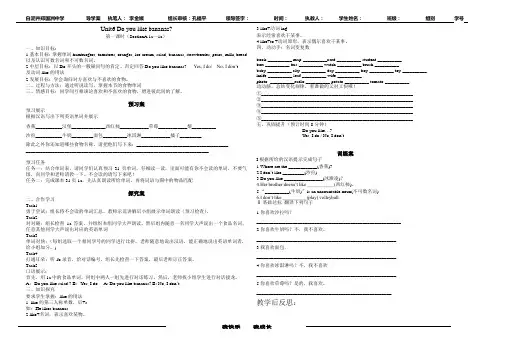
白泥井郑国洲中学 导学案 执笔人: 李金娥 组长审核:孔福平 领导签字: 时间: 执教人: 学生姓名: 班级: 组别 学号
我快乐 我成长 Unit6 Do you like bananas?
第一课时(SectionA 1a—1c)
一、知识目标:
1.基本目标:掌握单词hamburgers, tomatoes, oranges, ice-cream, salad, bananas, strawberries, pears, milk, bread以及认识可数名词和不可数名词。
2.中层目标:以Do开头的一般疑问句的肯定、否定回答Do you like bananas? Yes, I do/ No, I don’t
及动词like的用法
2.发展目标:学会询问对方喜欢与不喜欢的食物。
二、过程与方法:通过听说读写,掌握本节的食物单词
三、情感目标:同学间互相谈论喜欢和不喜欢的食物,增进彼此间的了解。
预习案
预习展示
根据汉语写出下列英语单词并展示
香蕉___________汉堡______________西红柿____________草莓____________梨__________
沙拉___________牛奶_________面包__________冰淇淋____________橘子_________
除此之外你还知道哪些食物名称,请把他们写下来:______________________________________
____________________________________________________________________________
预习任务
任务一:结合单词表,请同学们认真预习31页单词,仔细读一读,里面可能有你不会读的单词,不要气馁,向同学和老师请教一下。不会读的请写下来吧!
人教新目标英语七上Unit6Doyoulikebananas教案4
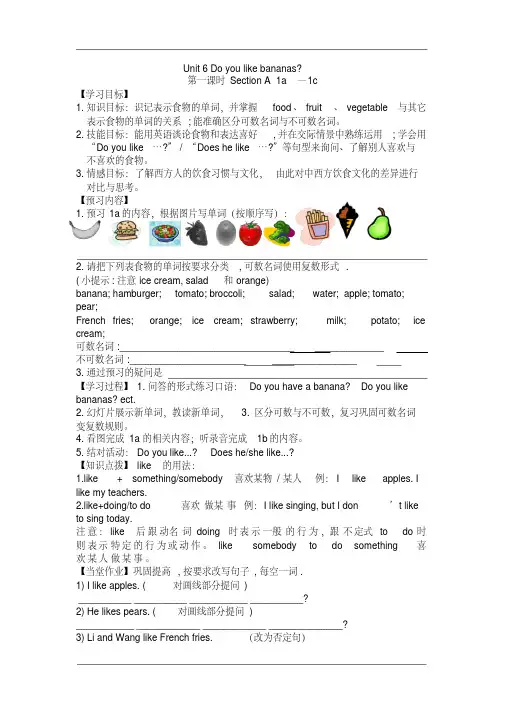
Unit 6 Do you like bananas? 第一课时Section A 1a—1c
【学习目标】
1.知识目标:识记表示食物的单词,并掌握food、 fruit、 vegetable与其它
表示食物的单词的关系;能准确区分可数名词与不可数名词。
2.技能目标:能用英语谈论食物和表达喜好,并在交际情景中熟练运用;学会用
“Do you like…?” /“Does he like…?”等句型来询问、了解别人喜欢与
不喜欢的食物。
3.情感目标:了解西方人的饮食习惯与文化,由此对中西方饮食文化的差异进行
对比与思考。
【预习内容】1.预习1a的内容,根据图片写单词(按顺序写):
2.请把下列表食物的单词按要求分类,可数名词使用复数形式.
(小提示:注意ice cream, salad和orange) banana; hamburger; tomato; broccoli; salad; water; apple; tomato;
pear;
French fries; orange; ice cream; strawberry; milk; potato; ice
cream;
可数名词:_________________________________ _____________
不可数名词:______________________ ________________
3.通过预习的疑问是
【学习过程】1.问答的形式练习口语:Do you have a banana? Do you like
bananas? ect.
2.幻灯片展示新单词,教读新单词, 3.区分可数与不可数,复习巩固可数名词
变复数规则。4.看图完成1a的相关内容;听录音完成1b的内容。
5.结对活动:Do you like...? Does he/she like...?
【知识点拨】like 的用法:
1.like + something/somebody 喜欢某物/某人例:I like apples. I
人教版初中英语七年级上册Unit 6 Section B(1a-1e)教学教案和教学反思
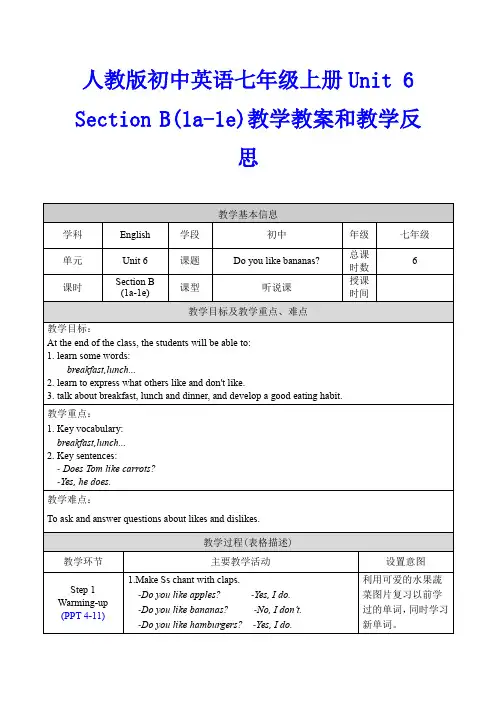
人教版初中英语七年级上册Unit 6
Section B(1a-1e)教学教案和教学反思
教学基本信息
学科 English 学段 初中 年级 七年级
单元 Unit 6 课题 Do you like bananas? 总课时数 6
课时 Section B
(1a-1e) 课型 听说课 授课时间
教学目标及教学重点、难点
教学目标:
At the end of the class, the students will be able to:
1. learn some words:
breakfast,lunch...
2. learn to express what others like and don't like.
3. talk about breakfast, lunch and dinner, and develop a good eating habit.
教学重点:
1. Key vocabulary:
breakfast,lunch...
2. Key sentences:
- Does Tom like carrots?
-Yes, he does.
教学难点:
To ask and answer questions about likes and dislikes.
教学过程(表格描述)
教学环节 主要教学活动 设置意图
Step 1
Warming-up
(PPT 4-11) 1.Make Ss chant with claps.
-Do you like apples? -Yes, I do.
-Do you like bananas? -No, I don’t.
-Do you like hamburgers? -Yes, I do. 利用可爱的水果蔬菜图片复习以前学过的单词,同时学习新单词。 2. Ss look at the pictures and review the words.
初一上册英语第6单元句式精讲名补教案 Unit 6 Do you like bananas
本文由一线教师精心整理/word可编辑
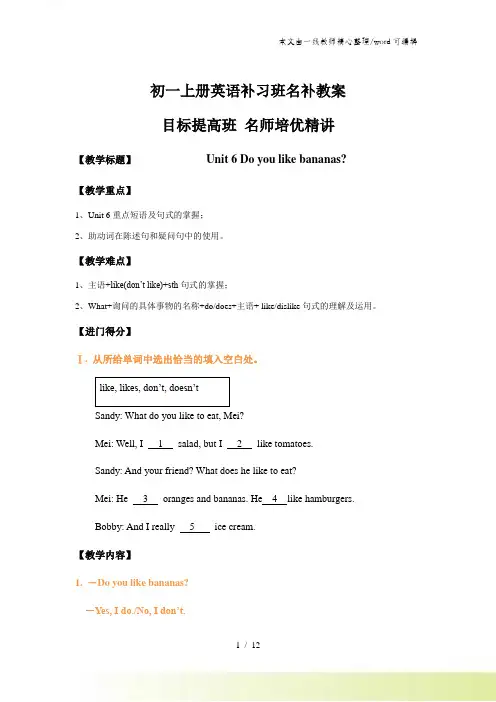
1 / 12 初一上册英语补习班名补教案
目标提高班 名师培优精讲
【教学标题】 Unit 6 Do you like bananas?
【教学重点】
1、Unit 6重点短语及句式的掌握;
2、助动词在陈述句和疑问句中的使用。
【教学难点】
1、主语+like(don’t like)+sth句式的掌握;
2、What+询问的具体事物的名称+do/does+主语+ like/dislike句式的理解及运用。
【进门得分】
Ⅰ. 从所给单词中选出恰当的填入空白处。
like, likes, don’t, doesn’t
Sandy: What do you like to eat, Mei?
Mei: Well, I 1 salad, but I 2
like tomatoes.
Sandy: And your friend? What does he like to eat?
Mei: He 3 oranges and bananas. He
4 like hamburgers.
Bobby: And I really 5 ice cream.
【教学内容】
1. -Do you like bananas?
-Yes, I do./No, I don’t. 本文由一线教师精心整理/word可编辑
2 / 12 1)本句中的like是动词,它的意思是“喜欢”,和本单元学习的play,have,watch一样都是有实际意义的动词。当句子的谓语是实义动词时,在一般现在时中,它的一般疑问句是用助动词来构成,当句子的主语是第一人称第二人称单复数,或者第三人称复数时,用助动词do放在句子的开头,并且要大写。它的回答是:Yes, 主语+do. / No, 主语+don’t.
人教版七年级英语上册第六单元教案
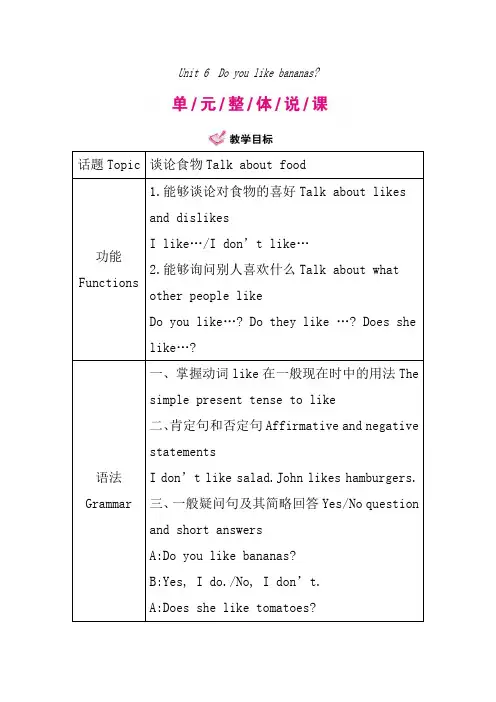
Unit 6 Do you like bananas?
话题Topic 谈论食物Talk about food
功能Functions 1.能够谈论对食物的喜好Talk about likes
and dislikes
I like…/I don’t like…
2.能够询问别人喜欢什么Talk about what
other people like
Do you like…? Do they like …? Does she
like…?
语法Grammar 一、掌握动词like在一般现在时中的用法The
simple present tense to like
二、肯定句和否定句Affirmative and negative
statements
I don’t like salad.John likes hamburgers.
三、一般疑问句及其简略回答Yes/No question
and short answers
A:Do you like bananas?
B:Yes, I do./No, I don’t.
A:Does she like tomatoes?
B:Yes, she does./No, I don’t.
四、能够正确使用下列表示食物的可数名词、不可数名词以及既可用作可数又可用作不可数的名词Countable nouns & Uncountable nouns
Countable:hamburgers, eggs, oranges,
bananas, apples, pears, carrots,
vegetables, tomatoes, strawberries
Uncountable:milk, bread, rice
Countable nouns & Uncountable nouns:food,
fruit, ice-cream, salad, chicken
新目标Go+for+it版七年级英语上册教学设计新部编版:Unit+6+Do+you+like+bananas
精品教学教案设计 | Excellent teaching plan
育人犹如春风化雨,授业不惜蜡炬成灰
教师学科教案
[ 20 – 20 学年度 第__学期 ]
任教学科:_____________
任教年级:_____________
任教老师:_____________
xx市实验学校
精品教学教案设计 | Excellent teaching plan
育人犹如春风化雨,授业不惜蜡炬成灰 Unit 6 Do you like bananas?
教学内容:
本单元的核心项目是“喜欢和不喜欢(like and dislike)”。围绕着这一中心项目,课文中设计了各种食物及水果的插图和不同形式的表格,让学生进行听、说、读、写等各种学习活动。通过本单元的教学,使学生学会询问对方与了解别人喜欢与不喜欢的食物,学业会谈论自己与他人早、中、晚餐喜爱吃的食物,为其今后能在交际中恰当地表达自己的情感、灵活运用已经学过的常用功能项目、进一步学习并掌握新的语言功能奠定了坚实的基础。
教学目标:
⑴知识目标:A、学会询问对方喜欢与不喜欢的食物; B、学习并激情 些食物的词汇;
C、学会谈论自己与他人早、中、晚 餐喜爱吃的食物; D、学会营养配。
⑵能力目标:A、能准备表达喜欢和不喜欢的食物;
B、能根据具体情景对话,与他人沟通信息,合作完成任务;
C、通过听、说、读、写四项技能的训练,促进学生语言运用能力的提高。⑶情感目标:A、通过学习西文食品文化,促使学生了解西方生活方式与文化,培养跨
文化交际的意识;
B、通过开展小组活动,指导学生积极与他人合作,培养他们的合作精神;
C、通过任务型活动,使学生学会在实际生活中均衡饮食,合理配餐。
教学重点、难点:
重点:A动词like一般现在时的各种句式及一般疑问句的肯定、否定回答;
B关于各种食物的词汇;
人教版三年级英语下册《Do you like bananas?》教学设计
《Do you like bananas》教学设计
一、教学目标
1、学习新词汇:orange,banana,hamburger,tomato,French fries,salad,ice cream,broccoli,strawberry
2、运用句型“Do you like…?”来询问他人喜爱的食物,并用Yes/No来回答。
3、让学生体验中西不同的饮食结构及文化,提高学习兴趣。
二、教学重点
能掌握运用语法与功能。
Do you like…?
Yes,I do. / No,I don’t.
三、教学难点
能掌握和运用本课的词汇。
四、教学设备
录音机、实物、图片、卡片、多媒体课件。
五、教学方法:任务型教学,活动型教学
六、教学时间:1课时
七、板书
Unit 6 Do you like bananas?
orange s
banana s
hamburger s
Do you like French fries Yes,I do.
Tomato es No,I don’t.
salad
ice cream
broccoli strawberry ies
八、教学过程
Step1:Greetings.
T:Good morning,boys and girls.
Ss:Good morning,Teacher.
T:How are you,everyone?
Ss:I’m fine,thanks. How are you?
T:I’m OK. Thank you.
(课前问候,能拉近我与学生的距离)
Step2:Warming up.
Let students revise the chant together:
Do you like bananas优秀教学设计
《Do you like bananas?》教学设计版本人教版(Go for it)年级/册/课七年级上册Unit6
情感态
度价值
观目标To understand the different habits between Chinese and western diets
and some common expressions of preferences and dislikes.
能力
目标1. Cultivate students to have different opinions on the same thing.
2. Cultivate students' ability to classify what they have learned.教
学
目
标
知识
目标1. Know the new words of food: pear, orange, tomato, hamburger,
strawberry, ice-cream, salad, milk, bread.
2. Learn to discuss their likes and dislikes.
--Do you like···?
--Yes, I do. I like···/ No, I don't. I like···
3. Students get information about their classmates' favourite and other
things.
教学资源教材、多媒体、学生在学习、生活及课堂交流中的再生资源。
教学重点1.To master the vocabulary about food.
2.To talk about one's preferences and dislikes by using the target
languages. 教
材
解
读
教学难点1.To create language communication, drill sentence pattern.
最新人教版七年级上册Unit 6 Do you like bananas
含山县河刘初中集体备课教案
1 2013—2014年度人教版七年级上册英语教案
Unit 6 Dou you like bananas?
主备人: 备课时间:2013年 月 日
成员:
The 1st period (Section A 1a—2c)
Teaching objectives:
Knowledge aims:
1.New words: hamburger, orange, ice—cream, salad, banana, strawberry, pear, bread, milk,
2. Sentence Patterns:
-----Do you like salad? ----No, I don’t./ Yes, I do.
-----Do you like oranges? ----No, I don’t./ Yes, I do.
Ability aims
1. Learn to talk about likes and dislikes.
2. Learn food names.
Emotional aims
Develop students’affection by making conversations in English and make Ss keep healthy by eating healthy foods.
Teaching keys:
1.New words: hamburger, orange, ice—cream, salad, banana, strawberry, pear, bread, milk,
2.Sentence Patterns:
-----Do you like salad? ----No, I don’t./ Yes, I do.