
Unit 6 Do you like bananas 全单元教案
1 Unit 6 Do you like bananas? Period 1(Section A 1a-1c) Teaching aims 1. Learn words and be able to say, read and write them: orange(s), banana(s), strawberry, strawberries, pear(s), apple(s), tomato(es), carrot(s), vegetable(s), hamburger(s), egg(s), ice-cream(s), salad(s), bread, chicken 2. Be able to talk about likes and dislikes by using: I/We/They like oranges. He/She likes oranges. I /We/They don’t like bananas. He/She doesn’t like hamburgers. Do you like salad? Yes, I do./No, I don’t.[来源:Z,xx,k.Com] Does he/she like tomatoes? Yes, he/she does. / No, he/she doesn’t. 3. Understand the difference between countable nouns and uncountable nouns. Teaching key and difficult points: 1. Learn these words and be able to say, read and write them: 2. Be able to talk about likes and dislikes by using: I/We/They like oranges. He/She likes oranges. I /We/They don’t like bananas. He/She doesn’t like hamburgers. Do you like salad? Yes, I do./No, I don’t.[来源:Z,xx,k.Com] Does he/she like tomatoes? Yes, he/she does. / No, he/she doesn’t. Moral objects (1) To call students’ attention to others’ interests and enable them to care more about classmates. (2) To improve Sts’ communicating skills and enable them to keep their health. 教学设计 备注 Step 1. Warm-up and revision (1)Daily greeting to the students (2)Revision: What’s this/that in English? What color is it?[来源:学科网] T: What’s this in English? (show a picture of and orange) T: What color is it? 2
Step 2. Presentation –New words. (1) Go on asking: What’s this/that in English? What color is it? T: What’s this in English? (show a picture of an apple and if the student don’t know it, show the phonetic symbol of the word.) T: Spell it, please. S: A-P-P-L-E. T: What color is it? S: It’s red. (Present the other three words as above: pear, strawberry, banana) T: We can call all of these things fruit. (Teach the new word “fruit”.) Show pictures and ask the Ss “What are these/those?” and ask the SS to spell the plural forms of these words: oranges, apples, pears, strawberries, bananas. (2) Repeat step (1) to present: carrot, carrots, tomato, tomatoes and vegetable, vegetables. (3) Present some more words by showing pictures. Get the Ss to make an effort to pronounce and spell the new words. Bread, hamburger ,hamburgers, milk, ice-cream, ice-creams, salad, chicken ,an egg, eggs We can call all of these things food: 食物 3. Memory Challenge: Who has the best eyes? (1)Show the pictures, and say the plural forms of the nouns and some uncountable noun. (2) Summarize. 可数名词有复数形式, 不可数名词一般没有复数形式 Step 3 Presentation Target language 1 1. Show the pictures and say: I like tomatoes, but I don’t like bread. 2.Let students say: I like …, but I don’t like .... 3. Show the pictures and say: She likes bread, but she doesn’t like milk. 3
He likes chicken, but he doesn’t like eggs. 4. Let students say: He/She likes …, but he/she doesn’t like .... According Ss’ answers and say: We/They like … We/They don’t like … 5. Sing a chant: Bananas, bananas, I like bananas! Salad, salad, I like salad! Strawberries, strawberries, I don’t like strawberries! Pears, pears, he likes pears! Milk , milk, he likes milk! Tomatoes, tomatoes, He doesn’t like tomatoes! Step 4 Work 1a . 1. Read the words. 2.T: Look at the pictures and fill in the chart . Fruit Food Vegetable
3. Match the words with the things in the picture. 4. Check the answers . Step 5 Present the new language 1 . 1. T: Oh, we have lots of delicious fruits . I like apples best. Do you like apples ? S1 :Yes , I do. I like apples. S2: No, I don't . I like salad. T: Do you like salad ? S3: Yes , I do. I like salad. / No, I don't . I don’t like salad. Step 6 Pairwork . 1. T: Work in pairs .Ask and answer with your partners . (Before class the students have draw some pictures of the food ) 2. Get the Ss to ask and answer in pairs, using the sentences: A: Do you like…? B: Yes, I do./ No, I don’t. 3. When you ask and answer, please fill in the chart. Name Like Dislike
Step 7 Present the new language 2 . 1. Show pictures and ask and answer questions Does she/he like…?
人教新目标英语七上Unit6Doyoulikebananas教案4
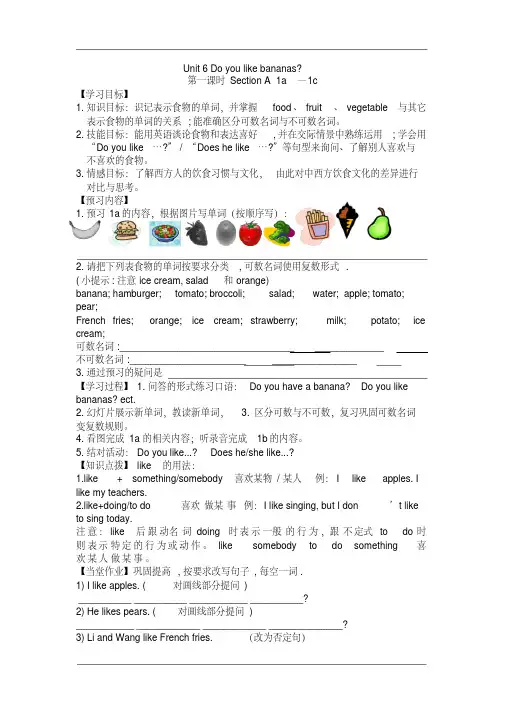
Unit 6 Do you like bananas?第一课时Section A 1a—1c【学习目标】1.知识目标:识记表示食物的单词,并掌握food、 fruit、 vegetable与其它表示食物的单词的关系;能准确区分可数名词与不可数名词。
2.技能目标:能用英语谈论食物和表达喜好,并在交际情景中熟练运用;学会用“Do you like…?” /“Does he like…?”等句型来询问、了解别人喜欢与不喜欢的食物。
3.情感目标:了解西方人的饮食习惯与文化,由此对中西方饮食文化的差异进行对比与思考。
【预习内容】1.预习1a的内容,根据图片写单词(按顺序写):2.请把下列表食物的单词按要求分类,可数名词使用复数形式.(小提示:注意ice cream, salad和orange)banana; hamburger; tomato; broccoli; salad; water; apple; tomato; pear;French fries; orange; ice cream; strawberry; milk; potato; ice cream;可数名词:_________________________________ _____________不可数名词:______________________ ________________3.通过预习的疑问是【学习过程】1.问答的形式练习口语:Do you have a banana? Do you like bananas? ect.2.幻灯片展示新单词,教读新单词,3.区分可数与不可数,复习巩固可数名词变复数规则。
4.看图完成1a的相关内容;听录音完成1b的内容。
5.结对活动:Do you like...? Does he/she like...?【知识点拨】like 的用法:1.like + something/somebody 喜欢某物/某人例:I like apples. I like my teachers.2.like+doing/to do喜欢做某事例:I like singing, but I don’t like to sing today.注意:like后跟动名词doing时表示一般的行为,跟不定式to do时则表示特定的行为或动作。
人教版七年级上Unit6_Do_you_like_bananas)课件
1. Write down the conversation(2c) between your and your partner.
2. Write a report according to the survey.
Unit 6 Do you like bananas
Aims and Language points:
2. -Let’s think about the food.
-Sure.
-让我们想想(吃什么)食物吧。 -当然。/没问题
think about “对…有(某种观点); 回想起;考虑”
Eg. You can think about it. 你可以把这事考虑一下。
Sure.
What do you think about him? 你觉得他这人怎么样?
中用助动词does。 疑问句和否定句中用到does后,谓语动词用原形(like).
Let’s chant
Join us, join us. Let’s have a party. Do you like salad ? Yes, I do. Do you like bread ? No, I don’t. Does he like apples ? Yes, he does. Does she like pears? No, she doesn’t. Do they like hamburgers? Yes, they do. I see. I see. Let’s have a party.
Do you like …?
Names
tomatoes
ice-cream
hamburger s
2a.Listen and circle the food. (Students’ Book Page 32)
七年级上册英语unit6_Do_you_like_bananas整单元课件

tomatoes
2c Practice the conversations above.
Give answers that are true for you.
1. practice v. & n. 练习。如:practice playing tennis 练习打网球
football practice 足球训练
oranges
ice cream salad bananas
2b Listen again. Fill in the blanks.
have v. 有,吃,喝。第三人称单数形式为has。 例句:I have an apple every day.我每天吃一个苹果。
tomatoes
ice cream ice cream
It’s his birthday. birthday dinner
2d
Jack: Hey, John’s birthday dinner is next week. Let’s think about the food. Tom: Sure. How about burgers, vegetable salad, and some fruit? Bill: Sounds good. John likes hamburgers. Jack: Oh, I don’t like salad. Bill: But John likes salad, and it’s his birthday. Jack: Yes, you’re right. What about the fruit? Tom: I think John likes strawberries and apples. Bill: OK. Let’s have strawberries and apples then.
人教版初中初一七年级英语上册 名师教学课件 Unit 6 Do you like bananas (
John likes strawberries and apples.
Complete the sentences. 1.你喜欢沙拉吗? 是的,我喜欢。
__D_o__you __l_ik__e__salad? Yes, I __d_o____ .
Bob Gina
Reading time
Read the conversation in 2d. Then answer the questions.
1. Does John like hamburgers?
Yes, he does.
2. What does Jack don’t like?
Jack doesn’t like salad.
3. He (like / likes) bananas, but he (don’t / doesn’t) like oranges.
4. We (likes / like) hamburgers, but we (don’t / doesn’t) like chicken.
5. They (likes / like) pears, but they (don’t / doesn’t) like strawberries.
Thank You
新疆伊犁新源县扬新中学 李绍君
人教版 英语 七年级上册
Section A (2d-3c) Grammar & practicing
新疆伊犁新源县扬新中学 李绍君
Learning goals 1. 了解可数名词与不可数名词、单数名词与复数名词
2. 学会用like谈论喜好 •3. 学会使用一般疑问句及其回答 •Do you like strawberries? •Yes, I do/No, I don't. •Does he like pears? •Yes, he does/No, he doesn't. •He likes… He doesn’t like…
新目标Go+for+it版七年级英语上册教学设计新部编版:Unit+6+Do+you+like+bananas

教师学科教案[ 20 – 20 学年度第__学期]任教学科:_____________任教年级:_____________任教老师:_____________xx市实验学校Unit 6 Do you like bananas?教学内容:本单元的核心项目是“喜欢和不喜欢(like and dislike)”。
围绕着这一中心项目,课文中设计了各种食物及水果的插图和不同形式的表格,让学生进行听、说、读、写等各种学习活动。
通过本单元的教学,使学生学会询问对方与了解别人喜欢与不喜欢的食物,学业会谈论自己与他人早、中、晚餐喜爱吃的食物,为其今后能在交际中恰当地表达自己的情感、灵活运用已经学过的常用功能项目、进一步学习并掌握新的语言功能奠定了坚实的基础。
教学目标:⑴知识目标:A、学会询问对方喜欢与不喜欢的食物;B、学习并激情些食物的词汇;C、学会谈论自己与他人早、中、晚餐喜爱吃的食物;D、学会营养配。
⑵能力目标:A、能准备表达喜欢和不喜欢的食物;B、能根据具体情景对话,与他人沟通信息,合作完成任务;C、通过听、说、读、写四项技能的训练,促进学生语言运用能力的提高。
⑶情感目标:A、通过学习西文食品文化,促使学生了解西方生活方式与文化,培养跨文化交际的意识;B、通过开展小组活动,指导学生积极与他人合作,培养他们的合作精神;C、通过任务型活动,使学生学会在实际生活中均衡饮食,合理配餐。
教学重点、难点:重点:A动词like一般现在时的各种句式及一般疑问句的肯定、否定回答;B关于各种食物的词汇;C名词复数的使用。
难点:一般现在时中单数第三人称的变化形式。
课时安排第一课时Section A la –lc 第二课时Section A 2a –4第三课时Section B la –2c 第四课时Section B3a –4 Self-checkPeriod 1Teaching materials:Section A 1a-1c课前准备教师:搜集关于食物的图片,多媒体教学课件,制作表格(见教学步骤)。
新目标人教版七年级英语上册Unit 6 Do you like bananas Section A (1a—1c)优秀说课稿
新目标人教版七年级英语Unit6 Do you like bananas? Section A (1a—1c)说课稿说课教师:授课班级:授课时间:今天我说课的内容是新目标人教版七年级Unit6 Do you like bananas? Section A ( 1a-1c). 我将从教材分析、教学目标、教学重难点、教学过程四个部分进行说课。
一、说教材分析:本单元既是新知,也是对旧知的复习与提升。
在Unit5 这个单元中,学生学过Do you have…?Yes, I do. / No, I do n’t. 的句型,并初步掌握了一般疑问句的结构及答语。
而我所执教的Unit 6 这一单元,Do you like…?是要求学生们能够询问别人是否喜欢某物。
两个单元具有相似点:Do you …? Yes, I do. / No, I do n’t.的句型来询问并应答;同时又具有不同点:谈论话题不同,第5单元以体育用品为主题谈论某人是否拥有某物,而第6单元则以食物为主题谈论个人喜好;知识词汇不一样;情感态度价值观不同。
二、说教学目标:A.知识与技能:1、关于水果的词汇;表达喜好的结构;能听说、认读单词:apples, milk, salad, tomatoes, bread, hamburgers….2、掌握句型:Do you like …?及回答Yes, I do. / No, I do n’t.B.过程与方法:1、通过创设情境,歌谣,游戏等活动,学会询问别人喜欢或不喜欢的食物,如:Do you like …?并能作出应答。
2、能够和组员合作,通过演一演的方式把知识内化。
C.情感、态度与价值观:1、情感态度:该部分学习内容贴近学生的生活,谈论的主题涉及学生的饮食习惯和偏爱,极易于激发学生学习英语的欲望和兴趣。
2、学习策略:采取小组合作学习的方式,培养同学间相互沟通和交流的能力。
三、说教学重难点:根据教学大纲要求,教材编排特点,并从学生的实际出发,我将本课的重点与难点确定为:重点:1、关于食物的词汇;能听说、认读单词:apples, milk, salad, tomatoes, bread, hamburgers….2、掌握句型:Do you like …?及应答:Yes, I do. / No, I do n’t.难点:根据创设情境运用句型“Do you like …?”及应答。
人教版七年级上册英语Unit6 Do you like bananas 单元课件 (共57张PPT)
tomatoes oranges strawberries
pears
hamburgers bananas
Game: Who has the best eyes? 谁的眼睛最亮?
1a Match the words with the things in the
picture.
1. hamburgers d 2. tomatoes i
3b
Number these sentences [1 - 4] to make a conversation.
?
Make your own conversations in pairs.
so: 英语口语中常用的语气词,相当于汉 语中的“于是,那么,这样一来”,其承 上启下的作用。
Practice the conversation above. Give answers that are true for you.
Apple round ,apple red.
苹果圆,
苹果红
Apple juicy ,apple sweet.
苹果多汁, 苹果甜
Apple apple I love you.
苹果苹果 我爱你
Apple sweet I love to eat.
苹果甜甜
我爱吃
What’s the song about?这首歌关于什么?
A: I like …. Do you like…? B: No, I don’t. C: Let’s have… D: Sounds good. (No, I don’t like it.)
Unit 6 Do you like bananas
Section B 1a:
1
人教版七年级上册英语Unit6Doyoulikebananas
人教版七年级上册英语Unit6 Do you like bananas一. 教材分析人教版七年级上册英语Unit6 Do you like bananas主要讲述了关于喜好和食物的话题。
本节课的主要内容是让学生能够用英语询问和描述他们对不同食物的喜好。
教材通过简单的对话和词汇,帮助学生掌握基本的交际用语,并能够运用这些句子进行日常交流。
此外,本单元还引入了一般现在时态的用法,让学生能够用英语描述他们的日常喜好和习惯。
二. 学情分析在进入七年级上册时,学生们已经掌握了基本的英语语法和词汇知识,具备一定的听、说、读、写的能力。
然而,对于一般现在时态的用法和复杂的句子结构,他们可能还较为陌生。
因此,在教学过程中,需要注重引导学生理解和运用一般现在时态,并通过大量的练习和实际操作,让他们能够熟练运用该时态进行描述和交流。
三. 说教学目标1.知识目标:学生能够掌握一般现在时态的用法,并能够用英语询问和描述他们对不同食物的喜好。
2.能力目标:学生能够听懂、说出一般现在时态的句子,并能够运用该时态进行日常交流。
3.情感目标:通过小组合作和互动交流,学生能够增强自信心,提高团队合作意识。
四. 说教学重难点1.教学重点:一般现在时态的用法和食物词汇的掌握。
2.教学难点:一般现在时态的运用和食物词汇的灵活运用。
五. 说教学方法与手段1.教学方法:采用任务型教学法,通过小组合作、互动交流和实际操作,引导学生主动参与学习过程。
2.教学手段:利用多媒体教学资源,如图片、音频和视频,增加学生的学习兴趣和参与度。
六. 说教学过程1.导入:通过展示一些常见食物图片,引导学生谈论他们对食物的喜好。
2.新课呈现:引入一般现在时态的概念,并通过示例句子让学生理解一般现在时态的用法。
3.对话练习:让学生听录音或观看视频,模仿对话中的句子,并进行角色扮演。
4.小组活动:学生分组进行讨论,用英语询问和描述他们对食物的喜好。
5.巩固练习:通过完成练习题和互动游戏,让学生进一步巩固一般现在时态的用法。
人教版英语七年级上册 Unit 6 Do you like bananas
This is a fruit and vegetable house (果疏屋). What’s in the house? (果蔬屋里有什么?)
some vegetables
some fruits
banana bananas
pear pears
strawberry strawberries
2 A: Do you like salad? B: No, I don’t.
1 A: Do you like bananas? B: Yes, I do.
3 A: Do you like oranges? B: Yes, I do.
Post-listening
1c Practice the conversations with your partner. Then make your own conversations.
2. tomatoes __i _ 3. oranges _f__ 4. ice-cream _h__ 5. salad __b_ 6. bananas _g__
7. strawberries __c_ 8. pears __j_
9. milk __e_ 10. bread _a__
Read the dialogue in the picture.
Read the conversation after the tape.
1. Girl: I like hamburgers. Do you like hamburgers? Boy: Yes, I do.
2. Girl: Do you like tomatoes? Boy: No, I don't like tomatoes.
—Do you like bananas? —Yes, I do. —Do you like salad? —No, I don’t. —Do you like oranges? —Yes, I do.
《Unit 6 Do you like banana?》说课稿
《Unit 6 Do you like banana? 》说课稿Section A 1 (1a-2d)一、教学目标:1. 语言知识目标:1) 能掌握下列词汇:banana, hamburger, tomato, ice-cream, salad, strawberry, pear, milk, bread, birthday, dinner, food, week, sure, How about …?, burger, vegetable, fruit, right, then2) 能掌握以下句型:①—Do you like salad? —Yes, I do. / No, I don’t.②—Does she/he like …? —Yes, she/he does./ No, she/he doesn’t.③—I like … /I don’t like …④—He/Sh e likes … / He/She doesn’t like …3) 能通过介绍食物学会询问对方喜欢与不喜欢的食物。
2. 情感态度价值观目标:该部分学习内容贴近学生的生活,谈论的主题涉及学生的饮食习惯和偏爱,对学生养成健康的饮食习惯很有帮助,能引起学生的特别关注,极易于激发学生学习英语的欲望和兴趣,使他们乐于参与各种英语实践活动。
通过学习西方食品文化,促使学生了解西方生活方式与文化,培养跨文化交际的意识。
二、教学重难点1. 教学重点:1) 学习并积累一些食物的词汇。
2) 名词复数的使用。
3)动词like一般现在时的各种句式及一般疑问句的肯定、否定回答;2. 教学难点:1) 行为动词like的一般现在时的用法;2) 使用do和does引导的一般疑问句的构成和使用。
三、教学过程I. New wordsAccording the pictures, learn the new words.II. Warming-upAsk some Ss questions:T: What’s that?S1: It’s _______.T: What are those?S1: They are _______.III. Presentation1. Show some pictures of food on the screen and learn the new words.(banana, hamburger, tomato, ice-cream, salad, strawberry, pear, milk, bread, birthday, food, burger, vegetable, fruit)2. Let Ss read and try to remember the new words.3. T: Let’s look at the picture in 1a. Match the words with the things in the picture. Thencheck the answers.IV. ListeningT: Let’s work on 1b. Listen and number the conversations [1-3].Ss listen to the tape and number the conversations.V. Pa ir work1. Read the conversations in 1b. Have Ss read after the teacher.2. Now let’s act out the conversations 1-3.(Ss work with their partner and act out the conversation 1-3.)3. Look at the picture and make more conversations using the words in 1a.4. Let some pairs act out their conversations.VI. Listening1. Point to and read each word aloud, Ss only listen. Then let some Ss read the words bythemselves. Check that Ss understand the meaning of the ea ch word.2. Play the recording for the first time, Ss only listen.3. The n play the recording again Ss circle the words they hear. Play the recording again.Check the answers.4. A girl and a boy want to have something in the restaurant. Do they like hamburgers? Doesthe boy like milk? Does the boy like ice-cream? Now let’s listen to the recording.For the first time, Ss only listen.For the second time, Ss listen and fill in the blanks.Play the recording for the third time, Check the answers.VII. Pair work1. Read the conversation in speech bubbles in 2b. Ask Ss to read after the teacher.2. Ss practice the conversations in pairs.3. Let some pairs act out the conversations.4. Ss give answers that are true for them. Then practice their conversations.5. Ask some pairs act out their conversations.VIII. Reading1.According the pictures, learn the new words.2.Read the dialogue in 2d. Then answer the questions.Does John like hamburgers?What does Jack don’t like?What fruit does John like?3. Read the dialogue with your partner. Then role play the conversation.4. Practice the conversation with your partner.5. 评价:(让学生们对自己的表现及语言表达能力进行自我评价,在小组内评价,然后进行评出最优秀的小组。