
Alice Walker Everyday Use中英文版本
Everyday Use Alice Walker I will wait for her in the yard that Maggie and I made so clean and wavy yesterday afternoon. A yard like this is more comfortable than most people know. It is not just a yard. It is like an extended living room. When the hard clay is swept clean as a floor and the fine sand around the edges lined with tiny, irregular grooves, anyone can come and sit and look up into the elm tree and wait for the breezes that never come inside the house. Maggie will be nervous until after her sister goes: she will stand hopelessly in corners, homely and ashamed of the burn scars down her arms and legs, eying her sister with a mixture of envy and awe. She thinks her sister has held life always in the palm of one hand, that "no" is a word the world never learned to say to her. You've no doubt seen those TV shows where the child who has "made it" is confronted, as a surprise, by her own mother and father, tottering in weakly from backstage. (A pleasant surprise, of course: What would they do if parent and child came on the show only to curse out and insult each other?) On TV mother and child embrace and smile into each other's faces. Sometimes the mother and father weep, the child wraps them in her arms and leans across the table to tell how she would not have made it without their help. I have seen these programs. Sometimes I dream a dream in which Dee and I are suddenly brought together on a TV program of this sort. Out of a dark and soft-seated limousine I am ushered into a bright room filled with many people. There I meet a smiling, gray, sporty man like Johnny Carson who shakes my hand and tells me what a fine girl I have. Then we are on the stage and Dee is embracing me with tears in her eyes. She pins on my dress a large orchid, even though she has told me once that she thinks orchids are tacky flowers. In real life I am a large, big-boned woman with rough, man-working hands. In the winter I wear flannel nightgowns to bed and overalls during the day. I can kill and clean a hog as mercilessly as a man. My fat keeps me hot in zero weather. I can work outside all day, breaking ice to get water for washing; I can eat pork liver cooked over the open fire minutes after it comes steaming from the hog. One winter I knocked a bull calf straight in the brain between the eyes with a sledge hammer and had the meat hung up to chill before nightfall. But of course all this does not show on television. I am the way my daughter would want me to be: a hundred pounds lighter, my skin like an uncooked barley pancake. My hair glistens in the hot bright lights. Johnny Carson has much to do to keep up with my quick and witty tongue. But that is a mistake. I know even before I wake up. Who ever knew a Johnson with a quick tongue? Who can even imagine me looking a strange white man in the eye? It seems to me I have talked to them always with one foot raised in flight, with my head fumed in whichever way is farthest from them. Dee, though. She would always look anyone in the eye. Hesitation was no part of her nature. "How do I look, Mama?" Maggie says, showing just enough of her thin body enveloped in pink skirt and red blouse for me to know she's there, almost hidden by the door. "Come out into the yard," I say. Have you ever seen a lame animal, perhaps a dog run over by some careless person rich enough to own a car, sidle up to someone who is ignorant enough to be kind to him? That is the way my Maggie walks. She has been like this, chin on chest, eyes on ground, feet in shuffle, ever since the fire that burned the other house to the ground. Dee is lighter than Maggie, with nicer hair and a fuller figure. She's a woman now, though sometimes I forget. How long ago was it that the other house burned? Ten, twelve years? Sometimes I can still hear the flames and feel Maggie's arms sticking to me, her hair smoking and her dress falling off her in little black papery flakes. Her eyes seemed stretched open, blazed open by the flames reflected in them. And Dee. I see her standing off under the sweet gum tree she used to dig gum out of; a look of concentration on her face as she watched the last dingy gray board of the house fall in toward the red-hot brick chimney. Why don't you do a dance around the ashes? I'd wanted to ask her. She had hated the house that much.
高级英语_everyday_use课文赏析

• Maybe we can conclude that Dee represents some black young people who failed to realize the really meaning of the feminism and feminism movement. It is easy to find that her sense of value is formed by the education of the White community. While all people celebrate and emphasize
• However, Walker wants to show us that Dee actually has no self-identity of herself. She is eager to be involved into the white society, even the simple following of the “tradition” only aims to get the “nice things”. To judge her own tradition and culture by the value of some one else is what Walker worries about.The three changes after the conflict of the three heroines show that how to form the self-identity of all women.You need to
Maggie — a flat character
• — docile, timid, shy, good-temped, kind-
高级英语第三版Everyday Use课文结构及知识要点
shingle: a thin, flat tile usually made of wood and fixed in rows to make a roof
furtive: quiet, cautious in a stealthy way to avoid being observed
At sixteen, she had a unique way of doing things, and knew what was the fashionable way of dressing, speaking, acting, etc.
stumble: a. to stop and /or make mistakes in speaking or reading aloud; b. to catch the foot on the ground while moving along and start to fall
She never hesitated by nature in anything she wanted to do.
sidle: move sideways, esp. in a shy or stealthy manner to avoid notice 侧身行走
shuffle: walk by pulling your feet slowly along the ground rather than lifting them; drag
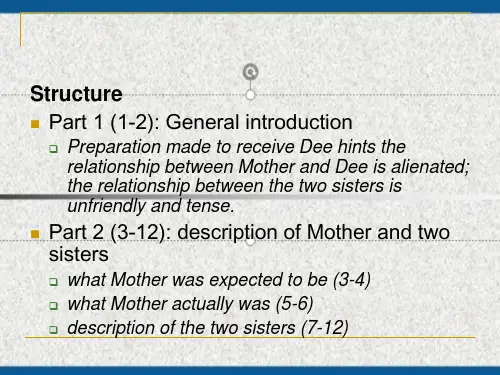
Structure
Part 1 (1-2): General introduction
Preparation made to receive Dee hints the relationship between Mother and Dee is alienated; the relationship between the two sisters is unfriendly and tense.
everyday-use人物分析

人物分析After I have learnt the Everyday Use, the mother’s image is deeply impressed in my mind. The author is Alice Walker. She is one of the minority writers recognized and appreciated by the majority of people. As a black women writer, her background provi des the sources of her work, especially work describing colored people’s life.First of all, I want to analysis her from the family character.She is tje mother of two different quality girls.On the one hand, Dee is the healthy one. She has an appearance which admired by most people. Just as the author says" Dee is lighter than Maggie, with nicer hair and a fuller figure. "Dee is not only excellent in her outlook, but also she has a good brain. And she is good at showing herself to others. But, Maggie is not quite healthy as her sister. Just as the author says in the beginning part of the work. She is shy and lack of confidence. Most of time, Maggie stands behind her mother. On the other hand, Dee has great curiosity about white culture and modern society, but Maggie is the traditional one. Even the two daughters are quite different, mama treats them as equal. She likes them all very sincerely. Before Dee comes back home,mama dreams one day she could appear on the TV show. It looks like mama wants her daughter Dee feels proud of her. "Sometimes I dream a dream in which Dee and I are suddenly brought together on a TV program of this sort. "But it is just a dream, in reality, she introduces herself as “a large, big-boned woman with rough, man-working hands.”Maggie who is her little daughter always living with her. For most parents' view, the little child should pay more attention. In the last part of the author's work, when Dee and Maggie are fighting for the quilt. The mama snatches the quilts from Dee and offer her instead some of the machine-stitched ones, which Dee does not want. Maybe it is the only and first time, Maggie wins. But it doesn't mean she dislike Dee, she just is puzzled that why Dee is so curiosity about the quilts. In mama's view, Dee is reasonable. From this I know, mama's way of love for the two daughters is different, but she loves them deeply. She wants them all have a happy family.The mother is a traditional black woman. She is shy and not dare to face the unknown white man."I never had an education myself. After second grade the school was closed down. Don't ask my why: in 1927 colored asked fewer questions than theydo now."Mama never has an education herself. In her words, she indicates that the black people's right has been seriously invaded. " I used to love to milk till I was hooked in the side in '49. Cows are soothing and slow and don't bother you, unless you try to milk them the wrong way."Mama's rib is been hurt very harm. But she thinks it is not the cow's fault, it's because her way of milking. She is quite kind and reasonable. "When she comes I will meet—but there they are!" Mama is so surprised and delighted to see her daughter Dee comes back home. After Dee is at home, she told mama, "Not Dee,Wangero Leewani Ka Kemanjo! "At first, I think the mama must be angry for the girl changed her name by herself. But to my astonishment, mama trys her best to call the new name. She just tells to her daughter, "Why shouldn't I? " She asked."If that's what you want us to call you,we'll call you."After I read this, I know she is a brilliant mother. She could accept Dee to use her new name Wangero, which has no “bad” history. As we all know that Dee is the symbol of the new culture. All these actions show us that she is a little bit like the white culture, or somehow, she is curious about it. From all this, we can get that the Mama in the fiction is a black woman who is protecting the Black Culture and the true meaning of black art. In Maggie and Mama’s opinion, the things which they are using everyday is the black art, and the true meaning of black art is not to show, but to use everyday use everyday.。
美国黑人女性文学

African American short stories of this period often dealt with problematic issues like separation, integration and redefinition of the African American past. Black people were seeking their cultural roots in Africa, the slogan “Black is beautiful” and the Afro hair-style arose. “Everyday Use” is Alice Walker’s answer to the social discourse of that time, especially concerning the African American concept of heritage and identity.
“Everyday Use -- for your grandmamma”
The motif of quilting has become central to Alice Walker’s concerns, since it suggests the strength to be found in connecting with one’s roots and one’s past.
Maggie
⊙ Being homely (not goodlooking), like a lame animal with burn scars down her arms and legs ⊙ Being shy and timid ⊙ Eying her sister with the mixture of envy and awe ⊙ Being nervous when meeting Dee
高级英语Everyday Use中Dee的人物分析

On the Character of Dee in Everyday Use Alice Walker’s Everyday Use was written in her early time. The short story was written during the heyday of the Black Power Movement. When I learned Everyday Use, my teacher talked much about how to treat traditional culture. In Alice Walker’s novel, mother and Maggie represent the traditional culture of black, while Dee highly praises the culture of white. She didn’t know about the meaning of the traditional culture of black. Dee and Maggie have extremely contrastive characters: Dee being successful, beautiful but arrogant type of woman, Maggie being simple-minded, disfigured and slow. I will analyze the character of Dee as follows:I Being selfishWhen the house burned, “I see Dee standing off under the sweet gum tree she used to dig gum out of; a look of concentration on her face as she watched the last dingy gray board of the house fall in toward the red-hot brick chimney. Why don’t you do a dance around the ashes? I’d wanted to ask her. She had hated the house that much.” Dee was selfish and she hated the old house. She didn’t take her mother’s feeling in consideration. Besides, Dee asked for dasher, churn and quilts. Dee refused to take another two quilts.II Being independent and determinedDee was independent and determined. “Dee, though. She would always look anyone in the eye. Hesitation was not part of her nature.”Her mother collected money for Dee and Dee went to the college. Since she was very young, she had gotten rid of the protection of her mother. Dee had her own style, no matter which to choose or how to do, she had never asked for help.III Being arrogantDee didn’t like her mother and her house, so she never brought her friends back home. When she came back home, She changed her name “Dee”into “Wangero Leewanika Kemanjo”, a traditional African name. Besides, she changed her hair and dressing style. Dee took photos for the house, the cow and Maggie to show the oldfashion off to her friends. But now it was different, Dee not only took photos, but also took her boyfriend back home. Compared with her former attitude towards everyday use, Dee showed tremendous cherish. She walked around the house to seek anything that had long history.In the past, the mother wanted to give the quilts to her elder daughter Dee. But Dee rejected them as too old-fashioned and out of style. Therefore the mother promised the quilts to her younger daughter Maggie. Now Dee asks her mother for the quilts and some more pieces of their family heritage because she now regards them as part of her cultural heritage, which she intends to hang on the wall. She wanted to show that she knew about African culture. So she was arrogant.In the end, against the expectation of Dee, the mother refused her wish and gave the quilts to Maggie, who would have agreed to give the quilts to her sister. Dee left without a piece of her family heritage, with her mother being satisfied with their simple southern life and with her sister Maggie, who would put the quilts to everyday use.From this novel, we should learn to have a right attitude to our culture and know the real meaning.。
高级英语-everyday-use课文赏析ppt
Maggie — a flat character
• — docile, timid, shy, good-temped, kindhearted and unselfish, a strong sense of inferiority
• — inherence of black culture, genuine love of black tradition
Dee — a round character
• —fashionable, rebellious, strongminded and ill-temped, a sense of vanity
• — a symbol of the modern black women
• — superficial love of black tradition
高级英语-everyday-use课文赏 析ppt
本课件仅供大家学习学习 学习完毕请自觉删除
谢谢
• She will stand hopelessly in corners, and homely after her sister goes.
• From that, we can know that Maggie is very afraid of people.
• Aunt Dee’s first husband whittled the dash, said Maggie so low that you almost couldn’t hear you.
• From that, we can know that Maggie feels herself inferior than others, and she is very shy. She has no hope, and she just adores her sister.
高级英语Everyday-Use中Dee的人物分析
On the Character of Dee in Everyday UseAlice Walker’s Everyday Use was written in her early time. The short story was written during the heyday of the Black Power Movement. When I learned Everyday Use, my teacher talked much about how to treat traditional culture. In Alice Walker’s novel, mother and Maggie represent the traditional culture of black, while Dee highly praises the culture of white. She didn’t know about the meaning of the traditional culture of black. Dee and Maggie have extremely contrastive characters: Dee being successful, beautiful but arrogant type of woman, Maggie being simple-minded, disfigured and slow. I will analyze the character of Dee as follows:I Being selfishWhen the house burned, “I see Dee standing off under the sweet gum tree she used to dig gum out of; a look of concentration on her face as she watched the last dingy gray board of the house fall in toward the red-hot brick chimney. Why don’t you do a dance around the ashes? I’d wanted to ask her. She had hated the house that much.” Dee was selfish and she hated the old house. She didn’t take her mother’s feeling in consideration. Besides, Dee asked for dasher, churn and quilts. Dee refused to take another two quilts.II Being independent and determinedDee was independent and determined. “Dee, though. She would always look anyone in the eye. Hesitation was not part of her nature.”Her mother collected money for Dee and Dee went to the college. Since she was very young, she had gotten rid of the protection of her mother. Dee had her own style, no matter which to choose or how to do, she had never asked for help.III Being arrogantDee didn’t like her mother and her house, so she never brought her friends back home. When she came back home, She changed her name “Dee”into “Wangero Leewanika Kemanjo”, a traditional African name. Besides, she changed her hair and dressing style. Dee took photos for the house, the cow and Maggie to show the oldfashion off to her friends. But now it was different, Dee not only took photos, but also took her boyfriend back home. Compared with her former attitude towards everyday use, Dee showed tremendous cherish. She walked around the house to seek anything that had long history.In the past, the mother wanted to give the quilts to her elder daughter Dee. But Dee rejected them as too old-fashioned and out of style. Therefore the mother promised the quilts to her younger daughter Maggie. Now Dee asks her mother for the quilts and some more pieces of their family heritage because she now regards them as part of her cultural heritage, which she intends to hang on the wall. She wanted to show that she knew about African culture. So she was arrogant.In the end, against the expectation of Dee, the mother refused her wish and gave the quilts to Maggie, who would have agreed to give the quilts to her sister. Dee left without a piece of her family heritage, with her mother being satisfied with their simple southern life and with her sister Maggie, who would put the quilts to everyday use.。
Everyday Use人物分析兼论其主题
0130 hand.that“110”is a word the world never learned to say to
her.而且 ,Dee(Wangero)面对 白人并 不逆来顺 受 ,委曲求 全 ,
美 国在政治上较 之从前 已经 发生 了天 翻地覆 的变 化。 比如 someone who is ignorant enough to be l(ind 0f him?That is the
说 ,轰轰 烈烈的 、席 卷全 国的 废奴运 动业 已结束 ,发 端 于 20 世纪 20年代 纽约市黑人聚居区一 哈莱姆的“黑人文艺 复兴” 也方兴未艾 。因此 ,她 所耳 闻 目睹 的美 国黑 人无论 在政 治 、 经济 还 是 文 化 等 方 面都 有 了 明 显 的改 观 。事 实 上 ,Alice
other folks’ habits,whole lives upon US two,sitting trapped and
ignorant underneath her voice.She washed I18 in a river of make
— believe.burned US with a lot of knowledge we didn’t necessa-
异 ,彰 显了她 的叛逆 精神 。“Dee is dead,”Wangero said,“I
couldn’t bear it any longer,being named after the people who
oppressed me.”一句极妙的道 出了 Dee的叛 逆精神和决心。 (三 )生 活态度上的差异 在 iV[aggie眼中 ,Dee(Wangero)是一 个 名副 其 实的 生活
关于高英everydayuse的人物分析
Character Analysis in Alice Walker's Everyday UseMamaMama, the narrator of the story, who is strong, hardworking as well as stern, she has many good qualities of the traditional black women. Unlike her young daughter, Maggie, she has her own outlook on life and values, even though she is a black woman and doesn’t have a good education. In the beginning of the article, we can see she also long for the meeting with her older daughter, because she and Dee sweep the yard so clean and wavy to wait for Dee. She even imagines that one day she and Dee could go for a popular TV show before she sees Dee, it tells us that she expects that Dee could respect and love her like other girls who show to their mothers. In the climax of the essay, Dee wants to rob the family heirloom, the quilts, which she had promised to give Maggie as her dowry. This time, she doesn’t meet the demand of Dee. As a mother, she is fair to her two daughters, even Dee and Maggie is as different as heaven and earth. At last, she even get angry with Dee, she couldn’t understand why Dee is so greedy and peacockish. In conclusion, Mama is a uneducated but practical character, she standing for the traditional black women in that stage.DeeDee is the object of jealousy, awe, and agitation among her family members, while as an individual she searches for personal meaning and a stronger sense of self. She get a good education. She is arrogant and always feels that she should enter into the white world, so she leaves her country and keeps on her pursuit in the big city. Actually, Dee is a tragic character, she is an ambivalent syntheses. On one hand, indeed, she doesn’t integrate into the white society. On the other hand, she has abandoned the old ideology and costumes of the traditional black people. Superficially, she own fashionable clothes and valuable jewelry, it seems that she has got the life what she has been pursuing for a long time. Actually, she couldn’t get the sense of belonging and sense of security in the big city, so she want to rob the quilts to meet her vanity, she just want to show off the quilts to the people in the city and tell them that she is not a black woman who owns nothing. In conclusion, Dee standing for one kind of people in that period that they have abandoned their hometown and origins to pursue a better life in big cities, but they can’t integrate into the white people either.MaggieMaggie, Nervous and maladjusted, she is a figure of purity, uncorrupted by selfishness or complex emotional needs. God is unfair to her, she has an excellent, beautiful sister, but she is ugly, clumsy and diffident. So she lives in her sister’s shadow for a long time. She even never spares efforts to strive for her proper interests. When Dee says that she wants to take the quilts, Maggie doesn’t say “no”. She lives at home and is protected by Mama, remaining virtually untouched by the outside world. She suffers from shyness and lack of education. She is also a tragic character. As a girl, she has ugly scars in her body and doesn’t get a good education, because of this, Dee even doesn’t think Maggie should have the right to inherit the heirloom. In the future,if the Mama passes away, it is a question whether Maggie could manage her life successfully or not. In contrast, Maggie is less sophisticated than her sister and less competent than her mother. In conclusion, Maggie standing for one kind of people in that society who still adhere to the past practices and they will inherit the tradition from generation to generation.。
Everyday Use for your grandmama
Everyday Use for your grandmamaby Alice WalkerAlice Walker (1944~ ), the author of Everyday Use for your grandmama, was borned in Eatonton, Georgia. When she went to Sarah Lawrence College in the early 1960’s, the civil rights movement was in full swing. She was actively involved in the movement. From 1967, she has been teaching creative writing and black literature, lecturing at several colleges. Now she is regarded as one of the most prominent writers in American literature and a most forceful representative of women’s literature and black literature.She has published a number of collections of short stories, poetry, and other published work. In 1983, Walker became the first African-American woman to win a Pulitzer Prize for fiction with her novel The Color Purple, which also won the National Book Award.The short stories Everyday Use(1973) is included in the Norton Anthology of Short Fiction, 2nd Edition, 1981, was written during the heyday of the Black Power movement, when African Americans were trying to gain racial equality and called for self-determination and racial dignity. Blacks were seeking their cultural roots in Africa, but a lot of blacks went off course, like Dee in this story.This is a short novel which tell us a story about a young black people, Dee, wants the old quilts only to be refused flatly by the mother, who intends to give them to Maggie, the younger one. The story begins with the narrator, a black women, awaiting the homecoming of her daugher Dee, an educated women pursuing the fasion things. Accompanying her young daughter Maggie. However, Dee has been scornful of black and delightes herself by the old way of life and becomes more interesting to the old quits made from pieces of clothes worn by grand and great grand parents and stitched by Grandma’s hand. The old quits are clearly a symbol of the cultural heritage of the black people. Their different feelings about the quilts reveal their different attitudes towards their heritage as blacks.Everyday use is told in the first-person point of view. This point of view involves readers in the story as they were experiencing of the story. This technique seeks tovalidate the experiences of an offten oppressed group of people: lower-class black women. In addition the first-person point of view, Everday use is enriched by Alice Walker’s employment of symbols. In particular, the contested heritage of the black people. Their different feeling about the quits reval their different attitudes towards their heritage as blacks. And, the auther adopted the historcal present. The historcal present refers to the employment of the present tense when narrating past events. It is used in fiction, for “hot news”, and in everyday conversation, it is partical any common with “verbs of communication” such as tell, write, etc.This story gives us a incisive description about the feminism, racism and the inheritance of culture. Everyday Use is Alice Walker’s answer to the social discourse of that time, especially concerning the African American concept of heritage and identity. The story is widely acceptd as one of the best stories on the dilemma of black heitage and has a wide range of images.It gives birth to new aspects every time you have understood one of the numerous levels of meaning the story includes.As a black writer, Walker is particularly interested in examining the relationships among the blacks themselves. And Walker's creative vision is rooted in the economic hardship, racial terror, and folk wisdom of African American life and culture, particularly in the rural South. Her writing explores multidimensional kinships among women and embraces the redemptive power of social and political revolution. Her writings also focus on the role of women of color in culture and history. Walker is a respected figure in the liberal political community for her support of unconventional and unpopular views as a matter of principle. And these are why, perhaps, that Alice Walker’s works have won great popularity all over in America.。