
从语言哲学的角度看汉语成语的英译-精选文档
从语言哲学的角度看汉语成语的英译
摘要】翻译是一种跨越语言、跨越文化、跨越社会的
活动。
在传统的翻译理论中笔者认为翻译的过程就是寻求对等的过程。
可事实上,绝对对等、完全对等很难实现。
成语是一种非常独特的语言表达方式,因而也常常成为翻译中的一个难点。
文从语言哲学角度出发,讨论汉语成语在英译过程中如何利用语言哲学基本命题在不同语境中实现成语的合理翻译。
语言哲学和翻译
语言无论是在中国古代哲学还是西方古典哲学都受到了格
外的关注。
早在公元前七世纪,我国先秦诸子最早谈及语言哲学的基本问题即“名”与“实”。
西方古典哲学对语言的关注也有很长的历史。
欧洲自古就
有许多哲学家认为语言是现实的反映。
古希腊的著名哲学家赫拉克利特(Heraclitus , 535-475 BQ 和柏拉图(427-347 BQ 都
谈到了词的起源、功能和使用问题。
所以说,无论是西方还是我
国的古代哲学家都对语言有着与生俱来的浓厚兴趣,同时他们要把对世界的认识和对问题的解释用语言加以描写。
这是哲学和语言相互联系的基本原因和内在因素。
翻译是和人类历史一样古老的活动。
世界各地的人类在劳
动过程中创造了各自的语言。
在此之后由于交往的可能和需要,翻译活动也就必不可少了。
因此可以说,翻译的历史,从各地的
原始人类开始以不同的语言作为工具而进行交流的那一天就开始了。
翻译的历史与语言的历史同时开始。
(陈福康,2000)因
此,翻译和语言的密切关系自不待言。
在进行翻译实践活动的过程中,我们可以将哲学中关于语言问题的认识和语言的客观规律加以利用,研
究这种存在和规律借以推动和深化对译学的研究。
翻译的语言哲学,也可称之为翻译语言学的哲学视角,即借助语言哲学的有关理论,铺垫翻译语言学深层结构的理论基石。
宓庆,2001)我们可以断定,将语言哲学作为科学研究手段应用
于翻译理论,一定会进一步深化翻译理论、扩充现代翻译语言学深层理论和论证手段。
本文论证从语言哲学的角度,我们不但能够探讨翻译学研
究的认识论和价值观问题,而且更重要的是利用其中的基本客观规律和语言逻辑来解决在翻译过程中遇到的成语翻译的难题。
本位观照,外位参照”
在语言哲学中,一个基本的命题就是“本位”和“外位”。
所谓的“位”,就是人的基本的立足点。
人们观察事物一般都是
从自身的角度出发。
身处东方的中国人称欧洲为“西方”。
欧洲
人看中国,称东亚地区为“ Far East”。
这种从自身角度出发看
问题的方法在语言中都有着深刻的体现。
语言中不计其数的词语都是各个语言群体从自己的“本位”角度出发创造出来的。
这样的语言体现着一定的价值观、伦理观、历史观和行为特征。
成语作为体现文化的标志性语言,更加具有这样的“本位”特点。
例
如,汉语中的“班门弄斧”“破釜沉舟”“一日为师,终生为父”“少壮不努力,老大徒伤悲”等都是中国人从自己的角度出
发总结出的具有“
外位”相对于“本位”而言。
在本文中外位”主要指
从外国人看事物的角度出发去思考问题。
“外位”在翻译实践中有着重要的意义。
因为翻译活动本身就是双语甚至三语之间的交流和转换。
如何让异域文化的读者能够没有障碍地接受和理解本土文化中特有的东西,“外位”起着至关重要的作用。
翻译研究绝对不能只顾及本位(本国、本民族及语言群体的语言文化、历史社会等)方面问题。
翻译如果只顾本位,不顾外位无异于闭门造车。
我国著名学者刘宓庆在其著作《翻译与语言哲学》中,提
出了“本位观照,外位参照”的语言哲学观点。
“观照”
contemplation )指人作为主体对外在客体(物质的或非物质的)全局性审视、剖析、思考、推断、定夺和抉择。
“观照”着眼于对整体的、全方位的及多维透析,排斥局部的、权宜的片面考虑。
(刘宓庆,2001)在翻译研究领域,我们首先需要的是要
立足本国本民族的文化的意识,即就是“本位观照”。
参照”通常都是具有求证的目的性。
参照还具有很高的
选择性,因为参照本身是一个非自足客体,对主体不存在归属性
和制约性。
缺乏“外位参照”对“本位观照”的“最大限度的完善加工”,则本位观必然无法涤除,扬弃其局限性。
成语的特点和常见的翻译误区
表面上看,汉语成语和英语习语之间建立了一一的“对
等”关系, 短语的意义也没有太大的出入。
甚至有人会认为此举 不但传达了短语的意义而且还消除了不同文化之间的交流障碍。
例如:
to kill the goose that lays the golden eggs 口蜜腹剑,笑里藏刀: He is an evil manwho has a mouth
that praises and a hand that kills.
人不可貌相,海水不可斗量: You can not judge a book
by its cover.
这山望到那山高: The grass always looks greener on
the other side.
忠言逆耳,良药苦口: Truth hurts.
以上这些例子都将汉语成语和英语习语画了一个绝对的等
号。
这种过度重视“外位”, 忽视“本位”的一概而论的误解看 似可取, 实际上却忽略了外来文化读者的真实感受、 期待心理和 阅读习惯。
通常, 一种文化的读者除了想要没有障碍地理解另一 文化的信息和没有误解地交流之外, 都渴望对非本族文化有一个 原汁原味的、深入的了解。
我们毕竟是生活在不同语言、不同文 化之中的,目的语读者应该有权利有机会通过翻译体验不同的文 化认识。
因此,这种片面地对文化异质的消除,实不可取,而且 徒劳(孙艺凤, 2004)。
虚张声势: to cry wolf
生死之交: Damon and Pythias
杀鸡取卵:。
从语言哲学的角度看汉语成语的英译
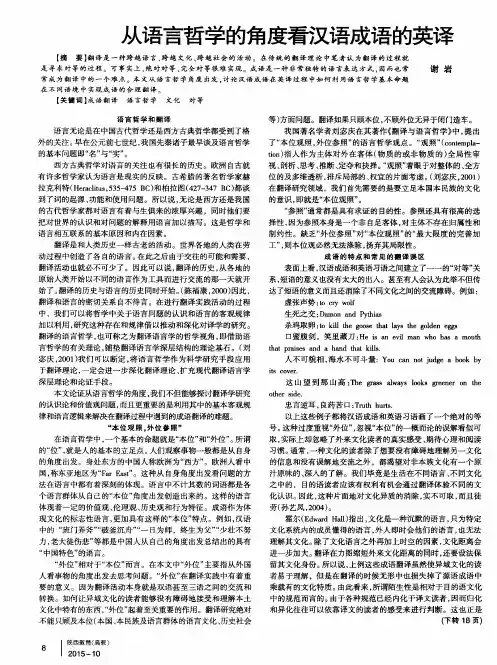
位 的及多维透析 , 排斥局部的、 权宜的片面考虑 。 ( 刘宓 庆 , 2 0 0 1 )
在翻译 研究 领域 ,我们首先需要 的是要立足本 国本 民族 的文化 的意识 , 即就是“ 本位观照” 。
拉克利特( H e r a c l i t u s , 5 3 5 — 4 7 5 B C) 和柏拉 图( 4 2 7 — 3 4 7 B C) 都谈 到了词 的起源 、 功能和使用 问题 。所以说 , 无论是西方还是我 国 的古代哲学家都对语言有着与生俱来 的浓厚兴趣 ,同时他们要
“ 参照 ” 通常都是具有求证 的 目的性 。参照还具有很高 的选 择性 , 因为参照本身是一个非 自足客体 , 对 主体不存在归属性 和
制约性 。缺乏“ 外位参 照” 对“ 本位观 照” 的“ 最 大限度的完善加
工” , 则本位观必然无法涤 除, 扬弃其局 限性 。
成 语 的 特 点和 常见 的 翻 译 误 区
在语言哲学 中, 一个基本的命 题就是 “ 本位” 和“ 外位 ” 。 所谓
表面上看 , 汉语成语和英语 习语之间建立 了一一的“ 对等” 关
系, 短语 的意义也没有太大的出入 。甚至有 ^ 会 为此举不但传 达 了短语 的意义而且还消除了不同文化之间的交流障碍。例如 :
虚张声势 : t o c r y w o l f
英语作文学好成语对汉语的意义

英语作文学好成语对汉语的意义The Significance of Mastering Idioms in English for Chinese Language Proficiency.Idioms are a rich and vibrant component of any language, embodying its cultural heritage, historical context, andthe wisdom of its people. In the Chinese language, idioms play a pivotal role, often conveying complex concepts and emotions in a concise and elegant manner. As China increasingly interacts with the global community, the importance of mastering English idioms for Chinese speakers cannot be overstated. This article explores thesignificance of learning English idioms for enhancing Chinese language proficiency.Firstly, understanding English idioms deepens cross-cultural communication. In the globalized world, effective communication requires an awareness of cultural differences and nuances. English idioms, often rooted in specific historical events or cultural practices, can providevaluable insights into the English-speaking world's values, beliefs, and ways of thinking. By understanding these idioms, Chinese speakers can avoid misunderstandings and misinterpretations, ensuring smoother and more meaningful cross-cultural exchanges.Secondly, English idioms can enrich the vocabulary and expression of Chinese speakers. Idioms are often more vivid and expressive than literal translations, offering a richer vocabulary to convey complex ideas and emotions. By mastering English idioms, Chinese speakers can enhancetheir own language skills, incorporating foreign elements into their vocabulary and expressions. This not only makes their language more dynamic and engaging but also demonstrates their openness to foreign cultures and a willingness to learn and adapt.Thirdly, learning English idioms cultivates critical thinking and analytical skills. Idioms often containimplicit meanings and double entendres, requiring the learner to think critically and analyze their context and intended meaning. This process of decoding andunderstanding idioms trains the brain to think outside the box, encouraging flexibility and creativity in thinking. For Chinese speakers, this can be a valuable tool in enhancing their language proficiency, as it sharpens their ability to understand and interpret complex language structures and nuances.Moreover, English idioms provide a window into the world's diverse cultures and thought processes. By studying these idioms, Chinese speakers can gain insights into the values, beliefs, and ways of life of different cultures. This understanding can foster a more tolerant and inclusive attitude towards cultural diversity, promoting cultural exchange and mutual understanding.Additionally, English idioms can serve as a bridge between Chinese and English, facilitating language translation and interpretation. In the process of translating English idioms into Chinese or vice versa, learners are forced to consider the equivalence of meaning, tone, and style. This exercise not only enhances their language proficiency but also sharpens their sensitivity tolanguage nuances and cultural differences.In conclusion, mastering English idioms holds significant value for Chinese speakers in enhancing their language proficiency. It deepens cross-cultural communication, enriches vocabulary and expression, cultivates critical thinking and analytical skills, and serves as a bridge between Chinese and English. As China's influence grows on the global stage, it becomes increasingly important for Chinese speakers to embrace and master English idioms, thereby enriching their language toolbox and fostering deeper cultural understanding and exchange.。
对中国成语的认识英语作文高中
对中国成语的认识英语作文高中Idioms are a unique and fascinating aspect of the Chinese language, rich in history, culture, and deep meanings. They are phrases or sayings that cannot be understood by simply translating their literal words but require knowledge of their cultural backgrounds and historical contexts.One of the most striking features of Chinese idioms is their conciseness. Often composed of just a few words, they pack a punch of meaning, sometimes conveying complex ideas or emotions in a succinct manner. For instance, the idiom "画蛇添足" (huàshétiān zú) literally means "to draw a snake and add feet to it," but figuratively, it describes doing something unnecessary that may even ruin a good situation.Another noteworthy aspect is their richness in metaphors and analogies. Chinese idioms often use ordinary objects or situations to symbolize abstract concepts or complex emotions. For example, "杯水车薪" (bēi shuǐchēxīn) compares a small amount of water to a large pile of firewood, symbolizing an inadequate effort to solve a significant problem.The origin of Chinese idioms is often tied to historical events, literary works, or folk tales. Many of them have interesting stories behind them, making them not only useful in communication but also entertaining. For instance, the idiom "守株待兔" (shǒu zhūdài tù) comes from a story about a farmer who stopped working and waited for rabbits to crash into his stump, hoping to get them for free. This idiom now refers to waiting idly for something improbable to happen.Understanding and using Chinese idioms correctly can greatly enhance theexpressiveness and elegance of one's language. However, due to their cultural specificity, they can be challenging for non-native speakers to grasp. Nevertheless, with patience and practice, anyone can appreciate and enjoy the beauty and wisdom embedded in these timeless phrases.In conclusion, Chinese idioms are an essential part of the Chinese language and culture. They reflect the wisdom and experiences of the Chinese people throughout history and continue to influence and enrich the way we communicate and express ourselves today.中文对照译文:成语是汉语中一个独特而迷人的方面,具有丰富的历史文化和深刻的含义。
我对中国成语的认识的英语作文
我对中国成语的认识的英语作文英文版:My Understanding of Chinese IdiomsChinese idioms are fixed expressions or phrases that carry a meaning different from the literal interpretation of the words.They are an essential part of Chinese culture and are widely used in daily life, literature, and art.There are numerous idioms in Chinese, each with its unique meaning and usage.One of the most fascinating aspects of Chinese idioms is their origin, which often comes from historical events, folk stories, or ancient literature.For example, the idiom "画龙点睛" (huàlóng diǎn jīng)literally means "to add a finishing touch," but it refers to the final touch that makes something perfect.This idiom is derived from a story about a painter who added a dragon"s eye to a painting, bringing it to life.Chinese idioms are not only a reflection of Chinese culture but also a tool for people to express their thoughts, emotions, and experiences.They are often used to convey advice, warnings, or moral lessons.For instance, the idiom "知足常乐" (zhìzúcháng lè) means "contentment brings happiness," reminding people to be satisfied with what they have.Moreover, Chinese idioms are rich in imagery and often involveanimals, plants, or natural phenomena.For example, the idiom "狐假虎威" (hújiǎhǔwēi) describes a weak person who relies on the strength of a powerful person to intimidate others.This idiom uses the imagery of a fox and a tiger to convey the meaning effectively.In conclusion, Chinese idioms are an integral part of Chinese culture and language.They carry deep meanings and are used to convey various messages, including advice, warnings, and moral lessons.Understanding Chinese idioms can help us better understand Chinese culture and the way Chinese people think and express themselves.中文版:我对成语的认识成语是固定短语或词组,其含义与字面上的解释不同。
浅析汉语成语的英译

浅析汉语成语的英译[摘要]成语结构紧凑、意义精辟,本文就英语翻译成语从五个方面作探讨。
[关键词]成语汉语英语翻译汉语成语具有言简意赅、生动形象、寓意明确、富有哲理等语言特征,承载着不同的民族文化特色和文化信息,与文化传统紧密相连,不可分割。
因此,在翻译时要尽量再现其本族的语言风格和丰富的内涵。
若仅仅以词汇的同义性为前提,采用对等翻译的方法,往往就会词不达意、貌合神离。
本文试图从以下六个方面,对汉语成语的英译作一些探索。
一、保持原文风格的直译法(literal translation)从翻译角度来看,直译是在保持原文信息的前提下,力求使译文与原文在选词用字、句法结构、形象比喻及风格特征等方面尽可能趋于一致,译文和原文常用相同的表达形式来体现同样的内容,并且产生同样的效果。
直译法不仅能够传达成语中所承载的文化信息,而且能产生较高的文化信息传递的有效度,同时还保留了汉语成语的民族色彩和生动形象,使英语读者能更好地感受汉语文化。
这种译法为英语输入了新的表达方式,丰富了英语语言文化。
例如:美国作家赛珍珠(Pearl S. Buck)女士的英译作品《水浒传》(All Men Are Brothers),深受英美读者欢迎。
她希望把中国名著原原本本地介绍到西方,因此她尽量保持原著的风格,保留中国古代语言特有的表达方式和行文习惯。
要做到这一点,最有效、最便捷的翻译方法就是直译。
赛珍珠在翻译中尽量使用直译。
比如她将成语“东奔西逃”直译为“ran east and west”,“江湖好汉”直译成“a good fellow of the rivers and lakes”。
又如:“瓜熟蒂落,水到渠成”用直译法译成“When a melon is ripe, it falls off its stem and when water flows, a channel is formed.”这一直译既保持了原成语的形象比喻,又保持了原文两部分的对仗形式;既正确表达了原文的内容,又保持了原文的结构,一举两得。
你对中国成语的认识英语作文
Chinese Idioms: A Window to UnderstandingChinese CultureIdioms are a unique and integral part of any language, and Chinese is no exception. These phrases, often浓缩着profound wisdom and historical references, serve as a window to understanding the rich tapestry of Chinese culture. My acquaintance with Chinese idioms has been an enlightening journey that has deepened my appreciation for the beauty and depth of the Chinese language.One of the first Chinese idioms I encountered was "画蛇添足," which translates to "to draw a snake and add feet to it." This idiom originates from an ancient story about a group of people who were competing to draw snakes. One person finished quickly and decided to add feet to his snake, thinking it would make it more realistic. However, snakes do not have feet, and so his efforts were deemed unnecessary and foolish. This idiom teaches us the importance of not overdoing things and understanding the natural limits of situations.Another idiom that captured my interest is "井底之蛙," which means "a frog at the bottom of a well." This idiomcompares a frog's limited view from the bottom of a well to a person's narrow perspective or lack of understanding due to limited experience or knowledge. It serves as a reminder to always seek to broaden our horizons and avoid being satisfied with a superficial understanding."熟能生巧" is another Chinese idiom that resonates deeply with me. It translates to "practice makes perfect" and emphasizes the importance of constant practice and repetition in achieving mastery. This idiom reminds us that success often requires persistent effort and dedication, and that with enough practice, even the most challenging tasks can become second nature.These are just a few examples of the vast array of Chinese idioms that exist, each carrying a unique message and lesson. The beauty of these idioms lies in theirability to convey complex ideas and life lessons in a concise and memorable manner. They are not just phrases but also embodiments of Chinese culture, history, and philosophy.Learning Chinese idioms has been a rewarding experience that has not only expanded my vocabulary but also deepenedmy understanding of Chinese culture and values. These phrases, often rich in imagery and metaphor, have helped me gain insights into the way Chinese people view the world and approach life.In conclusion, Chinese idioms are a valuable resource for anyone interested in learning about Chinese culture and language. They are not just words but also powerful tools for understanding the wisdom and insights embedded in the Chinese language. My acquaintance with these idioms has been an enriching journey that has broadened my horizons and deepened my appreciation for the beauty and depth of the Chinese language.**中国成语:了解中国文化的窗口**成语是任何语言中独特且不可或缺的一部分,汉语也不例外。
对中国成语的认识英语作文
对中国成语的认识英语作文英文版:As an ancient cultural heritage of China, idioms have accumulated and accumulated through generations of Chinese people. Through idioms, we can understand the essence of Chinese history, culture, and life, and even the hearts and minds of Chinese people. However, with the rapid development of society and the information explosion, it is easy for us to fall into the trap of superficiality and inaccuracy in the use of idioms. Therefore, how to understand and use Chinese idioms correctly has become an increasingly important issue.From my perspective, understanding Chinese idioms starts with knowing their historical and cultural background. As an expression rooted in Chinese traditional culture, each idiom has its own origin and story behind it, which we can learn from relevant historical books, novels, and other literature works. For example, the idiom "to be lost in thought" originated from the story of a scholar who was so absorbed in his research that he forgot to eat and drink. Therefore, we can understand its original meaning and usage, which is helpful for us to use it correctly.Besides historical background, understanding idioms also requires us to know their common meanings and interpretations. Generally speaking, idioms have different meanings depending on different contexts and purposes. Therefore, we need to know how to interpret them flexibly according to different situations. For instance, the idiom "to run in a straight line" can be used to describe someone who always persists in his/her own way, which needs to be interpreted in different contexts.Finally, we need to master idioms that are widely used and familiar in our daily life. We can read and listen to various media such as news programs, books, movies and listen to them attentively, understand their common meanings and usage patterns, and then integrate them into our daily life.中文版:成语是中国传统文化中的瑰宝,它们历经千年的积累和沉淀,是中国人民智慧的结晶。
中文四字成语英译研究
中文四字成语英译研究由于中西方文化的差异,中文四字成语——这一相当具有中国特色的语言文化内容成为西方学者关注的焦点。
然而,四字成语的翻译也是汉英翻译中的一个难点。
本文就对一些中文四字成语进行了分类,并介绍了一些中文四字成语以及英译的例子和翻译方法。
标签:四字成语;翻译;英语中文的四字成语,是中国文化的一大特点。
而随着全球化的进程逐步加快,世界各个民族的文化交流逐步加深。
特别是我国成功举办北京奥运会之后,外国朋友对中国文化的兴趣越发浓厚。
与谚语、俚语等不同,汉语四字成语更以其对仗工整,音韵对称的美学功能和修辞特点而成为翻译中的一个难点。
中国的四字成语一般来自于古代经典、著名著作、历史故事、民间传说,或者是民间长期约定俗成的独特的语言表达方式,通常都具有鲜明的形象和浓厚的民族色彩特征。
那么,为了更好地探讨中文四字成语的翻译思路,我们先来了解一下中西文化差异之所在。
语言是表达思想的,而思想是客观的反映,人类有许多共同的生活经验,共同感受,所以不同的文化有不少重合处(cultural overlaps)。
在英汉两种语言中,同一名词会有相同的内涵意义或者联想意义。
比如狐狸都比喻为狡猾,猴子都比喻为机灵。
但由于受到客观条件的制约,不同的民族往往用不同的名词来比喻表达同一思想。
例如:汉语用“山中无老虎,猴子称霸王”,英语用“In the land of the blind, the one-eyed man is king”.成语就好像一面镜子。
它反映一个民族或一个文化的特点。
汉英成语的差异正说明了这点。
汉英文化的差异可以概括为以下几个方面的不同。
一、比喻上的不同中国人常常用“杀鸡取卵”来比喻一个人贪心过甚,以至于一无所得。
而英语则用“kill the goose that lays golden eggs”来表达这个意思。
还有如:爱屋及乌Love me, love my dog.无风不起浪No smoke without fire.湿得像落汤鸡As wet as a drowned rat.蠢得像猪As stupid as a goose.二、地域文化的不同中国人常常用“雨后春笋”来形容一般事物的迅速发展和大量涌现。
浅析汉语四字成语的英译
浅析汉语四字成语的英译浅析汉语四字成语的英译[摘要]:在进行新希望大学英语综合教程阅读部分的教学过程中,发现许多句子如果用直译的方法翻译过来,有些生硬,别扭,相反如果翻译成汉语的四字成语,会感觉到恰如其分,想到这样的对应关系,会让人有心头一喜的感觉。
下面就将所有总结与大家分享,不足之处,敬请各位同仁批评指正。
[关键词]:四字成语汉译英英译汉一、概要汉语中的许多成语,习语,读起来朗朗上口,听起来通俗易懂,用起来随心应手,尤其是四字成语,最为多见,数量也最多,约占汉语的90%以上。
而英语是一种非常理性的语言,最看重清晰明确,最忌逻辑混乱与文字堆砌,不像汉语那样过分借重辞藻来加强文义,烘托氛围,所以将汉语中的四字成语翻译成英文会是一个很繁杂的工程。
许多学者都是从汉语的构成结构为出发点,来研究其翻译的。
但是这会出现许多的问题,这也是傅一勤在从《林语堂当代汉英词典》到《新时代汉英大词典》——以中文四字成语的英译为例这篇文章中提到的问题,因中文的四字成语常具有句子的形态,很容易让人把它当作一个独立的短句或谓语(即无主语的句子)来翻译,因此常造成在表面上看起来似乎没有问题、而在实际应用上却格格不入的翻译,完全不能适用,必须另起炉灶,重新翻译。
比如明哲保身 use ones wits to ensure one’s own survival(and shirk moral responsibility);be worldly wise and play safe:他一向信奉明哲保身的处世哲学。
He has always believed in the philosophy of self-preservation.所以笔者认为从英译汉的角度来研究汉语四字成语的翻译会更恰当,更实用。
二、英汉四字成语对照喉头哽咽:get a huge lump in one’s throat迫不及待:could not wait for someone to do something出乎意料:Against all expectation, Mike finished high school with top grades.不出所料:The show lived up to all our expectations--- it was so wonderful.梦中情人:Mrs. Green Fields had hoped for a similar romance when she met her love on the Internet.衣着得体仪表堂堂:The man was well-dressed, and she was not disappointed in his physical appearance.和谐相处共度一生:The lonely young woman felt she’d finally found the man with whom she can live with in harmony.如意郎君:Mr. right失声痛哭:Looking at my mom, I almost burst out crying.经济拮据:I knew money was tight.钻石戒指:There was a tiny ring with a diamond chip in the center.言归正传:Let’s get down to business.点头同意:I could only nod my head in agreement.百分之百同意:I’m 100% in agreement with you.温柔和睿智:gentle wise spirit毫无音信:A few weeks went by with no response.收支平衡:make both ends meet毫不例外:I was no different.反过来讲:In return, tugs brought new meaning to the term adoration.形影不离:wherever I went, he wanted to be there too,.病入膏肓:Two men ,both seriously ill, occupied the same hospital room..时机成熟:As soon as it seemed appropriate ,the other man asked if he could be moved next to the window.美丽如画:The novelist’s vivid description made us imagine the picturesque and beautiful scenery at the shores.生机勃勃:I like spring very much because it enlivens all nature.轻而易举:Michael was broke when he started his business,but now he can buy 10 houses for his mother with ease.又惊又喜:At this news, the look on his face was a mixture of surprise and happiness.束手无策:As he was digging, other helpless parents arrived, clutching their hearts, saying:“my son, my daughter!”三、结语从上面可以看出,汉语的四字成语有时候相当于英语的一个名词,形容词,动词,或者相当于汉语的形容词短语,介宾短语,或者无主句等等。
对中国成语的认识英语作文高中
对中国成语的认识英语作文高中Title: Grasping the Essence of Chinese Idioms as a High School StudentAs a high school student with a burgeoning interest in linguistics and cultural studies, my encounter with Chinese idioms has been nothing short of enlightening. Chinese idioms, or 成语(chéngyǔ), are a collection of four-character expressions that encapsulate wisdom, historical events, and moral lessons, serving as a bridge to the profound cultural heritage of China.Embarking on this journey, I've come to appreciate the conciseness and depth that chéngyǔoffer. Each idiom is a distillation of a story or an experience, providing insights into the complexities of human emotions, ethics, and ancient Chinese philosophies. For example, the idiom 掩耳盗铃(yǎn ěr dào líng), translating to "covering one's ears while stealing a bell," illustrates the folly of thinking one's deceit is unseen, highlighting the universal truth that self-deception is no escape from reality.What strikes me the most about these idioms is their enduring relevance. In a world that is constantly changing, the wisdom encapsulated in these four characters remains timeless.For instance, 同舟共济(tóng zhōu gòng jì), meaning "in the same boat, crossing the river together," speaks volumes about cooperation and mutual support in facing challenges, a principle that resonates just as strongly in today's global society.Learning Chinese idioms has also provided me with a unique lens through which to view the language's structure and beauty. The way these idioms blend historical narratives, philosophical depth, and linguistic economy is truly fascinating. They not only enrich my vocabulary but also enhance my understanding of Chinese cultural nuances and the values that have been passed down through generations.Moreover, diving into the world of chéngyǔhas greatly improved my cross-cultural communication skills. Being familiar with these idioms allows me to engage more deeply with Chinese literature, films, and conversations, fostering a greater appreciation for the richness of Chinese culture and its influence on the world.In conclusion, as a high school student exploring the realm of Chinese idioms, I've gained invaluable insights into the wisdom and beauty of Chinese culture. Chéngyǔare more than just expressions; they are a testament to the enduring legacy of China's historical depth, philosophical insights, and linguisticelegance. This exploration has not only broadened my linguistic horizons but has also deepened my respect and admiration for a culture that continues to influence the world profoundly.。