
古希腊罗马神话欣赏-课程教学大纲及样题
《古希腊、罗马神话》课程教学大纲课程编码:30615022 学分: 2 总学时:36说明【课程性质】《古希腊、罗马神话》是全日制大学本科教育英语专业高年级开设的专业选修课。
【教学目的】使学生了解西方文化渊源,从文化的角度学习英语词汇,培养和提高其文化素养、鉴赏能力和对异域文化的敏感度。
【教学任务】以古希腊、罗马神话的重要神祗、英雄的轶事为主线,分析现代英语中源于神话的词语与典故及以古希腊、罗马神话为题材的英美文学作品、雕塑、绘画、建筑等艺术作品,提高学生的文化能力和鉴赏水平。
【教学内容】古希腊、罗马神话简介,旧神谱系与天地的起源,奥林匹斯山新神,普罗米修斯与人类,次神的故事,英雄的故事【教学原则和方法】教学原则:以培养具有文化能力和鉴赏水平的学生为原则教学方法:采用多媒体课件教学,辅以影视欣赏和学生讨论促进教学【先修课程要求】本课程是在学生完成了精读、泛读、英美文学、影视欣赏、英美文化概况等课程,并掌握了一定的专业知识和技能基础上开设的专业选修课。
【学时分配】序号内容学时安排小计理论课时实验课时习题课时上机课时1 第一部分2 22 旧神谱系与天地的起源2 23 奥林匹斯山新神10 104 普罗米修斯与人类 4 45 次神的故事6 66 英雄的故事8 87 影视欣赏 4 4总计 36 36 【教材与主要参考书】教材:常耀信《希腊罗马神话》外语教学与研究出版社,1981年。
参考书:廖光蓉《英语词汇与希腊罗马神话》湖南师范大学出版社,1999年。
徐国萍《希腊罗马神话及典故成语》海洋出版社,2001年。
陶洁《希腊罗马神话一百篇》中国对外翻译出版公司,1989年。
大纲内容第一部分古希腊、罗马神话简介【教学目的和要求】教学目的:了解希腊述神话的起源、形成、和发展教学要求:掌握学习古希腊、罗马神话的意义、目的,重要性和方法【内容提要】第一节什么是神话第二节神话的起源和发展第三节神话故事与神话学的区别第四节神话的分类第五节学习神话的原因、意义和方法【教学重点与难点问题】教学重点:神话的分类教学难点:神话的起源和发展【复习思考题】1. 什么是神话?2. 神话故事与神话学的区别是什么?第二部分天地的起源【教学目的和要求】教学目的:讲述天地的起源教学要求:掌握旧神谱系中主要的神及由此派生出来的英语词汇【内容提要】第一节天地的起源第二节旧神谱系:地神盖娅、天神乌拉诺斯,十二提坦巨神第三节以cosmos、chron为词根的派生单词【教学重点与难点问题】教学重点:天地如何起源的教学难点:旧神谱系中诸神之间的关系及名称【复习思考题】1.天地是如何起源的?2.试论述旧神谱系中诸神的关系。
第三部分奥林匹斯山新神【教学目的和要求】教学目的:讲述奥林匹斯山新神谱系中诸神的职能、地位及轶事教学要求:掌握诸神的名称、地位及由此派生出来的英语单词【内容提要】第一节宙斯:天神之父,地上万物的最高统治者第二节赫拉:宙斯的正妻,女性的代表第三节雅典娜:智慧女神、雅典城的守护女神第四节阿波罗:太阳神第五节阿尔忒弥斯:月神第六节狄俄倪索斯:酒神与狂饮欢乐之神第七节阿拂洛狄特:爱情之神第八节波塞东:海神第九节哈台斯:冥王第十节赫斐斯托司:火神与工匠神第十一节阿瑞司:战神第十二节赫尔墨斯:宙斯的信使【教学重点与难点问题】教学重点:十二主神的名称、职能、地位及代表物教学难点:诸神的名称及关系【复习思考题】1.列出奥林匹斯山十二主神的名称、职能及代表物。
2.奥林匹斯山十二主神的特点有什么?3.试述大小熊星座的来历。
4.举例说明宙斯的风流成性。
5.试述阿波罗与达芙尼的爱情故事。
第四部分普罗米修斯与人类【教学目的和要求】教学目的:讲述普罗米修斯如何创造了人类教学要求:掌握普罗米修斯的英雄事迹、人类的四个时代及潘多拉的故事【内容提要】第一节普罗米修斯与人类的起源第二节以普罗米修斯的故事为题材的文学作品第三节人类的不同时代第四节潘多拉的盒子【教学重点与难点问题】教学重点:普罗米修斯与人类的起源,人类的四个时代教学难点:普罗米修斯的象征意义【复习思考题】1.人类是如何被创造的?2.宙斯是如何惩罚普罗米修斯的?3.人类经历了哪几个时代?这几个时代分别有什么特点?4.潘多拉的盒子有什么寓意?第五部分次神的故事【教学目的和要求】教学目的:了解希腊神话中一些重要次神的故事教学要求:掌握相对重要的一些轶事和源于此的典故【内容提要】第一节冥王哈德斯与珀耳塞福涅的故事第二节西西弗斯及相关典故第三节坦塔罗斯及相关典故第四节俄耳普斯与欧律狄克的故事第五节潘神一、潘神的象征意义二、以pan为词根的单词和词组第六节酒神狄俄倪索斯一、酒神及其跟随者二、狄俄倪索斯与希腊悲剧三、酒神崇拜及仪式特点四、源于酒神的词语【教学重点与难点问题】教学重点:西西弗斯及相关典故坦塔罗斯及相关典故以pan为词根的单词和词组教学难点:潘神的象征意义狄俄倪索斯与希腊悲剧酒神崇拜及仪式特点【复习思考题】1.西西弗斯的故事有什么寓意?2.试讲述冥王哈德斯与珀耳塞福涅的爱情故事。
3.试论述潘神的象征意义。
4.酒神崇拜有什么特点?5.试论述狄俄倪索斯与希腊悲剧的关系。
第六部分英雄的故事【教学目的和要求】教学目的:讲述英雄的故事教学要求:掌握英雄的主要业绩【内容提要】第一节赫拉克勒斯的十二业绩第二节伊阿宋与金羊毛一、阿尔戈的英雄们二、伊阿宋与美地亚第三节俄狄浦斯与恋母情结第四节特洛伊战争一、不和的苹果二、特洛伊主要人物三、特洛伊战争中重要事件四、阿客琉斯的脚跟五、特洛伊木马六、奥德修斯之旅【教学重点与难点问题】教学重点:特洛伊战争及与其有关的典故俄狄浦斯与恋母情结教学难点:特洛伊战争中的相关人物、人物关系及事件【复习思考题】1.赫拉克勒斯是怎样完成了十二项英雄业绩晋升为神的?2.伊阿宋是如何克服了重重困难找到金羊毛的?3.试述特洛伊战争的起因。
4.阿客琉斯的脚跟有什么寓意?5.什么是恋母情结?6.讲述特洛伊木马的故事及其寓意。
7.试述奥德修斯是如何克服千难万险重返家园的?执笔人:姜艳审核人:龚柏岩《古希腊、罗马神话》课程考核大纲【考核目的】了解学生对经典希腊罗马神话故事的掌握情况,帮助学生加深对神话的定义、意义的理解,提高英语语言水平;考核学生对以神话故事为题材的文学作品的分析和鉴赏能力,为更好的理解西方文明及文化打好基础。
【课程学习的基础】本课程是在学生完成了精读、泛读、英美文学、影视欣赏、英美文化概况等课程,并掌握了一定的专业知识和技能基础上开设的专业选修课。
先修课程不在考核范围内。
【考核的内容范围】本课程主要考核学生对神话中主要神祗和英雄的名称、事件的熟悉程度,现代英语中源于此的词汇和典故的掌握及以神话为主题的文学作品的了解。
【考核方法】期末开卷考试,占60%,平时考核如出勤、作业、课堂表现占40%【对试题的要求】对试题的要求:题型比例:客观性试题占80%,包括单选题、判断题、匹配题、填空题、辨识题等主观性试题占20%,包括翻译题、论述题等难度等级:分为较易、中等、较难三个等级,大致比例为20:60:20【考核的具体内容】第一部分古希腊、罗马神话简介知识点:1.什么是神话2.神话的起源和发展3.神话故事与神话学的区别4.神话的分类5.学习神话的原因、意义和方法考核目标:1.识记:神话的起源与发展2.理解:神话的定义,神话故事与神话学的区别3.运用:神话的分类第二部分天地的起源知识点:1.天地的起源2.旧神谱系:地神盖娅、天神乌拉诺斯,十二提坦巨神3.以cosmos、chron为词根的派生单词考核目标:1.识记:旧神谱系中重要的神明2.理解:天地是如何起源的3.运用:以cosmos、chron为词根的派生单词第三部分奥林匹斯山新神知识点:1.奥林匹斯山新神谱系中诸神的名称、职能、地位及轶事2.由此派生出来的英语单词考核目标:1.识记:奥林匹斯山新神名称2.理解:奥林匹斯山新神职能、地位及轶事3.运用:奥林匹斯山主神的职能、地位、重要轶事及源于此的英语单词第四部分普罗米修斯与人类知识点:1.普罗米修斯是如何创造了人类2.普罗米修斯的英雄事迹3.人类的不同时代4.潘多拉的盒子考核目标:1.识记:普罗米修斯潘多拉2.理解:普罗米修斯是怎样成为人类的缔造者3.运用:普罗米修斯创造人类的故事,人类的不同时代,潘多拉的盒子的故事及寓意第五部分次神的故事知识点:1.冥王哈德斯与珀耳塞福涅的故事2.西西弗斯及相关典故3.坦塔罗斯及相关典故4.俄耳普斯与欧律狄克的故事5.潘神6.酒神狄俄倪索斯考核目标:1.识记:(1)冥王哈德斯(2)珀耳塞福涅(3)坦塔罗斯(4)俄耳普斯与欧律狄克(5)潘神(6)酒神2.理解:(1)冥王哈德斯与珀耳塞福涅的故事(2)俄耳普斯与欧律狄克的故事(3)狄俄倪索斯与希腊悲剧(4)酒神崇拜及仪式特点 (5) 潘神的象征意义3.运用:(1) 西西弗斯及相关典故(2) 坦塔罗斯及相关典故(3) 潘神及酒神在神话中的地位第六部分英雄的故事知识点:1.赫拉克勒斯的十二业绩2.伊阿宋与金羊毛3.俄狄浦斯与恋母情结4.特洛伊战争考核目标:1.识记:(1)赫拉克勒斯(2)伊阿宋(3)俄狄浦斯(4)海伦(5)帕里斯(6)墨涅拉俄斯(7)阿伽门农(8)阿客琉斯(9)奥德修斯2.理解:(1)赫拉克勒斯的十二业绩(2)伊阿宋与金羊毛(3)奥德修斯之旅3.运用:(1)特洛伊木马(2)俄狄浦斯与恋母情结(3)阿客琉斯的脚跟【样题】I. Fill in the following blanks with proper names or words in Greco-Roman myths.(每小题2分,共20分)1.In the ancient Greek myth of creation , before earth ,sea and heavens became known, there was only__________ which is the dark and silent abyss.2.By the end of the war between Zeus and Cronus, a titan called ___________was singled out to hold up the world on his back as a punishment for his supporting Cronus against Zeus.3._________, was bathed in bliss and brightness the home of the gods, where Zeus ruled as the father of gods and men.4. In the Olympian Gods, ____________is the god in charge of the sea.5. The ___________ , the second epic of Homer, narrates the tribulations and feats of Odysseus fromthe time he left Troy with his fleet and the moment when he set foot again on the soil of Ithaca.6. As a messenger god, _____________is naturally the god of roads and door ways.7. In Greek myths, the apple of a goddess_______caused a ten-year war8. The riddle “what is that which has one voice and yet becomes four-footed and two-footed andthree-footed’ was given by Sphinx and later was solved by ________.9. In the palace of Hades ,the king of Corinth ________ had to push up a hill a huge stoneconstantly ,but the stone would roll back down again before it reached the top.10._________was turned into a Laurel tree when she was trying to escape from Apollo’s pursuit.II. Multiple choice.(每小题1分,共10分)1.________was not only the god of prophecy but the god of health and healing.A. ZeusB. HermesC. ApolloD. Mars2. Prometheus was finally saved by_____?A. ApolloB. PoseidonC. HeraclesD. Hermes3. During the age of ______,men further degenerated ,ruthless and ferocious. They delighted in warand perished in ceaseless strife.A. GoldenB. SilverC. BronzeD. Iron4.In all accounts of Greek myths, _________ is known as the protector and benefactor of man, for hegave mankind a number of gifts including fire.A. UranusB. PrometheusC. EpimetheusD. Zeus5. ________was a handsome youth who was so vain that he thought no one but himself was worthy to see his youthful beauty.A. NereusB. ProteusC. PersephoneD. Narcissus6._________ performed twelve stupendous labors, which ultimately won his way to heaven.A. HephaestusB. HermesC. HeraclesD. Hades7. One of Zeus’ mistresses ________ and her son were transformed to bears and have remained to this day, known as the constellation of the Great and Little Bear.A. IoB. NiobeC. PhilemonD. Callisto8.________ was dipped by his mother in the waters of Styx which could render the human body immune to sword and fire.A. AgamemnonB. AchillesC. OedipusD. Sisyphus9.Who is the god of theatre?A. PanB. SatyrC. DionysusD. Apollo10.With the help of Medea, ___________emerged safe and sound , and finally brought the goldenfleece back.A. OedipusB. MenelausC. OdysseusD. JasonIII.Write out the concerning names or characters in Greek myths from which the following words are derived.(每小题1分,共10分)1. Junoesque ( )2. gorgon ( )3. panic ( )4. venereal ( )5. cereal ( )6. bacchanalian ( )7. volcano ( )8. Atlantic ( )9. martial ( )10. hector ( )IV. Write out the names relative to the description below.(每小题2分,共10分)1.__________ It was the weapon of Zeus and Athena. It possessed the power to terrify anddisperse the enemy or to protect friends.2.____________ Sea-nymphs, whose singing charmed mariners to leap into the sea passing theirisland.3.____________ The leader of the Achaeans in the Trojan war, the king of Mycene.4.____________ Monsters with brazen claws, protruding teeth and coiling snakes round their headsand necks.5.____________ His name signifies all,he came to be considered a symbol of the universe andpersonification of Nature.plete the following idioms by using the names in Greco-Roman myths according to the implication of each idiom in current English . (每小题3分,共15分)1.___________ the prediction that is true but is not believed.2._____________the fountainhead of all evils3._____________chosen by Sigmund Freud to designate a son’s feelingof love toward his mother and jealous hatred toward his father.4._____________a trap intended to undermine an enemy, or subversionfrom inside.5._____________the mystical person or thing that is hard to be understood.VI. Fragment identification. (每小题4分,共20分)Read the following poem fragments, each is about a character in Greek myths. Write out the related names according to the following fragments ."Titan! to whose immortal eyesThe sufferings of mortality,Seen in their sad reality,Were not as things that gods despise;What was thy pity's recompense?A silent suffering, and intense;The rock, the vulture, and the chain;All that the proud can feel of pain;The agony they do not show;The suffocating sense of woe."Thy godlike crime was to be kind;To render with thy precepts lessThe sum of human wretchedness,And strengthen man with his own mind. And, baffled as thou were from high,Still, in thy patient energyIn the endurance and repulseOf thine impenetrable spirit,Which earth and heaven could not convulse,A mighty lesson we inherit."------ From Byron2."More lovely than her, whom the gods Endowed with all their gifts; and O, too likeIn sad event, when to the unwiser sonOf Japhet brought by Hermes, she insnared Mankind with her fair looks, to be avengedOn him who had stole Jove's authentic fire."------ from Milton3. When the world is puddle-wonderfulthe queerold balloonman whistlesfar and weeand bettyandisbel come dancingfrom hop-scotch and jump-rope andit’sspringand the goat-footed balloon Man whistlesfar and wee------ from In Just4.“Lord of Thebes, do not sow a furrow of children against the will f the gods for if you beget a son, that child will kill you, and all your house shall wade through blood.”----- from Eruipides5. As I bent down to look, just oppositeA shape within the watery gleam appearedBending to look on me. I started back;It started back; but pleased I soon returned,Pleased it returned as soon with answering looksOf sympathy and love. There had I fixedMine eyes till now, and pined with vain desire,Had not a voice thus warned me; “What thou seest,What there thou seest, fair creature, fair creature, is thyself;”------- From MiltonVII. Translation. (每小题3分,共15分)1.If a public relation officer is as shy as Daphne, how can she carry out her duty?2.How could they refuse the siren song of the land to adventurers?3.He dared his father’s Olympian fury.4.Students studying for final examinations yearn for the Elysian idleness of the summer vacation.5.What an Arcadia you live in!执笔人:姜艳审核人:龚柏岩。
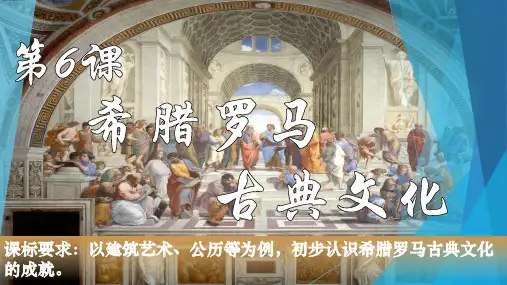
第6课 希腊罗马古典文化课件(共17张PPT).ppt
真正的法律应该 对 一 切 人 有 效 ,应 该 永 远 有 效 ……
——罗马政治家西塞罗
四、公历的缘起
1.罗马历法 ①来源: 古埃及人的太阳历 ②经过: 凯撒命人以太阳历为蓝本编制“儒略历” ③影响: 罗马皇帝以此为基督教立法
儒略历成为今天公历的基础
蓝本 太阳历(古埃及)
公历的缘起
凯撒 儒略历
课标要求:以建筑艺术、公历等为例,初步认识希腊罗马古典文化 的成就。
一、文学和雕塑
希腊、罗马的古典文化体现在神话、文学、艺 术、哲学、科学、史学、法学、体育等方面 1、希腊神话:神人同形同性
希腊诸神
希腊神话“神人同形同性”
所谓“同形”是指神和人一样,有着 人的形态和肉体,只是在一定意义上比我 们人更发达、更美。
3、希腊雕塑:希腊人文雕刻艺术达到完美境界 宙斯像是古代世界七大奇迹之一
《掷铁饼者》
二、建筑艺术
1.希腊建筑艺术
①体现: 神庙
②特点:
神庙四周以廊柱环绕, 主神有粗有细 ③代表:
雅典帕特农神庙
充满力量感, 最早是在希腊 人建造神庙时
发明的。
柱头由一对标志 性的涡形装饰, 置于柱帽之上, 运用较为广泛。
所谓“神人同性”就是说神和人一样, 有欲望,有嫉妒,有恨,有俗人所有的弱点。
2、希腊文学:《荷马史诗》(了解早期希腊社会)
荷马吟诗
荷马(约前9世纪—前8世纪)古希腊盲诗
人。
相传记述了公元前12~前11世纪特 洛伊战争,以及关于海上冒险故事的 古希腊长篇叙事代表作——史诗《伊 利亚特》和《奥德赛》,即是他根据 民间流传的短歌综合编写而成。他的 杰作《荷马史诗》,在很长时间里影 响了西方的宗教、文化和伦理观。
《希腊神话故事两则》教案

《希腊神话故事两则》教案
教学目标;1.初步了解希腊神话故事产生的社会背景和它在世界文学史上的地位
2.欣赏希腊神话的艺术魅力
教学重点:1. 分析普罗米修斯与阿喀琉斯的人物特征(精神)
2.体会希腊神话的艺术魅力
难点:
一:教学过程
(一):导入
《圣斗士星矢》这系列的动漫作品,相信这里一定有很多人看过了吗!这虽然是一部日本动漫作品,但其中的一些人物:雅典娜、潘多拉、宙斯、阿波罗等等,同样也是古希腊神化故事中耳熟能详的人物,今天我们就要学一篇新的课文,两则古希腊神话故事,大家可以从中找一找那些熟悉的名字,看一看在神话故事里,他们是怎样的一个人
(二):综述(相关资料)。
英美概况-希腊罗马神话教案
《英美概况》教案The Greek and Roman MythologyTeaching Objectives:The students should get to know the stories in the Greek and Roman mythologyTeaching Methods:Presentation, Question-answeringDifficult/Focal Points:The Main Gods and Goddess in the mythologyThe heroes and their storiesTeaching Procedure:Part I Greece& RomeGreece is a country in southeastern Europe. Situated on the southern end of the Balkan Peninsula, Greece has land borders with Albania阿尔巴尼亚, the Republic of Macedonia 马其顿and Bulgaria保加利亚to the north, and Turkey to the east. The Aegean Sea爱琴海lies to the east of mainland Greece, the Ionian Sea 爱奥尼亚海to the west, and the Mediterranean Sea 地中海to the south.Modern Greece traces its roots to the civilisation of ancient Greece, generally considered the cradle of western civilization. As such, it is the birthplace of democracy,[7] Western philosophy,[8] the Olympic Games, Western literature and historiography, political science, major scientific and mathematical principles, and Western drama,[9] including both tragedy and comedy.Ancient Greece is the civilization belonging to the period of Greek history lasting from the Archaic period of the 8th to 6th centuries BC to 146 BC and the Roman conquest of Greece after the Battle of Corinth. At the center of this time period is Classical Greece, which flourished during the 5th to 4th centuries BC, at first under Athenian leadership successfully repelling the military threat of Persian invasion. The Athenian Golden Age ends with the defeat of Athens at the hands of Sparta in the Peloponnesian War in 404 BC.Classical Greek culture had a powerful influence on the Roman Empire, which carried a version of it to many parts of the Mediterranean region and Europe, for which reason Classical Greece is generally considered to be the seminal culture which provided the foundation of Western civilizationPart II Survey of the mythic historyThe mythological "history of the world" may be divided into three or four broader periods:A.The myths of origin or age of gods ("births of gods"): myths about the origins of the world, thegods, and the human race.B.The age when gods and mortals mingled freely: stories of the early interactions between gods,demigods, and mortals.C.The age of heroes (heroic age), where divine activity was more limited. The last and greatest of theheroic legends is the story of the Trojan War and after.A. The myths of origin or age of gods ("births of gods"): myths about the origins of the world, the gods, and the human race."Myths of origin" or "creation myths" represent an attempt to render the universe comprehensible in human terms and explain the origin of the world.( First Dynasty ) He begins with Chaos, a yawning nothingness. Out of the void emerged Gaia Gaea(the Earth). (Second Dynasty) Without male assistance, Gaia gave birth to Oranos Uranus (the Sky) who then fertilized her. From that union were born first the Titans—six males: Coeusk, Crius, Cronus, Hyperion, iapetus, and Oceanus; and six females: Mnemosyne, Phoebe, Rhea, Theia, Themis,and Tethys. After Cronus was born, Gaia and Oranos decreed no more Titans were to be born.. Cronus castrated his father and became the ruler of the gods with his sister-wife Rhea as his consort, and the other Titans became his court.(Third Dynasty) A motif of father-against-son conflict was repeated when Kronos was confronted by his son, Zeus. Because Kronos had betrayed his father, he feared that his offspring would do the same, and so each time Rhea gave birth, he snatched up the child and ate it. Rhea hated this and tricked him by hiding Zeus and wrapping a stone in a baby's blanket, which Kronus ate. When Zeus was grown, he fed his father a drugged drink which caused Kronos to vomit, throwing up Rhea's other children and the stone, which had been sitting in Kronos' stomach all along. Zeus then challenged Kronos to war for the kingship of the gods. At last, with the help of the Cyclopes (whom Zeus freed from Tartarus), Zeus and his siblings were victorious, while Kronos and the Titans were hurled down to imprisonment in Tartarus.Zeus was plagued by the same concern and, after a prophecy that the offspring of his first wife, Metis, would give birth to a god "greater than he"—Zeus swallowed her. She was already pregnant with Athena, however, and they made him miserable until Athena burst forth from his head—fully-grown and dressed for war.The Olympian GodsGreek Name Roman Name Image God or Goddess of... GenerationZeus JupiterKing of the gods and ruler of MountOlympus; god of the sky and thunder.Youngest child of the Titans Cronusand Rhea. Symbols include thethunderbolt, eagle, oak tree, scepterand scales. Brother and husband ofHera, although he had many lovers.FirstHera JunoQueen of the gods and the goddess ofmarriage and motherhood. Symbolsinclude the peacock, pomegranate,crown, cuckoo, lion and cow.Youngest daughter of Cronus andRhea. Wife and sister of Zeus. Beingthe goddess of marriage, shefrequently tried to get revenge onZeus' lovers and their children.FirstPoseidon NeptuneLord of the seas, earthquakes andhorses. Symbols include the horse,bull, dolphin and trident. Middle sonof Cronus and Rhea. Brother of Zeusand Hades. Married to the NereidAmphitrite, although, like his brotherZeus, he had many lovers.FirstHestia VestaGoddess of the hearth and of the rightordering of domesticity and thefamily; she was born into the firstOlympian generation and was one ofthe original twelve Olympians, butstories suggest that when Dionysushad arrived at Mount Olympus shegave him her spot in the twelve toprevent discordFirstApolloApolloGod of light, music, poetry, prophecyand archery. Symbols include the sun,lyre, bow and arrow, raven, dolphin,wolf, swan and mouse. Twin brotherof Artemis. Youngest child of Zeusand Leto.SecondArtemis DianaVirgin goddess of the hunt, virginity,archery and all animals. Symbolsinclude the moon, deer, hound,she-bear, snake, cypress tree and bowand arrow. Twin sister of Apollo.Eldest child of Zeus and Leto.SecondHermes MercuryMessenger of the Gods; god ofcommerce and thieves. Symbolsinclude the caduceus (staff entwinedwith two snakes), winged sandals andcap, stork and tortoise (whose shellhe used to invent the lyre). Son ofZeus and the nymph Maia. Thesecond-youngest Olympian, olderonly than Dionysus. He marriedDryope, the daughter of Dryops, andtheir son Pan became the god ofnature, lord of the satyrs, inventor ofthe panpipes and comrade ofDionysus.SecondAthena MinervaVirgin goddess of wisdom,handicrafts, defence and strategicwarfare. Symbols include the aegis,owl, olive tree, snake and spider.Daughter of Zeus and the OceanidMetis, she rose from her father's headfully grown and in full battle armorafter he swallowed her mother.SecondAres MarsGod of war, violence and bloodshed.Symbols include the boar, serpent,dog, vulture, spear and shield. Son ofZeus and Hera, all the other gods(excluding Aphrodite) despised him.His Latin name, Mars, gave us theword 'Martial'.SecondAphrodite VenusGoddess of love, beauty, and desire .Symbols include the dove, apple, bee,swan, myrtle, rose and seashell.Daughter of Zeus and the OceanidDione, or perhaps born from the seafoam after Uranus' blood drippedonto the earth and into the sea afterbeing defeated by his youngest sonCronus. Married to Hephaestus,although she cheated on himfrequently, most notably with hisbrother Ares. Her name gave us theword 'Aphrodisiac'.eitherSecondor from theTitangenerationHephaestus VulcanMaster blacksmith and craftsman ofthe gods; god of fire and the forge.Symbols include the fire, anvil, ax,donkey, hammer, tongs and quail.Son of Hera, either by Zeus or alone.After he was born, his parents threwhim off Mount Olympus, and helanded on the island of Lemnos.Married to Aphrodite. Unlike mostmythical husbands, it is never statedthat he cheated on her. His Latinname, Vulcan, gave us the word'Volcano'.SecondDemeter CeresGoddess of fertility, agriculture,nature, and the seasons. Symbolsinclude the poppy, wheat, torch, pigand serpent. Middle daughter ofCronus and Rhea. Her Latin name,Ceres, gave us the word 'cereal'. Oneof her surnames is Sitos as the giverof food, ('corn').First|-B. Age of gods and mortalsBridging the age when gods lived alone and the age when divine interference in human affairs was limited was a transitional age in which gods and mortals moved together. These were the early days of the world when the groups mingled more freely than they did later. Most of these tales were later told by Ovid's Metamorphoses变形记they are often divided into two thematic groups: tales of love, and tales of punishment.Tales of love often involve incest, or the seduction or rape of a mortal woman by a male god, resulting in heroic offspring. The stories generally suggest that relationships between gods and mortals are something to avoid; even consenting relationships rarely have happy endings.The second type (tales of punishment) involves the appropriation or invention of some important cultural artifact, as when Prometheus steals fire from the gods, when Tantalus steals nectar from Zeus' table and gives it to his own subjects—revealing to them the secrets of the gods, when Prometheus invents sacrifice, when Demeter teaches agriculture and the Mysteries to Triptolemus.Zeus’ consorts and children 配偶及子女By divine mothers Mortal/nymph/other motherC. Heroic ageThe age in which the heroes lived is known as the heroic age.[45] The epic and genealogical poetry created cycles of stories clustered around particular heroes or events and established the family relationships between the heroes of different stories; they thus arranged the stories in sequence.The Trojan WarThe Trojan War cycle, a collection of epic poems, starts with the events leading up to the war: Eris and the golden apple of Kallisti, the Judgement of Paris, the abduction of Helen, the sacrifice of Iphigenia at Aulis. To recover Helen, the Greeks launched a great expedition under the overall command of Menelaus' brother, Agamemnon, king of Argos or Mycenae, but the Trojans refused to return Helen. The Iliad, which is set in the tenth year of the war, tells of the quarrel between Agamemnon and Achilles, who was the finest Greek warrior, and the consequent deaths in battle of Achilles' cousin Patroclus and Priam's eldest son, Hector. After Hector's death the Trojans were joined by two exotic allies, Penthesilea, queen of the Amazons, and Memnon, king of the Ethiopians and son of the dawn-goddess Eos.[63] Achilles killed both of these, but Paris then managed to kill Achilles with an arrow in the heel. Achilles'heel was the only part of his body which was not invulnerable to damage by human weaponry. Before they could take Troy, the Greeks had to steal from the citadel the wooden image of Pallas Athena (the Palladium). Finally, with Athena's help, they built the Trojan Horse. Despite the warnings of Priam's daughter Cassandra, the Trojans were persuaded by Sinon, a Greek who feigned desertion, to take the horse inside the walls of Troy as an offering to Athena; the priest Laocoon, who tried to have the horse destroyed, was killed by sea-serpents. At night the Greek fleet returned, and the Greeks from the horse opened the gates of Troy. In the total sack that followed, Priam and his remaining sons were slaughtered; the Trojan women passed into slavery in various cities of Greece. The adventurous homeward voyages of the Greek leaders (including the wanderings of Odysseus and Aeneas (the Aeneid), and the murder of Agamemnon) were told in two epics, the Returns (the lost Nostoi) and Homer's Odyssey.[64] The Trojan cycle also includes the adventures of the children of the Trojan generation (e.g. Orestes and Telemachus).Part III Influence to western art and literatureThe widespread adoption of Christianity did not curb the popularity of the myths. With the rediscovery of classical antiquity in the Renaissance, the poetry of Ovid became a major influence on the imagination of poets, dramatists, musicians and artists.[104] From the early years of Renaissance, artists such as Leonardo da Vinci, Michelangelo, and Raphael, portrayed the Pagan subjects of Greek mythology alongside more conventional Christian themes.[104] Through the medium of Latin and the works of Ovid, Greek myth influenced medieval and Renaissance poets such as Petrarch, Boccaccio and Dante in Italy.[2]In Northern Europe, Greek mythology never took the same hold of the visual arts, but its effect was very obvious on literature. The English imagination was fired by Greek mythology starting with Chaucer and John Milton and continuing through Shakespeare to Robert Bridges in the 20th century. Racine in France and Goethe in Germany revived Greek drama, reworking the ancient myths.[104] Although during the Enlightenment of the 18th century reaction against Greek myth spread throughout Europe, the myths continued to provide an important source of raw material for dramatists, including those who wrote the libretti for many of Handel's and Mozart's operas.[105] By the end of the 18th century, Romanticism initiated a surge of enthusiasm for all things Greek, including Greek mythology. In Britain, new translations of Greek tragedies and Homer inspired contemporary poets (such as Alfred Lord Tennyson, Keats, Byron and Shelley) and painters (such as Lord Leighton and LawrenceAlma-Tadema).[106] Christoph Gluck, Richard Strauss, Jacques Offenbach and many others set Greek mythological themes to music.[2] American authors of the 19th century, such as Thomas Bulfinch and Nathaniel Hawthorne, held that the study of the classical myths was essential to the understanding of English and American literature.[107] In more recent times, classical themes have been reinterpreted by dramatists Jean Anouilh, Jean Cocteau, and Jean Giraudoux in France, Eugene O'Neill in America, and T. S. Eliot in Britain and by novelists such as James Joyce and André Gide.[。
九年级历史上册《古代希腊罗马文化》教案、教学设计
-通过对比分析,引导学生发现古希腊罗马文化与现代社会的联系与差异,提高学生的历史洞察力。
2.创设问题情境,引导学生主动探究,培养学生的历史思维能力。
-设计具有挑战性的问题,如“古希腊民主制度对现代政治的影响”、“罗马法律体系的演变及其意义”等,激发学生的思考与讨论。
-文学与戏剧:分析《荷马史诗》等古希腊文学作品的艺术价值,以及古希腊戏剧对后世戏剧发展的影响。
2.罗马文化
-法律体系:讲述罗马法的发展历程,重点介绍《十二铜表法》等代表性法典,以及罗马法对现代法律的影响。
-建筑与工程技术:介绍罗马建筑的特点,如圆顶、拱门等,以及罗马人在道路、水利等方面的工程技术成就。
在此基础上,教师应关注以下几点:
1.抓住学生的好奇心,激发学习兴趣,引导他们主动探索古希腊罗马文化的奥秘。
2.针对学生在知识掌握方面的不足,设计富有针对性的教学活动,帮助学生建立完整的知识体系。
3.注重培养学生的历史思维能力和评价能力,引导他们运用历史唯物主义观点分析问题。
4.关注学生的个体差异,因材施教,使每位学生都能在课堂中收获成长。
4.提高学生的史料阅读和分析能力,培养运用历史知识解决实际问题的能力。
(二)过程与方法
1.采用问题驱动法,激发学生的学习兴趣和探究欲望,引导学生主动参与课堂讨论,培养独立思考的能力。
2.通过小组合作、讨论、辩论等形式,培养学生的团队协作能力和口头表达能力。
3.利用多媒体教学资源,如图片、视频、文献等,丰富课堂教学内容,提高学生的学习兴趣。
3.强调古希腊罗马文化对现代社会的启示,如民主制度、法治精神等,提高学生的社会责任感和公民素养。
初中九年级历史教案-古希腊罗马文化-优秀
古希腊罗马文化【教学目标】1.知识与能力目标:了解希腊罗马在文学、哲学、建筑、雕塑等方面的成就。
2.过程与方法目标:培养学生解读材料的能力,提高学生比较分析历史问题的能力。
3.情感态度价值观目标:通过对希腊罗马文化的学习使学生认识到古希腊罗马文化对世界文化的影响。
【教学重点】希腊罗马文化的突出成就。
【教学难点】希腊罗马文化的特点。
【教学过程】一、导入新课:(讲述:一天,古希腊叙拉古城,一个人光着身子从浴室跑出,高声大喊“我明白了”——阿基米德。
)师:阿基米德是古希腊在科学上的一个典型代表人物,你还知道哪些古希腊的文化呢(预设:讲解雕塑和建筑。
)二、讲授新课:师:你们知道几何之父是谁吗(预设:欧几里写了《几何原本》。
)“几何学之父”欧几里得所著《几何原本》对后世数学发展起了不可估量的推动作用。
传说国王托勒密请欧几里得(约前33—约前275)为他讲授几何学时,问欧几里得有没有更便利的学习方法。
欧几里得回答说:“在几何学中,没有专为国王设置的捷径。
”有一位青年问欧几里得学了几何学后会有什么用处,他很不满地对仆人说:“给这个学生三个钱币,让他走。
他居然想从几何学中捞到实利。
”自印刷术传入欧洲后,《几何原本》被再版上千次之多。
我国明代科学家徐光启与传教士利玛赛合作翻译了《几何原本》前六卷,是有史以来第一个中文译本。
师:古希腊人是如何制定历法的古希腊人最初根据月亮的盈亏来制定历法。
公元前1世纪,罗马统帅恺撒改革历法,制定了一部新的太阳历,首开闰年之先河,史称“儒略历”,后发展为“奥古斯都历”。
师:希腊神话影响广泛,其特点是什么(生:“人神同形同性”。
)奥林匹亚神庙中的缪斯像是古代四大奇迹;《掷铁饼者》是希腊雕塑艺术中的杰作之一。
师:你们了解《荷马史诗》吗(预设:《荷马史诗》是宝贵的文化遗产,也是了解早期希腊社会的主要文献。
)师:《荷马史诗》包括什么(生:《荷马史诗》包括《伊里亚特》和《奥德赛》。
)师:希腊建筑艺术主要体现在神庙。
《希腊神话与西方文化》教学大纲
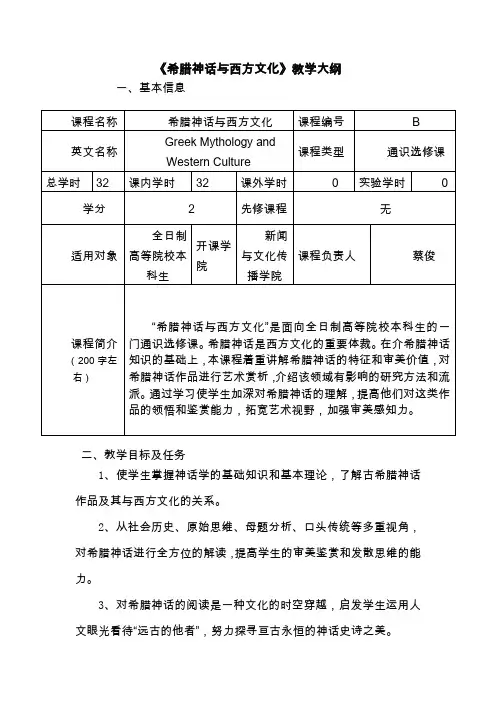
《希腊神话与西方文化》教学大纲一、基本信息二、教学目标及任务1、使学生掌握神话学的基础知识和基本理论,了解古希腊神话作品及其与西方文化的关系。
2、从社会历史、原始思维、母题分析、口头传统等多重视角,对希腊神话进行全方位的解读,提高学生的审美鉴赏和发散思维的能力。
3、对希腊神话的阅读是一种文化的时空穿越,启发学生运用人文眼光看待“远古的他者”,努力探寻亘古永恒的神话史诗之美。
三、学时分配四、教学内容及教学要求第一章绪论本章教学目的:理解神话的定义、特点,古希腊神话的定义、特点、来源及其与西方文化的关系本章主要内容:神话的定义和特点、希腊神话的定义和特点、古希腊神话与中国神话的比较、古希腊神话的来源、古希腊神话的构成。
本章重点、难点:希腊神话的特点及其与中国神话的对比。
本章参考文献:[美]依迪丝·汉密尔顿《神话——希腊、罗马及北欧的神话故事和英雄传说》,刘一南译,华夏出版社2010年版。
[美]依迪丝·汉密尔顿《希腊精神:西方文明的源泉》,辽宁教育出版社2003年版。
[法]裘利亚·西萨、马塞尔·德蒂安《古希腊众神的生活》,郑元华译,上海人民出版社2008年版。
[德]施瓦布《古希腊神话与传说》,高中甫译,光明日报出版社2008年版。
[俄]叶·莫·梅列金斯基《神话的诗学》,魏庆征译,商务印书馆2009年版。
[法]列维-布留尔《原始思维》,丁由译,商务印书馆1995年版。
[英]马林诺夫斯基《巫术科学宗教与神话》,李安宅编译,上海文艺出版社1987年版。
[英]泰勒《原始文化》,上海文艺出版社1992年版。
[法]列维-斯特劳斯《野性的思维》,李幼蒸译,中国人民出版社2006年版。
本章思考题:1、什么是“神话”?谈谈你的认识。
2、希腊神话对西方文化有什么影响?第一节什么是希腊神话1. 神话的定义2. 神话的特点第二节什么是古希腊神话1. 古希腊神话的定义2. 古希腊神话的特点第三节古希腊神话与中国神话的比较第四节古希腊神话与西方文化第二章宇宙起源的神话本章教学目的:使学生了解古希腊神话中关于宇宙起源的神话本章主要内容:、诸神起源神话、宙斯的神话、奥林波斯神话谱系本章重点、难点:诸神起源神话的内涵、奥林波斯神话谱系本章参考文献:[美]依迪丝·汉密尔顿《神话——希腊、罗马及北欧的神话故事和英雄传说》,刘一南译,华夏出版社2010年版。
希腊罗马神话.ppt
Introduction to the course
1、什么是神话? 2、什么是希腊罗马神话? 3、希腊罗马神话有什么关系? 4、希腊罗马神话的源头在哪里? 5、为什么要学习希腊罗马神话? 6、课内外要求。
马克思说 “神话是在人民的幻想中经过不自觉的艺术加 工方式所加工过的自然界和社会形态”。
希腊人——远古时期——抗争自然——迷茫、不安全—— 猜想——万能的神——强大自然形象化——物与灵的区别 ——万物有灵——神的拟人化——人类形智众神——父权 ——女神与凡人——英雄时代
东——大海 北——蒙古(大漠)、西伯利亚(冰雪) 西——高原、高山、荒漠 南——南蛮(《禹贡》)、热带海洋 封闭——中原(环境安定人,人依赖环境) “家”“族”形式的构建 儒家“孝”的伦理纲领 不适农耕、有草、游牧、内海、航路方便 开放——面对博大狂放的自然力——搏斗征服 生存感强、流动性强
勇敢VS仁义(道德价值观/cardinal virtues)
克里特-迈锡尼文明(古代爱琴文明)
爱琴地区包括爱琴海各岛屿、希腊半岛和小亚细亚半岛 早期的奴隶制国家 海上贸易和手工业 与古埃及隔海相望,受古埃及文明和两河流域影响 以克里特岛为中心地带的文明(始于公元前3000年)
影响到了迈锡尼(始于公元前1500年)
形成了克里特-迈锡尼文明
迈锡尼—— 同样不利于农作物,开发水上运输,全盛 更适应战争,城市在山顶,扩张
神话不是真实生活的叙述,而是真实生活的一种演绎或是 充满想象力的一种创造,是人在对世界还没有清楚认知时的 一种猜测和想象。神话不是一产生就是完整而成熟,它随着 人类认知的增长在一点一滴的积累中逐渐发展走向成熟的。
希腊神话包括神的故事和英 雄传说ห้องสมุดไป่ตู้大部分。希腊神话体现
Lecture-1-古希腊罗马神话-英文版-教学课件
5、寻找原型
• 伊阿宋寻找金羊毛 • 古希腊神话寻找金羊毛—中世纪骑士传
奇寻找圣杯—文艺复兴时期《巨人传》寻 找神瓶,流浪汉小说寻找父亲和争取生存 权利—19世纪俄国文学探求真理,寻找出 路,托尔斯泰《战争与和平》《安娜·卡列 尼娜》《复活》—20世纪文学寻找自我和 寻找精神理想(美)索尔·贝娄 《雨王亨德森》
Classical Greek and Roman
Mythology
Lecturer: Peng Xiaoling (彭晓玲)
Requirement and Evaluation
• Requirement: • 1. Punctual
attendance’
• 2. Active participation in the class
Therefore, there is some truth in the saying that
without certain knowledge of Greek and Roman mythology, one can never fully understand and appreciate western culture. (eg. literature, arts,… character)
Da Vinci, 1506
Arts
大理石雕塑 希腊古典时期
Jacopo Carucci Pontormo 1512-13 意大利佛罗伦萨乌斐兹美术馆.jpg
Other Aspects
❖ Apollo Program ❖ Poseidon Submarine ❖ Trident I & II missile
古希腊罗马神话英文简介PPT学习教案
The supreme god, patron of the Roman state and brother and husband of Juno
.
朱庇特 Jupiter
阿 佛 洛 狄 忒 (希 腊语: Αφροδίτη) 是 希 腊神 话中是 代表爱 情、美 丽与性 欲的女 神,同 时也是 丰育的 女神。 阿佛洛 狄忒不 仅是性 爱女神 ,她也 是司管 人间一 切情谊 的女神 。在希 腊神话 中,阿 佛洛狄 忒是奥 林匹斯 十二主 神的一 柱。
♠So the mythological stories grew and changed as they passed from Asia
Minor to Greece, or from Greece to the islands of the Aegean Sea, to Italy and Sicily. Moreover, the independence of the individual in the Greek states, where men thought for themselves, and no autocratic government or powerful priesthood exerted undue restraint, fostered variety and permitted artists so to modify infinitely to the richness of mythology and art.
古希腊罗马神话英文简介
会计学
1
Classical Mythology Is Truly Greek
These beliefs and stories have been handed down through so many years and modified in so many ways that confusion as to their real origin has naturally arisen.
古希腊神话PPT课件
若天仙。维纳斯很恼怒,派丘比特去惩罚 她,而丘比特却爱上了她。
• 由于普绪喀在夜晚点灯看见了爱神的真面
目,爱神愤然离去。
• 普绪喀走遍世界寻找恋人,求维纳斯宽恕她。
维纳斯让她做各种苦役,她都完成了。
• 最后一件是到冥界去偷保存珀耳塞福涅美貌
的盒子。普绪喀打开盒子,盒子里装的却是 永久的睡眠。
• 美军的“宙斯盾” 作战系统代表了当今世
界最先进的海军科技水平,其造价自然非 常高昂,每套作战系统(不含导弹)造价高达 2亿美元。
• 波塞冬(Poseidon),海神与地震之神。
尼普顿(Neptune,海王星)
• 雅典娜(Athena),智慧女神,兼司各种制
造技艺及战争。宙斯之女。 弥涅尔瓦(Minerva)
• 赫耳墨斯(Hermes),神使,旅人、盗贼
和商人的守护者。宙斯之子。 墨丘利(Mercury,水星)。
• 得墨忒耳(Demeter),谷物、婚姻女神,
宙斯的姐姐。 刻瑞斯(Ceres)。
• 赫淮斯托斯(Hephaestus),火神与冶炼
之神。宙斯与赫拉之子。阿芙罗狄忒之夫。 武尔坎(Vulcan,伏尔甘)。
• 在此基础上,后人继续深入发掘,共挖出了9
层古城的遗址。现代考古学家们普遍认为, 荷马史诗中的特洛伊在遗址的第4层,而最底 下的那层比荷马史诗的时代还要早一千年。
奥德赛
• 特洛伊战争胜利后,伊塔刻国王俄底修斯
(Ulysses,尤利西斯)带领部下乘船返乡。
• 独眼巨人波吕斐摩斯。海神波塞冬之子。
• 女妖塞壬(Sirens)。
俄狄浦斯
• 俄狄浦斯(Oedipus)是底比斯国王拉伊俄