
《精编中考语法专项练习》第6讲:动词分类及其基本用法
奥风英语《精编中考语法专项练习》Ⅰ.中考真题演练1.—Does the soup ________ nice?—Yes. It’s hot, but really delicious.A. soundB. feelC. lookD. taste2. This toy Mickey Mouse ________ be Amy's. She's the only kid at the picnic.A.mustB.canC. needD.can't3. —Shall I tell Jim the good news?—No, you ________. I’ve told him already.A. wouldn’tB. needn’tC. shouldn’tD. mustn’t4.-Excuse me, can you tell me the way to the People’s Park?-Walk along this road and turn right, and the park is on your right. You ________ miss it.A. needn’tB. mustn’tC. may notD. won’t5. —I often listen to the song Rainbow.—So do I. It ________ beautiful.A. feelsB. smellsC. sounds6. I called you, but nobody answered. Where ________ you?A. isB. areC. wasD. were7. The food here smells good, but what does it ________ like?A. tasteB. touchC. seemD. feel8. —Excuse me, have you got an eraser?—Sorry, I haven’t. Why ________ you ask Mary? Perhaps she’s got one.A. doB. don’tC. didD. didn’t9. — Do you know who cleaned the blackboard, Tina?—Yes. John ________.A. doB. doesC. did10. —Mom, must I finish my homework now?—No, you ________. You may have supper first.A. mustn’tB. needn’tC. can’t11. —Mr. Wang, can I finish my homework tomorrow?—No, you ________.A. can’tB. don’tC. needn’tD. won’t12. —Must I get up early tomorrow morning?—No, ________.A. you mustn’tB. I don’t think you have toC. you can’tD. you need13. —Will you stay for some more days?—Sorry, I ________. My mother called to ask me to go back at once.A. mustn’tB. may notC. can’tD. wouldn’t14. —Who is singing in the next room? Is it Lucy?—It ________ be her. She has gone to New York.A. can’tB. mustC. shouldn’tD. can15. —Will the new iphone cost a lot?—I ________ think so. Apple’s products are usually expensive.A. shouldn’tB. needn’tC. wouldD. must16. —Dad, can I go to the movie tonight?—Sure, but you ________ come back home before 9 o’clock.A. canB. mustC. mayD. might17. —May I take the magazine out of the reading room?—No, you can’t. You ________ read it here. It is the rule.A. mustB. wouldC. mayD. might18. As everyone knows, rubbish ________ everywhere.A. need be thrownB. mustn’t be thrownC. can’t throwD. may throw19. The room is big enough. It ________ hold 100 people.A. canB. must beC. needD. have to20. —Have you decided where to go for your summer vacation?—Not yet. We ________ go to Qingdao. It is a good place for vacation.A. mayB. shouldC. needD. must21. —May I go out now, Dad?—No. You ________ let your mother know first.A. canB. mayC. needD. must22. Cars, buses and bikes ________ stop when the traffic lights change to red.A. canB. mayC. mustD. need23. I have my own room in my house, so I ________ do what I want in it.A. mustB. have toC. need toD. can24. —________ we clean the classroom at once?— No, you ________. You ________ clean it after school.A. Must; needn’t; mayB. Must; mustn’t; can.C. Sh all; can’t; mustD. Need; mustn’t; may25. —Whose notebook is this?—It ________ Tom. I saw he used it just now.A. must belong toB. can’t belong toC. might be belonged to26. You ________ wear sports shoes when you climb a mountain.A. can’tB. shouldn’tC. mustn’tD. have to27.—Would you come to my birthday party tomorrow evening?—I’m afraid I ________. I have to look after my sister.A. wouldn’tB. can’tC. won’tD. mustn’t28. —________ I take some photos in the hall?—No, you ________.A. Can; needn'tB. Must; mustn'tC. Could; won'tD. May; mustn'tⅡ. 基础巩固练习1. –Wu Peng, have you finished reading ―Harry Potter V‖?-________. I still have some pages.A. Yes, I doB. No, I don’tC. Yes, I haveD. No I haven’t2. -Where is my umbrella?-It’s fine today. You ______ take an umbrella with you.A. can’tB. needn’tC. mustn’tD. shouldn’t3. -Is Jim at home by himself?-No. There’s another boy _________ with him.A. playingB. playC. playsD. to play4. -Phone me as soon as you get to Shanghai.-I _____.A. canB. shouldC. mustD. will5. When autumn comes, some tree leaves red.A. soundB. turnC. smellD. taste6. You _______ learn English well, I’m sure, without opening your mouth.A. needn’tB. can’tC. mustn’tD. may not7. This sweater feels soft. What is it ______ of, Jim?-Wool, I think.A. makeB. makesC. makingD. made8. -Must I write all the words down now?-No, you _______A. mustn’tB. can’tC. won’tD. needn’t9. The idea to eat in KFC ________ wonderful.A. tastesB. soundsC. smellsD. looks10. -May I have a pear, Mum?-Certainly. But you ______ wash your hands first.A. mayB. mustC. canD. need11. -When ______ this kind of computer ______, Li Ming?-Last year.A. did; useB. was; usedC. is; usedD. are; used12. -Will you __________ finish your homework before eight o’clock this evening?-Sorry, I won’t.A. canB. mayC. be able toD. are able to13. -May I go to the cinema, Mum?-Certainly. But you ________ be back by 11 o’clock.A. canB. mayC. mustD. need14. Han Meimei is good at _______. What about you?A. singing and dancingB. to sing and to danceC. to sing and dancingD. singing and to dance15. -Could I look at your pictures?-Yes, of course you ______A. couldB. canC. willD. might16. Everyone should make a contribution to ______ the environment.A. protectB. protectedC. protectingD. protects17. You _______ go and ask Meimei. She _______know the answer.A. must; canB. must; mayC. need; canD. can; may18. Tom with his brother _______ playing football very much. They are on the school team.A. likeB. likesC. likingD. are liking19. -When ________ you _________ your old friend?-The day before yesterday.A. will, visitB. did, visitC. have, visitedD. was, visited20. You _______ worry about me. It’s nothing serious.A. can’tB. mustn’tC. needn’tD. won’t21. -__________ we make it half past seven, Tom?-What about _______ it a little earlier?A. Shall, makingB. Shall, to makeC. Will, makingD. will, to make22. -I _______ sleepy today.-Drink some tea, and you’ll be good as new.A. feelB. keepC. turnD. grow23. Look! These ______be dinosaur eggs because they are the biggest of all.A. mustB. canC. shouldD. may24. The policeman kept the thief _______ for four hours.A. standingB. to standC. to sitD. sitting25. -Look! That man looks like Mr. Brown.-It ______ be him, for he ______ America.A. can’t; has gone toB. may not; has goneC. mustn’t; has been toD. ca n’t; has been toⅢ. 中考模拟强化练习1. You look tired now. You ________ stay at home and have a rest.A. had toB. had betterC. would like toD. would rather2. -What a nice bike! How long have you _______ it, Kate?-About half a year.A. boughtB. receivedC. takenD. had3. –Mary, ________ you play chess?-Yes, I can do it very well. I want to join the chess club.A. canB. shouldC. mustD. need4. -I have spent too much time playing computer games these days.-I think so. You _____ stop, for your study and your health.A. willB. mustC. canD. may5. We _______ careful when we are walking across the road. There are too many vehicles now.A. can beB. may beC. must be6. –Have you ever heard the song ―TAKE ME TO YOUR HEART‖?-Yes, it ________ terrific. All of us like it very much.A. smellsB. soundsC. looksD. tastes7. Our teacher saw us ______ on the desks and went out of the classroom.A. to sitB. satC. sitingD. sitting8. You look tired now. You ________ stay at home and have a rest.A. had toB. had betterC. would like toD. would rather9. -Waiter, I’d l ike some Ningbo Dumplings.-Sorry, sir. Ningbo Dumplings _______ only for lunch and dinner.A. serveB. servedC. are servedD. are serving10. Cars, buses and bikes _______ stop when the traffic light is red.A. canB. mustC. mayD. need11.–Dinner is ready. Help yourself!-Wow! It ________ delicious. Could you please tell me how to cook it?A. tastesB. looksC. soundsD. feels12. -Write to me as soon as you arrive there.-I________.A. mustB. shouldC. willD. can13. Every day I spend two hours _______ my homework.A. finishing to doB. finishing doingC. to finish to doD. to finish doing14.–Listen! Is Tom singing in the classroom?-No. It ________ be Tom. He has gone to Paris.A. may notB. needn’tC. can’t15. -Must I finish the exercise this afternoon?-Yes, you ______, but you ______ finish it now.A. must; mustn’tB. must; don’t have toC. may; needn’tD. may; mustn’t16. -________ you _______ take a bus to school?-Yes.But now I usually go to school on foot.A. Did, use toB. Were, used toC. Do, use to17.–Mike, I can’t stop playing computer games.-For your eyes, my dear friend, I’m afraid you ________.A. have toB. mayC. must18. -Mum, ________ I play computer games?-Yes, you can, but you have to finish your homework first.A. mustB. mayC. willD. need19. Tom with his brother _______ playing football very much.A. likeB. likesC. likingD. are liking20. -_________ we have a picture in the park tomorrow?-Good idea. We really need a rest.A. ShallB. MayC. ShouldD. Must21. The cake ______ good. I can’t wait to eat it.A. feelsB. soundsC. becomesD. smells22. -Must I hand in my composition today?-No, you ______. You may give it to me tomorrow.A. needn’tB. can’tC. mustn’tD. shouldn’t23. Someone is knocking at the door. It ______ my mother. It’s time for her to be back.A. can beB. may not beC. must beD. mustn’t be24. -________ you play golf, Li Ming?-No. But I play table tennis.A. CanB. MayC. MustD. Should25. –What _______ your English teacher look like?-She is quite slim.A. doB. isC. doesD. was26. -Can you stay here for lunch?- Sorry, ________. I have to see my parents.A. I can’tB. I shouldn’tC. I mustn’tD. I won’t27. You _______ buy the TV guide for next week, I have already bought a copy.A. mustn’tB. needn’t toC. don’t have toD. can’t28. -Must I stay at home and take care of her?-No, you ________.A. mustn’tB. won’tC. can’tD. needn’t29. _______ I fill in the check-in form right now, sir?-No, you needn’t. You can complete it this afternoon.A. MayB. CanC. WouldD. Must30. -_______ I get here at seven tomorrow morning, Tom?-No, you ________.A. Must; can’tB. Can’t; canC. Must; needn’tD. Must; shouldn’t31. -Look! It _________ be Jack on the playground.-It _________ be him. Because I saw him enter the school library just now.A. must, mustn’tB. can, can’tC. may, mustn’tD. must, can’t32. John, you needn’t do your work today, you ______ do it tomorrow if you’re tired.A. mustB. mayC. can’t33. -Whose guitar is this?-It _______ Alice. She plays the guitar.A. might beB. must beC. can belongD. might belong to34. Pizza is ready now, and it _______ nice. Would you like some?A. smellsB. feelsC. soundsD. goes35. We _______ keep the new traffic law and learn how to protect ourselves.A. mayB. shouldC. canD. need36. -__________ you free this evening, Li Ming?-No, I have much work to do this evening.A. DoB. IsC. AreD. Will37. -What about ______ out for a walk now?-Good idea!A. goB. to goC. goingD. to going38. Li Lei can’t go hiking with us tod ay, because he _______ take care of his sick mother.A. has toB. mayC. mustn’tD. needn’t39. -I hear you’ve got a set of Australian stamps. ______ I have a look?-Yes, certainly.A. DoB. MayC. ShallD. Should40. The book _____by the young writer sells well. It is popular among middle school students.A. was writtenB. writingC. wroteD. written答案及解析第六讲:动词分类及其基本用法Ⅰ.中考真题演练1. D taste在本句中用作系动词,表示“尝起来……”。
中考英语语法精讲精练系列-动词(共30张PPT)

have to 只好,不得不(客观的必须, 有时态人称变化) don' have to do D..habe to o..? Ys,.do. No,.. don't.
ought to
ough oto/oughtn't to 应当(表示义务责任,☐语中 多用 should
do
Ougt..totdo..? Yes...ought. No.ogtn't.
2M30y0w6atch stopped.(我的表停了),stop是不及物动词
及物动词与不及物动词: 这两类动词的主要区别在于它们是否需要宾语来完成其意义。 及物动词(Transitive Verbs) 及物动词是指那些需要一个宾语来完成其意义的动词。换句话说,及物动词的动作必须作用 于某个对象上。例如: I read a book.(“read”是及物动词,“a book”是宾语) She eats an apple.(“eats”是及物动词,“an apple”是宾语)
need
需要 必须(常用于否定句和疑问句 中) need not/needn't do Need.. ..? Ys-.st.no,.needn't.
used to
过去常常(现在已不再)
used notlusedn't/usen't to do didn't use to do
Ued..toto...? Yes..sed. No,.use(d)n't. e to do...?
23006
非谓语动词(AuxiliaryVerb)
非谓语动词的分类、意义及构成:
非谓语形式
时态和语态
构成
不定式
to do to be doing to be done to have
英语动词分类讲解及练习(有答案)
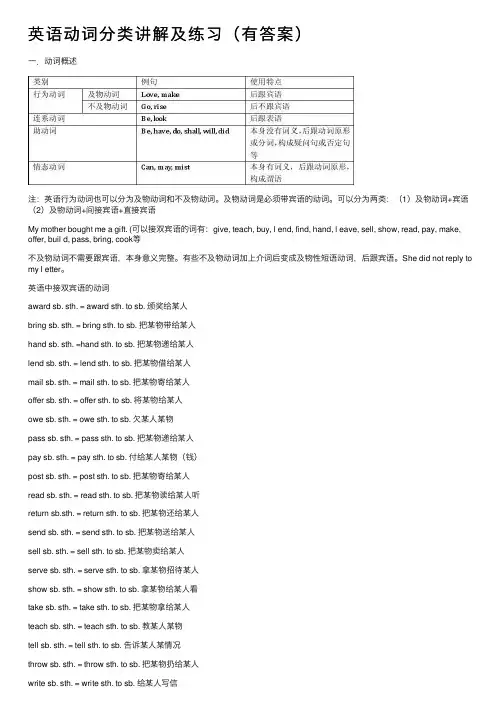
英语动词分类讲解及练习(有答案)⼀.动词概述注:英语⾏为动词也可以分为及物动词和不及物动词。
及物动词是必须带宾语的动词。
可以分为两类:(1)及物动词+宾语(2)及物动词+间接宾语+直接宾语My mother bought me a gift. (可以接双宾语的词有:give, teach, buy, l end, find, hand, l eave, sell, show, read, pay, make, offer, buil d, pass, bring, cook等不及物动词不需要跟宾语,本⾝意义完整。
有些不及物动词加上介词后变成及物性短语动词,后跟宾语。
She did not reply to my l etter。
英语中接双宾语的动词award sb. sth. = award sth. to sb. 颁奖给某⼈bring sb. sth. = bring sth. to sb. 把某物带给某⼈hand sb. sth. =hand sth. to sb. 把某物递给某⼈lend sb. sth. = lend sth. to sb. 把某物借给某⼈mail sb. sth. = mail sth. to sb. 把某物寄给某⼈offer sb. sth. = offer sth. to sb. 将某物给某⼈owe sb. sth. = owe sth. to sb. ⽋某⼈某物pass sb. sth. = pass sth. to sb. 把某物递给某⼈pay sb. sth. = pay sth. to sb. 付给某⼈某物(钱)post sb. sth. = post sth. to sb. 把某物寄给某⼈read sb. sth. = read sth. to sb. 把某物读给某⼈听return sb.sth. = return sth. to sb. 把某物还给某⼈send sb. sth. = send sth. to sb. 把某物送给某⼈sell sb. sth. = sell sth. to sb. 把某物卖给某⼈serve sb. sth. = serve sth. to sb. 拿某物招待某⼈show sb. sth. = show sth. to sb. 拿某物给某⼈看take sb. sth. = take sth. to sb. 把某物拿给某⼈teach sb. sth. = teach sth. to sb. 教某⼈某物tell sb. sth. = tell sth. to sb. 告诉某⼈某情况throw sb. sth. = throw sth. to sb. 把某物扔给某⼈write sb. sth. = write sth. to sb. 给某⼈写信2、双宾语易位时需借助介词for的常⽤动词book sb. sth. = book sth. for sb. 为某⼈预定某物buy sb. sth. = buy sth. for sb. 为某⼈买某物choose sb. sth. = choose sth. for sb. 为某⼈选某物cook sb. sth. = cook sth. for sb. 为某⼈煮某物draw sb. sth. = draw sth. for sb. 为某⼈画某物fetch sb. sth. = fetch sth. for sb. 为某⼈去取某物find sb. sth. = find sth. for sb. 为某⼈找到某物fix sb. sth. = fix sth. for sb. 为某⼈准备某物get sb. sth. = get sth. for sb. 为某⼈拿来某物make sb. sth. = make sth. for sb. 为某⼈做某物order sb. sth. = order sth. for sb. 为某⼈订购某物pick sb. sth. = pick sth. for sb. 为某⼈采摘某物prepare sb. sth. = prepare sth. for sb. 为某⼈准备某物save sb. sth. = save sth. for sb. 为某⼈留某物sing sb. sth. = sing sth. for sb. 为某⼈唱某物(歌)spare sb. sth. = spare sth. for sb. 为某⼈让出某物steal sb. sth. = steal sth. for sb. 为某⼈偷某物3、有的动词后接的双宾语易位时,既可⽤介词to引出间接宾语,也可⽤介词for引出间接宾语,含义相同。
中考英语总复习语法精析第六讲动词一动词分类课件

2.不及物动词 (1)不及物动词本身意义完整,其后不必跟宾语。 如 come, go, run, walk, travel, listen, swim, live, work 等。 He works hard. 他工作努力。 People often swim in the river. 人们经常在这条河里游泳。
3.短语动词 英语中有许多动词可以加上介词、副词等构成短 语动词。短语动词像动词一样有及物和不及物之分。 它们尽管由几个词构成,但可以作为一个整体看待, 同行为动词一样使用。 常用的构成方式主要有以下五种:
(1)动词+副词 可 用 作 及 物 或不 及 物 动 词, 如 ring up“ 打 电 话”(用作及物动词),look out“小心”(用作不及物动 词)。如果用作及物短语动词应注意宾语位置的不同: 宾语如果是名词,可以放在副词后面,也可以放 在动词与副词之间;宾语如果是代词,则必须放在副 词和动词之间。 Please put on your coat.请穿上你的外套。 Let's think it over.咱们再仔细考虑一下。
分为及物动词和不及物动词。
1.及物动词
及物动词就是后面必须跟宾语意义才完整的动
词,如 love, need, want, ask, have, help, teach, make
等。它主要用于下列三种句型中:
(1)主语+谓语(及物动词)+简单宾语。
He often helps me. 他经常帮助我。
(2)如果不及物动词需要带宾语,则其后需要加适 当的介词,然后才可以跟宾语,实际上可以称为介词 的宾语。
The baby is smiling at us. 婴儿正对着我们笑呢。 He died of hunger. 他死于饥饿。
中考英语语法专题分类复习---动词的用法
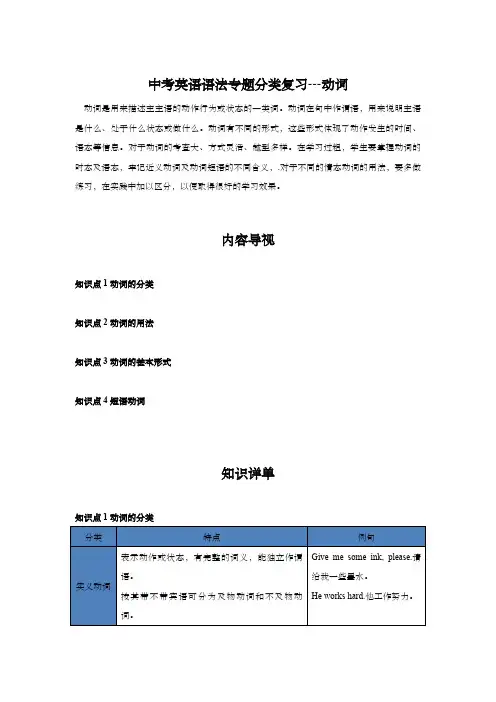
中考英语语法专题分类复习---动词动词是用来描述主主语的动作行为或状态的一类词。
动词在句中作谓语,用来说明主语是什么、处于什么状态或做什么。
动词有不同的形式,这些形式体现了动作发生的时间、语态等信息。
对于动词的考查大、方式灵活、越型多样。
在学习过粗,学生要掌握动词的时态及语态,牢记近义动词及动词短语的不同含义,.对于不同的情态动词的用法,要多做练习,在实践中加以区分,以便取得很好的学习效果。
内容导视知识点1动词的分类知识点2动词的用法知识点3动词的甚本形式知识点4短语动词知识详单知识点1动词的分类知识点2动词的用法1.实义动词2.连系动词3.助动词4.情态动词知识点3动词的甚本形式知识点4短语动词考点突破考点1 考查情态动词的用法1.(矜南中考)Hi, guy ! You______ not park your car here. It's for our customers only.A. needB. canC. willD. may【解析】选B。
由句意可知此处表示“不能在这里停车”,故用can not表示。
2.(安顺中考)-Must I do my homework now?-No,you _________. You may have a rest.A. mustn'tB. needn'tC. can'tD. wouldn't【解析】选B。
must的一般疑问句,否定回答为needn’t或don’t have to.3.(赤峰中考)-Do you have any plans for this weekend?-I'm not sum. I_______ go climbing Mount Tai.【解析】选C, 由答语前半句可知,此处表达不确定的意思,即“也许,可能”。
C项may 有此含义。
4.(遵义中考)She went to Hangzhou by train last night. She_______be at home now.A. must notB.may notC.can't【解析】选C。
中考英语语法专题-动词的分类 课件
常见带双宾语的动词有:give,bring,buy,get,leave,lend,make, offer, pass, teach
, tell, write, read, return等。
实义动词
2. 不及物动词。 在句中不必跟宾语就能表达完整意思的动词,如: He left yesterday. leave单独用能表达完整的意思,是不及物动词。
动词的分类
中考语法专题
你知道动词的分类吗?
He got up late.
情态动词
She can eat fruit by herself.
情态动词
He got up late.
The giraffe is so tall.
系动词
He got up late.
He likes reading books at night.
实义动词
【拓展】短语动词
常见的短语动词的构成方式有以下几种:
1. 动词十介词
hear of 听说
talk to/with 和……交谈
talk about/of 谈论 worry about 担心
get to 到达
look like 看起来像
listen to 听(某人或某物)
hear from收到…的来信
pick up 捡起
turn up 调大(音量等
)
ring up 打电话 put up 建造
send up 发射 take away 拿走 move away 搬走
send away 派遣 take down 拿下 turn down 关小 put down 放下 write down 记下
sell out 卖完
(特级教师整理)最新英语中考《语法——动词》专题复习考点精讲精练

He's reading a magazine This is the room where I once lived. He's reading.
LOGO
分类(实义动词 )
When will he arrive? He reached Beijing yesterday.
常见情态动词有can/must/need/will/may/could.
LOGO
分类(情态动词 )
We can be there on time tomorrow. May I have your name? Shall we begin now? You must obey the school rules. Grammar focus 语法点:情态动词+动词原形
LOGO
➢ get sb. sth. ➢ make sb. sth. ➢ order(命令)sb. sth. ➢ pick(挑选)sb. sth. ➢ prepare(准备)sb. sth. ➢ save(保存)sb. sth. ➢ sing sb. sth. ➢ steal(偷)sb. sth.
LOGO
and warmer. Grammar focus 语法点:系动词+形容词
LOGO
分类(助动词 )
帮助实义动词完成某些语法功能的动词 助动词本身没有实义,不能单独作谓语
主要有
be/do(does/did)/have(has/had) shall/will/should/would.
LOGO
分类(助动词 )
LOGO
分类(系动词 )
不能够单独作谓语
必须和名词、形容词等一起使用作句子的谓语
(2021年整理)初中英语动词分类讲解及练习(有答案)
(完整版)初中英语动词分类讲解及练习(有答案)编辑整理:尊敬的读者朋友们:这里是精品文档编辑中心,本文档内容是由我和我的同事精心编辑整理后发布的,发布之前我们对文中内容进行仔细校对,但是难免会有疏漏的地方,但是任然希望((完整版)初中英语动词分类讲解及练习(有答案))的内容能够给您的工作和学习带来便利。
同时也真诚的希望收到您的建议和反馈,这将是我们进步的源泉,前进的动力。
本文可编辑可修改,如果觉得对您有帮助请收藏以便随时查阅,最后祝您生活愉快业绩进步,以下为(完整版)初中英语动词分类讲解及练习(有答案)的全部内容。
(完整版)初中英语动词分类讲解及练习(有答案)编辑整理:张嬗雒老师尊敬的读者朋友们:这里是精品文档编辑中心,本文档内容是由我和我的同事精心编辑整理后发布到文库,发布之前我们对文中内容进行仔细校对,但是难免会有疏漏的地方,但是我们任然希望 (完整版)初中英语动词分类讲解及练习(有答案)这篇文档能够给您的工作和学习带来便利。
同时我们也真诚的希望收到您的建议和反馈到下面的留言区,这将是我们进步的源泉,前进的动力。
本文可编辑可修改,如果觉得对您有帮助请下载收藏以便随时查阅,最后祝您生活愉快业绩进步,以下为〈(完整版)初中英语动词分类讲解及练习(有答案)> 这篇文档的全部内容.动词概述表示动作或状态的词叫做动词。
可以分为以下四类:一、实义动词■①及物动词与不及物动词根据后面是否带宾语,行为动词又可分为及物动词和不及物动词,及物动词.Vt。
vi 。
They study hard.I know them well。
注:有的动词既可作及物动词,也可用作不及物动词。
如:She sings very well.She sang an English song just now。
英语里有不少实义动词可以兼作及物动词和不及物动词。
兼作及物动词和不及物动词时,____不变。
试比较:Shall I begin at once?She began working as a librarian after she left school.When did they leave Chicago?They left last week。
中考英语语法专项复习讲解及训练 动词分类及短语(含答案)
中考英语语法专项复习动词的分类及动词短语【中考解读】【考点分布】1.实义动词2.连系动词3.助动词4.情态动词【考点内容】掌握实义动词中及物动词和不及物动词的语法作用和延续性动词的用法,牢记连系动词和助动词基本用法及情态动词的辨析与运用。
【命题趋势】1.考察在特殊语境中动词、连系动词、助动词及情态动词的运用2.实义动词的词义辨析【动词定义】:表示动作和状态的词【动词分类】:动词按照其词义和在句中的作用可分为:实义动词、连系动词、助动词和情态动词一、系动词系动词有一定的词义,不但不完整,不能单独作谓语,必须和表语一起构成谓语,说明主语的状态、性质、特征或身份。
具体分类见下表She is a friendly girl and always gets on well with others.她很友好,总是能和别人友好相处。
She becomes more beautiful than three years ago.她比三年前漂亮多了。
The window remained open all the night.这扇窗子整夜开着。
The food in that restaurant looks delicious, but it tastes bad.那家餐馆的食物看起来不错,但尝起来难吃。
【注意】:(1)一般情况下,系动词没有被动语态形式。
(2)表示状态的系动词一般不用于进行时(feel除外);变化系动词表示“渐渐……”,可用于进行时。
It’s getting warmer and warmer.天气渐渐变得暖和。
[同步练习]①—The oranges ____________sweet.—Of course. They are from Yongxing, Chenzhou.taste B. eat C. drink②—Why do you ______ so upset?—Because I didn’t get the first place in the English competition.look B.sound C.smell D. feelKey:A,A二、助动词助动词:本身没有词义,不能单独作谓语,只能和实义动词或系动词一起构成谓语,以表示时态、语态、语气、人称和数,构成否定、疑问、强调、省略等。
《中考语法完全突破记忆大纲》第6讲:动词分类及其基本用法
第六讲:动词分类及其基本用法一.动词的分类根据其在句中的功能,动词可分为四类:实义动词(行为动词)、系动词、助动词、情态动词。
根据动作的时限,可分为:延续性动词和非延续性动词注意:延续性动词(如work, stay)可与一段时间(如for five days)连用。
非延续性动词(如buy, arrive)则不可。
二、各类动词的基本用法1.实义动词/行为动词(1)分类:实义动词又分为及物动词和不及物动词。
后面可以直接接宾语的动词叫及物动词;后面不可以直接接宾语的动词叫不及物动词。
如果此类词需要接宾语的话,则必须在其后加介词。
如:They watched a football game yesterday. (watch为及物动词)The baby cried. (cry为不及物动词)He went to Canada last year. (go为不及物动词,故要表示“去某地时”,需在其后加上介词to。
)(2)实义动词的功能主要在句中作谓语动词和非谓语动词。
非谓语动词有三种形式:不定式、动名词和分词。
如:Many people bought that book. (bought在本句中作谓语动词。
)He likes playing computer games.(本句中like为谓语动词,playing为动名词,作非谓语动词。
)2. 系动词系动词又可分为以下几类:(1) 状态系动词用来表示主语的状态,只有be一词。
be通常可以译为“是”或不译出。
如:He is a doctor. 他是一名医生。
They are angry. 他们生气了。
(2) 持续系动词表示主语继续或保持某种状况或态度,此类词主要有keep, rest, remain, stay, lie, stand等。
如:The weather remains cold. 天气仍然很冷。
Why he left rests a secret. 他为什么离开仍然是个秘密。
(完整版)中考零距离2017中考英语专题复习动词分类语法考点精讲真题精炼
动词分类考点一行为动词行为动词又叫实义动词,依据后来能否能跟宾语分为及物动词和不及物动词。
1. 及物动词及物动词就是后边一定跟宾语意义才完好的动词,有buy, keep 等。
如:love , need, want, ask , have,We love our great motherland very much.我们特别爱我们伟大的祖国。
My grandfather bought me a nice toy.我的祖父给我买了一个美丽的玩具。
Could you please keep the door open?请你开着门好吗?例—Sam, my iPhone is in my bedroom. Could you it for me?—No problem.A. bringB. fetchC. takeD. carry分析:句意 :“萨姆,我的 iPhone 在我的寝室里。
你能给我去拿来吗? ”“没问题。
”bring 指把东西从远处带到近处;fetch指去把东西取来;take 指把东西从近处带到远处;carry 一般指把东西带走,且是较重的物件。
依据句意可知此处表示“去取来”,因此选择B。
答案: B2.不及物动词(1) 不及物动词自己意义完好,后来不用跟宾语。
有listen , work, swim, live等。
如:come, go, run ,walk , travel ,She works hard. 她工作努力。
People often swim in the river.人们常常在这条河里游泳。
(2)假如不及物动词需要带宾语,则后来需要加适合的介词。
如:例—When did your uncle in Shanghai?—The day before yesterday.A. arriveB. getC. reach分析:所给三个选项都有“抵达”的意思:时要用介词at ; get 后接地址名词时要加介词arrive后接大地方时用介词to ; reach 后直接加地址。