
高一英语必修一第二单元语法课件
直接引语 (变化前) 间接引语(变化后)
祈使句
不定式
The officer said to The officer ordered him, “Don’t him not to leave his leave your post.” post.
直接引语 (变化前) 间接引语(变化后)
Let’s开头的祈使 that 引导的宾语从句
10.He said, “Mother, the boy is very naughty.” →He ____ very naughty. A. said his mother that the boy was B. said to his mother that the boy is C. told his mother that the boy was D. spoke to his mother that the boy was
purse?” Rose asked Tom ___. A. whether that he had seen her purse B. whether he had seen her purse C. that whether he had seen her purse D. that if he has seen her purse
5.He asked me ________ with me. A. what the matter is B. what the mater was C. what’s the matter D. what was the matter
解析:如果直接引语是“What’s the matter?” “What’s wrong?” “What’s the trouble?”, 变间接引语时 语序不变。
句
I suggested him that
I said to him, “Let’s start at once.”
we (should) start at once.
直接引语 (变化前) 间接引语(变化后)
感叹句 He said: “How happy I am!”
that/what/how引导 的宾语从句 He said that he was very happy.
station.
were → are
3. Mum said to me to make sure the
light was turned off.
said to → told
翻译下列句子。 1. 他建议我带上雨伞。 He advised me to take an umbrella with me.
The mother asked Tom to get up early.
直接引语如果是以“Let’s”开头的祈 使句,变为间接引语时,通常用 “suggest +动句词(或从句)。” 例如:
He said, "Let’s go to the film." →He suggested going to the film. 或He suggested that they should go to
2. He said, “Don’t do that again.” He _____ me _______ that again. A. said to me; not to do B. said to me; don’t do C. told me; don’t do D. told me; not to do
“Don’t speak to me like that,” the teacher said to the student.
3. “Would you please stop to have a rest?” she said.
She asked me to stop to have a rest.
C. Whether I was a Party member or a League member D. whether was I a Party member or a League
member 解析: 选择疑问句要变成whether 引导的宾语从句
7. “You’ve already got well, haven’t you?” she asked. →She asked ________.
She said that he would be busy.
3. She said to Tom, “Can you help me?”→
She asked Tom if/whether he could help her.
Learning useful structure
Look at these sentences:
8. He asked ________ for the computer. A. did I pay how much B. I paid how much C. how much did I pay D. how much I paid
9.The boy said, “May I go along with you?” The boy asked me ___. A. if I might go along with you B. if he might go along with you C. if he might go along with me D. if he might go along with the boy
4. He asked me to lower my voice.
“Could you please lower your voice?” he said.
单句改错。
1. Mr. Liu told us don’t be late again. don’t → not to
2. He says we were to meet him at the
6. He asked , “Are you a Party member or a League member?” →He asked me ______.
A. am I a Party member or a League member B. was I a Party member or a League member
He said how happy he was.
例如:
1.The teacher said to the students, “Don’t waste your time.” → The teacher told the students not
to waste their time.
2.The mother said, “Tom, get up early, please.”→
see the film.
练一练
1.“Please close the window,” he said to me.
→He ______ me _____ the window. A. said to; to close B. told to; closing C. asked ; to close D. said to; please close
A. if I have already got well, hadn’t you B. whether I had already got well C. have I already got well D. had I already got well.
解析: 反意疑问句要变成whether引导 的宾语从句.
2. 老师告诉我们上课时不要吃东西。 The teacher told us not to eat in class.
谢谢!
S1: Open the window. S2: Pass on the book to your deskmate. S3: Will you please close the door?
Then ask: What is the difference among the sentences ?
Make clear the difference between commands and requests and finish the following exercises:
3.“Don’t put it on my hat.”his wife said to him. His wife told him ___put it on ___hat. A. don’t, his B. don’t, her C. not to, his D. not to, her
4. Rose asked Tom, “Did you see my
(R)
祈使句的直接引语和间接引语
祈使句的间接引语——采用 “动词+宾语+不定式”结构。
told/asked/ordered sb. (not) to do sth.
如果祈使句是表示请求,间接引语的 动词常用ask,如果是表示命令,间接 引语的动词常用tell, order, command 等。
1. Go and collect the wood right now. (C)
2. Could you go and get the shopping bags,
please?
(R)
3. Shut the door at once. (C)
4. Go and get my coat. (C) 5. Would you please get that book for me?
把下列句子变为直接引语或间接引语。 1. “Open the window, please.” Mother
said to me.
Mother asked / told me to open the window. 2. The teacher told the student not to speak to him / her like that.
合集下载
高一英语必修一第二单元语法 ppt课件

高一英语必修一第二单元语法
2. He said, “Don’t do that again.” He _____ me _______ that again. A. said to me; not to do B. said to me; don’t do C. told me; don’t do D. told me; not to do
高一英语必修一第二单元语法
Make clear the difference between commands and requests and finish the following exercises:
1. Go and collect the wood right now. (C)
2. Could you go and get the shopping bags,
句
I suggested him that
I said to him,
we (should) start at
“Let’s start at once.
once.”
高一英语必修一第二单元语法
直接引语 (变化前) 间接引语(变化后)
感叹句 He said: “How happy I am!”
that/what/how引导 的宾语从句 He said that he was very happy. He said how happy he was.
高一英语必修一第二单元语法
4. Rose asked Tom, “Did you see my
purse?” Rose asked Tom ___. A. whether that he had seen her purse B. whether he had seen her purse C. that whether he had seen her purse D. that if he has seen her purse
2. He said, “Don’t do that again.” He _____ me _______ that again. A. said to me; not to do B. said to me; don’t do C. told me; don’t do D. told me; not to do
高一英语必修一第二单元语法
Make clear the difference between commands and requests and finish the following exercises:
1. Go and collect the wood right now. (C)
2. Could you go and get the shopping bags,
句
I suggested him that
I said to him,
we (should) start at
“Let’s start at once.
once.”
高一英语必修一第二单元语法
直接引语 (变化前) 间接引语(变化后)
感叹句 He said: “How happy I am!”
that/what/how引导 的宾语从句 He said that he was very happy. He said how happy he was.
高一英语必修一第二单元语法
4. Rose asked Tom, “Did you see my
purse?” Rose asked Tom ___. A. whether that he had seen her purse B. whether he had seen her purse C. that whether he had seen her purse D. that if he has seen her purse
新教材人教版高中英语必修一 Unit 2 Language points课件
make up an excuse 编造一个理由
make up with sb. 与某人和解
第十九页,共二十七页。
【语境应用】翻译句子。
我们编了一个故事。这个故事由三个部分组成。其 中之一是关于一个人如何弥补他的过失的。
We make up a story. The story is made up of three parts, one of which is about how a man makes
2. Recognise text type recognise vt. to know who someone is or what
something is, because you have seen, heard, experienced, or learned about them in the past 辨别出;承认;认可
第十一页,共二十七页。
【归纳】 admire sb. for sth. 因某事而钦佩某人
【拓展】 admiration n. 赞美; 钦佩 express/ have admiration for sb./ sth. (表示) 羡慕/ 钦佩某人/ 物 with/ in admiration 钦佩地
第三页,共二十七页。
【语境应用】根据汉语意义完成句子。
1) 她是个优秀的教师,能够管好课堂纪律。
She's a good teacher who ___h_a_s_c_o_n_t_r_o_l_ofher class.
2) “你需要帮忙吗?”“不用,已经搞定了,谢谢。”
‘Do you need any help?’
up his mistakes.
第二十页,共二十七页。
make up with sb. 与某人和解
第十九页,共二十七页。
【语境应用】翻译句子。
我们编了一个故事。这个故事由三个部分组成。其 中之一是关于一个人如何弥补他的过失的。
We make up a story. The story is made up of three parts, one of which is about how a man makes
2. Recognise text type recognise vt. to know who someone is or what
something is, because you have seen, heard, experienced, or learned about them in the past 辨别出;承认;认可
第十一页,共二十七页。
【归纳】 admire sb. for sth. 因某事而钦佩某人
【拓展】 admiration n. 赞美; 钦佩 express/ have admiration for sb./ sth. (表示) 羡慕/ 钦佩某人/ 物 with/ in admiration 钦佩地
第三页,共二十七页。
【语境应用】根据汉语意义完成句子。
1) 她是个优秀的教师,能够管好课堂纪律。
She's a good teacher who ___h_a_s_c_o_n_t_r_o_l_ofher class.
2) “你需要帮忙吗?”“不用,已经搞定了,谢谢。”
‘Do you need any help?’
up his mistakes.
第二十页,共二十七页。
高中英语人教版必修一第二单元 Grammar课件(共18张PPT)
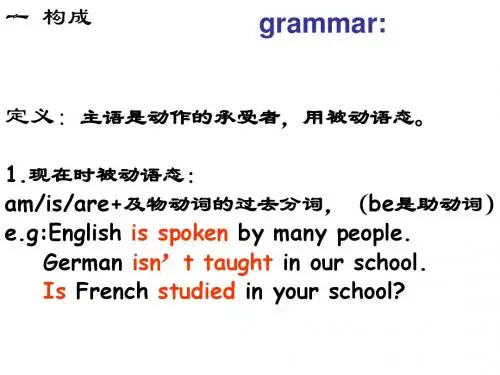
一 构成
grammar:
定义:主语是动作的承受者,用被动语态。
1.现在时被动语态: am/is/are+及物动词的过去分词,(be是助动词) e.g:English is spoken by many people. German isn’t taught in our school. Is French studied in your school?
• 3.明年我校还要修一幢新教学楼。 • Another new teaching building _____ _____ _______ in our school next year. • 4.中国南方种水稻。 • Rice ____ ______ in South China. • 5.昨天爸爸给你买了一辆自行车。 • A bike ______ ________ for you by your father yesterday.
在被动语态中要注意的问题
在上面我们已经初步了解了被动语态的构成和主动变被动的方法。下面 我们接着学习在被动语态中要注意的问题。 ①一些使役动词(let, have, make等)或感观动词(see, hear, watch, notice等)在主动语态中后面接的动词不定式不带to,但改为被动语态时,要 补上to。如: A. The boss makes the workers work 18 hours a day. The workers are made to work 18 hours a day by the boss. B. I saw him enter the house. He was seen to enter the house by me. C. The teacher let them leave the classroom after class. They were let to leave the classroom by the teacher after class. D. We hear her sing in the room every day. She is heard to sing in the room every day. [注意]当使用see/hear/watch sb doing sth时,变为被动语态时,
grammar:
定义:主语是动作的承受者,用被动语态。
1.现在时被动语态: am/is/are+及物动词的过去分词,(be是助动词) e.g:English is spoken by many people. German isn’t taught in our school. Is French studied in your school?
• 3.明年我校还要修一幢新教学楼。 • Another new teaching building _____ _____ _______ in our school next year. • 4.中国南方种水稻。 • Rice ____ ______ in South China. • 5.昨天爸爸给你买了一辆自行车。 • A bike ______ ________ for you by your father yesterday.
在被动语态中要注意的问题
在上面我们已经初步了解了被动语态的构成和主动变被动的方法。下面 我们接着学习在被动语态中要注意的问题。 ①一些使役动词(let, have, make等)或感观动词(see, hear, watch, notice等)在主动语态中后面接的动词不定式不带to,但改为被动语态时,要 补上to。如: A. The boss makes the workers work 18 hours a day. The workers are made to work 18 hours a day by the boss. B. I saw him enter the house. He was seen to enter the house by me. C. The teacher let them leave the classroom after class. They were let to leave the classroom by the teacher after class. D. We hear her sing in the room every day. She is heard to sing in the room every day. [注意]当使用see/hear/watch sb doing sth时,变为被动语态时,
高一英语人教版必修第一册课件:Unit 2
三、be to do表将来
表示按计划中约定的或按职责、义务、要求即将发生的动作,也可 表示注定要发生某事。 Eg:My best friend is to be married in November this year.我最好的朋 友打算今年11月份结婚。(计划) Your plan is to be a failure.你的计划注定要失败。
3. official adj. 官方的,正式的
搭配:official languages 官方语言 official responsibilities 公务 an official announcement/statement 官方公告/声明 make an official visit 进行正式访问 a government official 政府官员
二、be going to do 表将来
1. 人作主语时,表示打算做某事 2. 物作主语时,表示有迹象表明要发生某事 Eg:After graduation, they are going to set up a business of their own. 毕业后,他们打算开办一家自己的公司。(打算) It’s going to be a fine day for surfing tomorrow. 明天将会是冲浪的好天气。(有迹象表明)
五、现在进行时表将来
1. 位移动词的进行时表将来 现在进行时表将来主要表示按计划或安排将要发生的事。此时所 使用的动词多是表示位置移动的动词(词组),如come, go off, leave, arrive, fly, start, travel, walk, ride, drive, take off等。 Eg:When are you going off for your holiday? 你什么时候动身去度假? She is leaving for Singapore tonight. 她今晚将动身去新加坡。
【新人教版】高一英语上册必修一同步课件Unit 2 Travelling Around (语法课件)
Are you staying here till next week?
Exercise
Look!He
(fly)a kite.
Spring is coming. The weather warmer.
(get) warmer and
A foreign guest is
(give) a lecture this afternoon。
weekend. • 3,I think you will find this guidebook useful. • 4, We are taking a trio to Hebei next month to see my
grandmother. • 5, Are you contacting the travel agent this Friday? • 6, If you ask him, I’m sure he will give you a ride to the
he
(attend) a meeting in Seoul.
• 3, I
(not, pack) until the day after tw if she
(check in) tonight or tomorrow.
• 5,
(you, check out) of the hotel tomorrow?
结构:主语+be(am,is,are)+动词-ing形式。 They are playing basketball now.
Listen! She is singing an English song.
Grammar:Present continuous tense
• 现在进行时 表将来,主要用于表示按计划或安排要发生的动作。 常有“意图”“决定”的意思。 • They’re getting married next month.
Exercise
Look!He
(fly)a kite.
Spring is coming. The weather warmer.
(get) warmer and
A foreign guest is
(give) a lecture this afternoon。
weekend. • 3,I think you will find this guidebook useful. • 4, We are taking a trio to Hebei next month to see my
grandmother. • 5, Are you contacting the travel agent this Friday? • 6, If you ask him, I’m sure he will give you a ride to the
he
(attend) a meeting in Seoul.
• 3, I
(not, pack) until the day after tw if she
(check in) tonight or tomorrow.
• 5,
(you, check out) of the hotel tomorrow?
结构:主语+be(am,is,are)+动词-ing形式。 They are playing basketball now.
Listen! She is singing an English song.
Grammar:Present continuous tense
• 现在进行时 表将来,主要用于表示按计划或安排要发生的动作。 常有“意图”“决定”的意思。 • They’re getting married next month.
高一英语必修一第二单元语法课件

Students are expected to understand and master the basic grammar rules in Unit 2 of Compulsory English for Grade 1.
They will be able to apply the grammar rules in different contexts and scenarios, and improve their language skills in both written and spoken English.
Simple, Complex, and Compound.
A clause that functions as the subject of a sentence.
Definition
"What she said is true." (The subject of the sentence is the clause "What she said.")Fra bibliotek总结词
在条件状语从句中,虚拟语气用于表达假设条件,通常与if连用。
详细描述
在条件状语从句中,虚拟语气通常采用一般过去时表示与现在事实相反的情况,采用过去完成时表示与过去事实相反的情况。例如,“If I were you, I would choose that option.”(如果我是你,我会选择那个选项。)
02
CHAPTER
nominal clause
Definition
A clause that functions as a sentence or a part of a sentence and contains a subject and a predicate.
高一英语必修一第二单元语法课件
Go and collect the wood right now. Could you go and get the shopping bags, please? Shut the door at once. Go and get my coat. Would you please get that book for me?
Grammar
单击添加副标题
单击此处添加文本具体内容,简明扼要地阐述你的观点
复习 (把下列直接引语改为间接引语)
e said: “I’ve left my pen in my room.”→He told me that he had left his book in his room.
She said: “He will be busy.”→ She said that he would be busy.
The teacher told the students not to waste their time.
例如: He said, "Let’s go to the film." →He suggested going to the film.或He suggested that they should go to see the film.
Homework
“Could you please lower your voice?” he said.
She asked me to stop to have a rest.
单句改错。Mr. Liu told us don’t be late again.2. He says we were to meet him at the station.3. Mum said to me to make sure the light was turned off.
Grammar
单击添加副标题
单击此处添加文本具体内容,简明扼要地阐述你的观点
复习 (把下列直接引语改为间接引语)
e said: “I’ve left my pen in my room.”→He told me that he had left his book in his room.
She said: “He will be busy.”→ She said that he would be busy.
The teacher told the students not to waste their time.
例如: He said, "Let’s go to the film." →He suggested going to the film.或He suggested that they should go to see the film.
Homework
“Could you please lower your voice?” he said.
She asked me to stop to have a rest.
单句改错。Mr. Liu told us don’t be late again.2. He says we were to meet him at the station.3. Mum said to me to make sure the light was turned off.
人教新课标必修一Unit 2 知识点课件(30张幻灯片)
8.enrich 使丰富 It is generally believed that t_r_a_v_e_li_n_g_a_b_r_o_a_d_ can enrich
one's knowledge. 一般认为出国旅游可增长见识。
enrich your school life make your school life colorful
The woman _s_e_ll_in__g__ (sell) vegetables has gone home.
He is a teacher _re_s_p_e_c_t_e_d_(respect) by us all .
Para 4 最后到19世纪的时候,英语这种语 言就变得稳定了。当时,英语的拼 写发生了两个很大的变化:先是塞 缪尔•约翰逊编写了他的英语词典, 后是诺亚•韦伯斯特出版了《美国英 语词典》。后者使得美式英语的拼 写有了其独特的个性。
C. More than+形容词 很/非常
I am more than glad to help you. D. more than +从句 远非/难以/ 完全不能(其后常连用can)
The heat there was more than he could stand.
E. More than one person has made this suggestion.
2. even if= even though 引导让 步状语从句,“尽管;即使”
Even if it rains tomorrow, we will leave for Beijing.
即使他不来,我们也要按时出发。 _E_v_e_n__if_h_e__d_o_e_s_n_'_t _c_o_m_e_,____ _w_e__w_i_ll_s_e_t_off on time.
高中英语外研版必修一《ⅡGrammar——过去分词作定语和一般过去时的时间状语》课件
[即时训练] Ⅰ.单句填空 1.Most people invited (invite) to the ball were famous
stars. 2.This famous novel written (write) by Mr. Smith is wort
h reading. 3.The question discussed (discuss) yesterday was about
4.The children examined in the hospital yesterday (昨天在
医院检查的) were seriously ill.
5.The people exposed to the sunlight
(暴露在阳
光下的) got sunburnt.
6.The boy punished seriously by the teacher (受到老师严重
During his middle school years he often went for the com petition.
他在中学时代经常参加竞赛。
I saw him today. 我今天见过他。
Ⅰ.用括号内所给动词的适当形式填空 1.Prices of daily goods bought (buy) online are lower
2.The problem discussed at the meeting yesterday
(在昨天的会议上讨论的) was very difficult to solve.
3.The window broken by that naughty boy (被那个顽皮的
男孩儿打破的) is being repaired.
新人教版英语必修一_Unit 2 语法课-教学课件
Tuesday cinema 8:00am Friday Kate 5:00pm
PLANNING
He is playing tennis on Monday afternoon. He is going to the cinema on Tuesday morning. He is meeting Kate on Friday.
attention
The present continuous tense is more usual for other personal arrangements: What time are you meeting Kate tomorrow? (not do you meet)
Compare:
2
Gary might visit China next year,but he’s still not sure.
3
Kate has been invited to a meeting in Iceland. She will apply for a visa soon.
4
Could you help me with this box,please? I’m afraid I’m going to drop it.
Present continuous
What time are you arriving? I’m going to the cinema this
evening.
Present simple
What time does the train arrive? The film starts at 8.15.
其中有一些动词一般不用于进行时。 1.表示事实状态的,如:have, belong, possess, owe, exist, include, contain,weigh, measure等。 2.表示心理状态的,如:know,realize,think,imagine, remember,recognize,prefer,love,hate等。 3.系动词,如:seem, appear, feel, taste等。 4.某些瞬间动词,如:accept,give,refuse,finish, decide,complete等。
PLANNING
He is playing tennis on Monday afternoon. He is going to the cinema on Tuesday morning. He is meeting Kate on Friday.
attention
The present continuous tense is more usual for other personal arrangements: What time are you meeting Kate tomorrow? (not do you meet)
Compare:
2
Gary might visit China next year,but he’s still not sure.
3
Kate has been invited to a meeting in Iceland. She will apply for a visa soon.
4
Could you help me with this box,please? I’m afraid I’m going to drop it.
Present continuous
What time are you arriving? I’m going to the cinema this
evening.
Present simple
What time does the train arrive? The film starts at 8.15.
其中有一些动词一般不用于进行时。 1.表示事实状态的,如:have, belong, possess, owe, exist, include, contain,weigh, measure等。 2.表示心理状态的,如:know,realize,think,imagine, remember,recognize,prefer,love,hate等。 3.系动词,如:seem, appear, feel, taste等。 4.某些瞬间动词,如:accept,give,refuse,finish, decide,complete等。