
多维阅读第7级-A Big Earthquake 大地震
高考英语一轮复习 Unit4 Earthquakes阅读理解全方位训练11
入舵市安恙阳光实验学校高考英语一轮复习全方位配套训练人教版必修一Unit 4 Earthquakes阅读理解1第Ⅰ组AEveryone has heard of the San Andreas fault (断层),which constantly threatens California and the West Coast with earthquakes.But how many people know about the equally serious New Madrid fault in Missouri? Between December of 1811 and February of 1812,three major earthquakes occurred,all centered around the town of New Madrid,Missouri,on the Mississippi River.Property damage was severe.Buildings in the area were almost destroyed.Whole forests fell at once,and huge cracks opened in the ground,releasing some strong smell chemicals.The Mississippi River itself completely changed character,developing sudden rapids and whirlpools(激流和漩涡).Several times it changed its course,and once,according to some observers,it actually appeared to run backwards.Few people were killed in the New Madrid earthquakes,probably simply because few people lived in the area in 1811;but the severity of the earthquakes was shown by the fact that the shock waves rang bells in church towers in Charleston,South Carolina,on the coast.Buildings shook in New York City,and clocks were stopped in Washington,D.C.Scientists now know that America’s two major faults are essentially different.The San Andreas is a horizontal (水平的) boundary between two major land masses that are slowly moving in oppositedirections.California earthquakes result when the two masses make a sudden move.The New Madrid fault,on the other hand,is a vertical fault;at some point,possibly hundreds of millions of years ago,rock was pushed up toward the surface,probably by volcanoes under the surface.Suddenly,the volcanoes cooled and the rock collapsed,leaving huge cracks.Even now,the rock continues to settle downwards,and sudden sinking motions cause earthquakes in the region.The fault itself,a large crack in this layer of rock,with dozens of other cracks that split off from it,extends from northeast Arkansas through Missouri and into southern Illinois. Scientists who have studied the New Madrid fault say there have been numerous smaller quakes in the area since 1811;these smaller quakes indicate that larger ones are probably coming,but the scientists say they have no method of predicting when a large earthquake will occur.1.This passage is mainly about .A.the New Madrid faultB.the San AndreasC.the causes of faultsD.current scientific knowledge about faults2.Which of the following pictures best describes the type of the NewMadrid fault?3.This passage implies that .A.horizontal faults are more dangerous than vertical faultsB.vertical faults are more dangerous than horizontal faultsC.a lot of people would die if the 1811 New Madrid earthquakes happened todayD.the volcanoes that caused the New Madrid fault are still alive【语篇解读】本文通过历史回顾和科学分析,提醒人们多关注New Madrid地区频繁的地震。
地震 高中英语阅读理解
地震高中英语阅读理解Earthquakes: Unraveling the Mysteries of the Earth's Dynamic ForcesEarthquakes, the sudden and often violent shaking of the Earth's surface, have captivated the human imagination for centuries. These powerful natural phenomena have the ability to reshape the landscape, topple structures, and claim countless lives, leaving an indelible mark on the collective consciousness of humanity. As we delve into the intricate workings of earthquakes, we uncover a complex tapestry of scientific understanding that not only illuminates the forces that shape our planet but also highlights the ongoing efforts to mitigate the devastating impact of these events.At the heart of earthquake science lies the theory of plate tectonics, which revolutionized our understanding of the Earth's dynamic interior. This theory posits that the Earth's surface is composed of a series of massive plates, constantly in motion, driven by the convection of the planet's molten interior. The boundaries between these plates are the primary loci of seismic activity, as the relentless forces of compression, tension, and shear create immense stresses that are ultimately released in the form of earthquakes.When tectonic plates collide, one plate is typically forced beneath the other, a process known as subduction. This subduction zone is a hotbed of seismic activity, as the descending plate generates intense friction and pressure, triggering a series of earthquakes. The Pacific Ring of Fire, a region encircling the Pacific Ocean, is a prime example of this, with a high concentration of active volcanoes and frequent earthquake occurrences.Earthquakes, however, are not limited to plate boundaries; they can also occur within the interior of tectonic plates, often along pre-existing fault lines. These intraplate earthquakes can be equally devastating, as evidenced by the 2011 Tohoku earthquake in Japan, which triggered a devastating tsunami and caused widespread destruction.The magnitude of an earthquake, a measure of the energy released during the event, is a crucial factor in determining its potential for destruction. The Richter scale, developed in the 1930s by American seismologist Charles Richter, provides a logarithmic scale for measuring earthquake magnitude, with each unit increase representing a tenfold increase in the amount of energy released. The most powerful earthquakes, often referred to as "megaquakes," can reach magnitudes exceeding 9.0 on the Richter scale, releasing staggering amounts of energy and causing catastrophic damage.While the raw power of earthquakes is awe-inspiring, the true tragedy lies in the human cost of these events. Densely populated urban centers, often built atop vulnerable geological structures, bear the brunt of the destruction, with buildings collapsing, infrastructure crumbling, and lives lost. The 2010 Haiti earthquake, for instance, claimed over 300,000 lives and left countless more injured or displaced, highlighting the devastating impact of these natural disasters on vulnerable communities.In the face of such immense challenges, the scientific community has dedicated itself to understanding the complex mechanisms that drive earthquakes, with the ultimate goal of improving our ability to predict and mitigate their consequences. Advancements in seismic monitoring technology, the development of early warning systems, and the implementation of stringent building codes have all played a crucial role in reducing the loss of life and property during earthquakes.Yet, the unpredictable nature of these events remains a formidable challenge. Earthquake prediction, long the Holy Grail of seismology, has proven to be an elusive goal, as the complex interplay of factors that trigger seismic events continues to defy our best efforts at forecasting. Nonetheless, scientists remain undaunted, leveraging the power of data analysis, computational modeling, and interdisciplinary collaboration to unravel the mysteries of the Earth'sdynamic forces.Beyond the scientific realm, the impact of earthquakes has also shaped the cultural and societal landscape of affected regions. The resilience and adaptability of communities in the face of such adversity have inspired awe and admiration, as people come together to rebuild and recover in the aftermath of these events. The lessons learned from past earthquakes have informed urban planning, emergency response protocols, and disaster management strategies, ensuring that we are better prepared to face the challenges that lie ahead.As we continue to grapple with the realities of a changing climate and the increasing frequency and intensity of natural disasters, the study of earthquakes assumes an even greater importance. By understanding the complex interplay of tectonic forces, we can develop more effective strategies for mitigating the impact of these events, protecting vulnerable populations, and ensuring the long-term resilience of our communities.In the end, the story of earthquakes is one of both humility and resilience. It reminds us of the raw power of nature and the fragility of our human constructs, but it also inspires us to push the boundaries of scientific understanding, to innovate, and to work together in the face of adversity. As we continue to unravel themysteries of the Earth's dynamic forces, we are reminded of our place in the grand tapestry of our planet, and the vital importance of our collective efforts to safeguard our future.。
2024高考英语一轮复习Unit4Earthquakes练习含解析新人教版必修1
Unit 4 EarthquakesⅠ.阅读理解AAn earthquake is one of the most common natural disasters.It may cause great damage.So it is wise to learn some simple safety tips to protect yourself or your family members.Fragile items,like those made of glass are easily broken and should usually be placed on a lower surface,near the ground instead of placing them on cupboards higher up.Never place them near your bed,sofas and other furniture where you would be sitting or lying down.When there is strong movement,these pieces will fall to the floor directly and not on you.There is a strong chance of short circuits (短路) and fire breakouts during an earthquake.Make sure you turn off electrical connections and gas immediately when an earthquake happens.During an earthquake,lie beneath an object that is not easily damaged.Do not go near objects that could directly fall on you.Never use the elevator to go down.Stay inside until the shaking stops and it is safe to go outside.Research has shown that most injuries happen when people inside buildings try to go e the staircases at all times.If you are outdoors,do not take shelter under a tree,streetlights,electric poles or tall buildings.If you are driving,stop your car and stay in a safe place.Do not park your car under a tree or any tall object.If trapped in debris (瓦砾堆),cover your mouth with a handkerchief or clothing.Tap on a pipe or wall so rescuers can find e a whistle (哨子) if one is available.Never shout for help.Shouting can cause you to breathe in dangerous amounts of dust.Do not light a match because you may burn yourself.Do not move about or kick up dust.1.Which of the following is closest in meaning to the underlined word “Fragile”in Paragraph 2?A.Easily found.B.Easily broken.C.Expensive.D.Heavy.2.Where should the items made of glass be put to reduce the injury from the earthquake?A.On cupboards.B.On a lower surface.C.In the bedroom.D.Where children can’t reach them.3.What are people advised to do during the earthquake?A.Go out the building at once.B.Drive to a safe place quickly.C.Take shelter under a tree.D.Turn off electricity and gas immediately.语篇解读:地震是最常见的自然灾难之一,常造成巨大的损失。
高一英语 Unit 7 Earthquakes(双语版)

高一上册Unit 7 Earthquakes地震Lesson 25 1 DialogueCarl and Wang Bing are students.Wang Bing is reading a book about earthquakes.卡尔和王兵都是学生。
王兵正在读一本有关地震的书。
Wang Bing:Carl,what does"quake"mean,as in the word "earthquake"?王兵:卡尔,"earthquake"这个词中"quake"是什么意思?Carl:It means "to shake".So,in an earthquake,the earth shakes.And so do you,it you're afraid,and if the earthquake's a big one.卡尔:它的意思是“震动”,因此,地震时,地球震动。
假如是强地震,如果你害怕,你也会抖动的。
Wang Bing:Were you in San Francisco at the time of the big earthquake in 1989?王兵:1989年旧金山大地震时你在那儿吗?Carl:Sure I was.I'll never forget that.卡尔:我当然在那儿了,我永远也不会忘记那次地震。
Wang Bing:What was it like?王兵:那次地震怎么样?Carl:Very strange.It was my first earthquake,you see,and I didn't know what was happening.First I heard a noise.卡尔:很奇怪。
那是我第一次经历地震,你瞧,我当时还不知道发生了什么事,我最先听到一阵响声。
高考英语复习拓展阅读之地震灾难volcano 课件
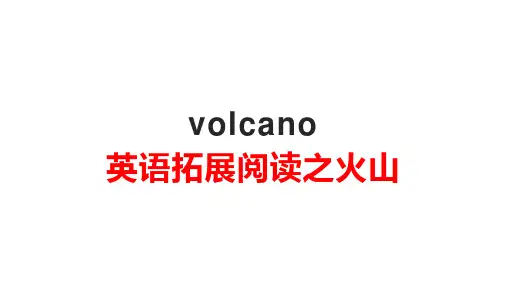
In an interview with Britain’s Sky News, Folau said he was frightened when the waves took him from land into the sea. “What came into my mind when I was helpless at sea were two things,” he said. He added, “One, that I still had faith in God. Two, is my family. And I only remember how my family will think, at that moment, ‘Maybe he died.’”
There was even a video recorded by Folau’s son Koli Folau, who went searching for his father. The video shows that almost nothing was left standing on the island other than a church, where many of the villagers took shelter.
New Zealand’s Acting High Commissioner Peter Lund said Tongan officials told him last Sunday that a man was missing from Atata island. “And they weren’t very optimistic about it,” Lund said.
百科英语阅读地震

百科英语阅读地震Earthquakes: Exploring the Fascinating World of Seismic ActivityEarthquakes are one of the most awe-inspiring and powerful natural phenomena on our planet. These sudden and often devastating events have captivated the human imagination for centuries, leading to a rich tapestry of scientific understanding and cultural significance. As we delve into the topic of earthquake-related English reading, we will uncover the intricacies of this dynamic geological process, its impact on our lives, and the ways in which we strive to comprehend and mitigate its effects.At the heart of earthquake studies lies the fundamental understanding of plate tectonics the intricate dance of the Earth's vast crustal plates as they slowly shift and collide over time. This dynamic movement is the driving force behind the majority of seismic activity, as the immense stresses and strains built up along plate boundaries are periodically released in the form of earthquakes. By studying the patterns and characteristics of these tectonic movements, scientists have been able to develop sophisticated models and prediction methods, allowing us to better anticipate and prepare for the consequences of these natural occurrences.One of the most crucial aspects of earthquake-related English reading is the exploration of the various types of seismic waves that radiate outward from the epicenter of an earthquake. Primary waves (P-waves) and secondary waves (S-waves) are the two primary classifications, each with distinct properties and propagation patterns. Understanding the behavior of these waves is essential for accurately locating the origin of an earthquake, as well as for designing structures that can withstand the shaking and stresses they impart. Additionally, the study of surface waves, which travel along the Earth's crust, has provided valuable insights into the underlying geological structure and composition of our planet.Alongside the scientific understanding of earthquakes, the cultural significance of these events has also been a rich subject of exploration. Across the globe, various societies have developed unique perspectives on the causes and meanings of earthquakes, often rooted in mythology, religion, and traditional beliefs. From the ancient Greek god Poseidon's role in shaking the earth to the Japanese belief in the earth-shaking activities of the dragon godRyūjin, these cultural narratives have shaped our collective understanding and response to seismic events.In the modern era, the study of earthquakes has become increasingly interdisciplinary, drawing upon fields such as engineering,seismology, geography, and disaster management. The development of advanced monitoring and early warning systems has been a crucial area of focus, allowing for more effective preparedness and emergency response. Additionally, the study of historical earthquake records and the mapping of fault lines have provided invaluable insights into the patterns and probabilities of future seismic events, informing urban planning and infrastructure design.As we continue to deepen our understanding of earthquakes, the importance of earthquake-related English reading cannot be overstated. By engaging with the latest research, case studies, and technological advancements in this field, we can better comprehend the complex interplay between the Earth's internal dynamics and their profound impact on human societies. Whether it is through the study of seismic wave propagation, the analysis of earthquake-resistant building design, or the exploration of cultural and historical perspectives, the pursuit of earthquake knowledge remains a critical endeavor in our quest to coexist more harmoniously with the dynamic forces that shape our planet.In conclusion, the study of earthquakes through English reading offers a multifaceted and captivating journey of scientific discovery, cultural exploration, and practical application. As we continue to unravel the mysteries of these powerful natural events, we deepen our understanding of the Earth's inner workings and our own placewithin the grand tapestry of our dynamic world. By embracing this knowledge, we can strive to build more resilient communities, mitigate the devastating consequences of earthquakes, and ultimately, enhance our ability to live in harmony with the ever-changing face of our remarkable planet.。
2023年高考英语外刊时文精读专题03看到空中的碳足迹
2023年高考英语外刊时文精读精练 (3)Carbon emissions碳排放Seeing footprints in the air看到空中的碳足迹主题语境:人与自然主题语境内容:环境保护【外刊原文】(斜体单词为超纲词汇,认识即可;下划线单词为课标词汇,需熟记。
)Chris Jones of the University of California, Berkeley, was on a river in the Amazon rainforest when he put th e finishing touches on the world’s first online household carbon calculator(计算器). That was in 2005. He hoped that, if he could show people how much greenhouse gas was associated with daily activities—driving the car, heating the house—they might change their behaviour and contribute in some small measure to saving the Amazon. Seventeen years later, trackers are providing a wealth of often-neglect ed information about the carbon emissions of everyday life. They provide local and micro data which usefully supplement the global findings of the Intergovernmental Panel on Climate Change.Trackers work by asking users to answer questions such as: how many miles a year do you drive; how much is your annual household electricity bill; how often do you eat meat? They then calculate a personal or household estimate of emissions of carbon-dioxide equivalent (CO2e,二氧化碳当量排放量) per year. Alex Beale, a climate blogger in Atlanta who has studied them, reckons there are dozens of household carbon trackers and hundreds of specialist ones, including those which calculate emissions from food or other industries, such as a new one from the Stockholm Environment Institute (SEI) to track emissions from shipping. For individuals, reckons Mr Beale, the most comprehensive are the Cool Climate tracker run by Dr Jones at Berkeley and the calculator set up by the World Wildlife Fund (WWF) and SEI. What do they tell us?Dr Jones describes the main household polluting activities as “cars, coal, cows and consumption,roughly in that order”.By far the largest single source of emissions is the family vehicle. One car of average fuel efficiency driven 14,000 miles (22,500km) spews out 7 tonnes of carbon, according to Dr Jones’s tracker. Swapping it for an electric vehicle would save over 6 tonnes, or an eighth of the average American household’s yearly emissions.No other change would generate that much saving, though electricity in the homeis responsible for over 5 tonnes of carbon emissions a year, so generating it with solar panels(太阳能电池板) would come close . Like electric vehicles, a roof full of solar panels is not cheap. Changing diets costs less, and American households consume meat worth 2.7 tonnes of CO2e a year, far more than most people. If Americans went vegetarian(素食者), that would be like half an average solar roof.These household averages, however,disguise what may be the most important thing carbon trackers reveal: that apparently similar households produce very different emissions. By combining their tracker’s results with postal(邮政的)code data, the University of California team worked out average emissions by area. Places with high emissions—mostly suburbs(郊区)—produce four or five times as much carbon as inner cities or rural areas, a much larger multiple than might have been ex pected. Chicago’s households produce37 tonnes of CO2e a year; suburban Eola’s, some35 miles (56km) from the Windy City, emit96 tonnes. This is not only because of commuting(通勤). Trips to and from work account for less than a fifth of miles driven; the rest are to shops, schools and so on.Even more striking is the difference air travel makes. The average household contribution from flying is 1.5 tonnes, less than a car. But half of Americans never fly. According to Cool Climate, flying 100,000 miles a yearproduces a stunning(惊人的)43 extra tonnes of CO2. If jet-set households were to cut their travel sharply, they would have a disproportionate(不成比例的)effect on emissions. They might even do something for the Amazon.Over the next 30 years, many countries are promising to move to net-zero carbon, imply ing that household emissions will have to be cut to close to nothing. Stephanie Roe, WWF’s lead climate scientist, reckons that, at best, half the reduction might be achieved through demand-side measures, such as behavioural changes by individuals and households. And even that would require companies and governments to provide more incentives(激励)to change through supply-side investments to make low-carbon options cheaper and more widely available.Trackers, it seems, have daunting(令人怯步的)lessons for public bodies and private households alike.【课标词汇】1.associate将…(与…)联系起来,把…联系在一起Most people associate this brand with good quality.大多数人把这个品牌和优良品质联系在一起。
2021_2022学年新教材高中英语课时评价十三Unit4NaturalDisastersReadi
Therefore, effective measures should be taken as soon as possible to stop its happening. So how should we deal with the frightening sandstorms?
Some experts offer practical advice as follows: For one thing, more money ought to be put into tree planting and forest protection in order to keep more water on the Earth. For another, government of all countries should make laws on environment protection. For example, banning the use of throw-away chopsticks and punishing illegal tree cutting. Scientists should also study and find ways to lower the grade of its destruction and to improve the environment. As for some schools, education about sandstorms should be spread properly and timely to make more and more people attach great importance to this problem.
Ⅱ. 单句语法填空 1. With more forests _d_e_s_tr_o_y_e_d_(destroy), huge quantities of good earth are being washed away each year. 2. The earthquake was so big that most of the houses in the small village were completely _in_ruins. 3. The big fire caused great damage _to_the building built last year. 4. He was trying to save the girl _tr_a_p_p_e_d_(trap) in the burning house. 5. _B_u_r_y_i_n_g_(bury) myself in preparing the coming final exam, I have no time to learn about the news at home and abroad.
20版:(步步高) (全国) Unit 4 Earthquakes
Book 1Unit 4EarthquakesⅠ.阅读理解(2019·浙江五校联考)Emoji might not be your first choice of communication in a disaster,but researchers feel they could make a difference during emergencies,where every second counts.Now,the Emojiquake campaign is lobbying for an earthquake emoji to be added to the Unicode set—the standard group of icons available on digital devices worldwide.The campaign aims to find an earthquakeappropriate design to be submitted to Unicode.“Approximately up to one third of the world’s population are exposed to earthquakes,”explains University of Southampton seismologist(地震学家) Dr Stephen Hicks,a founder of the campaign.“So we really want to be able to communicate to all of those regions,all of those different languages,and an emoji is an amazing way of doing that.”Unlike many other weather and climate related events,where longer warning times or visible signs are available,earthquakes move incredibly quickly and are difficult to measure while they are still occurring.Populations in areas like Japan and Mexico are dependent on earthquake early warning technology,which issues an alert on digital devices and broadcast media.“You may have seconds to get under a table or to protect yourself,” explains Dr Hicks.“That can be lifesaving in many cases.Naturally you don’t want too much wording in the warning message.”Pictographs(象形文字) and other visuals like emoji have a track record of being faster and easier to understand than written information.Dr Sara McBride,a communications specialist,who is also part of the campaign,told BBC News,“Emoji can cross the boundaries of written languages,helping communicate valuable information to people who may struggle to read a certain language.”The potential usefulness of emoji in emergencies could extend well beyond earthquakes.A team of designers also came up with emerji—an entire set of emoji dedicated to climate and environmental events.1.According to the passage,why did the campaign choose earthquakes as their target? A.Because earthquakes threaten many people in different regions.B.Because earthquakes are the easiest to be expressed by an emoji.C.Because earthquakes are not difficult to measure while occurring.D.Because earthquakes are the most destructive disasters in the world.答案A解析推理判断题。
高中英语Unit4EarthquakesSectionⅠWarmingUpReading_Compr
Ⅰ Fast-reading Skim the text and choose the best answer. 1.What’s the main idea of the text? A.A terrible earthquake of Tangshan. B.Before the earthquake of Tangshan. C.During the earthquake of Tangshan. D.Damages of the earthquake of Tangshan. 答案:A
Unit 4 Earthquakes
The Chinese government was illprepared for a disaster of this scale at that time. The day following the quake, helicopters and planes began dropping food and medicine into the city. About 100,000 soldiers of the Chinese People’s Liberation Army were ordered to Tangshan, and many had to march on foot from Jinzhou, a distance of more than 180 miles. About 30,000 medical personnel were called in, along with 30,000 construction workers. In the decisive first week after the disaster, many people died from lack of medical care.