
创伤高级生命支持ATLS-医学资料
创伤高级生命支持ppt课件
ATLS原则
创伤处理必须掌握三个原则: • 优先处理原则 • 不必因诊断不明确而延误有效的治疗的原则 • 详细的病史对急性创伤病人的评估在一开始
时是不必需的
ATLS必须掌握的抢救技术
• 对多发创伤的病人进行初级和二级评估 • 建立病人的通气道并实施人工呼吸 • 成人和婴儿的经口腔/鼻腔气管插管 • 脉搏血氧定量和呼气二氧化碳测定 • 环甲膜切开术 • 对休克病人的评估和处理,特别是威胁生命的出血
ATLS基本程序---复苏
C:循环与止血
• 稳定循环:胸外心脏按压、建立静脉通路、复 苏药物、电除颤、液体复苏等
• 失血是创伤患者最常见的死亡原因:积极和持 续的容量复苏不能代替机械或手术止血 ,通过 直接压迫或手术止血 是至关重要的
• 低体温问题 :对于创伤病人来说,低体温是一 种致死的并发症,所以应该采取积极措施保持 病人体温恒定
保护颈椎
当建立呼吸通道时 手法固定颈椎于一个适合的位
置是十分必要的
重要的注意事项
• 颈部检查不能除外颈椎损伤 • 假定在多系统损伤的患者中存在颈
椎的损伤, 特别是在锁骨以上钝性 损伤并伴有意识水平的改变
缺陷
• 设备损坏 • 麻醉后不能插管伴有外科手术通气困难 • 未知的喉部骨折 /气道的横断面不完全
Q : 什么因素提供了受伤患者的 血液动力学改变的证据?
这些因素包括
1. 意识水平 2. 皮肤颜色 3. 脉搏 (质量, 频率, 节律)
• 颈动脉搏动存在 • 股动脉搏动存在 • 桡动脉搏动存在
SBP 60 mmHg SBP 70 mmHg SBP 80 mmHg
☆外出血 在初检中检出并给于控制
分类: • I级创伤:严重创伤病人,伴有生理紊乱或脏器部
高级创伤生命支持PPT
18
创伤机制:
• 钝性伤:询问是否使用安全带,方向盘 变形,撞击方向,车损情况,是否抛出。
• 穿通伤:受伤的部位,子弹的口径与速 度,弹道方向,射击距离。
• 烧伤与低温:爆炸,碎片,吸入有毒气 体。饮酒、吸毒、落水等是导致患者热 量大量丢失的原因。
• 被抛出或翻滚的儿童
• 高速机动车事故(车速 >64kmh,变形>50cm, 乘客
• RR<10 OR >29
车厢变形>30cm)
• sBP<90 mmHg
• 获救时间>20min
• 连枷胸
• 坠落高度>6m
• 2处以上长骨骨折
• 翻车
• •
踝、腕近段骨折
头、颈、躯干、肘和膝关节 以里的锐器伤
• •
• 颅脑外伤昏迷或GCS<=8 • 假设复合伤、昏迷患者、锁骨以上钝器
伤患者存在颈椎损伤。(颈椎保护)
9
B:呼吸与通气支持
• 通过视、触、叩、听发现:张力性气胸、 连枷胸、肺挫伤、大量血胸、开放性气 胸。
注意:张力性气胸患者表现为呼吸困难、 频速,正压通气使病情加重。 昏迷的患者气管插管-正压通气会导致气 胸。
7
特殊人群优先处理原则与成人相同
• 儿童:所需输血量、输液量、药物剂量小,相 对体表面积大。
• 孕妇:存在解剖结构和生理功能的改变。 • 老人:生理功能的储备减少。存在DM,CHF,
CAD,限制性或阻塞性肺病,肝病,出凝血疾 病,周围血管疾病等。合并用药史。
8
A:维持气道与颈椎保护
• 视、听、感:异物,面、颌骨骨折,气 管、吼骨折。(chin lift, jaw thrust)
高级创伤生命支持课件

创伤病人死亡时间分布
• 数秒至数分钟〔脑、脑干、高位脊髓、心脏、 主动脉和大血管〕
• 数分钟至数小时〔硬膜外、下血肿、血气胸、 肝脾破裂、骨盆骨折、大量失血〕
• 数天至数周〔感染、MODS〕
• 黄金时间:强调急诊救治的重要性,在创伤后 的数小时内成功的处理患者,可以使患者的死 亡率、致残率将至最低。
• 颅脑外伤昏迷或GCS<=8 • 假设复合伤、昏迷患者、锁骨以上钝器
伤患者存在颈椎损伤。〔颈椎保护〕
B:呼吸与通气支持
• 通过视、触、叩、听发现:张力性气胸、 连枷胸、肺挫伤、大量血胸、开放性气 胸。
注意:张力性气胸患者表现为呼吸困难、 频速,正压通气使病情加重。 昏迷的患者气管插管-正压通气会导致气 胸。
管切开
• B:治疗张力性气胸,给氧,监测SaO2 • C:建立静脉通路:2条Ivs, • 化验:血型、配血、Hct、HCG • 治疗:2—3L Ringer iv, 无效那么输血。
同型血vs O型血。 • 一般不用血管活性药、激素、NaHCO3、
或持续晶体,必要时手术治疗。
首次评估中的辅助检查
• ECG:心脏损伤时出现HR增快、房颤、 室早、ST改变,HR减慢、差传、早搏可 能是心脏灌注缺乏或缺氧所致。PEA。
• 在受伤的患者与严重程度超过了医务人 员的处理能力时,优先处理那些耗时短、 所需医疗人力与设备少的患者。
首次评估
注意患者的意识状态、皮肤颜色、脉搏
颅脑外伤昏迷或GCS<=8
D, Disability: neurologic status
• A, Airway maintenance 环境因素:接触化学制剂、有毒物质、射线等,应注意自身保护。
AdvancedTraumaLifeSupport-ATLS高级创伤生命支持

Advanced Trauma Life SupportAdvanced Trauma Life Support (ATLS) is a training program for doctors and Advanced Practice/Critical Care Paramedics in the management of acute trauma cases, developed by the American College of Surgeons. The program has been adopted worldwide in over 40 countries,[1] sometimes under the name of Early Management of Severe Trauma (EMST), especially outside North America. Its goal is to teach a simplified and standardized approach to trauma patients. Originally designed for emergency situations where only one doctor and one nurse are present, ATLS is now widely accepted as the standard of care for initial assessment and treatment in trauma centers. The premise of the ATLS program is to treat the greatest threat to life first. It also advocates that the lack of a definitive diagnosis and a detailed history should not slow the application of indicated treatment for life-threatening injury, with the most time-critical interventions performed early. However, there is mixed evidence to show that ATLS improves patient outcomes.[1][2][3][4][5][6]Primary SurveyThe first and key part of the assessment of patients presenting with trauma is called the primary survey. During this time, life-threatening injuries are identified and simultaneously resuscitation is begun. A simple mnemonic, ABCDE, is used as a memory aid for the order in which problems should be addressed.A AirwayB BreathingC CirculationD DisabilitiesE Expose/EnvironmentA - Airway Maintenance with Cervical Spine ProtectionThe first stage of the primary survey is to assess the airway. If the patient is able to talk, the airway is likely to be clear. If the patient is unconscious, he/she may not be able to maintain his/her own airway. The airway can be opened using a chin lift or jaw thrust. Airway adjuncts may be required. If the airway is blocked (e.g, by blood or vomit), the fluid must be cleaned out of the patient's mouth by the help of sucking instruments.B - Breathing and VentilationThe chest must be examined by inspection, palpation, percussion and auscultation. Subcutaneous emphysema and tracheal deviation must be identified if present. Life-threatening chest injuries, including tension pneumothorax, open pneumothorax, flail chest and massive haemothorax must be identified and rapidly treated. Flail chest, penetrating injuries and bruising can be recognised by inspection.C - Circulation with Hemorrhage ControlHemorrhage is the predominant cause of preventable post-injury deaths. Hypovolemic shock is caused by significant blood loss. Two large-bore intravenous lines are established and crystalloid solution given. If the patient does not respond to this, type-specific blood, or O-negative if this is not available, should be given. External bleeding is controlled by direct pressure. Occult blood loss may be into the chest, abdomen, pelvis or from the long bones.D - Disability (Neurologic Evaluation)During the primary survey a basic neurological assessment is made, known by the mnenomic AVPU (alert, verbal stimuli response, painful stimuli response, or unresponsive). A more detailed and rapid neurological evaluation is performed at the end of the primary survey. This establishes the patient's level of consciousness, pupil size and reaction, lateralizing signs, and spinal cord injury level.The Glasgow Coma Scale is a quick method to determine the level of consciousness, and is predictive of patient outcome. If not done in the primary survey, it should be performed as part of the more detailed neurologic examination in the secondary survey. An altered level of consciousness indicates the need for immediate reevaluation of the patient's oxygenation, ventilation, and perfusion status. Hypoglycemia and drugs, including alcohol, may influence the level of consciousness. If these are excluded, changes in the level of consciousness should be considered to be due to traumatic brain injury until proven otherwise.E - Exposure / Environmental controlThe patient should be completely undressed, usually by cutting off the garments. It is imperative to cover the patient with warm blankets to prevent hypothermia in the emergency department. Intravenous fluids should be warmed and a warm environment maintained. Patient privacy should be maintained.Secondary SurveyWhen the primary survey is completed, resuscitation efforts are well established, and the vital signs are normalizing, the secondary survey can begin.The secondary survey is a head-to-toe evaluation of the trauma patient, including a complete history and physical examination, including the reassessment of all vital signs. Each region of the body must be fully examined. X-rays indicated by examination are obtained.If at any time during the secondary survey the patient deteriorates, another primary survey is carried out as a potential life threat may be present.The person should be removed from the hard spine board and placed on a firm mattress as soon as reasonably feasible as the spine board can rapidly cause skin breakdown and pain while a firm mattress provides equivalent stability for potential spinal fractures.[7]Alternatives to ATLSAnaesthesia Trauma and Critical Care (ATACC) is an international trauma course based in the United Kingdom. It is an advanced trauma course and represents the next level for trauma care and trauma patient management post ATLS certification. Accredited by two Royal Colleges and numerous emergency services, the course runs numerous times per year for candidates drawn from all areas of medicine and trauma care.[8] Specific injuries, such as major burn injury, may be better managed by modified ATLS protocols such as EMSB (Emergency Management of Severe Burns: a training course and protocols developed by the Australian and New Zealand Burn Association (ANZBA) and also adopted by the British Burn Association).[9][10]EvidenceAs of 2008 no evidence exist as to whether or not ATLS training improved outcomes.[11]HistoryATLS has its origins in the United States in 1976, when orthopaedic surgeon Dr. James K. Styner, piloting a light aircraft, crashed his plane into a field in Nebraska. His wife was killed instantly and three of his four children sustained critical injuries. He carried out the initial triage of his children at the crash site. Dr. Styner had to flag down a car to transport him to the nearest hospital; upon arrival, he found it closed. Even once the hospital was opened and a doctor called in, he found that the emergency care provided at the small regional hospital where they were treated was inadequate and inappropriate.[12]Upon returning to work, he set about developing a system for saving lives in medical trauma situations. Styner and his colleague Paul 'Skip' Collicott, with assistance from Advanced Cardiac Life Support personnel and the Lincoln Medical Education Foundation, produced the initial ATLS course which was held in 1978. In 1980, the American College of Surgeons Committee on Trauma adopted ATLS and began US and international dissemination of the course. Styner himself recently recertified as an ATLS instructor, teaching his Instructor Candidate course in the UK and then in the Netherlands.Since its inception, ATLS has become the standard for trauma care in American emergency departments and advanced paramedical services. Since emergency physicians, paramedics and other advanced practitioners use ATLS as their model for trauma care it makes sense that programs for other providers caring for trauma would be designed to interface well with ATLS. The Society of Trauma Nurses has developed the Advanced Trauma Care for Nurses (ATCN) course for Registered Nurses. ATCN meets concurrently with ATLS and shares some of the lecture portions. This approach allows for medical and nursing care to be well coordinated with one another as both the medical and nursing care providers have been trained in essentially the same model of care. Similarly, the National Association of Emergency Medical Technicians has developed the Prehospital Trauma Life Support (PHTLS) course for basic Emergency Medical Technicians (EMT)s and a more advanced level class for Paramedics. The International Trauma Life Support committee publishes the ITLS-Basic and ITLS-Advanced courses for prehospital profesionals as well. This course is based around ATLS and allows the PHTLS-trained EMTs to work alongside paramedics and to transition smoothly into the care provided by the ATLS and ATCN-trained providers in the hospital.See also•Trauma team•Basic Life Support•Advanced Life Support•Advanced Cardiac Life Support•Pediatric Advanced Life Support•Definitive Surgical Trauma Skills•ABC (medicine)•List of emergency medicine coursesFurther reading•American College of Surgeons (2008). Atls, Advanced Trauma Life Support Program for Doctors. Amer College of Surgeons. ISBN 978-1-880696-31-6.External links•Advanced Trauma Care for Nurses [13]•Definitive Surgical Trauma Skills [14]•About ATLS [15]References[1]Bouillon, B., Kanz, K.G., Lackner, C.K., Mutschler, W., & Sturm, J. The importance of Advanced Trauma Life Support (ATLS) in theemergency room [Article in German]. Unfallchirurg, 107(10), 844-850.[2]Hedges, J.R., Adams, A.L., & Gunnels, M.D. ATLS practices and survival at rural level III trauma hospitals, 1995-1999. PrehospitalEmergency Care, 6(3), 299-305.[3]Sethi, D.D., Habibula, S., & Kelly, A.M. Advanced trauma life support training for hospital staff. Cochrane Database of Systematic Reviews2003, Issue 3. Art. No.: CD004173. DOI: 10.1002/14651858.CD004173.pub2.[4]van Olden, G.D., Meeuwis, J.D., Bolhuis, H.W., Boxma, H., & Goris, R.J. (2004, November). Clinical impact of advanced trauma lifesupport. American Journal of Emergency Medicine, 22(7), 522-525.[5]Barsuk, D., Ziv, A., Lin, G., Blumenfeld, A., Rubin, O., Keidan, I., Munz, Y., & Berkenstadt, H. (2005, March). Using advanced simulationfor recognition and correction of gaps in airway and breathing management skills in prehospital trauma care. Anesthesia and Analgesia, 100(3), 803-809.[6]Roettger, R. H., Taylor, S. M., Youkey, J. R., & Blackhurst, D. W. (2005, August). The general surgery model: A more appealing andsustainable alternative for the care of trauma patients. The American Surgeon, 71(8), 633-638.[7]Amal Mattu; Deepi Goyal; Barrett, Jeffrey W.; Joshua Broder; DeAngelis, Michael; Peter Deblieux; Gus M. Garmel; Richard Harrigan;David Karras; Anita L'Italien; David Manthey (2007). Emergency medicine: avoiding the pitfalls and improving the outcomes. Malden, Mass: Blackwell Pub./BMJ Books. pp. 60. ISBN 1-4051-4166-2.[8]Anaesthesia Trauma and Critical Care ()[9]/emsb.htm[10].au/go/education-and-training/courses/external-provider-courses/emsb[11]Jayaraman S, Sethi D (2009). "Advanced trauma life support training for hospital staff". Cochrane Database Syst Rev (2): CD004173.doi:10.1002/14651858.CD004173.pub3. PMID 19370594.[12]Carmont MR (2005). "The Advanced Trauma Life Support course: a history of its development and review of related literature".Postgraduate medical journal81 (952): 87–91. doi:10.1136/pgmj.2004.021543. PMID 15701739.[13]/education/atcn[14]/education/courses/surgical_trauma.html[15]/trauma/atls/about.htmlArticle Sources and Contributors5 Article Sources and ContributorsAdvanced Trauma Life Support Source: /w/index.php?oldid=359050281 Contributors: Andreas Carter, Anna Lincoln, Atacc1, Autoload, Balancer, BigrTex,Biophysiscool, Blackhawk charlie2003, Brendanconway, Bunnyhop11, Carbonix, Cburnett, Ckshayin, CliffC, Couki, Dan100, Dancinginblood, Daniel575, Dantheman531, Daveb, Drravikanojia, Edward, Fingers-of-Pyrex, Flowersofnight, Galaxiaad, Graham87, GrigoriX2, Howard224, Ian4298, Idmdave, Jakednb, Jmh649, Johan Malmgren, Mandarax, Matt2501, Obsidianearth, Quadell, Rainbowbriteuk, Ravindar bethi, Rhcastilhos, Rjwilmsi, Rsabbatini, Sapient, Serrin, Starburns, StefanB sv, Trevor Wennblom, Twirligig, World Perspective, Wouterstomp, Wuzur, Xnike315x,59 anonymous editsLicenseCreative Commons Attribution-Share Alike 3.0 Unported/licenses/by-sa/3.0/。
创伤生命支持

按致伤因素分类
撕脱伤
钝挫伤 扭、拉伤 其它损伤,如烧伤、冻伤等。
按受伤类型分类
按创伤后体表有无伤口,分为闭合
伤和开放伤两类; 火器伤按伤道形态,可以分成切线 伤、贯通伤、盲管伤和反跳伤四种; 按体腔(颅腔、胸腔、腹腔、脊髓 腔和关节腔等)伤中的硬脑膜、胸 膜、腹膜、椎管内壁以及关节囊是 否被穿透,可分成穿透伤和非穿透 伤。
死亡高峰期重合。 强调急诊救治的重要性,在创伤后的 数小时内成功的处理患者,可以使患 者的死亡率、致残率将至最低。
常见致伤因素
机械因素:如锐器切割、钝器打击、重 力挤压、火器射击等所致的 损伤。 物理因素:如高温、低温、电流、放射 线、激光等,可造成相应的 烧伤、冻伤、电击伤、放射 伤等。
胃肠减压 预防误吸 胃内营养 观察出血
首次评估及复苏辅助措施
X线及超声检查 (不应因妊娠回避必要的X线检查) 生命体征平稳后择期进行: 创伤部位 创伤程度 内脏器官损伤情况 内出血
二次评估
时机:生命体征平稳后 目的:明确诊断(伤部、伤型、伤 因、伤情 ) 内容:病史 查体 GCS评分 辅助检查 方法: Head to toe
二次评估
病史(创伤类型)
钝性伤:询问是否使用安全带,方向盘变形, 撞击方向,车损情况,是否抛出。 穿通伤:受伤的部位,子弹的口径与速度, 弹道方向,射击距离。 烧伤与低温:爆炸,碎片,吸入有毒气体。 饮酒、吸毒、落水等是导致患者热量大量丢 失的原因。 环境因素:接触化学制剂、有毒物质、射线 等,应注意自身保护。
创伤分类
根据受伤部位分类
按外力作用类型分类
《高级创伤生命支持》课件
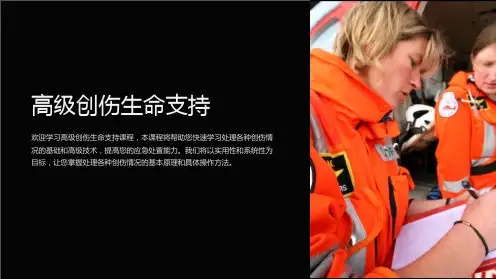
手术设备
确定手术器械和设备,遵守医疗 规范和操作标准。
手术后处理
对手术创口进行及时处理和护理, 维护患者的身体稳定和康复治疗。
车祸伤员处理
场面评估
对车祸现场进行评估,判断事故造成的影响和 伤害程度。
伤员分类
对伤员进行分类,根据伤情严重程度和处理优 先级进行处理。
高级创伤生命支持
欢迎学习高级创伤生命支持课程,本课程将帮助您快速学习处理各种创伤情 况的基础和高级技术,提高您的应急处置能力。我们将以实用性和系统性为 目标,让您掌握处理各种创伤情况的基本原理和具体操作方法。
大纲概述
课程内容简介
介绍本课程的概述和主要内容,包括从基础知识到高级技术的系统培训。
课程目标
明确本课程的培训目标,提高学员的应急处理能力和快速反应能力。
前置知识
介绍本课程的前置知识和学习要求,包括医学基础知识和实践操作技能。
创伤生命支持概述
急救响应
介绍创伤的定义、类型和常见症 状以及应对创伤的快速反应和处 理流程。
实践操作
介绍ABC急救法和各种常见创伤 的处理和急救方法,包括气道管 理、止血和疼痛处理等。
医学基础
介绍创伤的相关医学知识和基础 原理,包括血管、组织和器官的 解剖结构和生理功能。
心肺复苏
1
评估现场
对患者的症状和情况进行快速评估,决定是否需要心肺复苏。
2
进行复苏
按照心肺复苏的操作规范进行复苏操作,包括人工呼吸和心脏按压。
3
维护通畅
维护气道通畅和心血管功能稳定,直到救援车到达并进行后续治疗。
意识障碍处理
明确病情
对患者的基本信息和症状进行初步分析,确定 是否存在严重意识障碍。