
人教版英语七年级下册第七单元短语语法知识点总结
Unit7 It’sraining! 【短语归纳】 1. notbad不错2.atthepark在公园 3.haveagoodtime/haveagreattime/havefun/enjoyoneself过得很愉快 4.takeamessagefor…为……捎个口信5.callsb.back给某人回电话 6.noproblem没问题7.rightnow现在8.talkonthephone通过电话交谈 9.someof…当中的一些10.bythepool在游泳池边11.drinkorangejuice喝橙汁12.studyhard努力学习13.onavacation在度假14.inthemountains在山里15.callsb.给某人打电话16.writetosb.给某人写信 17.rightfor…适合……18.takeaphotofor...给……拍一张照片 【用法集萃】 1.tellsb.(not)todosth.告诉某人(不要)做某事 2.haveagreattime+(in)doingsth.愉快地做某事 3.justrightfordoingsth.做某事正合适 ┃语法探究┃ Ⅰ.有关天气的表达: 询问天气的句型:How'stheweather=What'stheweatherlike 常见天气的描述: 1.晴朗: It'ssunny./Thesunisshiningbrightly. 2.阴天:It'scloudy. 3.刮风:It'swindy./Thewindisblowing. 4.下雨:It'sraining/rainy. 5.下雪:It'ssnowing/snowy. Ⅱ.电话常用语 1.我是…… Thisis…(speaking). 2.你是……吗?Isthat…(speaking) 3.是的,我就是。 Yes,speaking. 4.请问您是谁?Whoisthatspeaking 5.我可以和……讲话吗?MayIspeakto…? 6.他不在这儿。 He'snothere. 7.我能给……捎口信吗? CouldItakeamessagefor…? 8.你能告诉他给我回电话吗? Couldyoutellhimtocallmeback 9.当然,没问题。 Sure,noproblem. 10.别挂断。 Holdon. 11.请稍候。 Justamoment,please. 【练习吧】 ()1.[2012·聊城]—Hello,mayIspeaktoJohn,please —________ A.WhoareyouB.What'sthematter C.ThisisJohnspeaking.D.HeisJohn. ()2.—MayIspeaktoAnnie,please —________. A.Yes,you'rerightB.Speaking C.ThankyouD.Sheisfine 用所给单间的适当形式填空 1.It’swinterinFrance.Theweatheris_______(wind). 2.They____________(clean)theclassroomnow· 3.Todayis________(sun)andwecangoforawalk· 4.I'mhavingagreattime_________(see)themovies· 5.TherearemanyanimalsInthe_______(mountain). 句型转换:(每空一词) 1.ItiscloudyinShanghainow.(对画线部分提问) ①_____theweatherinShanghainow ②______theweather______inShanghainow 2.Thereismuchrainthisyear.=It_____very_____thisyear.
3.Tomstudiesmatheveryevening.(变为现在进行时) Tom____________mathnow. 4.Thesunisbrighttoday.=It____a____daytoday. 5.Itoftensnowshereinwinter.=There's__________hereinwinter.
6.ItiscoldinChangshanow.(对画线部分提问)_____theweather_____inShangshanow
7.Myparentsarecooking.(对画线部分提问)_________________parents_______ 8.Shewenttothemountainsonvacation.(对画线部分提问) ___________she_____onvacation 完成句子 1.Theyarehavingagoodtimeon______________(假日). 2.Itis_____________(潮湿的)inthesouthofChinainsummer. 3.TheweatherinBeijingiscoldand____________(有风的)inwinter. 4.It’s____________(晴朗的)today.Let’sgofishing. 5.Thepeopleherearevery(放松)_______________. 6.Itoftens_________inwinter. 7.It’scoldoutside.Youmustputonw_____clothes. 8.H_______isyourstudygoing 9.Itisat___________day.It’swindyandcold. 10.I’mverys______________tohearthenews.
11.Itoftens_______inthenorthofourcountryinwinter.
12.It'ssoh______.Let’sgoswimming· 13.Look!Mymotherisc________inthekitchen(厨房). 14.It’sc______outside.Putonyourcoat,please. 15.Heislisteningtolightmusic.Heisreallyr________. ┃能力提升训练┃ Ⅰ.补全对话,每空一词 A:1._______areyoufrom B:IamfromEngland. A:What'stheweather2.________inEngland B:It'sverynicenow.Theweatherisnevertoo 3.________ortoocold. A:Oh,it'sverynice.ButinChinait'softentoocold inwinterandit'stoohotin4.___________. B:Yes,IlikewinterinChinabecauseIcanskate(滑 冰)onrealiceinwinter. A:ButIlikesummer.Icanswimin5.____________pools insummer. Ⅱ.阅读理解 TheseasonsinAustraliaarenotlikeours.WhenitiswinterinChina,itissummerthere.Australiaisasoutherncountry;itisinthesouthoftheworld.June,JulyandAugustarethewintermonths;September,OctoberandNovemberarespring;thesummerisinJanuary,FebruaryandDecember,andMarch,AprilandMayaretheautumnmonths.Thenorthofthecountryishotterthanthesouth. Averylargepartofthiscountryhasnorainatall.Theeastcoast(海岸地区)hasrainallyear,andtherearenodrymonthsthere.Thesoutheastwindsblow(吹)herealltheyear.Theybringrainfromthesea.Thereisnotmuchrainonthewestside.ThesoutheasternpartofAustraliahassummerrainfromthesoutheastwinds.Theyonlyblowhereinsummer. ThesouthwesternpartofAustraliahaswinterrain.Thewestwindsblowoverthesouthwestinwinteronly.Insummer,thesouthwestofthecountryhasnorain.InthenorthofAustralia,thereisnoraininwinter.Theraincomesinsummer.Thenorthwestwindsbringit. ()1.InOctober,itis________inAustralia. A.springB.summer C.autumnD.winter ()2.Itis________inthesouththaninthenorthin Australia.
七下英语七单元知识点总结

七下英语七单元知识点总结Here's a summary of the key points for Unit 7 in Grade 7 English, written in an informal and conversational style:First up, we talked about the importance of using proper language when expressing our feelings. It's crucial to be direct yet respectful, like when you say, "I feel happy when I'm with you" instead of "You make me happy." See how the focus shifts from the other person to your own feelings? That's a great way to start a conversation about emotions.Next, we dived into the topic of past events. Remember how we practiced using "was" and "were" to talk about what happened in the past? Like, "I was at the park yesterday" or "We were having so much fun at the beach." It's a great way to relive those fun moments and share them with others.Then, we moved on to the tricky part of using "would" to talk about hypothetical situations. You know, like whenyou say, "If I had more time, I would go on a vacation."It's a way to express wishes and dreams without actually committing to them. It's kind of like a safe zone for your imagination.And let's not forget about comparing things. We learned how to use "than" to compare two things, like "She's taller than me" or "My book is more interesting.。
人教版七年级英语下册知识点总结总复习Unit7 It’s raining(共76张PPT)
教学重难点
1. 询问天气的情况的两种表达方式。 2.表示天气的词,名词与形容词的转化 3.take a message 4.形容词的用法。 5.work的用法。 6.just right for doing sth. 7.have a good time in doing sth. 8.tell sb to do sth.
—Can you make a kite? —No problem.
8.have a good/great time=have fun =enjoy oneself
(oneself要随主语的变化而变化) I'm having a good/great time. He enjoys himself in learning English.
5. buy bread to take home,
6. wear hats and sweaters,
7. play in the snow, 8. skate on a river,
9. have fun,
10. be relaxing here,
11. see you soon
课时重点回顾
- How’s the weather? - It’s raining./It’s cloudy./It’s sunny. - What are you doing? - I’m watching TV./I’m cooking. - What’s he doing? - He’s studying at his friend’s home. - What are they doing? - They’re playing basketball in the park. - How’s it going? - Great./Not bad./Terrible!
人教版七年级下册英语语法知识点归纳总结

人教版七年级下册英语语法知识点归纳总结一、情态动词can的用法can+动词原形,它不随主语的人称和数而变化。
1. 含有can的肯定句:主语+can+谓语动词的原形+其他。
2. 含有can的否定句:主语+can't+动词的原形+其他。
3. 变一般疑问句时,把can提前:Can+主语+动词原形+其他?肯定回答:Yes,主语+can。
否定回答:No,主语+can't.4. 含有can的特殊疑问句:特殊疑问词+can+主语+动词原形+其他?I can speak English.→I can't speak English.→Can you speak English? →What can you speak?二、what time和when引导的特殊疑问句1. 询问钟点时用what time,询问日期、月份、年份时用when。
2. What's the time?=What time is it?现在几点了?3. 时刻表达法:顺读法和逆读法。
三、how引导的特殊疑问句1. how 引导的特殊疑问句提问交通方式,其答语分三种情况:a. take a/an/the+交通工具(单数)b. by+交通工具(单数)c. on/in+限定词+交通工具---How do you go to school every day?---I take a bus to go to school every day./I go to school by bus every day./I go to school on the bus every day.2. how far 用来提问距离,多远,其答语分为两种:(1)用长度单位表示:It is five kilometers.(2)用时间表示:It’s twenty minutes’walk.3. how long 用来提问时间,意为多久回答常用“for+段时”。
七下英语第7单元知识点

七下英语第7单元知识点
1.数量词:
- 数词可以用来表示数量,如one, two, three等。
- 可以用来表示几分之几,如half, quarter等。
- 可以用来表示多少数量的一部分,如a quarter of, a third of 等。
2.形容词的比较级和最高级:
- 比较级通常在形容词前面加上more或-er,表示比较高的程度。
- 最高级通常在形容词前面加上the most或-est,表示最高的程度。
-比较级和最高级前面还可以加上不同程度的副词来表示更加强调的
程度。
3.名词的所有格:
-用来表示一个物体或人的所有关系,通常在名词后面加上's。
-当名词本身已经以s结尾时,只需要在名词末尾加上'即可。
4.介词:
-介词在句子中一般用来表示时间、地点、方向、原因等。
- 常见的介词有in, on, at, to, from等。
5.情态动词:
-情态动词表示说话人的情感、态度和意愿等。
- 常见的情态动词有can, could, may, might, must, shall, should, will, would, ought to等。
6.动词的时态和语态:
-动词的时态包括一般现在时、一般过去时、一般将来时、现在进行时、过去进行时、将来进行时等。
-动词的语态有主动语态和被动语态。
7.副词的用法:
-副词用来修饰动词、形容词或其他副词,表示时间、地点、程度等。
-副词既可以作为句子中的状语,也可以用来修饰动词或其他词。
人教版七年级英语下册单元知识点总结(全册)
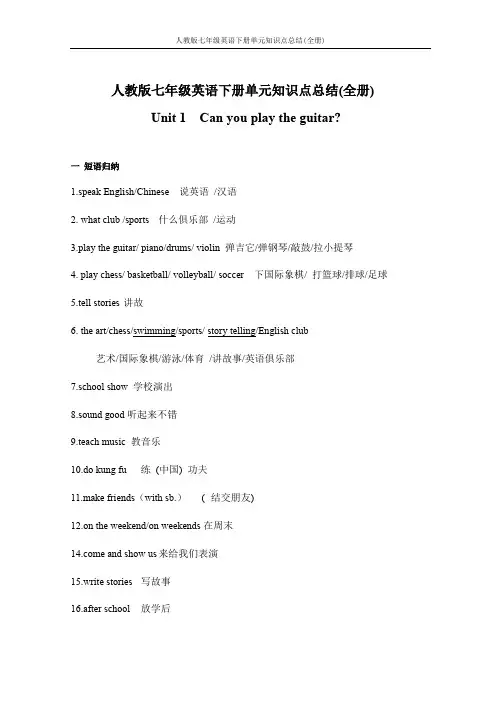
人教版七年级英语下册单元知识点总结(全册)Unit 1 Can you play the guitar?一短语归纳1.speak English/Chinese 说英语/汉语2. what club /sports什么俱乐部/运动3.play the guitar/ piano/drums/ violin 弹吉它/弹钢琴/敲鼓/拉小提琴4. play chess/ basketball/ volleyball/ soccer 下国际象棋/ 打篮球/排球/足球5.tell stories讲故6. the art/chess/swimming/sports/ story telling/English club艺术/国际象棋/游泳/体育/讲故事/英语俱乐部7.school show 学校演出8.sound good听起来不错9.teach music 教音乐10.do kung fu练(中国) 功夫11.make friends(with sb.)(结交朋友)12.on the weekend/on weekends在周末e and show us来给我们表演15.write stories写故事16.after school放学后17.English-speaking students说英语的学生18.play games 做游戏19.the Students’ Sports Center学生运动中心20.at the old people’s home在老人之家21.be in our school music festival 参加学校音乐节22.jion the music club加入音乐俱乐部二用法集萃1. play +棋类/球类下……棋,打……球2. play the +乐器弹/拉……乐器3. be good at doing sth.擅长做某事be good for.. 对… 有好处be good /kind to … 对… 友好4. be good with sb. 和某人相处地好; 善于应付(处理)…5. need(sb./sth.)to do… 需要(某人/某物)做….6. can + 动词原形能/会做某事7. a little + 不可数名词: 一点儿……9. like to do sth.或like doing sth. 喜欢做某事10.want to do…想做……11.What about…?…怎么样?(后面接Ving/代词/名词)12. talk用法: talk to/with sb. 跟某人说话talk about sth. 谈论某事tell 用法:tell sb sth. 告诉某人某事tell sb to do sth 告诉某人去做某事tell stories 讲故事say用法:say直接加说话的内容/itspeak用法:speak +语言13.help sb. with sth在某方面帮助某人= help sb.(to)do sth14.be free /busy有空/很忙15. call sb. at+号码拨打某人的……号码16. be in=join …成为…中的一员(P6)17.want …for the school show为学校表演招聘……三典句必背1. Can you draw? 你会画画吗?Yes, I can. / No, I can’t.是,我会。
人教版七年级英语下册unit7语法课件

B:He____i_sp__la_y_i_nsgoccer.He_____p_slaoycscereve
rySaturday.
3.A:__IJssutluied_y_in__g____Englishrightnow? B:No,sheisn’t.She____i_ss_t_u_d_y_iCnghinese.
看谁领 悟能力 强
2.Listen!Aboy____a_re_s_in_g_i_n(gsing).
3.TomandI___a_r_ep_l_a_y_in_g___(play)computergamesn
ow.
isdoing
4.Don'ttalk.Yourbrother_________(do)hishome
What’shedoing?
He’sstudyinginhisfriend’shome.
5.—近况怎么样? ___________________ —很好!/不错。/糟糕! __________H_o_w__’s_i_tg_o_i_n_g_?____
Great!/Notbad./Terrible!
It’s9:00
etimes,every…,
1.A:Whatareyoudoing?
记住谓语动词随 时间而变化哟!
B:I____a_m_d__ominyghomework.Ialways___myh
omewdorokintheevening. 2.A:What’sJohndoingrightnow?
太阳公公咧嘴笑,阳 光体育运动开始了!
看看学生和老师们在 干什么呢?你肯定能 用现在进行时描述了 吧!
—他们正在公园里打篮球。 ______________________________ 3_._—__他__们_W_在_h_a做_t_a什_r_e么t_h_?e_y_d_o_i_n_g_?_______ _4_.—__他__在__做__什__么__?_____________________ —他在他Th朋ey友’家re里pl学ay习in。gbasketballinthepar _______k_.________________________
七年级下册人教版英语unit7知识点
七年级下册人教版英语unit7知识点Unit 7 in 7th grade English curriculum involves learning about the English language as well as enhancing one's reading and writing skills. This unit mainly emphasizes learning new words and phrases, sentence structure, and grammar concepts. By the end of this unit, students should be able to express themselves in both spoken and written English with ease while using the appropriate vocabulary, sentence structure, and grammar.VocabularyThe unit 7 vocabulary list includes words related to school subjects, activities, and facilities. Students learn how to pronounce, spell, and use these words in sentences.A good way to memorize vocabulary is by creating flashcards. Each card should have one word on the front and its meaning on the back. Students can also use the words in sentences to reinforce their understanding of how to use them correctly.Sentence StructureStudents learn how to use adjectives, adverbs, and prepositions to add more detail to their sentences. They also learn how to use conjunctions to join two or more sentences together.Sentences in English follow a specific structure known as subject-verb-object. Understanding this structure helps students write sentences that are grammatically correct. It is also important for students to learn about the different tenses, such as the past tense and future tense, as they are used to express actions or events that have already happened or are yet to occur.Grammar ConceptsOne of the key grammar concepts in unit 7 is the use of verbs. Verbs show action, and it is important to know how to use them correctly to convey the intended meaning. Students learn about the basic forms of verbs, such as the infinitive, present participle, and past participle.Another grammar concept that students learn in this unit is the proper use of pronouns. Pronouns replace nouns in a sentence and help to avoid repetition. Students also learn about the different types of pronouns, such as personal, possessive, and reflexive pronouns.Reading and Writing SkillsUnit 7 also emphasizes the development of reading and writing skills. Reading helps students expand their vocabulary, comprehend grammar concepts, and understand sentence structure. Writing, on the other hand, helps students express themselves using the right words, sentence structure, and grammar.One way to improve reading and writing skills is by practicing with exercises or activities that provide context for the vocabulary and grammar concepts learned in this unit. For example, students can read short stories or articles related to school subjects and then answer questions to test their comprehension.Final ThoughtsIn summary, unit 7 of the 7th grade English curriculum is designed to help students improve their English language skills. It teaches them new vocabulary words and phrases, sentence structure, and grammar concepts. By the end of this unit, students should be able to effectively communicate their thoughts and ideas in both written and spokenEnglish using the appropriate vocabulary, sentence structure, and grammar.。
新人教版七年级下册unit7知识总
新人教版七年级下册unit7知识总结与练习教学内容Step1 作业检查及讲解Step2 听写Step3 第七单元知识点梳理短语归纳:Not badHave a good time /have a great time/have fun/enjoy oneself Take a message for...No problemTalk on the phoneBy the poolStudy hardIn the mountainsWrite to sb.At the parkCall sb. backRight nowSome of...Drink orange juiceOn a vacationCall sb.Right for...Take a photo of...用法集萃:Tell sb.(not)to do sth.Have a great time(in)doing sth.Just right for doing sth.重点解析:1. n. adj.sun阳光sunny 晴朗的snow雪snowy下雪的rain雨rainy下雨的wind风windy多风的cloud云cloudy多云的fog雾foggy多雾的ice冰icy结冰的2. 询问天气1)How’s the weather? It’s……北京的天气怎么样?多云。
How’s the weather in Beijing?It’s cloudy.2) What’s the weather like?It’s……What’s the weather like in Beijing? It’s cloudy.3. cook 1)v. 做饭2)n. 厨师cooker n. 厨具4. How’s it going? 情况如何?Not bad.不错。
Great.太好了。
Terrible.太糟了。
Pretty good.相当好Just so so.马马虎虎5. pretty1) adj. 俊俏;娇小;漂亮 a pretty girl 漂亮的姑娘2) adv. 相当;很;颇近义词是very或quiet6. hot炎热的------cold寒冷的warm温暖的-----cool凉爽的7. Thanks for...因......而感谢for是介词,后接n / pron / v-ing. (名词/代词、动名词)Thanks for the photo of your family. 谢谢你的全家福照片。
人教版初中英语七年级下Unit7-12重点归纳
初一(下)英语U.7-12重点归纳Unit7 1 look like 看起来像看起来像.... 2 curly /short/straight/long What does he look like? What does he look like?卷/短/直发一.短语hair 卷/短/直发3 medium height/build 中等高度/身体中等高度/身体中等高度/身体4 a little bit 一点儿…5 a pop singer 一位流行歌手一位流行歌手6 have a new look 呈现新面貌呈现新面貌7 go shopping (do some shopping) 去购物去购物8 the captain of the basketball team篮球队队长篮球队队长9 be popular with sb 为---所喜爱所喜爱10 stop to do sth 停下来去做某事停下来去做某事11 stop doing sth 停止正在做的事情停止正在做的事情12 tell jokes/ stories 讲笑话/ 讲故事讲故事13 have fun doing sth 愉快地做某事愉快地做某事14 remember ( forget) to do sth 记得(忘记)做某事(没有做的)记得(忘记)做某事(没有做的)15 remember (forget) doing sth 记得(忘记)做过某事(已做)记得(忘记)做过某事(已做)16 one of --- ---中的一个中的一个二.本单元的重点句:’t. 1 Is that your friend? No, it isn2 What does she look like? 3 I think I know her. ( I don’t think I know her.) 4 Wang Lin is the captain of the basketball team. 5 She’s a little bit quiet. 6 Xu Qian loves to tell jokes. 7 She never stops talking. 8 She likes reading and playing chess. 9 I don’t think he’s so great. 10 I can go shopping and nobody knows me. 11 Now he has a new look. 三.重难点解析1 What does/ do +主语询问某人的外貌特征,看上去什么样?主语 + look like? 询问某人的外貌特征,看上去什么样?询问某人的外貌特征,看上去什么样?Eg: What does your friend look like? 2 形容头发时,最后说颜色的顺序说。
人教版七年级下册英语Unit7知识点doc资料
Unit7 名词:weather 天气park 公园message 信息;消息problem 困难;难题Canada 加拿大summer 夏天juice 果汁;饮料vacation 假期Europe 欧洲mountain 高山country 国;国家winter 冬天;冬季动词:cook 做饭could 能;可以visit 拜访;参观sit 坐skate 滑冰形容词:windy 多风的cloudy 多云的sunny 晴朗的bad 坏的;糟的dry 干燥的cold 寒冷的;冷的hot 热的warm 温暖的rainy 阴雨的snowy 下雪的副词:back 回来;回原处again 再一次;又一次soon 不久;很快兼类词:rain v下雨;n雨水snow v下雪;n雪hard adv努力地;adj困难的Russian adj俄罗斯的;n俄罗斯人;俄语短语:take a message 捎个口信;传话right now 此刻;马上call(sb)back (给某人)回电话on(a)vacation 度假take a photo 拍照知识点:1、rain(1)动词:下雨It often rains in summer. 夏天经常下雨。
It rains heavily. 雨下的很大。
(2)名词:雨水,不可数名词The crops need rain. 庄稼需要雨。
The rain is dirty. 雨水很脏。
(3)rainy 形容词:多雨的The weather is rainy. 天气是多雨的。
下雨的不同表达:(1)It's raining in Guangzhou. 广州在下雨。
(2)It's rainy in Guangzhou. 广州在下雨。
2、weather 天气,不可数名词weather forecast天气预报fine weather 好天气bad weather 坏天气3、询问天气How's the weather?= What's the weather like?天气怎么样?How's the weather in + 地点/时间?= What's the weather like in + 地点/时间?某地/某时的天气怎么样?How's the weather in summer in Beijing?北京夏天的天气怎么样?What's the weather like in Shanghai?上海的天气怎样?4、名词+ y 描述天气cloud(云)→cloudy(多云的)wind(风)→windy(多风的)rain(雨)→rainy(下雨的)snow(雪)→snowy(下雪的)fog(雾)→foggy(多雾的)sun(太阳)→sunny(晴朗的)ice(冰)→icy(结冰的)It's + 天气形容词表示天气,回答How's the weather?等的提问,It可不翻译。