
英语语法 句子结构
句子三种结构:
简单句、并列句、复合句
简单句
A. 只包含一个主谓结构Mary opened the door.
B. 两个主语和一个谓语Steve and his friend are coming to dinner.
C. 一个主语和两个谓语Mary opened the door and greeted the guests.
简单句的五种基本句型
(1) 主语+连系动词+表语(S+V+P )
The weather is very cold.
(2) 主语+不及物动词(S+Vi )
He laughed.
(3) 主语+及物动词+宾语(S+V+O )
I like Chinese food.
(4) 主语+及物动词+间接宾语+直接宾语(S+V+IO+DO)
She taught them physics.
(5) 主语+及物动词+宾语+宾语补足语(S+V+O+C)
We must keep the room warm.
请说出下列句子类型。
1.Summer is coming.
2.They won’t let me go.
3.He showed me a new TV set.
4.She knows what to do.
5.The weather is very cold.
并列句(compound sentence):
把两个或几个简单句用并列连词连接起来,则成为一个并列句。
I turned on the TV. I watched it.
I turned on the TV and watched it.
I bought my sister a present. She didn’t like it.
I bought my sister a present, but she didn’t like it.
常用并列连词
• 平行并列连词: and, both…and, not only…but also, neither…nor
• 转折并列连词:but, however, while, yet
• 因果并列连词: for, so
• 选择并列连词: or, either…or
请用合适的并列连词把每组句子合并为一个并列句。
1. He was tired. He went to bed.
2. The child hid behind his mother's skirt. He was afraid of the dog.
3. He made a promise. He didn’t keep it.
4. Mary is opening the door. John is greeting her guests.
复合句:
主句+从句
主句是一个完整的句子,它可以独立存在。
从句是一个不完整的句子,它必须和一个主句连用,不能独立存在.
By the time he arrived, we had already left
在复合句中,主要包含以下类型从句:
1.主语从句 2.宾语从句
3.表语从句 4.同位语从句
5.状语从句 6.定语从句
中学生英文写作中经常
使用的从句有:
1. 宾语从句
2. 状语从句
3. 定语从句
指出下列各从句的类型:
I hope that everything is all right.
She was reading the newspaper when I came in.
She is the girl who sings best of all.
请用括号中所给的词把每组句子连接为一个复合句。
He has found out .She was late.(why)
I still remember the day .I first came to Beijing on that day.(when)
请把每组句子连接为一个含有状语从句复合句。
I’ll give the letter to him .I see him.
(时间状语从句)
He didn’t come yesterday .He was ill.
(原因状语从句)
It is such a big box .Nobody can move it.
(结果状语从句)
We’ll go to the great wall .It’s fine
tomorrow. (条件状语从句)
We should not go there all the time.
The place is quite pleasant.(让步状语从句)
有下划线的词叫从属连词
I’ll give the letter to him when I see him.
He didn’t come yesterday because he was ill.
It is such a big box that nobody can move it.
We’ll go to the great wall if it’s fine tomorrow.
Although the place is quite pleasant, we should not go there all the time.
请用所学知识改正下列病句
My roommate was sleeping, we didn’t want to wake her up.
I went to bed. Because I was tired.
《英语语法大全(完全版)
《英语语法大全(完全版)》一、英语语法基础1. 句子结构:英语句子通常由主语、谓语和宾语组成。
主语是句子讨论的对象,谓语是描述主语的动作或状态,宾语是动作的对象。
2. 时态:英语时态分为现在时、过去时和将来时,每种时态都有其特定的用法和形式。
3. 语态:英语语态分为主动语态和被动语态,主动语态强调动作的执行者,被动语态强调动作的承受者。
4. 名词:名词是表示人、物、地点、概念等实体的词。
名词有单数和复数形式,复数形式通常在单数形式后加s或es。
5. 代词:代词是代替名词的词,如I、you、he、she、it、we、they等。
6. 形容词:形容词是修饰名词或代词的词,表示人或物的特征或状态。
7. 副词:副词是修饰动词、形容词、其他副词或整个句子的词,表示时间、地点、程度等。
8. 介词:介词是连接名词、代词或相当于名词的词与句中其他词的词,表示位置、方向、时间等关系。
9. 连词:连词是连接单词、短语、从句或句子的词,表示并列、转折、因果等关系。
10. 冠词:冠词是放在名词前面的词,表示名词的特指或泛指。
二、英语语法进阶1. 非谓语动词:非谓语动词包括不定式、动名词和分词,它们在句子中起名词、形容词或副词的作用。
2. 虚拟语气:虚拟语气用于表示假设、愿望、建议等非现实的情况。
3. 倒装句:倒装句是将句子的谓语动词或助动词放在主语之前的句子结构,常用于强调或疑问句中。
4. 强调句:强调句用于强调句子的某个部分,通常使用itis/was that/who 的结构。
5. 省略句:省略句是在句子中省略了某些成分,但仍能保持句子的完整性和意义的句子。
6. 并列句:并列句是由两个或多个独立的句子通过并列连词连接而成的句子。
7. 复合句:复合句是由一个主句和一个或多个从句组成的句子,从句通常由从属连词引导。
8. 疑问句:疑问句是用于提出问题的句子,通常以疑问词或助动词开头。
9. 感叹句:感叹句是用于表达强烈情感或惊讶的句子,通常以感叹词或how/what开头。
5. 英语语法基础-谓语动词和句式结构
第一章:简单句第五节:谓语动词和五大句式结构5.1 谓语动词的构成谓语动词是句子中必须存在的部分,主要用于表达句子的时态、情态或主动、被动。
谓语动词主要包括助动词(如有)和主动词:(以swim为例)谓语动词 = 助动词(如有)+主动词此处仅展示几个简单的时态,本章节重点在于学会写出谓语动词,时态在此章节不细讲。
助动词跟时态密切相关,不同的时态助动词不同,主动词的形式也不一致,一般现在时和一般过去时在肯定句中其助动词可不显示。
注:谓语会紧跟主语,谓语必定是助动词(如有)和主动词结合而成。
能做助动词的有且仅有如下的几个:be(含各种变形),do, does, did, have(含各种变形)和情态动词(might, may, will, would, can, could, should等)练习:识别句子的助动词和主动词句子助动词主动词It changed my life forever. 无changed For example, the robot can work as a dangerous forcan work humans.From now on, you are my partner 无areThe chefs are preparing for dinner.We should spend more time together with my family.You will be very happy.We can continue the conversationSuddenly all the lights went outThe price of the house is always on the rise.The woman was very angryMany doctors are busy in the earthquake rescue.The plane will take off immediately.More and more people are protected in dangerous wildanimals.Each city's homeless people need help.I get up early today.In the future, robots will do all the things for people.Page2We learned a lot from that experience.所有时态的组成方式 – 谓语动词使用助动词和主动词相结合的方式进行,具体的组合方式为:(一个简单句的主动词有且只有一个)一个句子的谓语动词可有不多于4个助动词和至少一个主动词,具体构成方式如下表:谓语动词助动词1 助动词2助动词3助动词4主动词表现的时态或情态动词类型情态动词(will, could, may,should 等)完成助动词(have)进行助动词(be )被动助动词(be )所有动词示例A. It rains 一般现在时B. It rained 一般过去时C. It will rain 一般将来时D. It is raining 现在进行时E. It was raining 过去进行时F. Shehasarrived现在完成时G. She had arrived 过去完成时 G. It might rain 情态表达可能 H. It might have rained 情态+完成时 I. They have been working 现在完成进行时 J. James had been looking 过去完成进行时 K. Itmighthavebeenused情态+完成时被动Page4L. Wemayhavebeenbeingfollowed情态+完成进行时被动 紧随助动词后的动词形式必须是动词原型必须是过去分词(done ) 必须是现在分词(-ing)必须是过去分词(done)助动词表示的意义随着情态动词的意义而变化如could 可表示请求或者可能性1. 表示过去的动作对某时刻的影响2. 表示过去的动作经验对某时刻的影响3. 表示过去的动作持续到了某时刻 1. 进行中的动作或最近在做的动作 2. 对后续时间的安排或计划表达主语为动作的承受者注:助动词不一定存在在谓语中,且没有实际的含义,但主动词是必须存在的。
英语句子结构分析

❖ 我们可以给句子的动词加上副词修饰;给名 词加上形容词 介词短语修饰;给句子加上状 语进行修饰等;以使整个句子的意思变得更 加的丰富和充实 但不管如何变;都只有一个 主谓结构
come back home at seven in the
evening
简单句
9 Neither has he changed his mind; nor will he do so 并列句
10 What he said at the meeting is very important; isn’t it 复合句
❖ We will make them happy 形容词
❖ We found nobody in 副词
❖ Please make yourself at home 介词短语 let him do that 省to不定式
Don’t
❖ His father advised him to teach the lazy boy a lesson 带to不定式
❖ Where there is a will; there is a way
Exercises 判断句型
❖ 1 Having finished his homework; the boy went on to help his mother
简单句划线部分在句中作状语;修饰整 个句子
❖ 2 What he says doesn’t suit what he does 复合句包含两个名词性从句:What he says 是一个主语从句;what he does 是一个宾语 从句
英语句子成分和结构.ppt
5. I have a lot work to do. (主谓宾+宾补)
6. He went to London yesterday. (主谓宾)
20
Many thanks!
21
22
23
24
★主语一般在句首。
Walls have ears. 名词 He will take you to the hospital. 代词
Three plus four equals seven. 数词 Smoking is not allowed in public places. 动名词 To teach them English is my job. 不定式 →It is my job to teach them English. ★不定式作主语时,常用形式主语it句型
The boy you will know is Tom. 从句
Tom’s father didn’t come home yesterday night.
所有格
I met a friend on my way home. 副词
7
六.状语 The Adverbial
用来修饰动词、形容词或副词,说明方式、因果、条件、时间 、地点、让步、方向、程度、频率、目的等.
和系动词一起构成谓语。一般在系动词后
面,用来说明主语的性质,特征,状态等. E.g. My father is a professor. 名词 Everybody is here. 代词 Three times five is fifteen.数词 My new computer is expensive.形容词 His plan is to seek work in the city. to do不定式
英语语法——英语句子成分分析
英语语法——英语句子成分分析English Grammar - Analysis of XXXA XXX consists of two parts。
the subject and the predicate。
which are also known as the main components of the sentence。
The secondary components of a sentence include the object。
the adjective。
the adverb。
and the XXX.1) Subject: It is the subject of a sentence and the object of the entire sentence。
It is often a noun。
numeral。
or pronoun。
and is XXX:Students study.We are friends.In these two sentences。
the word "students" is a noun and "we" is a pronoun。
both serving as the subject of the sentence.2) Predicate: It is the statement made about the subject。
expressing the n or state of the subject。
It is often a verb or verb phrase。
and is placed after the subject。
For example:Students study.We are friends.In these two sentences。
the words "study" and "are" are verbs。
英语语法句式简单句子结构(透彻分析)
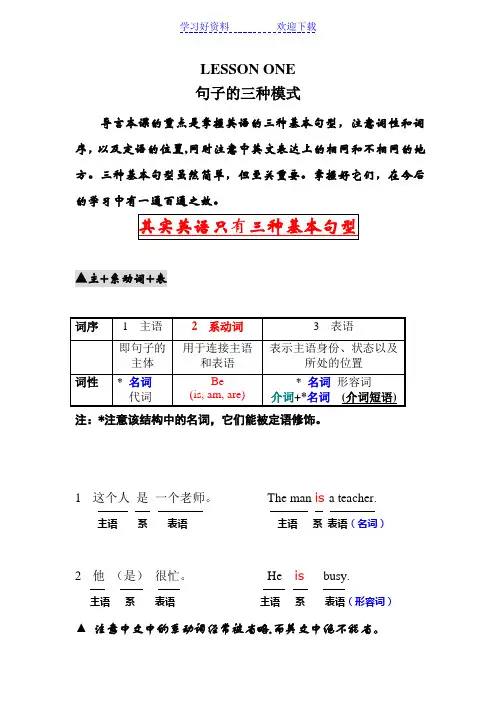
LESSON ONE句子的三种模式导言本课的重点是掌握英语的三种基本句型,注意词性和词序,以及定语的位置,同时注意中英文表达上的相同和不相同的地方。
三种基本句型虽然简单,但至关重要。
掌握好它们,在今后的学习中有一通百通之效。
▲主+系动词+表注:*注意该结构中的名词,它们能被定语修饰。
1 这个人是一个老师。
The man is a teacher.主语系表语主语系表语(名词)2 他(是)很忙。
He is busy.主语系表语主语系表语(形容词)▲注意中文中的系动词经常被省略,而英文中绝不能省。
3 她(是)在教室里。
She is in the classroom.主语系表语主语系表语(介词短语)▲定语只修饰名词,不破坏句子的基本结构。
通常由形容词和介词短语充当,形容词放在所修饰的名词之前,而介词短语放在所修饰的名词之后,请注意英语与汉语词序的不同。
看懂中文的定语是翻译好定语的关键。
介词短语---英国法学家波洛克介词短语Happiness is a station-----------Pollock, British jurist 形容词介词短语5形容词介词短语man is a teacher介词短语形容词6.教室里。
形容词介词短语The teacher is handsome.My book is表语(介词短语)定语(介词短语)She is介词短语即可以做表语也可以做定语,虽然它们词性相同,但由于词序不同,它们所起到的作用也不同,当在is的后面是表语,跟在名词的后面它就起到定语的作用。
课堂练习 11是2不是我的。
3.我的家乡hometown 峡谷valley里。
4那个贼面behind。
1. 是is2钱不是我的。
is not mine3.我的家乡峡谷里。
My hometown is4is1.医院里的那个傻子fool 是从英国来的。
2.教室里靠窗户的桌子上的那台电脑computer 是新的。
3.你们班里的那个漂亮的女孩子是个贼knife。
英语语法中的9种句子成分
英语语法中的9 种句子成分一. 主语Subject“主语”中的“主”是主人、主导的意思。
(一)定义:主语是动作的发出者,通常为一个句子中第一个独立的名词【或名词性结构】。
也可以理解为主语就是句子中说明的人或事物【sb/sth 】独立的:即不在短语中、不在从句中(二)句子中主句的4 种形式:1.名词本身2.代词3.动词-ing/to do 形式【注意:做状语的V-ing/to do 结构除外】4.主语从句【即主语是个句子,引导词that 不可省略】例句:The flower is beautiful.I love you.TeachingEnglish is my job. To teach English today is my job. (补充:动词做主语的-ing 形式称为动名词,to do 形式称为不定式。
前者强调经常性、习惯性,后者强调阶段性、特定性、将来性。
)That she is still alive is a wonder.二. 谓语Predicate(一)定义:谓语是主语发出的动作,通常为主语后的第一个独立的动词【或动词性结构】。
也可以说是用来说明主语的动作、状态和特征。
例句:He is singing.(其中的is是助动词,is singing 才是谓语)He likes singing.(likes 是实意动词,所以谓语是likes)现在分词/ 过去分词前无助动词的不是谓语。
(三)非谓语动词有谓语动词,就有非谓语动词。
那么,什么是非谓语动词?非谓语动词即一个句子中,不是谓语的动词就是非谓语动词。
非谓语的三种形式:1.doing(表主动、进行)2.done 动词过去式(表被动、完成)3.to do(表将来)例句:I saw a girl crying in a car.(crying 表明女孩主动在哭并且是正在进行)Beaten by Bob,Tom was very sad.(beaten 有两层含义,一是被别人打了,不是自己打的,是被动的。
英语句子先后顺序结构
英语句子先后顺序结构
在英语句子中,单词和短语的顺序对于表达意思和语法结构非常重要。
以下是一些常见的英语句子结构顺序:
1. 主语+谓语:这是最基本的句子结构,表示主语执行的动作或状态。
例如,“I run”。
2. 主语+谓语+宾语:这种结构表示主语执行的动作或状态涉及到某个宾语。
例如,“I like music”。
3. 主语+谓语+间接宾语+直接宾语:这种结构表示主语执行的动作或状态涉及到两个宾语,其中一个是间接宾语,另一个是直接宾语。
例如,“I give him a book”。
4. 主语+谓语+表语:这种结构表示主语的状态或属性。
例如,“I am happy”。
5. 主语+谓语+宾语+宾补:这种结构表示主语执行的动作或状态对宾语进行了补充说明。
例如,“I found him running”。
在句子中,一些常见的词或短语,如“and”、“but”、“or”等,可以用来连接两个或多个句子,形成复合句。
例如,“I like music and she likes dancing”。
此外,还有一些常见的句式结构,如“It is+形容词+to do sth”、“There is/are+名词”等。
这些结构都有特定的意思和用法,需要根据上下文和语境进行理解和使用。
英语句子结构的用法总结
英语句子结构的用法总结英语句子结构是语法中的重要部分,它决定了句子的表达和构建方式。
本文总结了一些常见的英语句子结构和它们的用法。
简单句- 主语+谓语: 一个简单句包含一个主语和一个谓语动词。
主语+谓语: 一个简单句包含一个主语和一个谓语动词。
例如:- My friend loves to read books.(我的朋友喜欢读书。
)- The sun rises in the east.(太阳从东方升起。
)复合句并列句- 并列句: 由两个或更多的简单句通过连接词(如and、but、or)连接而成。
这些句子在逻辑上相互独立。
并列句: 由两个或更多的简单句通过连接词(如and、but、or)连接而成。
这些句子在逻辑上相互独立。
例如:- I like to swim, and my sister likes to play tennis.(我喜欢游泳,而我姐姐喜欢打网球。
)- He walked to the store, but it was closed.(他走到商店,但是商店关门了。
)从句- 名词性从句: 从句在句子中担任名词的角色。
它可以作为主语、宾语或表语。
名词性从句: 从句在句子中担任名词的角色。
它可以作为主语、宾语或表语。
例如:- She told me what happened.(她告诉我发生了什么事。
)- 定语从句: 从句用来修饰前面的名词。
定语从句: 从句用来修饰前面的名词。
例如:- The book that I bought is very interesting.(我买的这本书很有趣。
)- The woman who lives next door is a doctor.(住在隔壁的那位女士是医生。
)- 副词从句: 从句用来修饰动词、形容词或副词。
它可以表示时间、条件、原因、目的等。
副词从句: 从句用来修饰动词、形容词或副词。
它可以表示时间、条件、原因、目的等。
例如:- I will call you when I arrive.(我到达时会给你打电话。
英语语法句子结构
一、英语语句基本结构分析:>> 主谓宾结构:主语:可以作主语的成分有名词(如boy),主格代词(如you),动词不定式,动名词等。
主语一般在句首。
注意名词单数形式常和冠词不分家!谓语:谓语由动词构成,是英语时态、语态变化的主角,一般在主语之后。
不及物动词(vi.)没有宾语,形成主谓结构,如:We come.宾语:宾语位于及物动词之后,一般同主语构成一样,不同的是构成宾语的代词必须是‘代词宾格’,如:me,him,them 等例:The boy needs a pen.主语the boy,谓语needs(need的第三人称单数形式),宾语a pen.>> 主系表结构:主语:同‘主谓宾’结构。
联系动词(Link verb):be动词(am,is,are,was,were,have been);其他联系动词如:become成为,turn变成,go变。
其特点是联系动词与其后的表语没有动宾关系,表语多为形容词或副词,既,不可能是宾语。
表语:说明主语的状态、性质、等。
可为形容词、副词、名词、代词、不定式、分词。
当联系动词不是be,而其后是名词和代词时,多表达‘转变为’之意,注意与动宾关系的区别。
感官动词多可用作联系动词:look well/面色好,sound nice/听起来不错,feel good/感觉好,smell bad/难闻例:Tom is a boy.(Tom是个男孩)/主语为Tom,系词为be动词的第三人称单数is,表语为a boy>> There be 结构:There be 表示‘存在有’。
这里的there没有实际意义,不可与副词‘there那里’混淆。
此结构后跟名词,表示‘(存在)有某事物’试比较:There is a boy there.(那儿有一个男孩。
)/前一个there无实意,后一个there为副词‘那里’。
二、定语:定语是对名词或代词起修饰、限定作用的词、短语或句子,汉语中常用‘……的’表示。